United States (US) Image Recognition Market Size & Growth Rate (2026-2032)
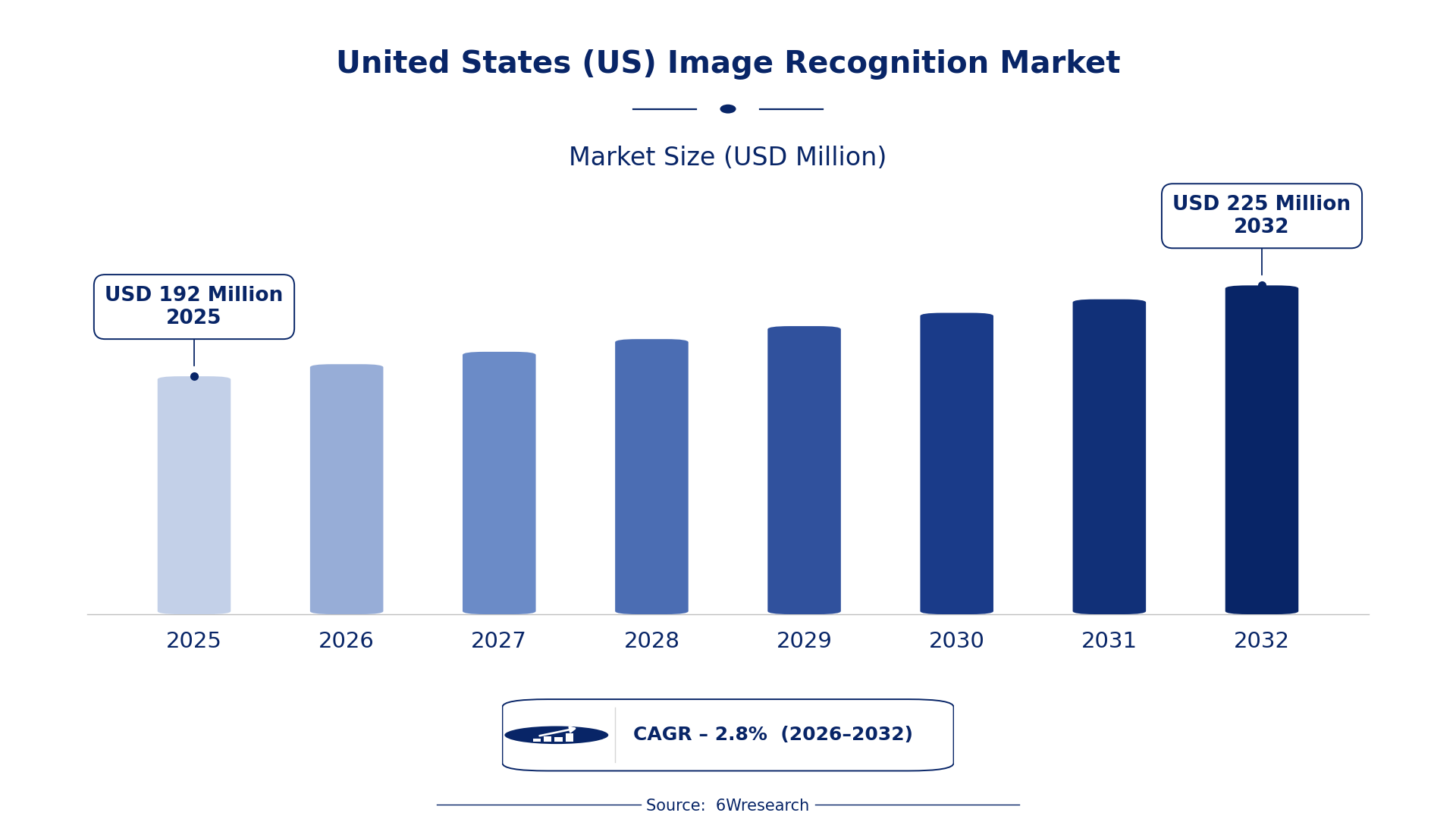
The United States (US) Image Recognition Market was estimated at USD 192 Million in 2025 and is projected to reach USD 225 Million by 2032, growing at a CAGR of 2.8% from 2026 to 2032.
United States (US) Image Recognition Market Synopsis
The US Image Recognition Market is at a pivotal junction, experiencing strong growth fueled by advanced technology adoption in various sectors. As industries increasingly recognize the value of image recognition in enhancing operational efficiency and customer engagement, the trajectory points toward further innovation and deployment.
Looking ahead, the market is set to evolve with a focus on accuracy and ethical use of data. As artificial intelligence and machine learning capabilities improve, the potential applications will expand, catering to diverse needs across retail, healthcare, automotive, and security sectors.
United States (US) Image Recognition Market Year-wise Growth Rate and Key Drivers
This graph illustrates the annual growth rates of the United States (US) Image Recognition Market from 2021 to 2032, highlighting a steady upward trajectory and projected expansion over the forecast period.
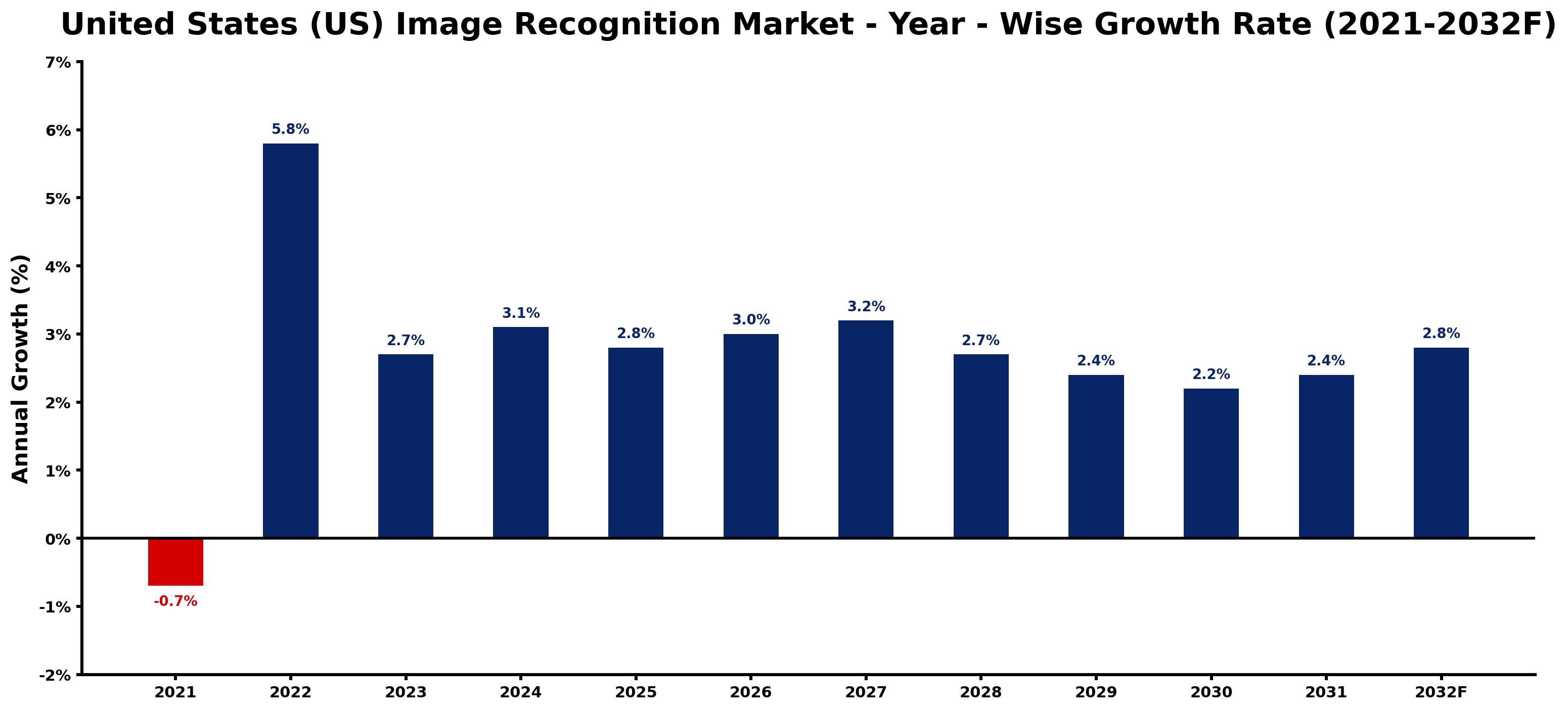
The table below presents the year‑wise growth rates along with the key drivers influencing the market
| Year | Growth Rate | Major Drivers |
| 2021 | -0.7% | Privacy regulations limiting AI data collection initiatives. |
| 2022 | 5.8% | Increased demand for automated retail checkout systems. |
| 2023 | 2.7% | Tech integration in digital marketing strategies boosts adoption. |
| 2024 | 3.1% | Growing implementation of biometric security systems nationwide. |
| 2025 | 2.8% | Rise in AI-based surveillance solutions for public safety. |
| 2026 | 3.0% | Increased focus on data privacy regulations affecting image use. |
| 2027 | 3.2% | Enhanced AR applications driving retail and advertising innovation. |
| 2028 | 2.7% | Greater healthcare adoption of image recognition for diagnostics. |
| 2029 | 2.4% | Demand for smart homes integrates advanced image technologies. |
| 2030 | 2.2% | Evolution of mobile applications leveraging enhanced image capabilities. |
| 2031 | 2.4% | Government incentives for tech adoption in educational institutions. |
| 2032 | 2.8% | Surge in social media platforms using image recognition tools. |
Note: Market size estimations and growth projections presented in this report are based on 6Wresearch's proprietary forecasting methodology, utilizing the latest available industry data, government publications, and primary research inputs.
United States (US) Image Recognition Market Key Takeaways
Below are some of the specific key takeaways from the market, including:
- The market is primarily driven by the increasing use of AI and machine learning technologies.
- Facial recognition systems are gaining traction for security and surveillance purposes.
- Retailers are leveraging image recognition for personalized marketing strategies.
- Healthcare applications are enhancing diagnostic processes through image analysis.
- Data privacy regulations are shaping the deployment strategies of image recognition technologies.
Evaluation of Restraints in United States (US) Image Recognition Market
Despite its growth, the US Image Recognition Market faces several restraints that could impede its expansion. Accuracy and reliability remain primary concerns, particularly in dynamic environments where image misinterpretation can occur. This is exacerbated by biases inherent in recognition algorithms, which can lead to ethical challenges and public backlash. on top of that, compliance with stringent data privacy regulations complicates the development and deployment of image recognition technologies. Companies must navigate these hurdles while striving for compatibility with existing systems, which can be a resource-intensive endeavor.
United States (US) Image Recognition Market Trends
Key trends currently shaping the US Image Recognition Market include an uptick in the adoption of facial recognition technologies for enhanced security measures. Retailers are increasingly utilizing visual search capabilities to improve customer experience, allowing for seamless product discovery. In healthcare, the integration of image analysis tools is gaining momentum, aiding in diagnostics and treatment planning.
The proliferation of deep learning algorithms is also driving advancements, enabling more accurate and efficient image processing. As visual data continues to grow, the demand for innovative solutions will likely escalate, prompting companies to invest heavily in R&D to stay competitive.
United States (US) Image Recognition Market Opportunities
Investment opportunities within the US Image Recognition Market are abundant, particularly in sectors like retail and healthcare. The increasing reliance on AI-driven solutions presents a unique chance for businesses to develop tailored image recognition applications that meet specific industry demands. The automotive sector stands to benefit significantly, especially with the rising trend of autonomous vehicles requiring advanced image processing capabilities. Security applications, particularly in surveillance and access control, are also ripe for growth as organizations look to enhance their safety measures through technology.
Government Initiatives in the United States (US) Image Recognition Market
Government policies are significantly influencing the trajectory of the US Image Recognition Market. With a focus on ensuring fair competition and safeguarding consumer privacy, regulatory frameworks are being established to govern the deployment of these technologies. Policymaking is prioritizing ethical standards and transparency, which are crucial for building public trust in image recognition systems.
- A recently completed initiative involved the introduction of new regulations under the California Consumer Privacy Act (CCPA), enhancing consumer control over personal data used in image recognition technologies.
- A current program focuses on funding research initiatives through the National Science Foundation (NSF) aimed at improving the accuracy and reliability of image recognition systems.
- A planned initiative set for 2026 will seek to establish a national framework for the ethical use of facial recognition technologies in public spaces.
- The Federal Trade Commission (FTC) is actively enforcing compliance with antitrust laws to ensure competitive practices among companies operating in the image recognition sector.
Future Insights of the United States (US) Image Recognition Market
As we look towards 2032, the US Image Recognition Market is expected to continue its upward trajectory. The ongoing demand for automation across various industries will spur further investment in image recognition technologies. Innovations in AI and machine learning will lead to more sophisticated applications, particularly in sectors like healthcare and automotive. The rise of e-commerce will further drive the need for advanced visual search capabilities, ensuring that the market remains vibrant and full of opportunities for investors and innovators alike.
United States (US) Image Recognition Market Latest Developments
In the past year, the US Image Recognition Market has seen a flurry of activity as companies race to implement cutting-edge technologies and enhance their offerings. From strategic partnerships to innovative product launches, the market is brimming with developments that signal robust growth ahead.
- A major technology vendor launched a new facial recognition software suite in Q1 2025, focusing on enhancing security in retail environments.
- An ongoing initiative by a leading regional operator aims to integrate image recognition capabilities into its surveillance systems, with rollout expected to complete by mid-2026.
- By late 2025, a partnership between a healthcare provider and a tech firm was formed to develop image analysis tools designed to improve diagnostic accuracy.
- A planned upgrade to national security protocols is set for implementation in 2027, which will incorporate advanced image recognition technologies for public safety measures.
United States (US) Image Recognition Market - Key Attractiveness of the Report
- 10 Years of Market Numbers
- Historical Data Starting from 2022 to 2025
- Base Year: 2025
- Forecast Data until 2032
- Key Performance Indicators Impacting the Market
- Major Upcoming Developments and Projects
Key Highlights of the Report:
- United States (US) Image Recognition Market Outlook
- Market Size of United States (US) Image Recognition Market, 2025
- Forecast of United States (US) Image Recognition Market, 2032
- Historical Data and Forecast of United States (US) Image Recognition Revenues & Volume for the Period 2022-2032F
- United States (US) Image Recognition Market Trend Evolution
- United States (US) Image Recognition Market Drivers and Challenges
- United States (US) Image Recognition Price Trends
- United States (US) Image Recognition Porter's Five Forces
- United States (US) Image Recognition Industry Life Cycle
- Historical Data and Forecast of United States (US) Image Recognition Market Revenues & Volume By Technology for the Period 2022-2032F
- Historical Data and Forecast of United States (US) Image Recognition Market Revenues & Volume By Digital Image Processing for the Period 2022-2032F
- Historical Data and Forecast of United States (US) Image Recognition Market Revenues & Volume By Facial Recognition for the Period 2022-2032F
- Historical Data and Forecast of United States (US) Image Recognition Market Revenues & Volume By Pattern Recognition for the Period 2022-2032F
- Historical Data and Forecast of United States (US) Image Recognition Market Revenues & Volume By Deployment Mode for the Period 2022-2032F
- Historical Data and Forecast of United States (US) Image Recognition Market Revenues & Volume By On-premises for the Period 2022-2032F
- Historical Data and Forecast of United States (US) Image Recognition Market Revenues & Volume By Cloud for the Period 2022-2032F
- Historical Data and Forecast of United States (US) Image Recognition Market Revenues & Volume By Component for the Period 2022-2032F
- Historical Data and Forecast of United States (US) Image Recognition Market Revenues & Volume By Hardware for the Period 2022-2032F
- Historical Data and Forecast of United States (US) Image Recognition Market Revenues & Volume By Software for the Period 2022-2032F
- Historical Data and Forecast of United States (US) Image Recognition Market Revenues & Volume By Services for the Period 2022-2032F
- Historical Data and Forecast of United States (US) Image Recognition Market Revenues & Volume By Application for the Period 2022-2032F
- Historical Data and Forecast of United States (US) Image Recognition Market Revenues & Volume By Scanning and Imaging for the Period 2022-2032F
- Historical Data and Forecast of United States (US) Image Recognition Market Revenues & Volume By Security and Surveillance for the Period 2022-2032F
- Historical Data and Forecast of United States (US) Image Recognition Market Revenues & Volume By Image Search for the Period 2022-2032F
- Historical Data and Forecast of United States (US) Image Recognition Market Revenues & Volume By Augmented Reality for the Period 2022-2032F
- Historical Data and Forecast of United States (US) Image Recognition Market Revenues & Volume By Marketing and Advertising for the Period 2022-2032F
- United States (US) Image Recognition Import Export Trade Statistics
- Market Opportunity Assessment By Technology
- Market Opportunity Assessment By Deployment Mode
- Market Opportunity Assessment By Component
- Market Opportunity Assessment By Application
- United States (US) Image Recognition Top Companies Market Share
- United States (US) Image Recognition Competitive Benchmarking By Technical and Operational Parameters
- United States (US) Image Recognition Company Profiles
- United States (US) Image Recognition Key Strategic Recommendations






































