United States (US) Integrated Cloud Management Platform Market Size & Growth Rate (2026-2032)
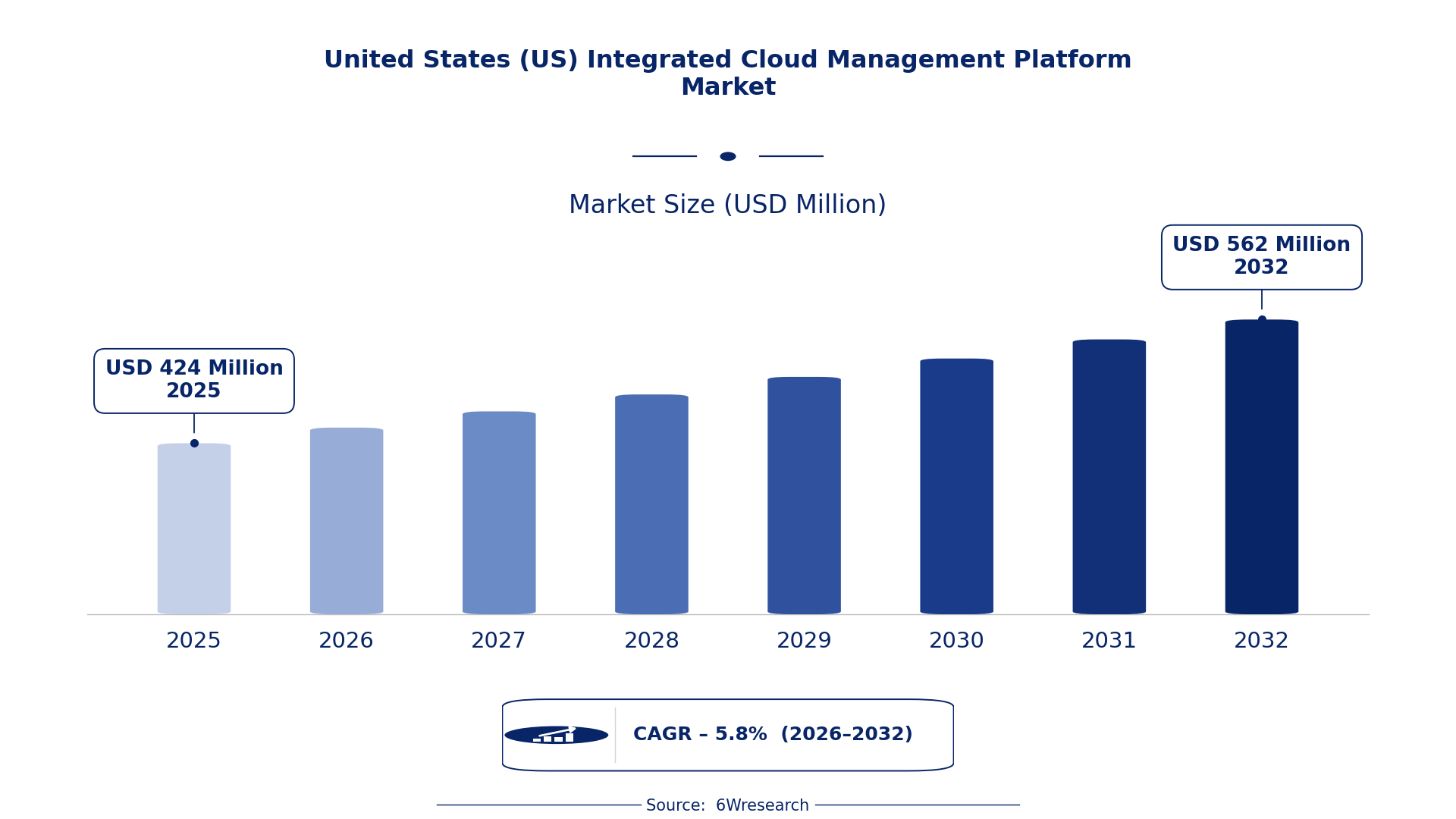
The United States (US) Integrated Cloud Management Platform Market was estimated at USD 424 Million in 2025 and is projected to reach USD 562 Million by 2032, growing at a CAGR of 5.8% from 2026 to 2032.
United States (US) Integrated Cloud Management Platform Market Synopsis
The driving force behind the United States Integrated Cloud Management Platform Market is the escalating demand for cloud-based solutions across various sectors. As organizations increasingly rely on cloud technologies, the need for efficient resource management is paramount, pushing integrated platforms to the forefront.
This market is characterized by a strong focus on automation and AI-driven functionalities, which enhance operational efficiency and scalability. The trend towards hybrid cloud environments is also shaping the competitive dynamics, as businesses seek to balance flexibility with security and compliance.
United States (US) Integrated Cloud Management Platform Market Year-wise Growth Rate and Key Drivers
This graph illustrates the annual growth rates of the United States (US) Integrated Cloud Management Platform Market from 2021 to 2032, highlighting a steady upward trajectory and projected expansion over the forecast period.
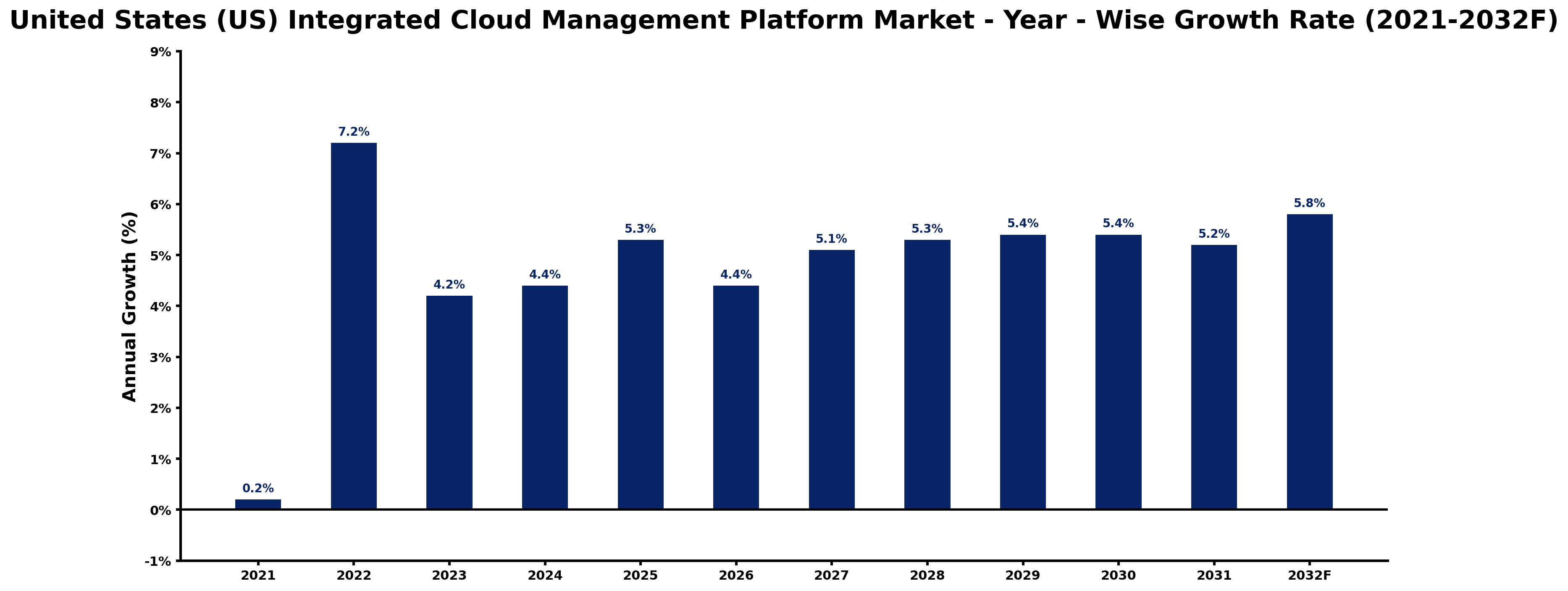
The table below presents the year‑wise growth rates along with the key drivers influencing the market
| Year | Growth Rate | Major Drivers |
| 2021 | 0.2% | Cloud Security Alliance promotes cloud governance standards. |
| 2022 | 7.2% | Increased adoption of 5G enhancing cloud service accessibility. |
| 2023 | 4.2% | Digital-first initiatives drive cloud resource optimization efforts. |
| 2024 | 4.4% | FedRAMP mandates spur compliance-driven cloud service purchases. |
| 2025 | 5.3% | Rise in disaster recovery concerns boosts cloud resilience adoption. |
| 2026 | 4.4% | Growing digital transformation budgets increase cloud platform investments. |
| 2027 | 5.1% | Emerging hybrid work models necessitate integrative cloud solutions. |
| 2028 | 5.3% | Tech-savvy millennials driving cloud utilization in businesses. |
| 2029 | 5.4% | Retailers embracing cloud for personalized customer experiences. |
| 2030 | 5.4% | Government incentives for tech startups boost cloud platform usage. |
| 2031 | 5.2% | Healthcare sector's digital record regulations fuel cloud demand. |
| 2032 | 5.8% | Sustainability goals push firms towards energy-efficient cloud solutions. |
Note: Market size estimations and growth projections presented in this report are based on 6Wresearch's proprietary forecasting methodology, utilizing the latest available industry data, government publications, and primary research inputs.
United States (US) Integrated Cloud Management Platform Market Key Takeaways
Below are some of the specific key takeaways from the market, including:
- The market is experiencing accelerated growth fueled by digital transformation initiatives.
- Automation and AI are critical components driving innovation in cloud management solutions.
- Hybrid and multi-cloud strategies are becoming standard practice among organizations.
- Security and compliance are paramount, influencing purchasing decisions significantly.
- The demand for cost-effective cloud solutions continues to rise as businesses seek efficiency.
Evaluation of Restraints in United States (US) Integrated Cloud Management Platform Market
Despite robust growth, the United States Integrated Cloud Management Platform Market faces several restraints. Chief among these are concerns surrounding data security and privacy, which remain top of mind for organizations transitioning to cloud environments. The complex nature of managing hybrid and multi-cloud infrastructures can overwhelm companies lacking sufficient expertise or resources. Compliance with evolving regulations, such as GDPR and CCPA, adds another layer of complexity. on top of that, the skills gap in cloud management professions presents a significant hurdle, hampering the ability of businesses to fully capitalize on integrated cloud solutions.
United States (US) Integrated Cloud Management Platform Market Trends
Several trends are shaping the United States Integrated Cloud Management Platform Market. The push towards hybrid and multi-cloud environments is notable, as organizations strive for better performance and flexibility in their cloud operations. Additionally, automation capabilities are in high demand, allowing businesses to streamline cloud management processes and reduce operational costs.
Security measures are evolving as organizations prioritize data protection, leading to increased investment in compliance features within cloud management platforms. As companies adapt to new technologies, scalability and cost-efficiency are also becoming critical factors influencing purchasing decisions.
United States (US) Integrated Cloud Management Platform Market Opportunities
The opportunities in the United States Integrated Cloud Management Platform Market are vast. Companies that provide integrated solutions capable of streamlining operations and optimizing costs are well-positioned for growth. Investment opportunities include cloud management software and infrastructure-as-a-service (IaaS) providers. on top of that, the integration of artificial intelligence and machine learning into cloud management tools presents a promising avenue for enhancing analytics and automation, aligning with the ongoing digital transformation efforts across industries.
Government Initiatives in the United States (US) Integrated Cloud Management Platform Market
Government policy plays a crucial role in shaping the United States Integrated Cloud Management Platform Market. Current regulations focus on promoting innovation while ensuring data security and interoperability within cloud computing. Guidelines such as the Federal Risk and Authorization Management Program (FedRAMP) highlight the government's commitment to stringent security standards, fostering confidence in cloud solutions.
- A recently completed initiative, the Cloud Smart strategy, aims to streamline cloud adoption across federal agencies.
- Current efforts include the GSA's Cloud Center of Excellence, which provides guidance on navigating cloud technologies.
- Future plans involve enhancing the Federal Risk Management framework to address emerging security threats.
- Ongoing training programs are being developed to equip federal employees with the necessary cloud management skills.
- Upcoming regulatory changes are expected to mandate increased transparency in cloud service billing practices.
Future Insights of the United States (US) Integrated Cloud Management Platform Market
Looking ahead to 2026-2032, the United States Integrated Cloud Management Platform Market is set for substantial growth. The demand for efficient management of complex cloud environments will drive innovation, particularly as businesses transition to hybrid and multi-cloud strategies. As artificial intelligence and machine learning technologies continue to evolve, integrated platforms will increasingly offer enhanced capabilities for orchestration, automation, and governance.
In addition, the emphasis on security and compliance will shape purchasing decisions, ensuring that integrated cloud management platforms remain a focal point for organizations navigating their digital transformation journeys.
United States (US) Integrated Cloud Management Platform Market Latest Developments
In the past year, the United States Integrated Cloud Management Platform Market has seen a flurry of activity, with companies aggressively developing new features and services. As organizations adapt to hybrid working environments, the demand for more sophisticated cloud management solutions has intensified.
- A leading technology vendor launched an advanced automation tool in early 2025, designed to enhance cloud resource management.
- Currently ongoing, a major regional initiative aims to upgrade digital infrastructure to support increased cloud adoption.
- A new partnership between cloud service providers is set to facilitate shared security frameworks, expected to be implemented by mid-2026.
- A comprehensive service upgrade is in the rollout phase, incorporating AI-driven analytics to improve operational efficiencies.
- A planned product launch in late 2025 will introduce a cloud management platform tailored for small to medium-sized enterprises.
United States (US) Integrated Cloud Management Platform Market - Key Attractiveness of the Report
- 10 Years of Market Numbers
- Historical Data Starting from 2022 to 2025
- Base Year: 2025
- Forecast Data until 2032
- Key Performance Indicators Impacting the Market
- Major Upcoming Developments and Projects
Key Highlights of the Report:
- United States (US) Integrated Cloud Management Platform Market Outlook
- Market Size of United States (US) Integrated Cloud Management Platform Market, 2025
- Forecast of United States (US) Integrated Cloud Management Platform Market, 2032
- Historical Data and Forecast of United States (US) Integrated Cloud Management Platform Revenues & Volume for the Period 2022-2032F
- United States (US) Integrated Cloud Management Platform Market Trend Evolution
- United States (US) Integrated Cloud Management Platform Market Drivers and Challenges
- United States (US) Integrated Cloud Management Platform Price Trends
- United States (US) Integrated Cloud Management Platform Porter's Five Forces
- United States (US) Integrated Cloud Management Platform Industry Life Cycle
- Historical Data and Forecast of United States (US) Integrated Cloud Management Platform Market Revenues & Volume By Component for the Period 2022-2032F
- Historical Data and Forecast of United States (US) Integrated Cloud Management Platform Market Revenues & Volume By Solutions for the Period 2022-2032F
- Historical Data and Forecast of United States (US) Integrated Cloud Management Platform Market Revenues & Volume By Services for the Period 2022-2032F
- Historical Data and Forecast of United States (US) Integrated Cloud Management Platform Market Revenues & Volume By Vertical for the Period 2022-2032F
- Historical Data and Forecast of United States (US) Integrated Cloud Management Platform Market Revenues & Volume By BFSI for the Period 2022-2032F
- Historical Data and Forecast of United States (US) Integrated Cloud Management Platform Market Revenues & Volume By IT and Telecom for the Period 2022-2032F
- Historical Data and Forecast of United States (US) Integrated Cloud Management Platform Market Revenues & Volume By Government and Public Sector for the Period 2022-2032F
- Historical Data and Forecast of United States (US) Integrated Cloud Management Platform Market Revenues & Volume By Manufacturing for the Period 2022-2032F
- Historical Data and Forecast of United States (US) Integrated Cloud Management Platform Market Revenues & Volume By Retail and Consumer Goods for the Period 2022-2032F
- Historical Data and Forecast of United States (US) Integrated Cloud Management Platform Market Revenues & Volume By Healthcare and Lifesciences for the Period 2022-2032F
- Historical Data and Forecast of United States (US) Integrated Cloud Management Platform Market Revenues & Volume By Energy and Utilities for the Period 2022-2032F
- Historical Data and Forecast of United States (US) Integrated Cloud Management Platform Market Revenues & Volume By Others for the Period 2022-2032F
- Historical Data and Forecast of United States (US) Integrated Cloud Management Platform Market Revenues & Volume By Organization Size for the Period 2022-2032F
- Historical Data and Forecast of United States (US) Integrated Cloud Management Platform Market Revenues & Volume By SMEs for the Period 2022-2032F
- Historical Data and Forecast of United States (US) Integrated Cloud Management Platform Market Revenues & Volume By Large Enterprises for the Period 2022-2032F
- United States (US) Integrated Cloud Management Platform Import Export Trade Statistics
- Market Opportunity Assessment By Component
- Market Opportunity Assessment By Vertical
- Market Opportunity Assessment By Organization Size
- United States (US) Integrated Cloud Management Platform Top Companies Market Share
- United States (US) Integrated Cloud Management Platform Competitive Benchmarking By Technical and Operational Parameters
- United States (US) Integrated Cloud Management Platform Company Profiles
- United States (US) Integrated Cloud Management Platform Key Strategic Recommendations






































