United States (US) LED Traffic Signs and Signals Market Size, Share & Growth Rate
The United States (US) LED Traffic Signs and Signals Market was estimated at USD 110 Million in 2025 and is projected to reach USD 129 Million by 2032, growing at a CAGR of 2.3% from 2026 to 2032. This growth trajectory is fueled by significant government initiatives aimed at enhancing road safety, coupled with the rising demand for energy-efficient traffic management solutions. The increasing urbanization and the integration of smart technologies into transportation systems further drive the adoption of LED traffic signs and signals, marking a pivotal shift in how cities manage traffic flow and safety.
United States (US) LED Traffic Signs and Signals Market Year-wise Growth Rate and Key Drivers
This graph highlights how the United States (US) LED Traffic Signs and Signals Market has steadily grown over the years, supported by major growth factors.
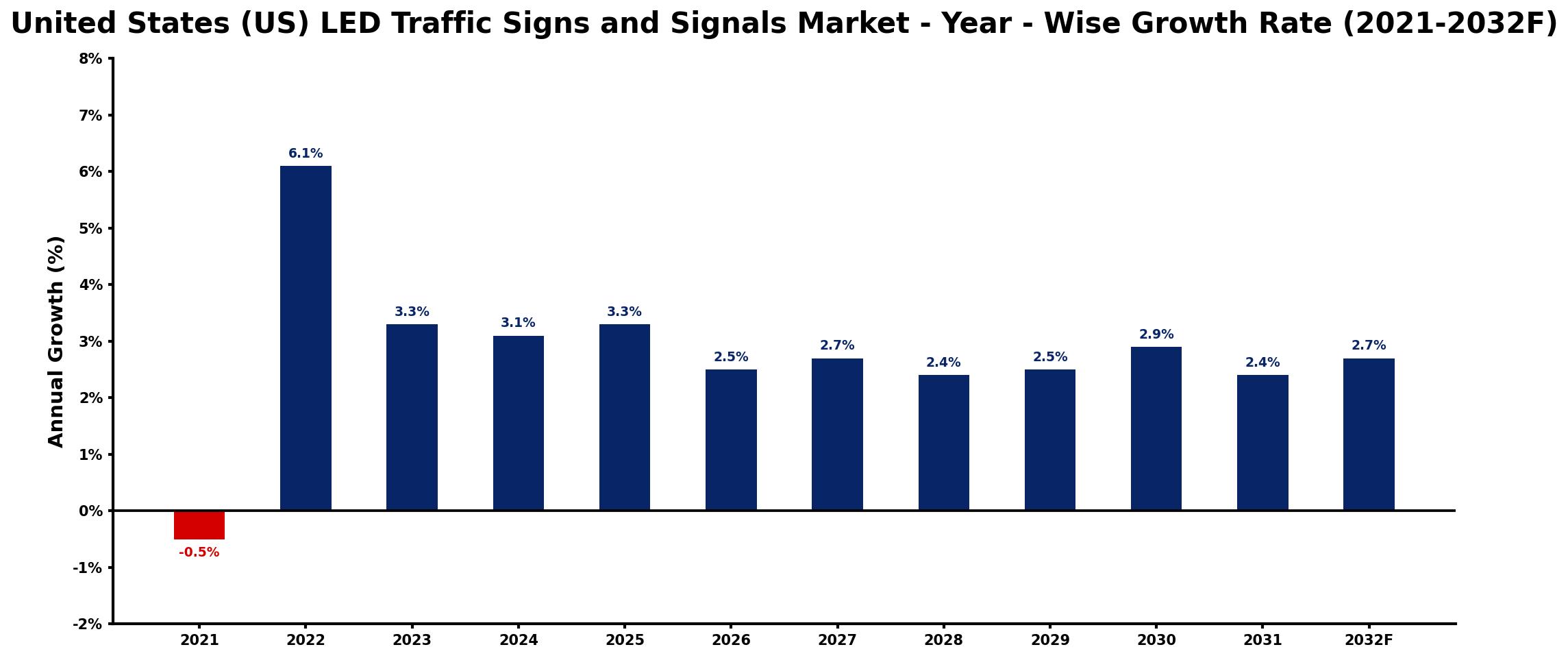
The table below presents the year‑wise growth rates along with the key drivers influencing the market
| Year | Growth Rate | Major Drivers |
| 2021 | -0.5% | decreased infrastructure investment levels |
| 2022 | 6.1% | increased urban development projects |
| 2023 | 3.3% | rise in smart city initiatives |
| 2024 | 3.1% | growing focus on road safety |
| 2025 | 3.3% | expansion of renewable energy policies |
| 2026 | 2.5% | increased government funding allocations |
| 2027 | 2.7% | advancements in digital technologies |
| 2028 | 2.4% | growing demand for automation solutions |
| 2029 | 2.5% | enhanced public safety regulations |
| 2030 | 2.9% | increased adoption of IoT applications |
| 2031 | 2.4% | rising interest in sustainable practices |
| 2032 | 2.7% | rising export shipment volumes |
Note: Market size estimations and growth projections presented in this report are based on 6Wresearch's proprietary forecasting methodology, utilizing the latest available industry data, government publications, and primary research inputs.
United States (US) LED Traffic Signs and Signals Market Synopsis
Currently, the US LED Traffic Signs and Signals Market is on an upward trajectory, characterized by the convergence of technological advancements and urban infrastructure development. Municipalities are recognizing the advantages of LED technology, particularly its energy efficiency and improved visibility, which are essential for enhancing road safety.
The market landscape is evolving with the integration of smart traffic management systems that leverage data analytics for real-time decision-making. This shift is not just about replacing traditional signals but enhancing overall traffic communication systems to create safer, more efficient roadways.
United States (US) LED Traffic Signs and Signals Market Key Takeaways
- The market is witnessing a robust shift toward energy-efficient and sustainable traffic solutions.
- Smart city initiatives are driving the demand for dynamic LED traffic signs and signals.
- Increased urbanization and infrastructure development are key market growth drivers.
- Government initiatives are promoting the adoption of LED technology across the nation.
- Competitive landscape necessitates continuous innovation and differentiation among market players.
Evaluation of Restraints in United States (US) LED Traffic Signs and Signals Market
Despite its growth potential, the US LED Traffic Signs and Signals Market faces several restraints that could impede progress. High initial installation costs remain a significant barrier, deterring some municipalities from transitioning to LED technology. Limited funding for infrastructure projects compounds this challenge, especially in regions where budgets are stretched thin. Additionally, the slow pace of government approvals and regulatory standardization processes can delay the implementation of innovative traffic solutions. Maintaining and upgrading existing systems adds further complexity, emphasizing the need for strategic planning and investment in sustainable technologies.
United States (US) LED Traffic Signs and Signals Market Trends
Several key trends are shaping the US LED Traffic Signs and Signals Market. The adoption of energy-efficient LED technologies is accelerating, not just for the sake of sustainability, but to reduce ongoing maintenance costs. Additionally, smart technologies are becoming essential components of traffic management systems, allowing for real-time data collection and adaptive signal control that can respond to fluctuating traffic patterns.
Dynamic messaging signs are gaining traction as they facilitate better communication with drivers, thereby enhancing safety and flow. Moreover, the increasing prevalence of connected and autonomous vehicles is creating demand for intelligent traffic management systems that seamlessly integrate with LED signage, signaling a fundamental transformation in how traffic is managed.
United States (US) LED Traffic Signs and Signals Market Opportunities
The market offers significant opportunities for investment in various aspects of traffic management. As municipalities look to modernize their systems, there is a growing demand for innovative manufacturing and supply solutions for LED traffic signs and signals. Furthermore, with the increasing focus on integrating Internet of Things (IoT) technologies, companies can explore advancements in smart traffic management solutions. Investors can also find opportunities in infrastructure development projects that prioritize sustainable and efficient traffic solutions, ensuring long-term returns in a rapidly evolving landscape.
Government Initiatives in the United States (US) LED Traffic Signs and Signals Market
Government policies in the US play a crucial role in promoting the adoption of LED traffic signs and signals. The Federal Highway Administration (FHWA) sets forth guidelines and standards that ensure effective and consistent implementation across the country. State and local governments are actively endorsing the transition to energy-efficient solutions, supported by initiatives aimed at reducing environmental impacts and enhancing operational efficiencies. These policies foster an environment conducive to innovation in traffic management technologies, further propelling market growth.
Future Insights of the United States (US) LED Traffic Signs and Signals Market
Looking ahead, the United States LED Traffic Signs and Signals Market is expected to continue its upward trend through 2026-2032, driven by increasing emphasis on road safety and the push towards smart city initiatives. The integration of advanced technologies with LED traffic solutions will create new opportunities, especially as urbanization accelerates and traffic congestion worsens. As municipalities invest in enhancing transportation infrastructure, the market is poised for steady growth, ultimately leading to safer, more efficient roadways.
United States (US) LED Traffic Signs and Signals Market Latest Developments (2025 - 2026)
Recent industry developments suggest a strong momentum in the adoption of LED technology within traffic management systems. Cities are increasingly investing in dynamic messaging systems that provide real-time updates to drivers, improving safety and traffic flow. Initiatives focusing on smart traffic systems are gaining traction, with trials being conducted in multiple municipalities to integrate LED signals with data analytics platforms for enhanced traffic management.
United States (US) LED Traffic Signs and Signals Market - Key Attractiveness of the Report
- 10 Years of Market Numbers
- Historical Data Starting from 2022 to 2025
- Base Year: 2025
- Forecast Data until 2032
- Key Performance Indicators Impacting the Market
- Major Upcoming Developments and Projects
Key Highlights of the Report:
- United States (US) LED Traffic Signs and Signals Market Outlook
- Market Size of United States (US) LED Traffic Signs and Signals Market, 2025
- Forecast of United States (US) LED Traffic Signs and Signals Market, 2032
- Historical Data and Forecast of United States (US) LED Traffic Signs and Signals Revenues & Volume for the Period 2022-2032F
- United States (US) LED Traffic Signs and Signals Market Trend Evolution
- United States (US) LED Traffic Signs and Signals Market Drivers and Challenges
- United States (US) LED Traffic Signs and Signals Price Trends
- United States (US) LED Traffic Signs and Signals Porter's Five Forces
- United States (US) LED Traffic Signs and Signals Industry Life Cycle
- Historical Data and Forecast of United States (US) LED Traffic Signs and Signals Market Revenues & Volume By Product for the Period 2022-2032F
- Historical Data and Forecast of United States (US) LED Traffic Signs and Signals Market Revenues & Volume By LED Traffic Signals for the Period 2022-2032F
- Historical Data and Forecast of United States (US) LED Traffic Signs and Signals Market Revenues & Volume By LED Traffic Signs for the Period 2022-2032F
- United States (US) LED Traffic Signs and Signals Import Export Trade Statistics
- Market Opportunity Assessment By Product
- United States (US) LED Traffic Signs and Signals Top Companies Market Share
- United States (US) LED Traffic Signs and Signals Competitive Benchmarking By Technical and Operational Parameters
- United States (US) LED Traffic Signs and Signals Company Profiles
- United States (US) LED Traffic Signs and Signals Key Strategic Recommendations






































