United States (US) Letterpress Printing Machinery Market Size, Share & Growth Rate
The United States (US) Letterpress Printing Machinery Market was estimated at USD 90 Million in 2025 and is projected to reach USD 106 Million by 2032, growing at a CAGR of 2.4% from 2026 to 2032. This growth trajectory is fueled by a renewed appreciation for traditional printing methods that emphasize quality and uniqueness. As businesses across various sectors strive for distinct branding, the tactile and visual appeal of letterpress printing continues to resonate strongly, driving demand.
United States (US) Letterpress Printing Machinery Market Year-wise Growth Rate and Key Drivers
This graph highlights how the United States (US) Letterpress Printing Machinery Market has steadily grown over the years, supported by major growth factors.
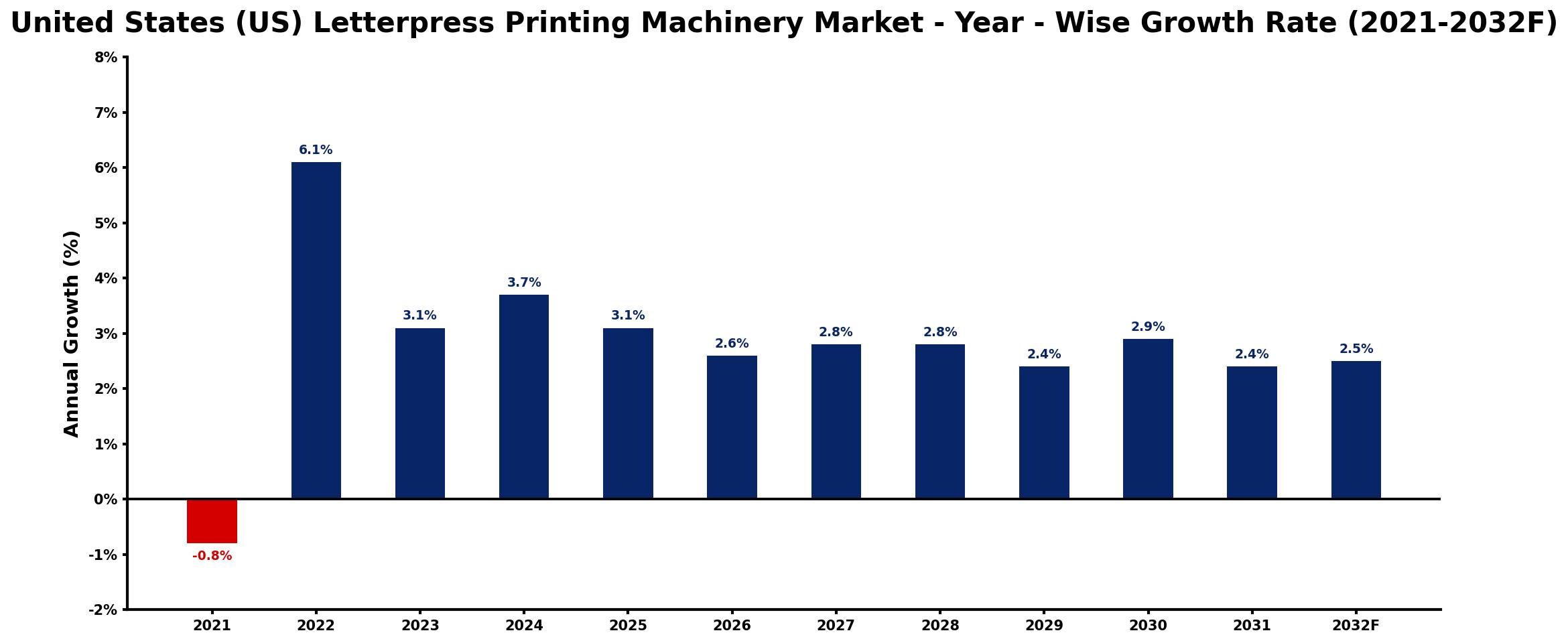
The table below presents the year‑wise growth rates along with the key drivers influencing the market
| Year | Growth Rate | Major Drivers |
| 2021 | -0.8% | decrease in custom orders volume |
| 2022 | 6.1% | rise in niche market demand |
| 2023 | 3.1% | expansion of artisan workshops |
| 2024 | 3.7% | increased investment in technology |
| 2025 | 3.1% | growth in eco-friendly materials |
| 2026 | 2.6% | surge in local business collaborations |
| 2027 | 2.8% | development of creative design trends |
| 2028 | 2.8% | enhancement of marketing strategies |
| 2029 | 2.4% | rising infrastructure development spending |
| 2030 | 2.9% | increased production capacity utilization |
| 2031 | 2.4% | rising demand from electronics |
| 2032 | 2.5% | increased focus on sustainability practices |
Note: Market size estimations and growth projections presented in this report are based on 6Wresearch's proprietary forecasting methodology, utilizing the latest available industry data, government publications, and primary research inputs.
United States (US) Letterpress Printing Machinery Market Synopsis
A notable shift in consumer preferences toward artisanal and bespoke products is propelling the letterpress printing sector. As companies increasingly look to differentiate themselves, the demand for high-quality printed materials such as invitations and packaging has surged, highlighting the unique capabilities of letterpress machinery.
Moreover, the integration of eco-friendly practices into manufacturing processes is becoming a critical selling point. With rising concerns about environmental sustainability, businesses are gravitating towards letterpress options that minimize energy consumption and waste production, thus aligning with broader green initiatives.
United States (US) Letterpress Printing Machinery Market Key Takeaways
- The market is seeing a revival, primarily driven by demand for high-quality, artisanal printing solutions.
- Sustainability is a major trend, prompting manufacturers to adopt eco-friendly materials and processes.
- Technological advancements, including digital integration, are expanding the functionality of letterpress printing machines.
- Smaller niche players are carving out a market presence alongside established manufacturers.
- There is significant investment potential in companies innovating traditional printing technology.
Evaluation of Restraints in United States (US) Letterpress Printing Machinery Market
Despite the steady growth, the US Letterpress Printing Machinery Market faces notable challenges. A key constraint is the overarching trend toward digital printing, which is often favored for its speed and cost-effectiveness. This shift has limited the traditional letterpress market's scalability and has resulted in reduced profit margins for manufacturers. Furthermore, the high maintenance costs associated with letterpress machinery can deter smaller printing companies from investing in new technology, thereby hindering overall market expansion. Lastly, the dwindling pool of skilled labor familiar with letterpress techniques poses an operational challenge, underscoring the need for focused training initiatives.
United States (US) Letterpress Printing Machinery Market Trends
Current trends show a significant push towards personalized and unique printed products, fueling demand for letterpress machinery that can deliver bespoke designs. Additionally, manufacturers are increasingly implementing automation and digital interfaces to enhance operational efficiency, making it easier for businesses to customize orders swiftly. The focus on sustainability is also gaining traction, with businesses adopting practices that support eco-friendly printing, from sourcing materials to reducing waste. As consumers seek authenticity and quality in their printed products, the letterpress market is positioned for continued relevance.
United States (US) Letterpress Printing Machinery Market Opportunities
As interest in artisanal products grows, the US Letterpress Printing Machinery Market presents several lucrative investment opportunities. Companies that manufacture or distribute letterpress equipment are well-positioned to capitalize on this trend, especially if they innovate to meet changing consumer needs. Research and development efforts aimed at modernizing equipment and enhancing digital integration will likely yield significant returns. Additionally, tapping into niche markets—such as wedding stationery or sustainable packaging—can provide competitive advantages in this evolving landscape.
Government Initiatives in the United States (US) Letterpress Printing Machinery Market
Government policies relevant to the US Letterpress Printing Machinery Market focus on environmental standards, trade regulations, and safety requirements. The Environmental Protection Agency (EPA) imposes emission regulations to limit pollution from printing activities, which prompts manufacturers to adopt cleaner technologies. Furthermore, trade policies influence the import and export dynamics of printing machinery, impacting operational costs for manufacturers. Compliance with safety standards established by the American National Standards Institute (ANSI) and the Occupational Safety and Health Administration (OSHA) is vital to ensure workplace safety and product quality within the industry.
Future Insights of the United States (US) Letterpress Printing Machinery Market
Looking forward to the period from 2026 to 2032, the United States Letterpress Printing Machinery Market is anticipated to maintain a positive outlook. The unique demand for specialty and customizable printing solutions will likely continue to grow, supported by consumers' preference for tangible, high-quality products. Sustainability will remain a driving factor, attracting environmentally conscious buyers who value the reduced waste and energy consumption associated with letterpress printing. For market players, investing in modernization and exploring new applications will be key strategies to capture this evolving demand landscape.
United States (US) Letterpress Printing Machinery Market Latest Developments (2025 - 2026)
Recent trends indicate a growing interest in collaborative efforts within the printing industry, where businesses are coming together to share resources and knowledge on sustainable practices. Simultaneously, advancements in automation technology have begun to influence production efficiency, allowing smaller firms to compete more effectively. The increasing availability of eco-friendly inks and materials is also notable, as companies strive to meet the rising consumer expectations for sustainable products.
United States (US) Letterpress Printing Machinery Market - Key Attractiveness of the Report
- 10 Years of Market Numbers
- Historical Data Starting from 2022 to 2025
- Base Year: 2025
- Forecast Data until 2032
- Key Performance Indicators Impacting the Market
- Major Upcoming Developments and Projects
Key Highlights of the Report:
- United States (US) Letterpress Printing Machinery Market Outlook
- Market Size of United States (US) Letterpress Printing Machinery Market, 2025
- Forecast of United States (US) Letterpress Printing Machinery Market, 2032
- Historical Data and Forecast of United States (US) Letterpress Printing Machinery Revenues & Volume for the Period 2022-2032F
- United States (US) Letterpress Printing Machinery Market Trend Evolution
- United States (US) Letterpress Printing Machinery Market Drivers and Challenges
- United States (US) Letterpress Printing Machinery Price Trends
- United States (US) Letterpress Printing Machinery Porter's Five Forces
- United States (US) Letterpress Printing Machinery Industry Life Cycle
- Historical Data and Forecast of United States (US) Letterpress Printing Machinery Market Revenues & Volume By Type for the Period 2022-2032F
- Historical Data and Forecast of United States (US) Letterpress Printing Machinery Market Revenues & Volume By Rotary Letterpress Machine for the Period 2022-2032F
- Historical Data and Forecast of United States (US) Letterpress Printing Machinery Market Revenues & Volume By Other for the Period 2022-2032F
- Historical Data and Forecast of United States (US) Letterpress Printing Machinery Market Revenues & Volume By Application for the Period 2022-2032F
- Historical Data and Forecast of United States (US) Letterpress Printing Machinery Market Revenues & Volume By Securities for the Period 2022-2032F
- Historical Data and Forecast of United States (US) Letterpress Printing Machinery Market Revenues & Volume By Invitation Card for the Period 2022-2032F
- Historical Data and Forecast of United States (US) Letterpress Printing Machinery Market Revenues & Volume By Other for the Period 2022-2032F
- United States (US) Letterpress Printing Machinery Import Export Trade Statistics
- Market Opportunity Assessment By Type
- Market Opportunity Assessment By Application
- United States (US) Letterpress Printing Machinery Top Companies Market Share
- United States (US) Letterpress Printing Machinery Competitive Benchmarking By Technical and Operational Parameters
- United States (US) Letterpress Printing Machinery Company Profiles
- United States (US) Letterpress Printing Machinery Key Strategic Recommendations






































