United States (US) Licensed Merchandise Market Size, Share & Growth Rate
The United States (US) Licensed Merchandise Market was estimated at USD 200 Million in 2025 and is projected to reach USD 234 Million by 2032, growing at a CAGR of 2.3% from 2026 to 2032. This growth is largely driven by the increasing consumer inclination towards branded products, including those stemming from popular entertainment, sports, and fashion sectors. As licensed merchandise becomes more integral to consumer identity and expression, innovative marketing strategies and the expansion of e-commerce platforms are significantly enhancing market accessibility and diversity.
United States (US) Licensed Merchandise Market Year-wise Growth Rate and Key Drivers
This graph highlights how the United States (US) Licensed Merchandise Market has steadily grown over the years, supported by major growth factors.
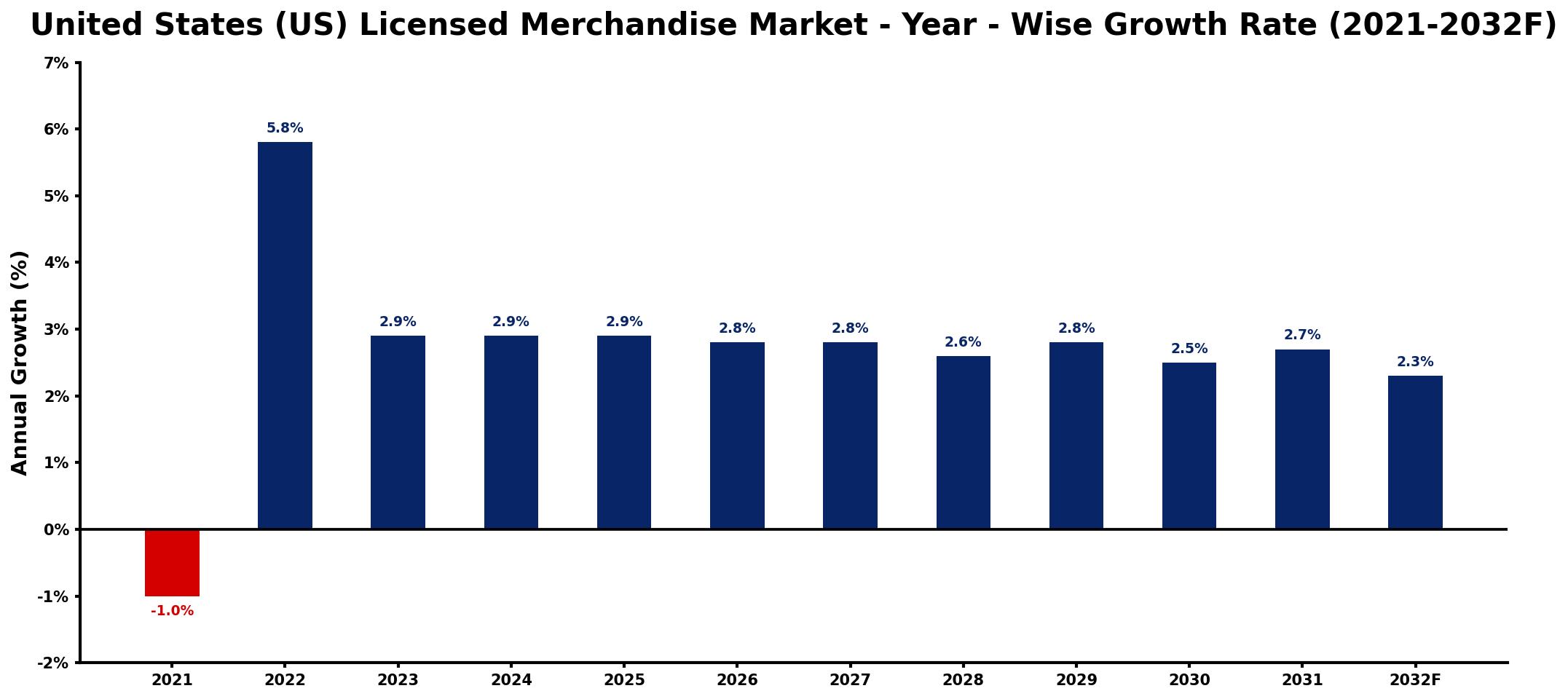
The table below presents the year‑wise growth rates along with the key drivers influencing the market
| Year | Growth Rate | Major Drivers |
| 2021 | -1.0% | decreased consumer spending trends |
| 2022 | 5.8% | rising brand collaboration partnerships |
| 2023 | 2.9% | expansion of online retail platforms |
| 2024 | 2.9% | increased demand for collectibles |
| 2025 | 2.9% | growing interest in nostalgia products |
| 2026 | 2.8% | enhanced marketing through social media |
| 2027 | 2.8% | surge in experiential retail offerings |
| 2028 | 2.6% | broader audience targeting strategies |
| 2029 | 2.8% | development of sustainable product lines |
| 2030 | 2.5% | integration of augmented reality experiences |
| 2031 | 2.7% | stronger global licensing agreements |
| 2032 | 2.3% | expansion into emerging markets |
Note: Market size estimations and growth projections presented in this report are based on 6Wresearch's proprietary forecasting methodology, utilizing the latest available industry data, government publications, and primary research inputs.
United States (US) Licensed Merchandise Market Synopsis
The licensed merchandise landscape in the U.S. is becoming increasingly dynamic, characterized by a convergence of consumer interests and strong brand identities. This segment thrives as fans of franchises, athletes, and icons eagerly seek products that resonate with their personal affiliations, further fueling sales across various channels.
With licensing agreements spanning numerous categories—from apparel to toys—the market is rich with opportunities for both established brands and emerging entities. The rise of e-commerce continues to redefine consumer engagement, allowing for greater reach and tailored marketing approaches.
United States (US) Licensed Merchandise Market Key Takeaways
- The U.S. licensed merchandise market is driven by strong consumer demand for branded products reflecting personal affiliations.
- E-commerce platforms play a pivotal role in enhancing market reach and facilitating innovative marketing strategies.
- Collaborative licensing agreements between intellectual property owners and manufacturers are increasing market diversity.
- The ongoing popularity of licensed merchandise in entertainment, sports, and fashion sectors bolsters market growth.
- Government initiatives aimed at protecting intellectual property rights support industry stability and growth.
Evaluation of Restraints in United States (US) Licensed Merchandise Market
Despite the growth potential, the US Licensed Merchandise market faces certain restraints. A notable challenge is the need for manufacturers to adapt to shifting consumer preferences, especially in an increasingly digital landscape. The rise of e-commerce has also prompted a reevaluation of traditional retail strategies. Additionally, issues surrounding counterfeit products and the protection of intellectual property rights pose ongoing hurdles for stakeholders, requiring vigilance and investment in robust anti-counterfeiting measures.
United States (US) Licensed Merchandise Market Trends
Several trends are shaping the United States Licensed Merchandise Market. Firstly, the integration of technology in product design and consumer interaction is becoming prevalent. Augmented reality experiences and interactive online platforms are enhancing the purchasing journey, creating deeper connections with brands. Secondly, the sustainable movement is influencing consumer choices, with many licensed products now reflecting eco-friendly practices and materials.
Additionally, collaborations between traditional brands and popular cultural icons are emerging as effective strategies to engage younger consumers. The emphasis on social media marketing continues to amplify brand visibility and consumer engagement, showcasing products in real-time contexts that resonate with target audiences.
United States (US) Licensed Merchandise Market Opportunities
The potential for growth in the US Licensed Merchandise market is substantial, particularly in niche segments. Emerging trends around experiential merchandise, which includes products that offer unique consumer experiences, are gaining traction. Furthermore, the rising popularity of collectibles and limited-edition items presents lucrative opportunities for manufacturers to attract dedicated fan bases.
Moreover, companies that invest in sustainable practices and transparently communicate their environmental commitments are likely to enhance brand loyalty and consumer trust. Engaging collaborations with influencers across various platforms can also open new avenues for market expansion, particularly among younger demographics.
Government Initiatives in the United States (US) Licensed Merchandise Market
Recognizing the economic significance of the licensed merchandise industry, the United States government has instituted several supportive policies. These initiatives focus on protecting intellectual property through rigorous copyright and trademark enforcement, which is crucial for maintaining market integrity. Additionally, the government actively encourages partnerships between licensors and licensees to stimulate innovation and growth in the sector. Public spending aimed at promoting fair trade practices further ensures a conducive environment for the licensed merchandise market to flourish.
Future Insights of the United States (US) Licensed Merchandise Market
Looking ahead to 2026-2032, the United States Licensed Merchandise Market is poised for continuous growth driven by evolving consumer preferences and advancements in technology. The increasing integration of digital experiences into traditional retail will likely redefine how consumers engage with licensed products. Additionally, as brands enhance their focus on sustainability, consumers will increasingly favor products that align with their values. Overall, the market is expected to thrive as it adapts to changes and embraces new consumer dynamics.
United States (US) Licensed Merchandise Market Latest Developments (2025 - 2026)
Recent developments in the United States Licensed Merchandise Market indicate a significant uptick in collaborations between franchises and fashion brands, leading to a surge in limited-edition product offerings. E-commerce platforms are integrating advanced technologies to enhance user experience, with personalized recommendations becoming more prevalent. Moreover, businesses are increasingly focusing on sustainability, with a notable rise in eco-friendly licensed products gaining traction among environmentally conscious consumers.
United States (US) Licensed Merchandise Market - Key Attractiveness of the Report
- 10 Years of Market Numbers
- Historical Data Starting from 2022 to 2025
- Base Year: 2025
- Forecast Data until 2032
- Key Performance Indicators Impacting the Market
- Major Upcoming Developments and Projects
Key Highlights of the Report:
- United States (US) Licensed Merchandise Market Outlook
- Market Size of United States (US) Licensed Merchandise Market, 2025
- Forecast of United States (US) Licensed Merchandise Market, 2032
- Historical Data and Forecast of United States (US) Licensed Merchandise Revenues & Volume for the Period 2022-2032F
- United States (US) Licensed Merchandise Market Trend Evolution
- United States (US) Licensed Merchandise Market Drivers and Challenges
- United States (US) Licensed Merchandise Price Trends
- United States (US) Licensed Merchandise Porter's Five Forces
- United States (US) Licensed Merchandise Industry Life Cycle
- Historical Data and Forecast of United States (US) Licensed Merchandise Market Revenues & Volume By Product Type for the Period 2022-2032F
- Historical Data and Forecast of United States (US) Licensed Merchandise Market Revenues & Volume By Apparel and Footwear for the Period 2022-2032F
- Historical Data and Forecast of United States (US) Licensed Merchandise Market Revenues & Volume By Accessories and Gifts for the Period 2022-2032F
- Historical Data and Forecast of United States (US) Licensed Merchandise Market Revenues & Volume By Toys and Games for the Period 2022-2032F
- Historical Data and Forecast of United States (US) Licensed Merchandise Market Revenues & Volume By Others for the Period 2022-2032F
- Historical Data and Forecast of United States (US) Licensed Merchandise Market Revenues & Volume By for the Period 2022-2032F
- Historical Data and Forecast of United States (US) Licensed Merchandise Market Revenues & Volume By Distribution Channel for the Period 2022-2032F
- Historical Data and Forecast of United States (US) Licensed Merchandise Market Revenues & Volume By Online Stores for the Period 2022-2032F
- Historical Data and Forecast of United States (US) Licensed Merchandise Market Revenues & Volume By Supermarkets and Hypermarkets for the Period 2022-2032F
- Historical Data and Forecast of United States (US) Licensed Merchandise Market Revenues & Volume By Departmental Stores for the Period 2022-2032F
- Historical Data and Forecast of United States (US) Licensed Merchandise Market Revenues & Volume By Specialty Stores for the Period 2022-2032F
- Historical Data and Forecast of United States (US) Licensed Merchandise Market Revenues & Volume By Others for the Period 2022-2032F
- Historical Data and Forecast of United States (US) Licensed Merchandise Market Revenues & Volume By for the Period 2022-2032F
- Historical Data and Forecast of United States (US) Licensed Merchandise Market Revenues & Volume By Price Range for the Period 2022-2032F
- Historical Data and Forecast of United States (US) Licensed Merchandise Market Revenues & Volume By Premium for the Period 2022-2032F
- Historical Data and Forecast of United States (US) Licensed Merchandise Market Revenues & Volume By Economic for the Period 2022-2032F
- Historical Data and Forecast of United States (US) Licensed Merchandise Market Revenues & Volume By for the Period 2022-2032F
- Historical Data and Forecast of United States (US) Licensed Merchandise Market Revenues & Volume By End-User for the Period 2022-2032F
- Historical Data and Forecast of United States (US) Licensed Merchandise Market Revenues & Volume By Men for the Period 2022-2032F
- Historical Data and Forecast of United States (US) Licensed Merchandise Market Revenues & Volume By Women for the Period 2022-2032F
- Historical Data and Forecast of United States (US) Licensed Merchandise Market Revenues & Volume By Children for the Period 2022-2032F
- United States (US) Licensed Merchandise Import Export Trade Statistics
- Market Opportunity Assessment By Product Type
- Market Opportunity Assessment By Distribution Channel
- Market Opportunity Assessment By Price Range
- Market Opportunity Assessment By End-User
- United States (US) Licensed Merchandise Top Companies Market Share
- United States (US) Licensed Merchandise Competitive Benchmarking By Technical and Operational Parameters
- United States (US) Licensed Merchandise Company Profiles
- United States (US) Licensed Merchandise Key Strategic Recommendations






































