United States Lidocaine Market Year-wise Growth Rate (2021-2031F)
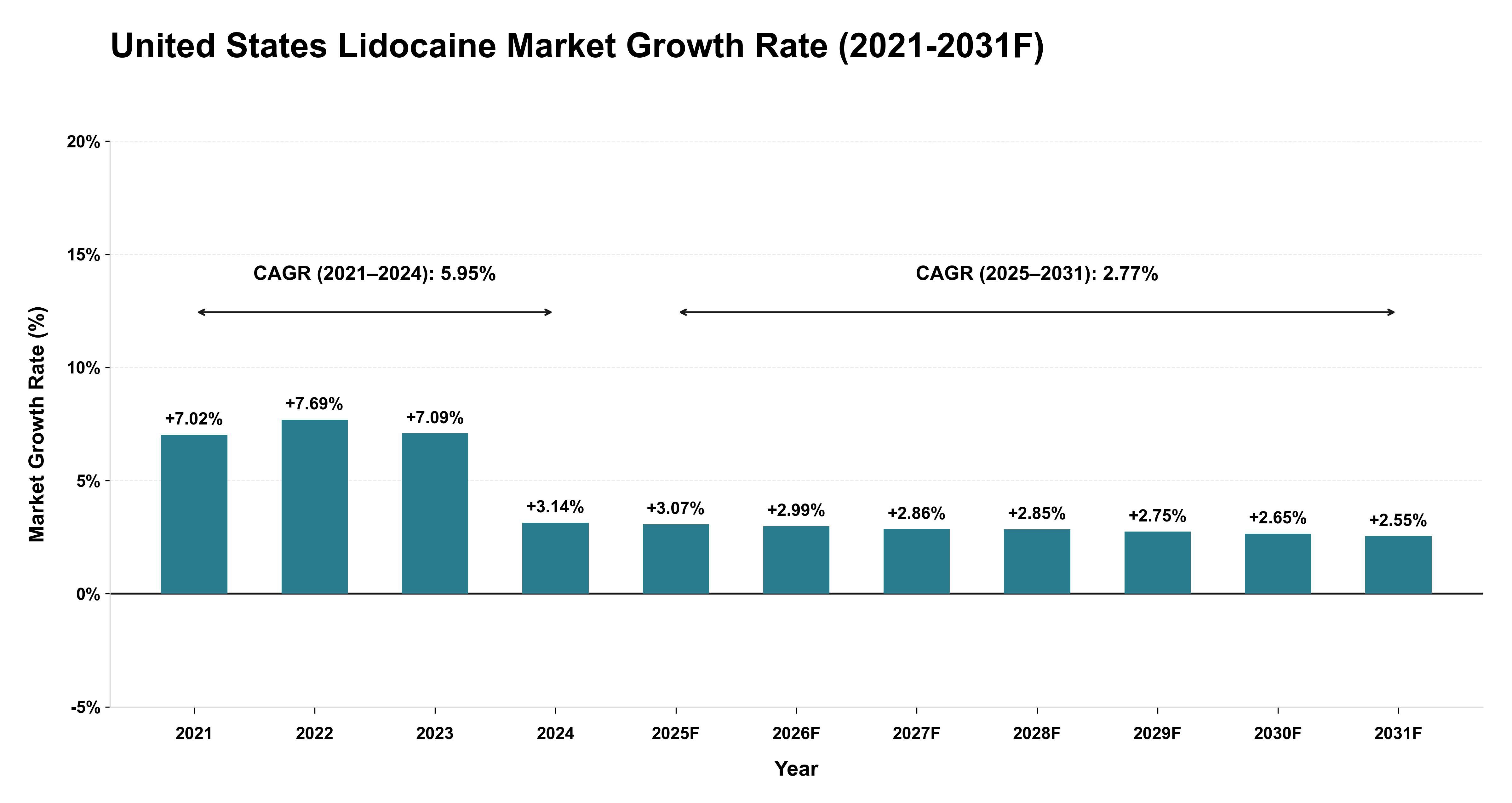
The United States Lidocaine Market experienced robust growth from 2021 to 2024, with an average annual CAGR of 5.95%. This period was characterized by significant demand from the healthcare sector for pain management purposes, driving the market expansion. However, in 2024, growth decelerated to 3.14%, indicating a shift in dynamics. Looking ahead to 2031, the forecast CAGR of 2.77% suggests a more moderate but steady growth trajectory. Factors such as increased competition among suppliers, evolving regulatory frameworks, and technological advancements in alternative pain management solutions are likely to contribute to this slowdown. Despite the deceleration, the Lidocaine Market remains resilient, adapting to changing consumer preferences and industry trends over the forecast period.
Key Highlights of the Report:
- United States (US) Lidocaine Market Outlook
- Market Size of United States (US) Lidocaine Market, 2024
- Forecast of United States (US) Lidocaine Market, 2031
- Historical Data and Forecast of United States (US) Lidocaine Revenues & Volume for the Period 2021- 2031
- United States (US) Lidocaine Market Trend Evolution
- United States (US) Lidocaine Market Drivers and Challenges
- United States (US) Lidocaine Price Trends
- United States (US) Lidocaine Porter's Five Forces
- United States (US) Lidocaine Industry Life Cycle
- Historical Data and Forecast of United States (US) Lidocaine Market Revenues & Volume By Formulation for the Period 2021- 2031
- Historical Data and Forecast of United States (US) Lidocaine Market Revenues & Volume By Injections for the Period 2021- 2031
- Historical Data and Forecast of United States (US) Lidocaine Market Revenues & Volume By Creams for the Period 2021- 2031
- Historical Data and Forecast of United States (US) Lidocaine Market Revenues & Volume By Ointments for the Period 2021- 2031
- Historical Data and Forecast of United States (US) Lidocaine Market Revenues & Volume By Gels for the Period 2021- 2031
- Historical Data and Forecast of United States (US) Lidocaine Market Revenues & Volume By Aerosol Liquids for the Period 2021- 2031
- Historical Data and Forecast of United States (US) Lidocaine Market Revenues & Volume By Others for the Period 2021- 2031
- Historical Data and Forecast of United States (US) Lidocaine Market Revenues & Volume By Application for the Period 2021- 2031
- Historical Data and Forecast of United States (US) Lidocaine Market Revenues & Volume By Dentistry for the Period 2021- 2031
- Historical Data and Forecast of United States (US) Lidocaine Market Revenues & Volume By Cardiac Arrhythmia for the Period 2021- 2031
- Historical Data and Forecast of United States (US) Lidocaine Market Revenues & Volume By Epilepsy for the Period 2021- 2031
- Historical Data and Forecast of United States (US) Lidocaine Market Revenues & Volume By Cosmetics for the Period 2021- 2031
- Historical Data and Forecast of United States (US) Lidocaine Market Revenues & Volume By Others for the Period 2021- 2031
- Historical Data and Forecast of United States (US) Lidocaine Market Revenues & Volume By Distribution channel for the Period 2021- 2031
- Historical Data and Forecast of United States (US) Lidocaine Market Revenues & Volume By Hospital Pharmacies for the Period 2021- 2031
- Historical Data and Forecast of United States (US) Lidocaine Market Revenues & Volume By Retailer Pharmacies for the Period 2021- 2031
- Historical Data and Forecast of United States (US) Lidocaine Market Revenues & Volume By Others for the Period 2021- 2031
- United States (US) Lidocaine Import Export Trade Statistics
- Market Opportunity Assessment By Formulation
- Market Opportunity Assessment By Application
- Market Opportunity Assessment By Distribution channel
- United States (US) Lidocaine Top Companies Market Share
- United States (US) Lidocaine Competitive Benchmarking By Technical and Operational Parameters
- United States (US) Lidocaine Company Profiles
- United States (US) Lidocaine Key Strategic Recommendations






































