US Mackerel Market (2025-2031) | Outlook, Size, Revenue, Analysis, Forecast, Growth, Companies, Value, Industry, Share & Trends
Market Forecast By Type (Atka Mackerel, Spanish Mackerel, Horse Mackerel, King Mackerel, Atlantic Mackerel, Pacific Mackerel), By Catch Type (Wild Catch, Aquaculture), By Form (Fresh Mackerel, Frozen And Processed Mackerel, Fresh Mackerel Fillets, Frozen Mackerel Fillets) And Competitive Landscape
| Product Code: ETC387001 | Publication Date: Aug 2022 | Updated Date: Nov 2025 | Product Type: Market Research Report | |
| Publisher: 6Wresearch | Author: Ravi Bhandari | No. of Pages: 75 | No. of Figures: 35 | No. of Tables: 20 |
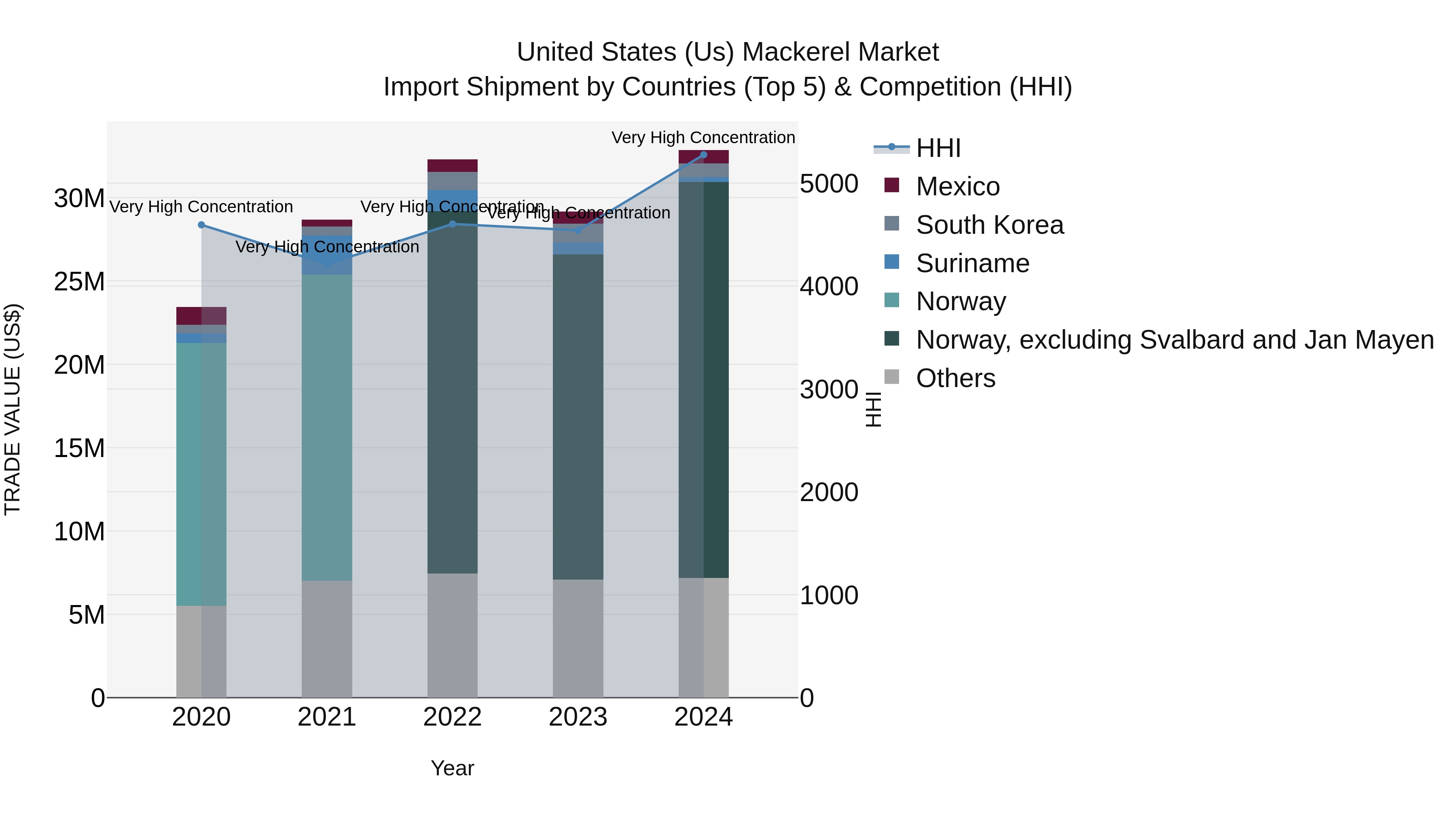
United States (US) Mackerel Market Top 5 Importing Countries and Market Competition (HHI) Analysis
In 2024, the United States saw significant mackerel import shipments from top exporting countries including Norway, Venezuela, Taiwan, Iceland, and South Korea. With a high Herfindahl-Hirschman Index (HHI) indicating concentration, the market remained competitive. The impressive compound annual growth rate (CAGR) of 8.79% from 2020 to 2024 highlights the sustained demand for mackerel imports. Additionally, the notable growth rate of 12.58% from 2023 to 2024 signals a strengthening market trend, showcasing opportunities for stakeholders in the US mackerel import industry.
US Mackerel Market Highlights
| Report Name | US Mackerel Market |
| Forecast period | 2025-2031 |
| CAGR | 5.8% |
| Growing Sector | Food and Beverage |
Topics Covered in the US Mackerel Market Report
The US Mackerel market report thoroughly covers the market by type, by catch type, by form and competitive Landscape. The report provides an unbiased and detailed analysis of the on-going market trends, opportunities/high growth areas, and market drivers which would help the stakeholders to devise and align their market strategies according to the current and future market dynamics.
US Mackerel Market Synopsis
The United States mackerel market has witnessed significant growth over the past few years, driven by increasing consumer awareness of the health benefits associated with mackerel consumption. Rich in Omega-3 fatty acids, mackerel supports heart health, improves mental acuity, and contributes to a balanced diet. The market's expansion is also fueled by the versatility of mackerel in culinary applications, ranging from grilling and frying to being an integral part of salads and sushi. This trend is expected to continue, with projections indicating a steady rise in demand for sustainably sourced mackerel. Additionally, in light of the growing demand, an emerging trend within the United States mackerel market is the increased focus on sustainable fishing practices. Consumers are becoming more environmentally conscious, prioritizing products that are sourced in a manner that minimizes impact on marine ecosystems. Additionally, the integration of technology in the supply chain, such as blockchain for traceability, is enhancing transparency and bolstering consumer trust. Furthermore, the rise of plant-based and lab-grown seafood alternatives is pushing the mackerel industry to innovate, adapting to a broader range of consumer preferences for protein sources. These trends underscore a dynamic shift towards sustainability, transparency, and innovation in the mackerel market.
According to 6Wresearch, US Mackerel market size is projected to grow at a CAGR of 5.8% during 2025-2031. The growth of the United States mackerel market can be attributed to several key factors. Firstly, the increasing consumer emphasis on healthy eating habits has significantly boosted the demand for mackerel, known for its high Omega-3 content and benefits to heart and mental health. Secondly, the diversification of mackerel's culinary applications has made it a popular choice among both home cooks and professional chefs, further driving its consumption. Additionally, the growing interest in sustainable eating habits is leading consumers to prefer mackerel sourced through environmentally friendly fishing practices, enhancing the market's growth prospects. Lastly, advancements in technology and supply chain management are improving the traceability and transparency of mackerel sourcing, thereby increasing consumer confidence and demand. These drivers collectively contribute to the upward trajectory of the mackerel market in the United States.
Government Initiatives Introduced in the US Mackerel Market
To support the sustainable growth of the mackerel industry, government agencies at various levels have implemented a series of initiatives designed to promote environmentally responsible fishing practices and ensure the long-term viability of marine ecosystems. Such measures include strict regulatory frameworks governing fishing quotas and seasonal restrictions aimed at preventing overfishing and allowing mackerel populations to regenerate. In addition, governments are increasingly investing in research and development projects focused on improving fishing gear and techniques to minimize bycatch and reduce the impact on marine habitats. Similarly, these efforts have enhanced the US Mackerel Market Share. Moreover, these initiatives reflect a comprehensive approach to maintaining the delicate balance between exploiting marine resources and preserving them for future generations.
Key Players in the US Mackerel Market
Several key companies play pivotal roles in the mackerel market, leveraging innovation and sustainability as cornerstones of their operations. Notable among them are Bumble Bee Foods, which has established a strong market presence through its commitment to quality and sustainability, and Thai Union Group, known for its comprehensive approach to responsible sourcing and environmental stewardship. Another significant player, Maruha Nichiro Corporation, continues to expand its global footprint, investing in state-of-the-art fishing and processing technologies to ensure product excellence and supply chain transparency. Moreover, the establishments’ grasp massive US Mackerel Market Revenues. Further, these companies, among others, are instrumental in shaping the mackerel market's future, prioritizing both consumer health and the health of the planet.
Future Insights of the US Mackerel Market
Looking ahead, the mackerel market is poised for evolution as consumer demand for sustainable and responsibly sourced seafood continues to rise. This growing awareness is expected to drive further innovations in fishing technology and practices, emphasizing eco-friendly methods that ensure minimal environmental impact and support marine biodiversity. Furthermore, the incorporation of blockchain and other traceability technologies in the supply chain will enhance transparency, allowing consumers to verify the sustainability of their seafood choices. As a result, companies that prioritize environmental stewardship and adopt transparent practices are likely to see increased market share and consumer loyalty, setting a new standard for the industry and contributing to the overall health of our oceans.
Market Analysis by Type
According to Ravi Bhandari, Research Head, 6Wresearch, in the realm of seafood products, the mackerel family distinguishes itself through a variety of offerings that cater to a wide range of culinary tastes and nutritional needs. Among these, the Atka Mackerel is notable for its rich flavor and firm texture, making it a sought-after choice for hearty dishes. The Spanish Mackerel, with its high oil content, offers a robust option for those seeking a stronger taste profile. For a bold flavor, the Horse Mackerel stands out, widely enjoyed across Europe and Asia for its unique taste. The King Mackerel, prized for its distinctive flavor and high omega-3 fatty acids, is a favorite among health-conscious consumers. Lastly, the Atlantic Mackerel is celebrated for its tender flesh and nutritional benefits, making it a staple in diets that prioritize health and wellness. Together, these variants present a diverse offering that highlights the versatility and nutritional value of mackerel.
Market Analysis by Form
In addition to the diversity of species, mackerel is available in various forms to meet the preferences and requirements of different culinary practices. Fresh Mackerel offers the pinnacle of taste and texture for those who appreciate the subtleties of seafood at its peak of flavor. Frozen and Processed Mackerel, on the other hand, provides a convenient option without sacrificing much of the nutritional value, making it a reliable choice for busy households and restaurants alike. Fresh Mackerel Fillets present a ready-to-cook option, eliminating the need for preparation and thus appealing to consumers seeking both quality and convenience. Frozen Mackerel Fillets extend this convenience further, allowing for the storage and gradual use of mackerel over time, ensuring that this nutrient-rich fish can be enjoyed year-round, regardless of the season.
Key Attractiveness of the Report
- 10 Years Market Numbers.
- Historical Data Starting from 2021 to 2024.
- Base Year: 2024.
- Forecast Data until 2031.
- Key Performance Indicators Impacting the Market.
- Major Upcoming Developments and Projects.
Key Highlights of the Report:
- US Mackerel Market Overview
- US Mackerel Market Outlook
- US Mackerel Market Forecast
- Market Size of US Mackerel Market, 2024
- Forecast of US Mackerel Market, 2031
- Historical Data and Forecast of US Mackerel Revenues & Volume for the Period 2021 - 2031
- US Mackerel Market Trend Evolution
- US Mackerel Market Drivers and Challenges
- US Mackerel Price Trends
- US Mackerel Porter's Five Forces
- US Mackerel Industry Life Cycle
- Historical Data and Forecast of US Mackerel Market Revenues & Volume By Type for the Period 2021 - 2031
- Historical Data and Forecast of US Mackerel Market Revenues & Volume By Atka Mackerel for the Period 2021 - 2031
- Historical Data and Forecast of US Mackerel Market Revenues & Volume By Spanish Mackerel for the Period 2021 - 2031
- Historical Data and Forecast of US Mackerel Market Revenues & Volume By Horse Mackerel for the Period 2021 - 2031
- Historical Data and Forecast of US Mackerel Market Revenues & Volume By King Mackerel for the Period 2021 - 2031
- Historical Data and Forecast of US Mackerel Market Revenues & Volume By Atlantic Mackerel for the Period 2021 - 2031
- Historical Data and Forecast of US Mackerel Market Revenues & Volume By Pacific Mackerel for the Period 2021 - 2031
- Historical Data and Forecast of US Mackerel Market Revenues & Volume By Catch Type for the Period 2021 - 2031
- Historical Data and Forecast of US Mackerel Market Revenues & Volume By Wild Catch for the Period 2021 - 2031
- Historical Data and Forecast of US Mackerel Market Revenues & Volume By Aquaculture for the Period 2021 - 2031
- Historical Data and Forecast of US Mackerel Market Revenues & Volume By Form for the Period 2021 - 2031
- Historical Data and Forecast of US Mackerel Market Revenues & Volume, By Fresh Mackerel for the Period 2021 - 2031
- Historical Data and Forecast of US Mackerel Market Revenues & Volume, By Frozen and Processed Mackerel for the Period 2021 - 2031
- Historical Data and Forecast of US Mackerel Market Revenues & Volume, By Fresh Mackerel Fillets for the Period 2021 - 2031
- Historical Data and Forecast of US Mackerel Market Revenues & Volume, By Frozen Mackerel Fillets for the Period 2021 - 2031
- US Mackerel Import Export Trade Statistics
- Market Opportunity Assessment, By Type
- Market Opportunity Assessment, By Catch Type
- Market Opportunity Assessment, By Form
- US Mackerel Top Companies Market Share
- US Mackerel Competitive Benchmarking, By Technical and Operational Parameters
- US Mackerel Company Profiles
- US Mackerel Key Strategic Recommendations
Markets Covered
The US Mackerel market report provides a detailed analysis of the following market segments:
By Type
- Atka Mackerel
- Spanish Mackerel
- Horse Mackerel
- King Mackerel
- Atlantic Mackerel
- Pacific Mackerel
By Catch Type
- Wild Catch
- Aquaculture
By Form
- Fresh Mackerel
- Frozen And Processed Mackerel
- Fresh Mackerel Fillets
- Frozen Mackerel Fillets
US Mackerel Market (2025-2031): FAQs
The market growth is driven by the increasing consumer emphasis on healthy eating habits has significantly boosted the demand for mackerel, known for its high Omega-3 content and benefits to heart and mental health.
The Spanish Mackerel category is estimated to list massive growth in future.
The Frozen and Processed Mackerel from type grips the supreme market share.
Bumble Bee Foods and Thai Union Group are some of the prominent players in the US Mackerel market.
6Wresearch actively monitors the US Mackerel Market and publishes its comprehensive annual report, highlighting emerging trends, growth drivers, revenue analysis, and forecast outlook. Our insights help businesses to make data-backed strategic decisions with ongoing market dynamics. Our analysts track relevent industries related to the US Mackerel Market, allowing our clients with actionable intelligence and reliable forecasts tailored to emerging regional needs.
Yes, we provide customisation as per your requirements. To learn more, feel free to contact us on sales@6wresearch.com
| 1 Executive Summary |
| 2 Introduction |
| 2.1 Key Highlights of the Report |
| 2.2 Report Description |
| 2.3 Market Scope & Segmentation |
| 2.4 Research Methodology |
| 2.5 Assumptions |
| 3 US Mackerel Market Overview |
| 3.1 US Country Macro Economic Indicators |
| 3.2 US Mackerel Market Revenues & Volume, 2021 & 2031F |
| 3.3 US Mackerel Market - Industry Life Cycle |
| 3.4 US Mackerel Market - Porter's Five Forces |
| 3.5 US Mackerel Market Revenues & Volume Share, By Type, 2021 & 2031F |
| 3.6 US Mackerel Market Revenues & Volume Share, By Catch Type, 2021 & 2031F |
| 3.7 US Mackerel Market Revenues & Volume Share, By Form, 2021 & 2031F |
| 4 US Mackerel Market Dynamics |
| 4.1 Impact Analysis |
| 4.2 Market Drivers |
| 4.2.1 Increasing consumer awareness about the health benefits of consuming mackerel |
| 4.2.2 Growing demand for seafood products as a source of protein and omega-3 fatty acids |
| 4.2.3 Rise in popularity of mackerel-based dishes in the United States |
| 4.3 Market Restraints |
| 4.3.1 Fluctuations in mackerel supply due to environmental factors and overfishing |
| 4.3.2 Competition from other seafood products in the market |
| 5 US Mackerel Market Trends |
| 6 US Mackerel Market Segmentations |
| 6.1 US Mackerel Market, By Type |
| 6.1.1 Overview and Analysis |
| 6.1.2 US Mackerel Market Revenues & Volume, By Atka Mackerel, 2021 - 2031F |
| 6.1.3 US Mackerel Market Revenues & Volume, By Spanish Mackerel, 2021 - 2031F |
| 6.1.4 US Mackerel Market Revenues & Volume, By Horse Mackerel, 2021 - 2031F |
| 6.1.5 US Mackerel Market Revenues & Volume, By King Mackerel, 2021 - 2031F |
| 6.1.6 US Mackerel Market Revenues & Volume, By Atlantic Mackerel, 2021 - 2031F |
| 6.1.7 US Mackerel Market Revenues & Volume, By Pacific Mackerel, 2021 - 2031F |
| 6.2 US Mackerel Market, By Catch Type |
| 6.2.1 Overview and Analysis |
| 6.2.2 US Mackerel Market Revenues & Volume, By Wild Catch, 2021 - 2031F |
| 6.2.3 US Mackerel Market Revenues & Volume, By Aquaculture, 2021 - 2031F |
| 6.3 US Mackerel Market, By Form |
| 6.3.1 Overview and Analysis |
| 6.3.2 US Mackerel Market Revenues & Volume, By Fresh Mackerel, 2021 - 2031F |
| 6.3.3 US Mackerel Market Revenues & Volume, By Frozen And Processed Mackerel, 2021 - 2031F |
| 6.3.4 US Mackerel Market Revenues & Volume, By Fresh Mackerel Fillets, 2021 - 2031F |
| 6.3.5 US Mackerel Market Revenues & Volume, By Frozen Mackerel Fillets, 2021 - 2031F |
| 7 US Mackerel Market Import-Export Trade Statistics |
| 7.1 US Mackerel Market Export to Major Countries |
| 7.2 US Mackerel Market Imports from Major Countries |
| 8 US Mackerel Market Key Performance Indicators |
| 8.1 Average selling price of mackerel in the US market |
| 8.2 Number of new mackerel product launches by manufacturers |
| 8.3 Consumer sentiment and interest in mackerel-based recipes and dishes |
| 8.4 Sustainability practices adopted by mackerel fishing companies in the US market |
| 8.5 Number of mackerel imports and exports in the US market |
| 9 US Mackerel Market - Opportunity Assessment |
| 9.1 US Mackerel Market Opportunity Assessment, By Type, 2021 & 2031F |
| 9.2 US Mackerel Market Opportunity Assessment, By Catch Type, 2021 & 2031F |
| 9.3 US Mackerel Market Opportunity Assessment, By Form, 2021 & 2031F |
| 10 US Mackerel Market - Competitive Landscape |
| 10.1 US Mackerel Market Revenue Share, By Companies, 2024 |
| 10.2 US Mackerel Market Competitive Benchmarking, By Operating and Technical Parameters |
| 11 Company Profiles |
| 12 Recommendations |
| 13 Disclaimer |
Global Go To Market Strategy - 2030
Export potential enables firms to identify high-growth global markets with greater confidence by combining advanced trade intelligence with a structured quantitative methodology. The framework analyzes emerging demand trends and country-level import patterns while integrating macroeconomic and trade datasets such as GDP and population forecasts, bilateral import–export flows, tariff structures, elasticity differentials between developed and developing economies, geographic distance, and import demand projections. Using weighted trade values from 2020–2024 as the base period to project country-to-country export potential for 2030, these inputs are operationalized through calculated drivers such as gravity model parameters, tariff impact factors, and projected GDP per-capita growth. Through an analysis of hidden potentials, demand hotspots, and market conditions that are most favorable to success, this method enables firms to focus on target countries, maximize returns, and global expansion with data, backed by accuracy.
By factoring in the projected importer demand gap that is currently unmet and could be potential opportunity, it identifies the potential for the Exporter (Country) among 190 countries, against the general trade analysis, which identifies the biggest importer or exporter.
To discover high-growth global markets and optimize your business strategy:
Click Here
Pricing
- Single User License$ 1,995
- Department License$ 2,400
- Site License$ 3,120
- Global License$ 3,795

Leadership Perspectives from Industry Events
Search
Thought Leadership and Analyst Meet





Our Clients








6WResearch In News
- India Air Conditioner Market Set for Strong Rebound in 2026 After Weather-Led Correction and GST-Driven Recovery: 6Wresearch
- ADAS in India: How Automatic Emergency Braking, Blind Spot Detection & Driver Monitoring are Transforming Road Safety
- Doha a strategic location for EV manufacturing hub: IPA Qatar
- Demand for luxury TVs surging in the GCC, says Samsung
- Empowering Growth: The Thriving Journey of Bangladesh’s Cable Industry
- Demand for luxury TVs surging in the GCC, says Samsung
Latest Reports
- Nicaragua RPG Gaming Market (2026-2032)
- New Zealand RPG Gaming Market (2026-2032)
- Netherlands RPG Gaming Market (2026-2032)
- Nauru RPG Gaming Market (2026-2032)
- Namibia RPG Gaming Market (2026-2032)
- Mozambique RPG Gaming Market (2026-2032)
- Montenegro RPG Gaming Market (2026-2032)
- Mongolia RPG Gaming Market (2026-2032)
- Monaco RPG Gaming Market (2026-2032)
- Micronesia RPG Gaming Market (2026-2032)
Industry Events and Analyst Meet

HIMTEX 2026

India Refining Summit 2026

India EV Show 2026

EV tech India Expo 2026

Auto Tech Asia 2026
Whitepaper
- Middle East & Africa Commercial Security Market Click here to view more.
- Middle East & Africa Fire Safety Systems & Equipment Market Click here to view more.
- GCC Drone Market Click here to view more.
- Middle East Lighting Fixture Market Click here to view more.
- GCC Physical & Perimeter Security Market Click here to view more.


