United States (US) Massage Equipment Market Top 5 Importing Countries and Market Competition (HHI) Analysis
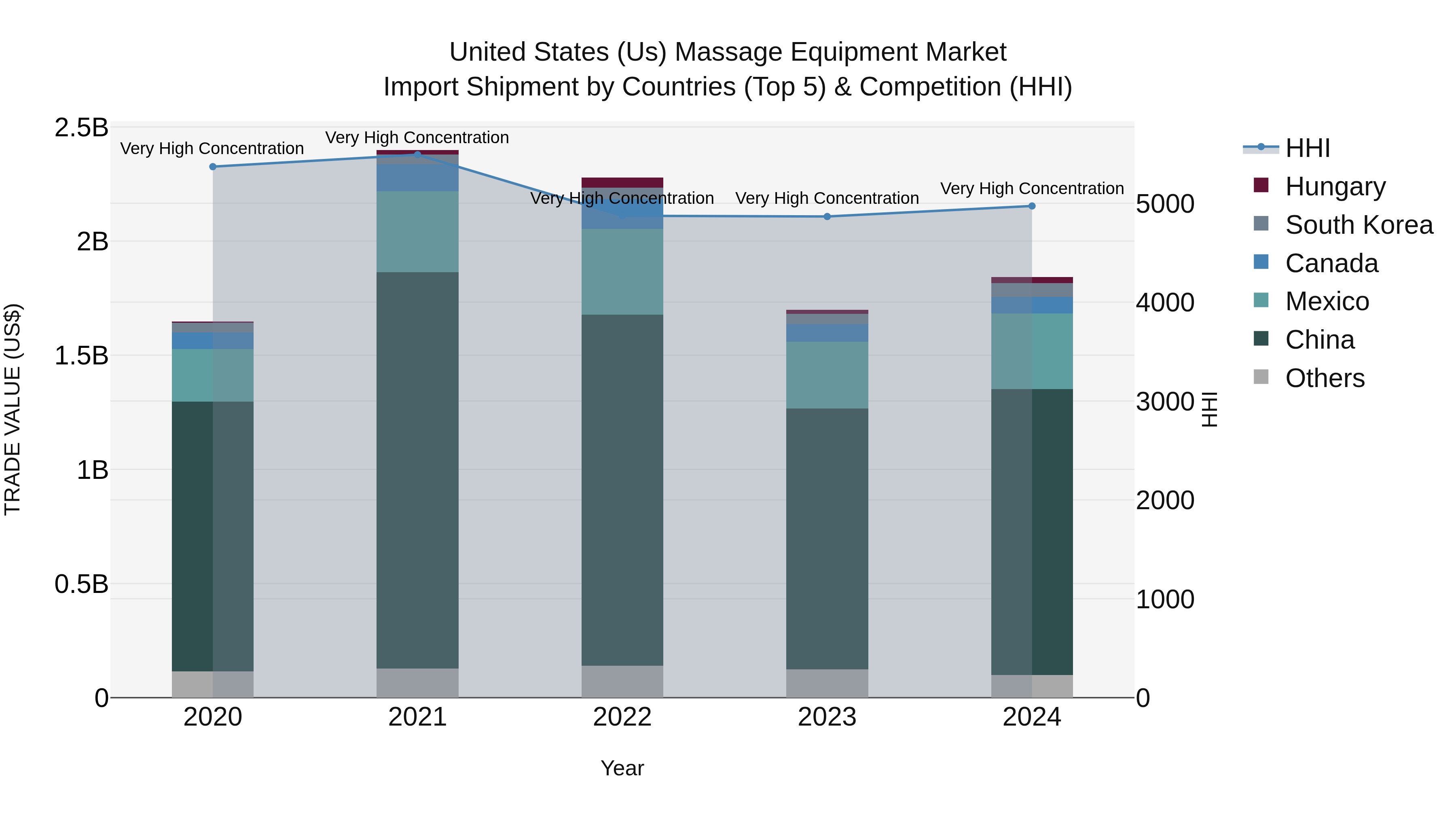
The United States continues to be a key market for massage equipment, with top exporters including China, Mexico, and Canada. The high Herfindahl-Hirschman Index (HHI) indicates a concentrated market in 2024, while the steady Compound Annual Growth Rate (CAGR) of 2.84% reflects a stable trajectory. A notable growth rate of 8.54% from 2023 to 2024 suggests increasing demand for massage equipment in the US market, with countries like South Korea and Hungary also contributing to the import shipments.
US Massage Equipment Market Highlights
| Report Name | US Massage Equipment Market |
| Forecast period | 2025-2031 |
| CAGR | 12.6% |
| Growing Sector | Personal Care |
Topics Covered in the US Massage Equipment Market Report
The US Massage Equipment market report thoroughly covers the market by product, by application and competitive Landscape. The report provides an unbiased and detailed analysis of the on-going market trends, opportunities/high growth areas, and market drivers which would help the stakeholders to devise and align their market strategies according to the current and future market dynamics.
US Massage Equipment Market Synopsis
The US massage equipment market has shown substantial growth over recent years, driven by increasing awareness of the health benefits of massage, the rise of wellness culture, and advancements in technology that have made massage equipment more effective and accessible. This market includes a wide range of products, from traditional massage tables and chairs to innovative gadgets like handheld massagers and high-tech massage guns. Consumers are not only seeking relief from physical ailments but also stress reduction and wellness, fueling demand across both professional and personal use sectors. Additionally, one notable trend in the US massage equipment market is the increasing preference for smart and connected devices. These products, equipped with AI and IoT technologies, offer personalized massage experiences by adapting to the user's preferences and health conditions. Another trend is the growing popularity of portable and compact massage devices, catering to the modern lifestyle of mobility and convenience. Furthermore, there's a surge in the adoption of eco-friendly and sustainable materials in the production of massage equipment, reflecting a broader societal shift towards environmental consciousness. These trends collectively signify a dynamic market poised for further innovation and growth.
According to 6Wresearch, US Massage Equipment market size is projected to grow at a CAGR of 12.6% during 2025-2031. Several growth drivers are propelling the US massage equipment market forward. Firstly, the increasing prevalence of lifestyle diseases, such as chronic back pain and stress-related ailments, has led to a higher demand for massage solutions as individuals seek non-pharmacological methods to manage their health. Secondly, the influence of social media and digital marketing has played a pivotal role in educating consumers about the benefits of regular massage, thereby increasing product accessibility and acceptance.
Additionally, the burgeoning wellness tourism sector, coupled with spa and wellness centers' expansion, has created a significant demand for professional-grade massage equipment. Lastly, corporate wellness programs recognizing the value of massage for employee health and productivity have emerged as a new and robust market segment. These drivers, combined, contribute to the ongoing expansion and diversification of the US massage equipment market.
Government Initiatives Introduced in the US Massage Equipment Market
Government initiatives also play a crucial role in shaping the future of the US massage equipment market. Federal and state regulatory bodies have been increasingly supportive, enacting policies that ensure the safety and efficacy of massage devices. Grants and funding opportunities for research in therapeutic massage methodologies are fostering innovation within the industry. Additionally, public health campaigns aimed at promoting the holistic benefits of massage therapy are contributing to broader consumer awareness and acceptance. Constantly, these actions have boosted the US Massage Equipment Market Share. Additionally, these governmental efforts underscore the importance of massage in public health and wellness, further buoying the market's growth prospects
Key Players in the US Massage Equipment Market
Several key companies are at the forefront of innovation and expansion in the US massage equipment market. Brookstone and Human Touch are recognized for their high-quality massage chairs and gadgets, blending cutting-edge technology with comfort. Osaki is another leader, offering a wide range of premium massage chairs known for their durability and effectiveness. Additionally, Panasonic and Homedics stand out for their diverse offerings, from handheld massagers to elaborate massage seating solutions. Moreover, the businesses’ grasp massive US Massage Equipment Market Revenues. Further, these companies not only drive technological advancements in the sector but also play a vital role in shaping consumer preferences through continuous product development and strategic marketing initiatives.
Future Insights of the US Massage Equipment Market
Looking ahead, the future of the US massage equipment market seems poised for even greater expansion and innovation. With the incorporation of artificial intelligence and machine learning, massage devices are expected to become more personalized, capable of adapting to the specific needs and preferences of users. Wearable massage technology is also on the rise, promising users the convenience of receiving therapeutic treatments on-the-go. Additionally, the integration of virtual reality (VR) into massage therapy sessions is anticipated, potentially offering immersive, stress-relieving experiences. Furthermore, the ongoing pursuit of sustainability and environmentally friendly materials in product manufacturing will likely appeal to the growing segment of eco-conscious consumers. Together, these advancements indicate a vibrant future for the massage equipment industry, characterized by technological progression, sustainability, and enhanced user experiences.
Market Analysis by Product Type
According to Ravi Bhandari, Research Head, 6Wresearch, the massage equipment market is distinguished by a diverse range of products tailored to meet various consumer needs and preferences. This includes Chairs & Sofas, designed with advanced features such as full-body scanning and zero gravity positions for an immersive relaxation experience. Back Massagers cater to those seeking targeted relief in the lumbar region, often equipped with heating functions and adjustable intensity settings. Handheld massagers offer the convenience of portability and are ideal for individuals needing focused treatment on specific body parts. Lastly, Neck & Shoulder massagers are uniquely shaped to wrap around these areas, providing deep kneading massage actions to alleviate tension and improve circulation. These categories collectively represent the extensive options available to consumers, each designed with the intent of delivering therapeutic benefits and enhancing well-being.
Market Analysis by Application
The applications of massage equipment extend across various settings, broadly categorized into Commercial and Home use. Commercial applications encompass spas, hotels, sports facilities, and healthcare centers where massage equipment is used to provide services to customers or assist in therapy and rehabilitation. On the other hand, home applications cater to individuals seeking to incorporate the benefits of massage into their daily routine, whether for relaxation, stress relief, or targeting specific areas of discomfort. Both venues highlight the versatility and growing demand for massage equipment, underlining its role in enhancing health and well-being in diverse environments.
Key Attractiveness of the Report
- 10 Years Market Numbers.
- Historical Data Starting from 2021 to 2024.
- Base Year: 2024.
- Forecast Data until 2031.
- Key Performance Indicators Impacting the Market.
- Major Upcoming Developments and Projects.
Key Highlights of the Report:
- US Massage Equipment Market Overview
- US Massage Equipment Market Outlook
- US Massage Equipment Market Forecast
- Market Size of United States (US) Massage Equipment Market
- Forecast of United States (US) Massage Equipment Market, 2031
- Historical Data and Forecast of United States (US) Massage Equipment Revenues & Volume for the Period 2021-2031
- United States (US) Massage Equipment Market Trend Evolution
- United States (US) Massage Equipment Market Drivers and Challenges
- United States (US) Massage Equipment Price Trends
- United States (US) Massage Equipment Porter's Five Forces
- United States (US) Massage Equipment Industry Life Cycle
- Historical Data and Forecast of United States (US) Massage Equipment Market Revenues & Volume By Product for the Period 2021-2031
- Historical Data and Forecast of United States (US) Massage Equipment Market Revenues & Volume By Chairs & Sofas for the Period 2021-2031
- Historical Data and Forecast of United States (US) Massage Equipment Market Revenues & Volume By Back Massagers for the Period 2021-2031
- Historical Data and Forecast of United States (US) Massage Equipment Market Revenues & Volume By Handheld for the Period 2021-2031
- Historical Data and Forecast of United States (US) Massage Equipment Market Revenues & Volume By Neck & Shoulder for the Period 2021-2031
- Historical Data and Forecast of United States (US) Massage Equipment Market Revenues & Volume By Others for the Period 2021-2031
- Historical Data and Forecast of United States (US) Massage Equipment Market Revenues & Volume, By Application for the Period 2021-2031
- Historical Data and Forecast of United States (US) Massage Equipment Market Revenues & Volume, By Commercial for the Period 2021-2031
- Historical Data and Forecast of United States (US) Massage Equipment Market Revenues & Volume, By Home for the Period 2021-2031
- United States (US) Massage Equipment Import Export Trade Statistics
- Market Opportunity Assessment, By Product
- Market Opportunity Assessment, By Application
- United States (US) Massage Equipment Top Companies Market Share
- United States (US) Massage Equipment Competitive Benchmarking, By Technical and Operational Parameters
- United States (US) Massage Equipment Company Profiles
- United States (US) Massage Equipment Key Strategic Recommendations
Markets Covered
The US Massage Equipment market report provides a detailed analysis of the following market segments:
By Product
- Chairs & Sofas
- Back Massagers
- Handheld
- Neck & Shoulder
- Others
By Application
- Commercial
- Home






































