United States (US) Microprocessor Market Size, Share & Growth Rate
The United States (US) Microprocessor Market was estimated at USD 143 Million in 2025 and is projected to reach USD 168 Million by 2032, growing at a CAGR of 2.3% from 2026 to 2032. This growth trajectory is fueled by the escalating demand for high-performance computing across various sectors, including automotive, healthcare, and consumer electronics. Moreover, the increasing integration of advanced technologies such as artificial intelligence and IoT is propelling the market forward, as businesses seek powerful microprocessors to enhance their operational efficiency.
United States (US) Microprocessor Market Year-wise Growth Rate and Key Drivers
This graph highlights how the United States (US) Microprocessor Market has steadily grown over the years, supported by major growth factors.
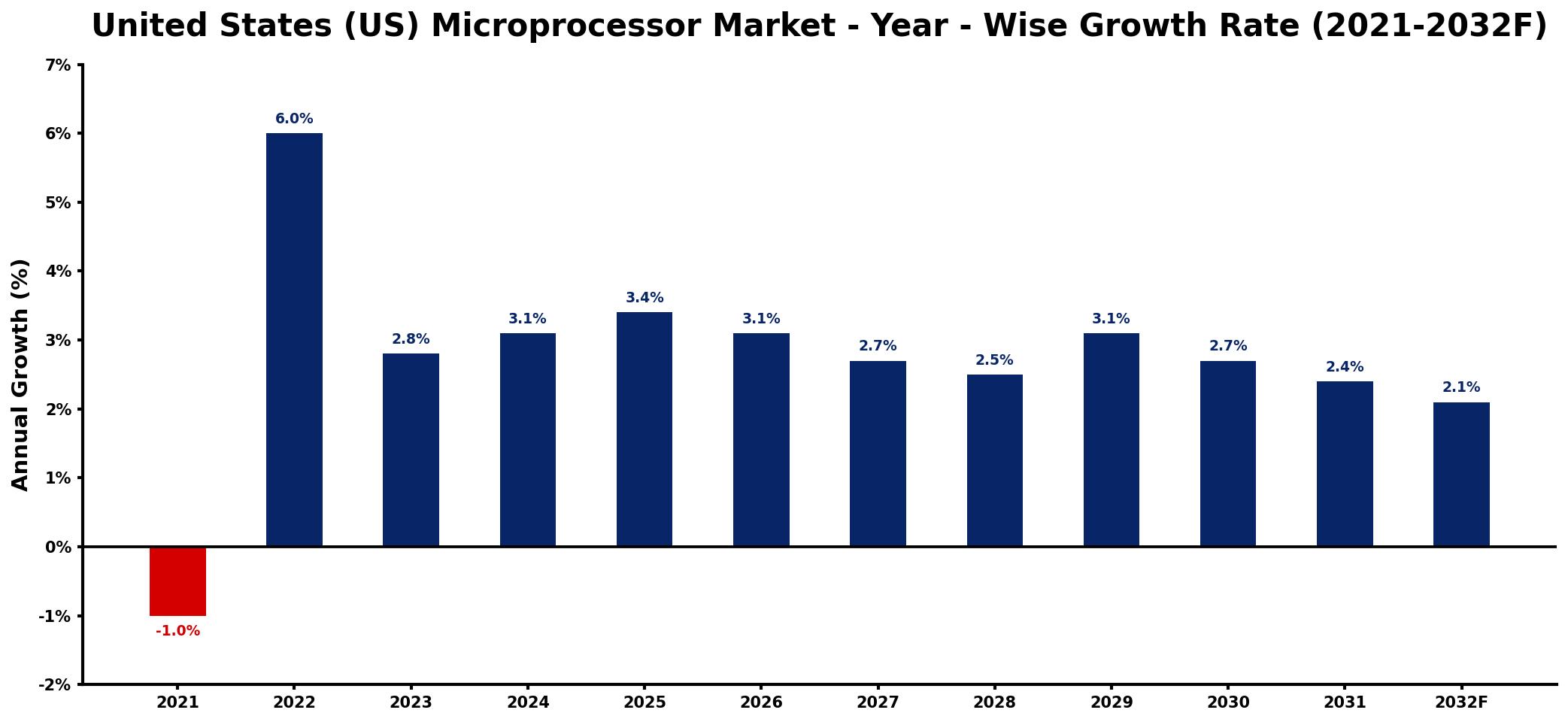
The table below presents the year‑wise growth rates along with the key drivers influencing the market
| Year | Growth Rate | Major Drivers |
| 2021 | -1.0% | Decreased consumer electronics demand |
| 2022 | 6.0% | Increased cloud computing investments |
| 2023 | 2.8% | Growth in AI technology applications |
| 2024 | 3.1% | Expansion of 5G infrastructure projects |
| 2025 | 3.4% | Rise in automotive tech integration |
| 2026 | 3.1% | Surge in data center construction |
| 2027 | 2.7% | expanding industrial usage applications |
| 2028 | 2.5% | Increased demand for IoT devices |
| 2029 | 3.1% | growing emerging market penetration |
| 2030 | 2.7% | rising procurement volume requirements |
| 2031 | 2.4% | increased production capacity utilization |
| 2032 | 2.1% | Increased investments in robotics |
Note: Market size estimations and growth projections presented in this report are based on 6Wresearch's proprietary forecasting methodology, utilizing the latest available industry data, government publications, and primary research inputs.
United States (US) Microprocessor Market Synopsis
The United States microprocessor market is witnessing a significant surge in demand, primarily driven by the rapid proliferation of smart devices and the evolution of cloud computing technologies. As industries pivot towards more efficient and sophisticated computing solutions, the necessity for robust microprocessors capable of handling complex tasks has never been more pronounced.
Simultaneously, the market faces increasing pressures to innovate, as technological advancements shorten product lifecycles and heighten competition among manufacturers. The shift towards energy-efficient processors is particularly noteworthy, reflecting a growing awareness of sustainability and operational cost management in business strategies.
United States (US) Microprocessor Market Key Takeaways
- The market is projected to witness steady growth, driven by advancements in computing technologies.
- Investment opportunities are emerging in sectors such as automotive and healthcare, where high-performance microprocessors are essential.
- Customization and specialization trends are gaining traction, with manufacturers tailoring solutions for specific applications.
- Intellectual property challenges and global trade tensions remain significant concerns for market players.
- Government initiatives are shaping a favorable environment for research and development within the microprocessor landscape.
Evaluation of Restraints in United States (US) Microprocessor Market
Despite the positive outlook, several constraints inhibit the US microprocessor market's growth potential. Chief among these is the intense competitive landscape, which drives a constant need for innovation and adaptation. Rapid technological advancements result in shorter product life cycles, compelling companies to invest heavily in research and development to maintain market relevance. Additionally, issues surrounding intellectual property rights, such as patent infringement, pose significant operational risks, while geopolitical dynamics can further complicate supply chain stability and market access.
United States (US) Microprocessor Market Trends
The microprocessor market is currently witnessing several transformative trends. A notable shift is towards the integration of artificial intelligence within microprocessor architecture, enhancing processing capabilities and enabling smart functionalities. Furthermore, the rise of edge computing is pushing demand for localized processing power, facilitating faster data processing and reduced latency. Additionally, there is a growing emphasis on security features within microprocessors as industries prioritize safeguarding sensitive information against cyber threats.
United States (US) Microprocessor Market Opportunities
The United States microprocessor market presents a plethora of investment opportunities. Sectors such as automotive and healthcare are particularly ripe for growth, as they increasingly rely on high-performance computing for innovations like autonomous vehicles and telemedicine solutions. Moreover, the ongoing expansion of cloud infrastructure and data centers creates a robust demand for specialized server processors. Companies that prioritize energy efficiency and seek to innovate in design and manufacturing processes are likely to attract significant investor interest, given the market's tilt towards sustainability.
Government Initiatives in the United States (US) Microprocessor Market
The US government has enacted various policies aimed at fostering innovation and protecting the microprocessor market. Key initiatives include intellectual property laws that safeguard technological advancements, ensuring a competitive environment for companies. Additionally, public funding programs focus on enhancing research and development efforts within the semiconductor space, driving progress in microprocessor technology. Regulations by entities like the Federal Trade Commission also work to maintain a balanced market structure, preventing monopolistic practices and encouraging fair competition.
Future Insights of the United States (US) Microprocessor Market
Looking ahead to 2026-2032, the US microprocessor market appears poised for substantial evolution. The integration of 5G technology and the Internet of Things is set to amplify the demand for high-performance microprocessors, particularly as smart device proliferation continues. Trends such as increased automation in various industries, along with advancements in machine learning and data analytics, will further propel market growth. However, manufacturers must remain vigilant of potential disruptions stemming from supply chain vulnerabilities and shifting global economic conditions.
United States (US) Microprocessor Market Latest Developments (2025 - 2026)
Recent industry developments signal an evolving landscape for the microprocessor market in the United States. Key players are prioritizing innovations in energy-efficient designs to meet rising sustainability demands. Moreover, collaborations between technology firms and research institutions are increasing, aiming to develop next-generation processors that harness the capabilities of artificial intelligence and edge computing. These collaborations are expected to catalyze further advancements and potentially lead to groundbreaking product launches in the near future.
United States (US) Microprocessor Market - Key Attractiveness of the Report
- 10 Years of Market Numbers
- Historical Data Starting from 2022 to 2025
- Base Year: 2025
- Forecast Data until 2032
- Key Performance Indicators Impacting the Market
- Major Upcoming Developments and Projects
Key Highlights of the Report:
- United States (US) Microprocessor Market Outlook
- Market Size of United States (US) Microprocessor Market, 2025
- Forecast of United States (US) Microprocessor Market, 2032
- Historical Data and Forecast of United States (US) Microprocessor Revenues & Volume for the Period 2022-2032F
- United States (US) Microprocessor Market Trend Evolution
- United States (US) Microprocessor Market Drivers and Challenges
- United States (US) Microprocessor Price Trends
- United States (US) Microprocessor Porter's Five Forces
- United States (US) Microprocessor Industry Life Cycle
- Historical Data and Forecast of United States (US) Microprocessor Market Revenues & Volume By Technology for the Period 2022-2032F
- Historical Data and Forecast of United States (US) Microprocessor Market Revenues & Volume By CISC for the Period 2022-2032F
- Historical Data and Forecast of United States (US) Microprocessor Market Revenues & Volume By RISC for the Period 2022-2032F
- Historical Data and Forecast of United States (US) Microprocessor Market Revenues & Volume By ASIC for the Period 2022-2032F
- Historical Data and Forecast of United States (US) Microprocessor Market Revenues & Volume By Superscalar for the Period 2022-2032F
- Historical Data and Forecast of United States (US) Microprocessor Market Revenues & Volume By DSP for the Period 2022-2032F
- Historical Data and Forecast of United States (US) Microprocessor Market Revenues & Volume By Application for the Period 2022-2032F
- Historical Data and Forecast of United States (US) Microprocessor Market Revenues & Volume By Smartphones for the Period 2022-2032F
- Historical Data and Forecast of United States (US) Microprocessor Market Revenues & Volume By Personal Computers for the Period 2022-2032F
- Historical Data and Forecast of United States (US) Microprocessor Market Revenues & Volume By Servers for the Period 2022-2032F
- Historical Data and Forecast of United States (US) Microprocessor Market Revenues & Volume By Tablets for the Period 2022-2032F
- Historical Data and Forecast of United States (US) Microprocessor Market Revenues & Volume By Embedded Devices for the Period 2022-2032F
- Historical Data and Forecast of United States (US) Microprocessor Market Revenues & Volume By Others for the Period 2022-2032F
- United States (US) Microprocessor Import Export Trade Statistics
- Market Opportunity Assessment By Technology
- Market Opportunity Assessment By Application
- United States (US) Microprocessor Top Companies Market Share
- United States (US) Microprocessor Competitive Benchmarking By Technical and Operational Parameters
- United States (US) Microprocessor Company Profiles
- United States (US) Microprocessor Key Strategic Recommendations






































