United States (US) Military Radar Market Size, Share & Growth Rate
The United States (US) Military Radar Market was estimated at USD 100 Million in 2025 and is projected to reach USD 118 Million by 2032, growing at a CAGR of 2.4% from 2026 to 2032. This growth trajectory is primarily fueled by a robust emphasis on modernizing military capabilities and enhancing surveillance and detection systems. Furthermore, rising geopolitical tensions and an increasing focus on countering new threats are contributing to the heightened demand for advanced radar technologies.
United States (US) Military Radar Market Year-wise Growth Rate and Key Drivers
This graph highlights how the United States (US) Military Radar Market has steadily grown over the years, supported by major growth factors.
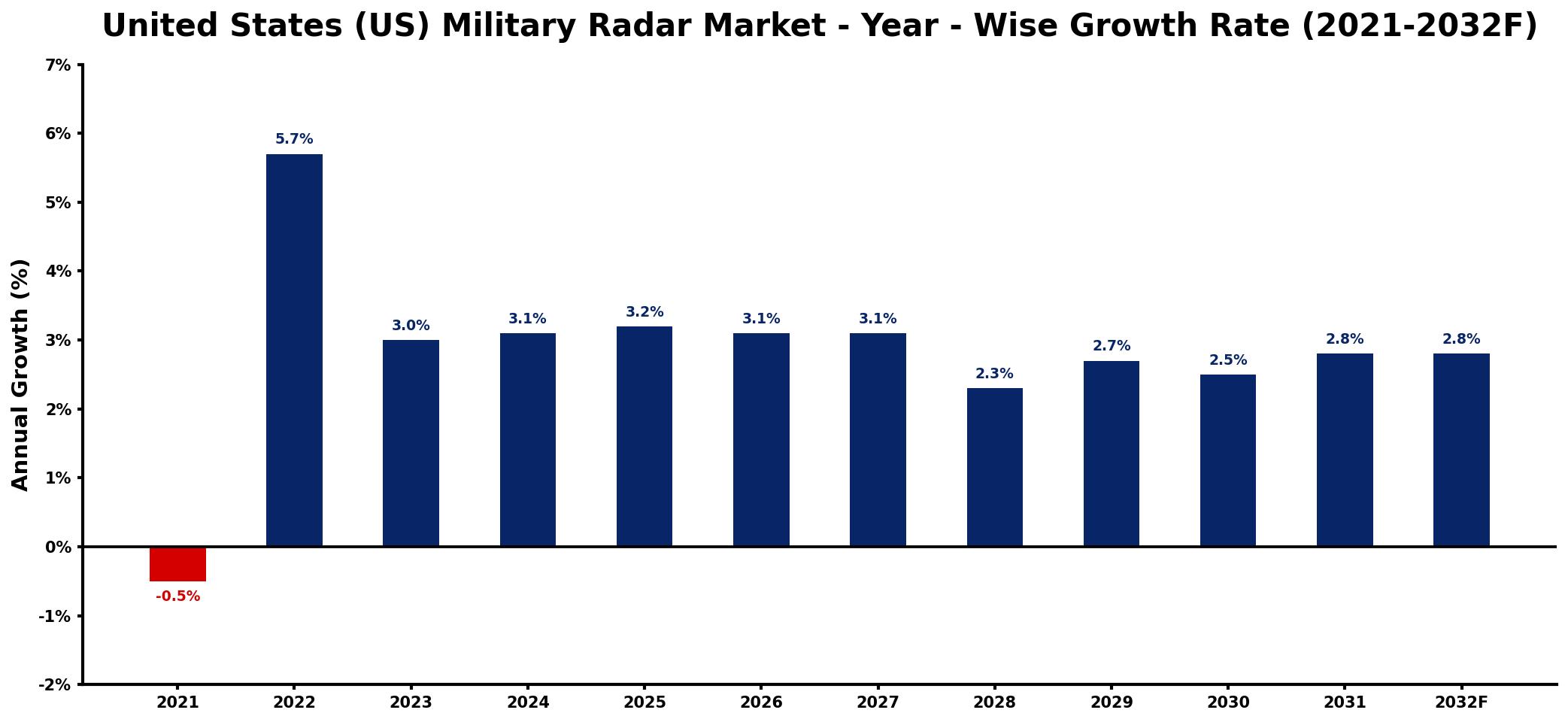
The table below presents the year‑wise growth rates along with the key drivers influencing the market
| Year | Growth Rate | Major Drivers |
| 2021 | -0.5% | Decreased defense budget allocations |
| 2022 | 5.7% | Rising defense expenditures globally |
| 2023 | 3.0% | Increased geopolitical tensions worldwide |
| 2024 | 3.1% | Growing demand for surveillance systems |
| 2025 | 3.2% | Advancements in sensor technologies |
| 2026 | 3.1% | Expansion of defense contracts awarded |
| 2027 | 3.1% | Increased focus on cybersecurity measures |
| 2028 | 2.3% | Emerging technologies adoption accelerates |
| 2029 | 2.7% | Enhanced collaboration with allies |
| 2030 | 2.5% | Strengthening of homeland security initiatives |
| 2031 | 2.8% | Investment in modernization programs |
| 2032 | 2.8% | Focus on multi-domain operations |
Note: Market size estimations and growth projections presented in this report are based on 6Wresearch's proprietary forecasting methodology, utilizing the latest available industry data, government publications, and primary research inputs.
United States (US) Military Radar Market Synopsis
The strongest force currently shaping the United States Military Radar Market is the relentless pursuit of technological superiority. As the US Armed Forces confront a multitude of evolving threats, the necessity for sophisticated radar systems capable of accurate target detection and tracking has never been greater. This demand is driving investments in next-generation radar solutions designed to enhance operational capabilities across various platforms.
Furthermore, the integration of artificial intelligence and machine learning into radar systems is becoming increasingly vital. These technologies not only enhance target identification and classification but also improve operational efficiency, thus solidifying the strategic importance of radar within the broader defense infrastructure.
United States (US) Military Radar Market Key Takeaways
- The market is experiencing significant growth driven by modernization initiatives within the US military.
- Next-generation radar systems are focusing on multifunctional capabilities, enhancing surveillance and defense operations.
- Investments in AI and machine learning technologies are reshaping radar functionality and effectiveness.
- Government policies prioritize interoperability and cybersecurity measures to strengthen radar systems.
- Challenges related to budget constraints and technological complexity remain, influencing market dynamics.
Evaluation of Restraints in United States (US) Military Radar Market
Despite the promising outlook, the United States Military Radar Market faces several restraints that could hinder its progress. One of the most pressing challenges is the rapid pace of technological evolution, which necessitates ongoing investment in innovation to keep pace with emerging threats. Budgetary constraints within the defense sector may further complicate funding allocations for radar programs, limiting the acquisition of new systems. Additionally, the intricacy of modern radar systems demands specialized expertise for operation and maintenance, presenting training and manpower issues for military personnel.
United States (US) Military Radar Market Trends
Current trends indicate a marked shift towards multifunctional radar systems capable of simultaneously executing various operations, such as tracking, surveillance, and missile defense. Another significant trend is the development of radar systems designed to withstand the challenges posed by electronic warfare and cyber threats, ensuring enhanced operational resilience. The ongoing investment in radar modernization programs reflects a commitment to upgrading legacy systems and deploying cutting-edge technologies tailored to meet the evolving landscape of military engagements.
United States (US) Military Radar Market Opportunities
The market presents numerous investment opportunities as demand for advanced radar solutions continues to escalate. Companies engaged in the development and manufacturing of next-generation radar systems, particularly those focused on air defense and intelligence gathering, are well-positioned for growth. Furthermore, investing in research and development initiatives aimed at creating innovative radar technologies can yield substantial returns, aligning with the military's shifting priorities towards enhancing national security capabilities.
Government Initiatives in the United States (US) Military Radar Market
Government policies are instrumental in shaping the United States Military Radar Market, with significant funding allocated for radar system advancements aimed at improving national security. The Department of Defense emphasizes the implementation of innovative radar technologies, such as phased-array radar systems, to enhance detection capabilities and response times. Additionally, there is a strong focus on ensuring interoperability across military branches and allied nations, fostering cooperation in joint operations. Cybersecurity measures are also prioritized to safeguard radar systems against potential vulnerabilities.
Future Insights of the United States (US) Military Radar Market
Looking ahead to 2026-2032, the United States Military Radar Market is anticipated to experience steady growth, fueled by increased defense budgets and heightened technological advancements. The ongoing modernization of military capabilities, particularly in border security and missile defense, will further drive the demand for sophisticated radar systems. As the military continues to prioritize enhancements in situational awareness and response times, the radar sector is poised for innovation and expansion, adapting to meet new challenges as they arise.
United States (US) Military Radar Market Latest Developments (2025 - 2026)
In recent months, the United States Military Radar Market has witnessed a surge in initiatives focused on integrating advanced technologies into radar systems. Companies are increasingly exploring collaborations aimed at enhancing radar resilience to cyber threats and improving operational effectiveness. Efforts to modernize existing radar systems are gaining momentum, reflecting a broader strategy to ensure that the US military remains at the forefront of technological innovation in defense.
United States (US) Military Radar Market - Key Attractiveness of the Report
- 10 Years of Market Numbers
- Historical Data Starting from 2022 to 2025
- Base Year: 2025
- Forecast Data until 2032
- Key Performance Indicators Impacting the Market
- Major Upcoming Developments and Projects
Key Highlights of the Report:
- United States (US) Military Radar Market Outlook
- Market Size of United States (US) Military Radar Market, 2025
- Forecast of United States (US) Military Radar Market, 2032
- Historical Data and Forecast of United States (US) Military Radar Revenues & Volume for the Period 2022-2032F
- United States (US) Military Radar Market Trend Evolution
- United States (US) Military Radar Market Drivers and Challenges
- United States (US) Military Radar Price Trends
- United States (US) Military Radar Porter's Five Forces
- United States (US) Military Radar Industry Life Cycle
- Historical Data and Forecast of United States (US) Military Radar Market Revenues & Volume By Platform for the Period 2022-2032F
- Historical Data and Forecast of United States (US) Military Radar Market Revenues & Volume By Airborne Radar for the Period 2022-2032F
- Historical Data and Forecast of United States (US) Military Radar Market Revenues & Volume By Land Radar for the Period 2022-2032F
- Historical Data and Forecast of United States (US) Military Radar Market Revenues & Volume By Naval Radar for the Period 2022-2032F
- Historical Data and Forecast of United States (US) Military Radar Market Revenues & Volume By Range for the Period 2022-2032F
- Historical Data and Forecast of United States (US) Military Radar Market Revenues & Volume By Long for the Period 2022-2032F
- Historical Data and Forecast of United States (US) Military Radar Market Revenues & Volume By Medium for the Period 2022-2032F
- Historical Data and Forecast of United States (US) Military Radar Market Revenues & Volume By Short for the Period 2022-2032F
- Historical Data and Forecast of United States (US) Military Radar Market Revenues & Volume By Very Short for the Period 2022-2032F
- Historical Data and Forecast of United States (US) Military Radar Market Revenues & Volume By Application for the Period 2022-2032F
- Historical Data and Forecast of United States (US) Military Radar Market Revenues & Volume By Weapon Guidance for the Period 2022-2032F
- Historical Data and Forecast of United States (US) Military Radar Market Revenues & Volume By Airspace Monitoring & Traffic Management for the Period 2022-2032F
- Historical Data and Forecast of United States (US) Military Radar Market Revenues & Volume By Airborne Mapping for the Period 2022-2032F
- Historical Data and Forecast of United States (US) Military Radar Market Revenues & Volume By Ground Surveillance & Intruder Detection for the Period 2022-2032F
- Historical Data and Forecast of United States (US) Military Radar Market Revenues & Volume By Navigation for the Period 2022-2032F
- Historical Data and Forecast of United States (US) Military Radar Market Revenues & Volume By Others for the Period 2022-2032F
- Historical Data and Forecast of United States (US) Military Radar Market Revenues & Volume By Frequency for the Period 2022-2032F
- Historical Data and Forecast of United States (US) Military Radar Market Revenues & Volume By C-Band for the Period 2022-2032F
- Historical Data and Forecast of United States (US) Military Radar Market Revenues & Volume By S-Band for the Period 2022-2032F
- Historical Data and Forecast of United States (US) Military Radar Market Revenues & Volume By X-Band for the Period 2022-2032F
- Historical Data and Forecast of United States (US) Military Radar Market Revenues & Volume By L-Band for the Period 2022-2032F
- Historical Data and Forecast of United States (US) Military Radar Market Revenues & Volume By UHF/VHF for the Period 2022-2032F
- Historical Data and Forecast of United States (US) Military Radar Market Revenues & Volume By Ku/K/Ka-Band for the Period 2022-2032F
- Historical Data and Forecast of United States (US) Military Radar Market Revenues & Volume By Component for the Period 2022-2032F
- Historical Data and Forecast of United States (US) Military Radar Market Revenues & Volume By Transmitter for the Period 2022-2032F
- Historical Data and Forecast of United States (US) Military Radar Market Revenues & Volume By Antenna for the Period 2022-2032F
- Historical Data and Forecast of United States (US) Military Radar Market Revenues & Volume By Receiver for the Period 2022-2032F
- Historical Data and Forecast of United States (US) Military Radar Market Revenues & Volume By Duplexer for the Period 2022-2032F
- Historical Data and Forecast of United States (US) Military Radar Market Revenues & Volume By Others for the Period 2022-2032F
- United States (US) Military Radar Import Export Trade Statistics
- Market Opportunity Assessment By Platform
- Market Opportunity Assessment By Range
- Market Opportunity Assessment By Application
- Market Opportunity Assessment By Frequency
- Market Opportunity Assessment By Component
- United States (US) Military Radar Top Companies Market Share
- United States (US) Military Radar Competitive Benchmarking By Technical and Operational Parameters
- United States (US) Military Radar Company Profiles
- United States (US) Military Radar Key Strategic Recommendations






































