United States (US) Mobile Application Security Market Size & Growth Rate (2026-2032)
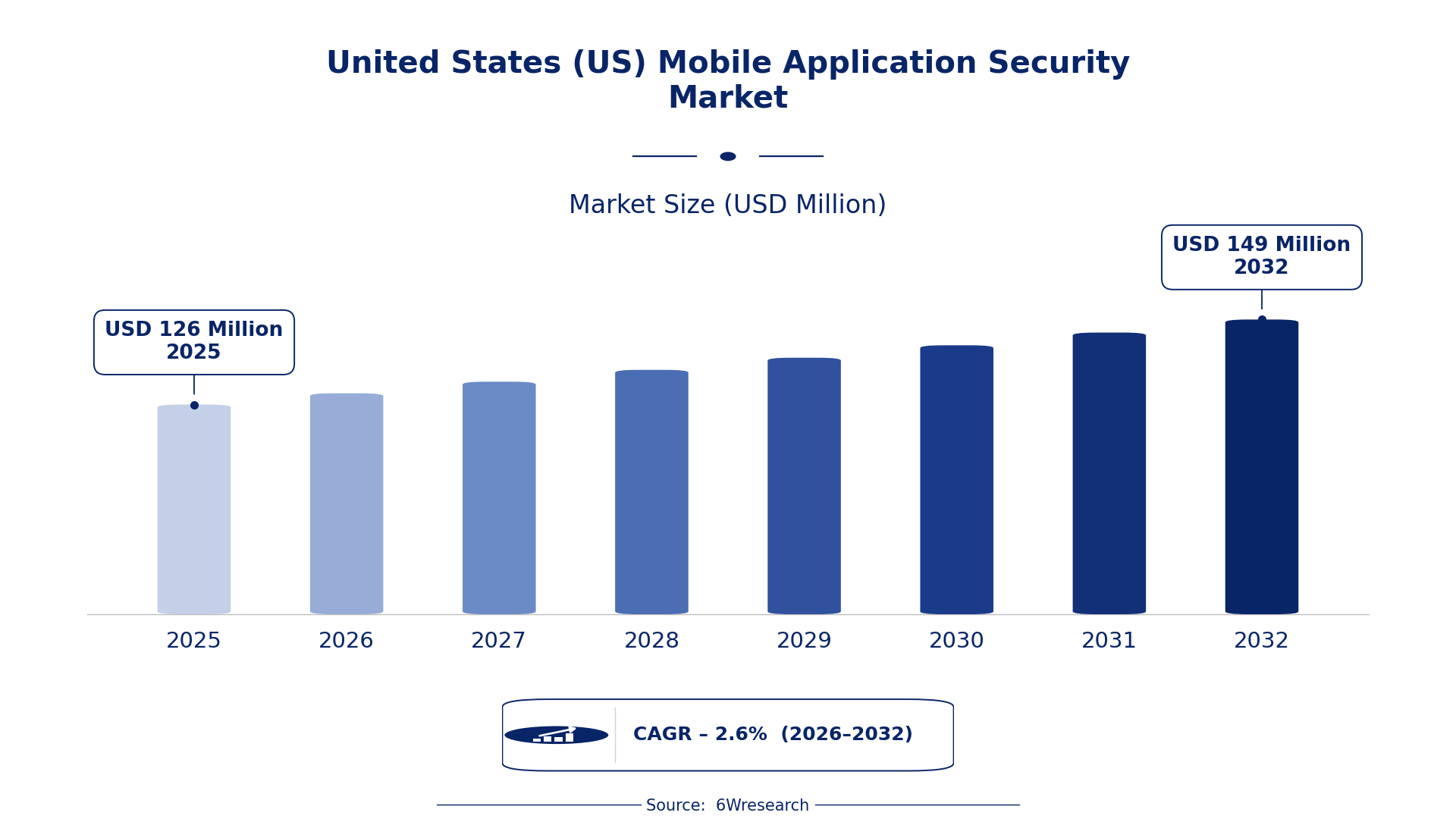
The United States (US) Mobile Application Security Market was estimated at USD 126 Million in 2025 and is projected to reach USD 149 Million by 2032, growing at a CAGR of 2.6% from 2026 to 2032.
United States (US) Mobile Application Security Market Synopsis
The United States Mobile Application Security Market is undergoing remarkable evolution, fueled by the surge in mobile application usage across sectors. With escalating cyber threats, businesses are increasingly channeling resources into securing their mobile platforms, ensuring data integrity, and enhancing user trust.
Looking ahead, this market is set to expand as companies not only prioritize security but also innovate their offerings. The growth trajectory indicates that mobile application security will become an indispensable aspect of digital transformation strategies across industries.
United States (US) Mobile Application Security Market Year-wise Growth Rate and Key Drivers
This graph illustrates the annual growth rates of the United States (US) Mobile Application Security Market from 2021 to 2032, highlighting a steady upward trajectory and projected expansion over the forecast period.
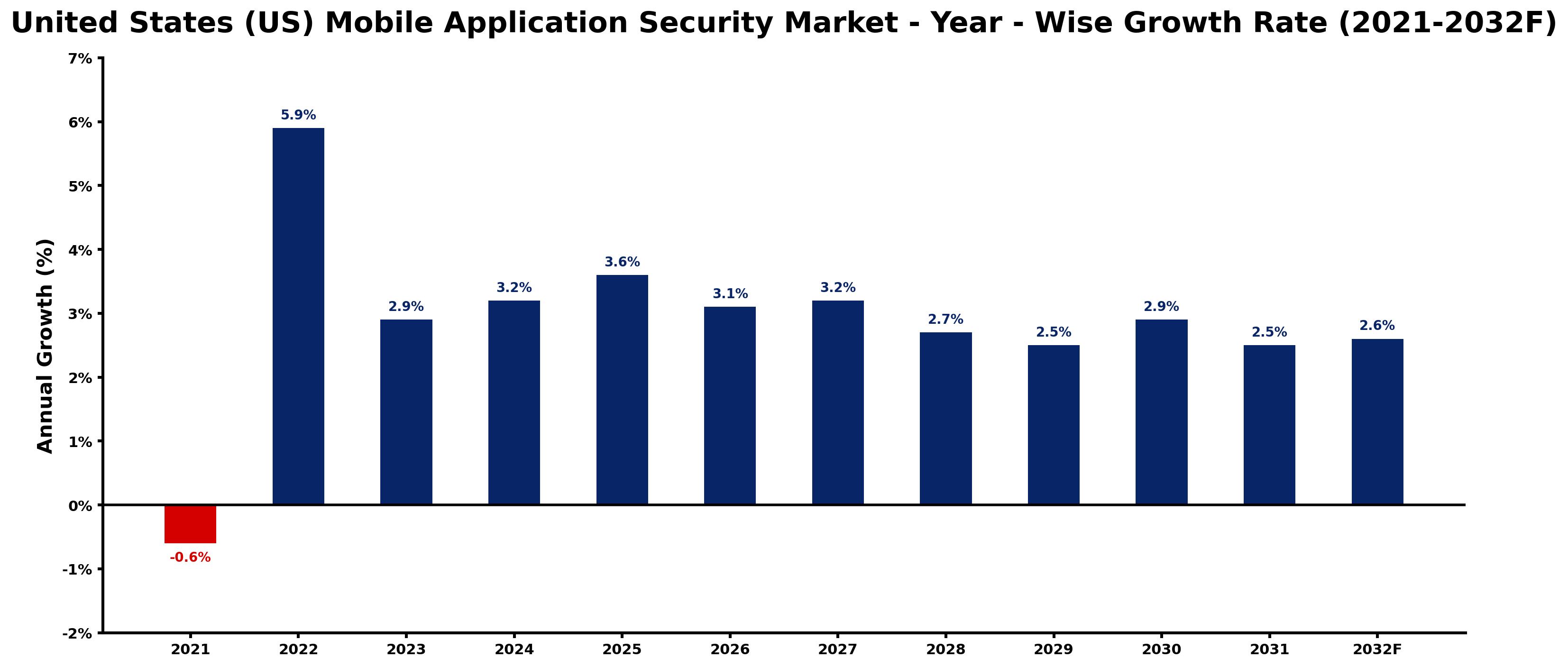
The table below presents the year‑wise growth rates along with the key drivers influencing the market
| Year | Growth Rate | Major Drivers |
| 2021 | -0.6% | Heightened scrutiny from CISA on security standards. |
| 2022 | 5.9% | Federal guidelines mandating stronger app security protocols. |
| 2023 | 2.9% | Increased vulnerabilities due to rise in remote work. |
| 2024 | 3.2% | State regulations enhancing mobile app privacy standards. |
| 2025 | 3.6% | Surge in app-based financial services requiring robust security. |
| 2026 | 3.1% | Adoption of biometric authentication in consumer mobile apps. |
| 2027 | 3.2% | Legislative focus on consumer data protection drives security. |
| 2028 | 2.7% | Public awareness of cyber threats strengthens security investments. |
| 2029 | 2.5% | Increased malware attacks prompt stricter app security measures. |
| 2030 | 2.9% | Collaborations between tech firms to enhance app protection. |
| 2031 | 2.5% | Emergence of new cybersecurity frameworks for app development. |
| 2032 | 2.6% | Focus on patching vulnerabilities in legacy applications. |
Note: Market size estimations and growth projections presented in this report are based on 6Wresearch's proprietary forecasting methodology, utilizing the latest available industry data, government publications, and primary research inputs.
United States (US) Mobile Application Security Market Key Takeaways
Below are some of the specific key takeaways from the market, including:
- Demand for mobile application security solutions is rising due to increased cyber threats targeting sensitive data.
- The shift toward remote work and BYOD practices is amplifying the need for robust mobile security measures.
- Investment opportunities are expanding, particularly in companies providing advanced encryption and threat detection services.
- Adherence to data protection regulations is driving businesses to seek compliance-focused security solutions.
- Government policies are increasingly influencing security practices and standards within the mobile application sector.
Evaluation of Restraints in United States (US) Mobile Application Security Market
Despite its growth potential, the US Mobile Application Security Market faces critical restraints. One of the most pressing is the dynamic nature of cyber threats. As attackers adopt more sophisticated methods, companies struggle to keep pace with the required security measures. on top of that, the diverse range of devices and operating systems complicates the development of universal security solutions. Striking a balance between stringent security protocols and user experience further complicates matters, as excessive security measures can detract from usability, challenging organizations to find a middle ground.
United States (US) Mobile Application Security Market Trends
Several key trends are shaping the US Mobile Application Security Market today. The widespread use of mobile devices for both personal and business activities is driving the demand for secure applications. With the rise of mobile payment systems and increasing regulations on data protection, companies are prioritizing advanced security technologies such as biometric authentication and secure coding practices.
on top of that, the trend of remote work has underscored the importance of mobile security, as employees access sensitive information from various locations. This trend is prompting businesses to adopt comprehensive security frameworks that encompass mobile application protections.
United States (US) Mobile Application Security Market Opportunities
As the reliance on mobile applications grows, so does the opportunity for investment in mobile application security solutions. Companies specializing in app shielding, code obfuscation, and vulnerability testing are well-positioned for growth. The burgeoning fields of mobile banking and e-commerce present fertile ground for developing innovative security measures to protect transactions and user data. With a heightened awareness of cybersecurity risks, the demand for sophisticated mobile application security solutions is expected to rise sharply.
Government Initiatives in the United States (US) Mobile Application Security Market
Government policies are playing a crucial role in shaping the United States Mobile Application Security Market. With a focus on consumer protection and data security, federal regulations are encouraging developers to implement best practices. These policies not only safeguard personal information but also foster a more secure digital environment.
- A recent regulatory framework enacted by the FTC requires mobile app developers to disclose data collection practices, enhancing transparency for users.
- Currently, the NIST is promoting secure coding practices through updated guidelines aimed at improving mobile application security development processes.
- A planned initiative by CISA is set to enhance threat intelligence sharing among mobile application developers, expected to begin in late 2025.
- Ongoing efforts by the Cybersecurity and Infrastructure Security Agency are addressing vulnerabilities in mobile applications through various public awareness campaigns.
- Anticipated updates to data protection regulations in 2026 are expected to reinforce security measures across all mobile application platforms.
Future Insights of the United States (US) Mobile Application Security Market
From 2026 to 2032, the United States Mobile Application Security Market is likely to continue its upward trajectory, bolstered by an increasing reliance on mobile applications. As organizations embrace new technologies like IoT and cloud-based solutions, the demand for comprehensive security measures will intensify. Regulatory pressures and growing cybersecurity awareness will push businesses to invest in cutting-edge security technologies, ensuring that user data remains protected amidst evolving threats.
United States (US) Mobile Application Security Market Latest Developments
Recent developments in the United States Mobile Application Security Market illustrate a landscape focused on innovation and security enhancement. Over the past year, several initiatives and product enhancements have emerged, reflecting the industry's response to evolving threats and regulatory requirements.
- In early 2025, a leading technology vendor launched an advanced encryption solution designed specifically for mobile applications, aimed at protecting user data in transit.
- Currently ongoing is a partnership between several regional firms to develop a comprehensive mobile application security framework that integrates threat detection capabilities.
- A significant service upgrade was announced in mid-2025, enhancing security testing features to better identify vulnerabilities in mobile apps before deployment.
- Looking ahead, a rollout expected in Q3 2026 aims to implement biometric authentication across a range of mobile applications to bolster user access security.
- An initiative currently underway seeks to educate small businesses about mobile application security best practices, enhancing their ability to protect sensitive customer data.
United States (US) Mobile Application Security Market - Key Attractiveness of the Report
- 10 Years of Market Numbers
- Historical Data Starting from 2022 to 2025
- Base Year: 2025
- Forecast Data until 2032
- Key Performance Indicators Impacting the Market
- Major Upcoming Developments and Projects
Key Highlights of the Report:
- United States (US) Mobile Application Security Market Outlook
- Market Size of United States (US) Mobile Application Security Market, 2025
- Forecast of United States (US) Mobile Application Security Market, 2032
- Historical Data and Forecast of United States (US) Mobile Application Security Revenues & Volume for the Period 2022-2032F
- United States (US) Mobile Application Security Market Trend Evolution
- United States (US) Mobile Application Security Market Drivers and Challenges
- United States (US) Mobile Application Security Price Trends
- United States (US) Mobile Application Security Porter's Five Forces
- United States (US) Mobile Application Security Industry Life Cycle
- Historical Data and Forecast of United States (US) Mobile Application Security Market Revenues & Volume By Solution for the Period 2022-2032F
- Historical Data and Forecast of United States (US) Mobile Application Security Market Revenues & Volume By Antivirus & Antitheft for the Period 2022-2032F
- Historical Data and Forecast of United States (US) Mobile Application Security Market Revenues & Volume By Data Recovery for the Period 2022-2032F
- Historical Data and Forecast of United States (US) Mobile Application Security Market Revenues & Volume By Others for the Period 2022-2032F
- Historical Data and Forecast of United States (US) Mobile Application Security Market Revenues & Volume By Deployment Type for the Period 2022-2032F
- Historical Data and Forecast of United States (US) Mobile Application Security Market Revenues & Volume By Cloud for the Period 2022-2032F
- Historical Data and Forecast of United States (US) Mobile Application Security Market Revenues & Volume By On Premise for the Period 2022-2032F
- Historical Data and Forecast of United States (US) Mobile Application Security Market Revenues & Volume By Industry Vertical for the Period 2022-2032F
- Historical Data and Forecast of United States (US) Mobile Application Security Market Revenues & Volume By BFSI for the Period 2022-2032F
- Historical Data and Forecast of United States (US) Mobile Application Security Market Revenues & Volume By Healthcare for the Period 2022-2032F
- Historical Data and Forecast of United States (US) Mobile Application Security Market Revenues & Volume By IT & Telecom for the Period 2022-2032F
- Historical Data and Forecast of United States (US) Mobile Application Security Market Revenues & Volume By Manufacturing for the Period 2022-2032F
- Historical Data and Forecast of United States (US) Mobile Application Security Market Revenues & Volume By Government and Public Sector for the Period 2022-2032F
- Historical Data and Forecast of United States (US) Mobile Application Security Market Revenues & Volume By Retail & E-commerce for the Period 2022-2032F
- Historical Data and Forecast of United States (US) Mobile Application Security Market Revenues & Volume By Others for the Period 2022-2032F
- United States (US) Mobile Application Security Import Export Trade Statistics
- Market Opportunity Assessment By Solution
- Market Opportunity Assessment By Deployment Type
- Market Opportunity Assessment By Industry Vertical
- United States (US) Mobile Application Security Top Companies Market Share
- United States (US) Mobile Application Security Competitive Benchmarking By Technical and Operational Parameters
- United States (US) Mobile Application Security Company Profiles
- United States (US) Mobile Application Security Key Strategic Recommendations






































