United States (US) Mobile Device Management Market Size, Share & Growth Rate
The United States (US) Mobile Device Management Market was estimated at USD 170 Million in 2025 and is projected to reach USD 228 Million by 2032, growing at a CAGR of 4.3% from 2026 to 2032. This robust growth is primarily driven by the rapid escalation of mobile device usage within enterprises, coupled with increasing demands for security and compliance amidst a backdrop of rising cybersecurity threats. The shift to remote work arrangements has further accelerated the need for effective mobile management solutions, positioning MDM as a critical component of organizational strategy.
United States (US) Mobile Device Management Market Year-wise Growth Rate and Key Drivers
This graph highlights how the United States (US) Mobile Device Management Market has steadily grown over the years, supported by major growth factors.
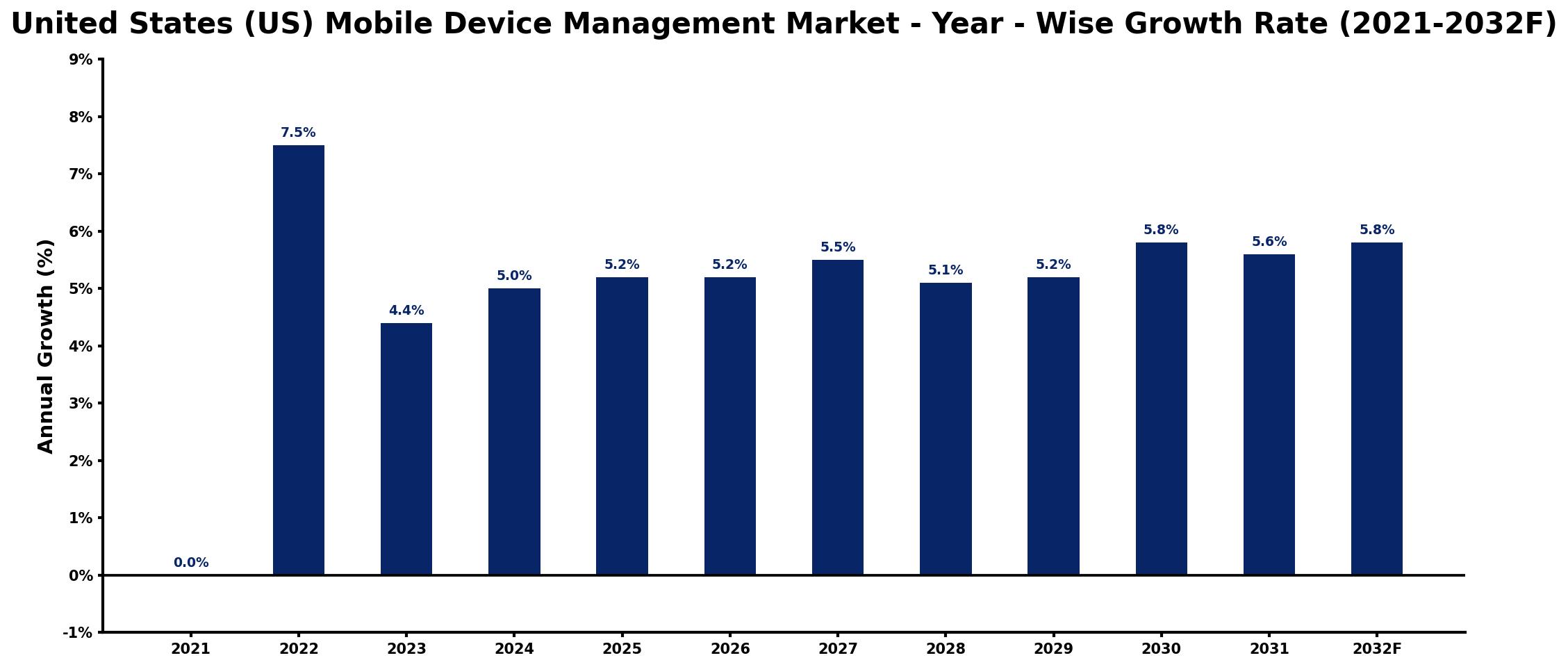
The table below presents the year‑wise growth rates along with the key drivers influencing the market
| Year | Growth Rate | Major Drivers |
| 2021 | 0.0% | Remote work adoption driving demand |
| 2022 | 7.5% | Rising cybersecurity threats increasing investment |
| 2023 | 4.4% | Cloud technology integration expansion |
| 2024 | 5.0% | Increased focus on compliance regulations |
| 2025 | 5.2% | Growing need for data security |
| 2026 | 5.2% | Expansion of IoT applications utilization |
| 2027 | 5.5% | Emergence of 5G networks adoption |
| 2028 | 5.1% | Rise in enterprise mobility solutions |
| 2029 | 5.2% | Cross-industry collaboration boosting innovation |
| 2030 | 5.8% | Focus on workforce productivity enhancements |
| 2031 | 5.6% | Investment in digital transformation initiatives |
| 2032 | 5.8% | rising infrastructure development spending |
Note: Market size estimations and growth projections presented in this report are based on 6Wresearch's proprietary forecasting methodology, utilizing the latest available industry data, government publications, and primary research inputs.
United States (US) Mobile Device Management Market Synopsis
The demand for Mobile Device Management (MDM) solutions in the United States is underscored by the growing trend of Bring Your Own Device (BYOD) policies. As more employees utilize personal devices for work, organizations are compelled to implement robust MDM systems to maintain data security and operational efficiency. This shift not only supports employee flexibility but also raises significant concerns regarding data protection and compliance.
In this competitive landscape, MDM providers are increasingly focusing on cloud-based solutions that offer scalability and flexibility, allowing businesses to manage a wide array of devices from a single platform. With an emphasis on application management and security features powered by artificial intelligence, the market is evolving rapidly to meet the complex needs of modern workplaces.
United States (US) Mobile Device Management Market Key Takeaways
- The MDM market in the US is driven by the rise of mobile device usage in corporate environments.
- Compliance with data protection regulations is a major factor influencing MDM investments.
- Cloud-based solutions are becoming increasingly popular due to their scalability and flexibility.
- Integration of AI and machine learning technologies is enhancing security features within MDM solutions.
- Organizations are focusing on user experience to increase productivity through effective mobile application management.
Evaluation of Restraints in United States (US) Mobile Device Management Market
Despite the positive growth trajectory, the US Mobile Device Management market faces significant challenges. The rapid evolution of mobile technology requires MDM solutions to undergo constant updates to remain effective against emerging threats. Moreover, the diverse array of devices and operating systems used in corporate settings complicates the management process. Organizations must also navigate the delicate balance between maintaining employee privacy and ensuring robust security, making comprehensive MDM strategies essential for success.
United States (US) Mobile Device Management Market Trends
Several notable trends are shaping the US Mobile Device Management market. A pronounced shift towards cloud-based MDM solutions reflects a desire for flexibility and ease of integration across different platforms. Furthermore, artificial intelligence and machine learning are being leveraged to improve security features, such as threat detection and automated compliance reporting. Additionally, the demand for unified endpoint management is rising, enabling organizations to manage various types of devices seamlessly, thereby enhancing operational efficiency.
United States (US) Mobile Device Management Market Opportunities
The US Mobile Device Management market is ripe with investment opportunities, particularly as businesses increasingly recognize the necessity for secure and efficient device management solutions. Companies focused on developing innovative MDM software, consulting services, and tailored security solutions will likely see substantial growth. Moreover, advancements in AI and machine learning present opportunities for creating cutting-edge solutions that address contemporary security challenges and improve user experience.
Government Initiatives in the United States (US) Mobile Device Management Market
Government policies have a significant influence on the Mobile Device Management market, particularly regarding data security and privacy. Regulations such as HIPAA and FISMA dictate stringent requirements that MDM providers must meet to safeguard sensitive data. Additionally, the increasing prevalence of BYOD trends has prompted the government to introduce guidelines aimed at managing personal devices used for work, further underscoring the importance of compliance for MDM providers seeking to engage with government entities.
Future Insights of the United States (US) Mobile Device Management Market
The future of the US Mobile Device Management Market appears promising, characterized by continued growth driven by the escalating adoption of mobile devices across diverse industries. As the shift towards remote work and BYOD policies remains prominent, organizations will prioritize MDM solutions that enhance security and compliance. Additionally, technological advancements such as the IoT and 5G connectivity will further energize the market, creating a demand for comprehensive MDM solutions tailored to manage the growing complexity of mobile ecosystems.
United States (US) Mobile Device Management Market Latest Developments (2025 - 2026)
Recent developments in the US Mobile Device Management market reflect a surge in interest from enterprises seeking to enhance their mobile security frameworks. As organizations adapt to a rapidly changing technological landscape, there has been a notable increase in partnerships aimed at integrating advanced security features into MDM solutions. Additionally, several companies are investing heavily in research and development to advance their offerings, focusing on user-centric solutions that streamline device management while ensuring robust data protection.
United States (US) Mobile Device Management Market - Key Attractiveness of the Report
- 10 Years of Market Numbers
- Historical Data Starting from 2022 to 2025
- Base Year: 2025
- Forecast Data until 2032
- Key Performance Indicators Impacting the Market
- Major Upcoming Developments and Projects
Key Highlights of the Report:
- United States (US) Mobile Device Management Market Outlook
- Market Size of United States (US) Mobile Device Management Market, 2025
- Forecast of United States (US) Mobile Device Management Market, 2032
- Historical Data and Forecast of United States (US) Mobile Device Management Revenues & Volume for the Period 2022-2032F
- United States (US) Mobile Device Management Market Trend Evolution
- United States (US) Mobile Device Management Market Drivers and Challenges
- United States (US) Mobile Device Management Price Trends
- United States (US) Mobile Device Management Porter's Five Forces
- United States (US) Mobile Device Management Industry Life Cycle
- Historical Data and Forecast of United States (US) Mobile Device Management Market Revenues & Volume By Component for the Period 2022-2032F
- Historical Data and Forecast of United States (US) Mobile Device Management Market Revenues & Volume By Solution (Device management, Application Management, Security Management, Other solutions) for the Period 2022-2032F
- Historical Data and Forecast of United States (US) Mobile Device Management Market Revenues & Volume By Services (Professional services, Managed services) for the Period 2022-2032F
- Historical Data and Forecast of United States (US) Mobile Device Management Market Revenues & Volume By Deployment Mode for the Period 2022-2032F
- Historical Data and Forecast of United States (US) Mobile Device Management Market Revenues & Volume By On-Premises for the Period 2022-2032F
- Historical Data and Forecast of United States (US) Mobile Device Management Market Revenues & Volume By Cloud for the Period 2022-2032F
- Historical Data and Forecast of United States (US) Mobile Device Management Market Revenues & Volume By Operating System for the Period 2022-2032F
- Historical Data and Forecast of United States (US) Mobile Device Management Market Revenues & Volume By iOS for the Period 2022-2032F
- Historical Data and Forecast of United States (US) Mobile Device Management Market Revenues & Volume By Android for the Period 2022-2032F
- Historical Data and Forecast of United States (US) Mobile Device Management Market Revenues & Volume By Windows for the Period 2022-2032F
- Historical Data and Forecast of United States (US) Mobile Device Management Market Revenues & Volume By MacOS for the Period 2022-2032F
- Historical Data and Forecast of United States (US) Mobile Device Management Market Revenues & Volume By Other Operating systems for the Period 2022-2032F
- Historical Data and Forecast of United States (US) Mobile Device Management Market Revenues & Volume By Organisation Size for the Period 2022-2032F
- Historical Data and Forecast of United States (US) Mobile Device Management Market Revenues & Volume By Small and Medium Enterprises for the Period 2022-2032F
- Historical Data and Forecast of United States (US) Mobile Device Management Market Revenues & Volume By Large Enterprises for the Period 2022-2032F
- Historical Data and Forecast of United States (US) Mobile Device Management Market Revenues & Volume By Vertical for the Period 2022-2032F
- Historical Data and Forecast of United States (US) Mobile Device Management Market Revenues & Volume By Banking, Financial Services and Insurance for the Period 2022-2032F
- Historical Data and Forecast of United States (US) Mobile Device Management Market Revenues & Volume By Telecom for the Period 2022-2032F
- Historical Data and Forecast of United States (US) Mobile Device Management Market Revenues & Volume By Retail for the Period 2022-2032F
- Historical Data and Forecast of United States (US) Mobile Device Management Market Revenues & Volume By Healthcare for the Period 2022-2032F
- Historical Data and Forecast of United States (US) Mobile Device Management Market Revenues & Volume By Education for the Period 2022-2032F
- Historical Data and Forecast of United States (US) Mobile Device Management Market Revenues & Volume By Transport and Logistics for the Period 2022-2032F
- Historical Data and Forecast of United States (US) Mobile Device Management Market Revenues & Volume By Government and Public Sector for the Period 2022-2032F
- Historical Data and Forecast of United States (US) Mobile Device Management Market Revenues & Volume By Manufacturing and Automotive for the Period 2022-2032F
- United States (US) Mobile Device Management Import Export Trade Statistics
- Market Opportunity Assessment By Component
- Market Opportunity Assessment By Deployment Mode
- Market Opportunity Assessment By Operating System
- Market Opportunity Assessment By Organisation Size
- Market Opportunity Assessment By Vertical
- United States (US) Mobile Device Management Top Companies Market Share
- United States (US) Mobile Device Management Competitive Benchmarking By Technical and Operational Parameters
- United States (US) Mobile Device Management Company Profiles
- United States (US) Mobile Device Management Key Strategic Recommendations






































