United States (US) Natural Food Colors Market (2025-2031) | Outlook, Trends, Growth, Value, Competitive Landscape, Companies, Analysis, Size & Revenue, Segmentation, Share, Forecast, Industry
Market Forecast By Product (Carotenoids, Curcumin, Carmine, Copper Chlorophyllin, Others), By Application (Bakery & Confectionery, Beverages, Diary & Frozen Products, Meat Products, Oil & Fat, Others) And Competitive Landscape
| Product Code: ETC9971191 | Publication Date: Sep 2024 | Updated Date: Nov 2025 | Product Type: Market Research Report | |
| Publisher: 6Wresearch | Author: Shubham Padhi | No. of Pages: 75 | No. of Figures: 35 | No. of Tables: 20 |
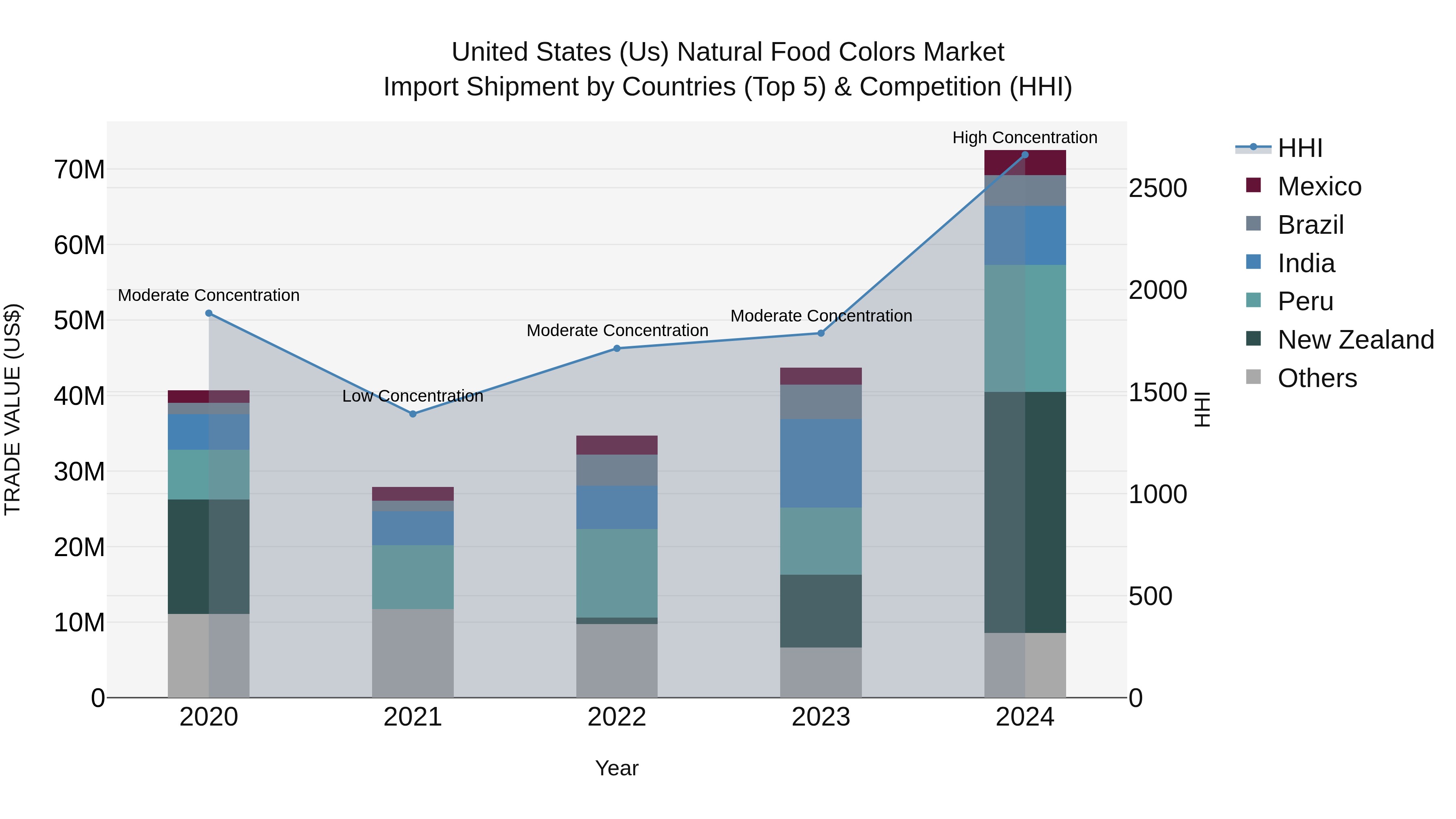
United States (US) Natural Food Colors Market Top 5 Importing Countries and Market Competition (HHI) Analysis
The United States witnessed a significant increase in natural food colors import shipments in 2024, with top exporting countries including New Zealand, Peru, India, Brazil, and Mexico. The market concentration, as measured by the HHI, shifted from moderate to high concentration within a year, indicating a more competitive landscape. The impressive compound annual growth rate (CAGR) of 15.53% from 2020 to 2024 demonstrates sustained market expansion. Moreover, the remarkable growth rate of 65.97% from 2023 to 2024 highlights the accelerating demand for natural food colors in the US market.
United States (US) Natural Food Colors Market Synopsis
The United States natural food colors market is experiencing steady growth driven by increasing consumer demand for clean-label and natural food products. The market is witnessing a shift towards natural ingredients due to rising health concerns and awareness about the potential risks associated with synthetic food colors. Key players in the market are focusing on product innovation and expanding their product portfolios to cater to the diverse requirements of food and beverage manufacturers. The market is characterized by a high level of competition, with companies investing in research and development to enhance the quality and efficacy of natural food colors. Growing adoption of natural food colors in various applications such as beverages, confectionery, bakery products, and dairy is expected to further drive market growth in the coming years.
United States (US) Natural Food Colors Market Trends
The US Natural Food Colors Market is experiencing significant growth driven by increasing consumer demand for clean label products and natural ingredients. Key trends include the rising popularity of plant-based and organic food colors, as well as the growing awareness of the health benefits associated with natural food colors. Opportunities in the market lie in the development of innovative and sustainable natural color solutions, such as those derived from fruits, vegetables, and other plant sources. Manufacturers are also exploring advanced technologies to enhance the stability and vibrancy of natural colors in various food and beverage applications. With consumers becoming more conscious of their food choices, the US Natural Food Colors Market presents a promising landscape for companies to capitalize on the shift towards clean, natural, and sustainable ingredients.
United States (US) Natural Food Colors Market Challenges
In the US Natural Food Colors Market, some of the key challenges faced include regulatory hurdles related to the approval of natural colorants, as the process can be time-consuming and costly. Additionally, sourcing high-quality natural ingredients at a consistent and competitive price can be challenging due to factors such as weather conditions affecting crop yields. Manufacturers also face the challenge of achieving vibrant and stable colors in their products using natural sources, as synthetic colors often provide more intensity and consistency. Consumer demand for clean label products further adds pressure on companies to use natural food colors, driving the need for innovation and investment in research and development. Overall, navigating these challenges requires strategic planning, strong supplier relationships, and a deep understanding of market trends and consumer preferences.
United States (US) Natural Food Colors Market Investment Opportunities
The United States natural food colors market is primarily driven by the increasing consumer preference for clean-label and natural ingredients in food products. Growing awareness about the potential health risks associated with synthetic food colors has led to a shift towards natural alternatives. Additionally, the rising demand for organic and non-GMO products further fuels the market growth for natural food colors. Manufacturers are also focusing on innovation and product development to offer a wider range of natural color options to cater to diverse consumer preferences. Government regulations promoting the use of natural ingredients in food products also play a significant role in driving the market. Overall, the trend towards healthier and more sustainable food choices is a key driver of the natural food colors market in the US.
United States (US) Natural Food Colors Market Government Polices
The US government has regulations in place regarding natural food colors used in the market. The Food and Drug Administration (FDA) approves natural color additives for use in food products based on safety assessments. These additives must be derived from natural sources and must be labeled accurately on food packaging. The FDA also monitors the use of color additives to ensure they meet safety standards and do not pose health risks to consumers. Additionally, the US Department of Agriculture (USDA) provides organic certification for natural food colors sourced from organic materials, ensuring compliance with organic standards. Overall, government policies aim to ensure the safety and transparency of natural food colors in the US market, providing consumers with confidence in the products they purchase.
United States (US) Natural Food Colors Market Future Outlook
The United States Natural Food Colors Market is projected to experience significant growth in the coming years due to increasing consumer awareness of health and wellness, growing demand for clean label products, and the shift towards natural and organic ingredients in the food and beverage industry. The market is expected to be driven by factors such as rising disposable incomes, changing dietary preferences, and stringent regulations on synthetic food colors. Manufacturers are likely to focus on developing innovative natural color solutions derived from fruits, vegetables, and plants to meet the rising demand for clean and transparent labeling. With consumers seeking healthier and more sustainable food options, the US Natural Food Colors Market is poised for steady expansion and opportunities for market players to capitalize on the growing trend towards natural ingredients.
Key Highlights of the Report:
- United States (US) Natural Food Colors Market Outlook
- Market Size of United States (US) Natural Food Colors Market, 2024
- Forecast of United States (US) Natural Food Colors Market, 2031
- Historical Data and Forecast of United States (US) Natural Food Colors Revenues & Volume for the Period 2021- 2031
- United States (US) Natural Food Colors Market Trend Evolution
- United States (US) Natural Food Colors Market Drivers and Challenges
- United States (US) Natural Food Colors Price Trends
- United States (US) Natural Food Colors Porter's Five Forces
- United States (US) Natural Food Colors Industry Life Cycle
- Historical Data and Forecast of United States (US) Natural Food Colors Market Revenues & Volume By Product for the Period 2021- 2031
- Historical Data and Forecast of United States (US) Natural Food Colors Market Revenues & Volume By Carotenoids for the Period 2021- 2031
- Historical Data and Forecast of United States (US) Natural Food Colors Market Revenues & Volume By Curcumin for the Period 2021- 2031
- Historical Data and Forecast of United States (US) Natural Food Colors Market Revenues & Volume By Carmine for the Period 2021- 2031
- Historical Data and Forecast of United States (US) Natural Food Colors Market Revenues & Volume By Copper Chlorophyllin for the Period 2021- 2031
- Historical Data and Forecast of United States (US) Natural Food Colors Market Revenues & Volume By Others for the Period 2021- 2031
- Historical Data and Forecast of United States (US) Natural Food Colors Market Revenues & Volume By Application for the Period 2021- 2031
- Historical Data and Forecast of United States (US) Natural Food Colors Market Revenues & Volume By Bakery & Confectionery for the Period 2021- 2031
- Historical Data and Forecast of United States (US) Natural Food Colors Market Revenues & Volume By Beverages for the Period 2021- 2031
- Historical Data and Forecast of United States (US) Natural Food Colors Market Revenues & Volume By Diary & Frozen Products for the Period 2021- 2031
- Historical Data and Forecast of United States (US) Natural Food Colors Market Revenues & Volume By Meat Products for the Period 2021- 2031
- Historical Data and Forecast of United States (US) Natural Food Colors Market Revenues & Volume By Oil & Fat for the Period 2021- 2031
- Historical Data and Forecast of United States (US) Natural Food Colors Market Revenues & Volume By Others for the Period 2021- 2031
- United States (US) Natural Food Colors Import Export Trade Statistics
- Market Opportunity Assessment By Product
- Market Opportunity Assessment By Application
- United States (US) Natural Food Colors Top Companies Market Share
- United States (US) Natural Food Colors Competitive Benchmarking By Technical and Operational Parameters
- United States (US) Natural Food Colors Company Profiles
- United States (US) Natural Food Colors Key Strategic Recommendations
Frequently Asked Questions About the Market Study (FAQs):
6Wresearch actively monitors the United States (US) Natural Food Colors Market and publishes its comprehensive annual report, highlighting emerging trends, growth drivers, revenue analysis, and forecast outlook. Our insights help businesses to make data-backed strategic decisions with ongoing market dynamics. Our analysts track relevent industries related to the United States (US) Natural Food Colors Market, allowing our clients with actionable intelligence and reliable forecasts tailored to emerging regional needs.
Yes, we provide customisation as per your requirements. To learn more, feel free to contact us on sales@6wresearch.com
1 Executive Summary |
2 Introduction |
2.1 Key Highlights of the Report |
2.2 Report Description |
2.3 Market Scope & Segmentation |
2.4 Research Methodology |
2.5 Assumptions |
3 United States (US) Natural Food Colors Market Overview |
3.1 United States (US) Country Macro Economic Indicators |
3.2 United States (US) Natural Food Colors Market Revenues & Volume, 2021 & 2031F |
3.3 United States (US) Natural Food Colors Market - Industry Life Cycle |
3.4 United States (US) Natural Food Colors Market - Porter's Five Forces |
3.5 United States (US) Natural Food Colors Market Revenues & Volume Share, By Product, 2021 & 2031F |
3.6 United States (US) Natural Food Colors Market Revenues & Volume Share, By Application, 2021 & 2031F |
4 United States (US) Natural Food Colors Market Dynamics |
4.1 Impact Analysis |
4.2 Market Drivers |
4.2.1 Increasing consumer awareness about health and wellness benefits of natural food colors |
4.2.2 Growing demand for clean label and organic food products |
4.2.3 Rising preference for plant-based and vegan food options |
4.3 Market Restraints |
4.3.1 High production costs of natural food colors compared to synthetic alternatives |
4.3.2 Limited availability and sourcing challenges for some natural color ingredients |
4.3.3 Regulatory restrictions and approval processes for natural food colorants |
5 United States (US) Natural Food Colors Market Trends |
6 United States (US) Natural Food Colors Market, By Types |
6.1 United States (US) Natural Food Colors Market, By Product |
6.1.1 Overview and Analysis |
6.1.2 United States (US) Natural Food Colors Market Revenues & Volume, By Product, 2021- 2031F |
6.1.3 United States (US) Natural Food Colors Market Revenues & Volume, By Carotenoids, 2021- 2031F |
6.1.4 United States (US) Natural Food Colors Market Revenues & Volume, By Curcumin, 2021- 2031F |
6.1.5 United States (US) Natural Food Colors Market Revenues & Volume, By Carmine, 2021- 2031F |
6.1.6 United States (US) Natural Food Colors Market Revenues & Volume, By Copper Chlorophyllin, 2021- 2031F |
6.1.7 United States (US) Natural Food Colors Market Revenues & Volume, By Others, 2021- 2031F |
6.2 United States (US) Natural Food Colors Market, By Application |
6.2.1 Overview and Analysis |
6.2.2 United States (US) Natural Food Colors Market Revenues & Volume, By Bakery & Confectionery, 2021- 2031F |
6.2.3 United States (US) Natural Food Colors Market Revenues & Volume, By Beverages, 2021- 2031F |
6.2.4 United States (US) Natural Food Colors Market Revenues & Volume, By Diary & Frozen Products, 2021- 2031F |
6.2.5 United States (US) Natural Food Colors Market Revenues & Volume, By Meat Products, 2021- 2031F |
6.2.6 United States (US) Natural Food Colors Market Revenues & Volume, By Oil & Fat, 2021- 2031F |
6.2.7 United States (US) Natural Food Colors Market Revenues & Volume, By Others, 2021- 2031F |
7 United States (US) Natural Food Colors Market Import-Export Trade Statistics |
7.1 United States (US) Natural Food Colors Market Export to Major Countries |
7.2 United States (US) Natural Food Colors Market Imports from Major Countries |
8 United States (US) Natural Food Colors Market Key Performance Indicators |
8.1 Consumer adoption rate of products featuring natural food colors |
8.2 Number of new product launches with natural food colors |
8.3 Market penetration of natural food colors in various food and beverage categories |
9 United States (US) Natural Food Colors Market - Opportunity Assessment |
9.1 United States (US) Natural Food Colors Market Opportunity Assessment, By Product, 2021 & 2031F |
9.2 United States (US) Natural Food Colors Market Opportunity Assessment, By Application, 2021 & 2031F |
10 United States (US) Natural Food Colors Market - Competitive Landscape |
10.1 United States (US) Natural Food Colors Market Revenue Share, By Companies, 2024 |
10.2 United States (US) Natural Food Colors Market Competitive Benchmarking, By Operating and Technical Parameters |
11 Company Profiles |
12 Recommendations |
13 Disclaimer |
Pricing
- Single User License$ 1,995
- Department License$ 2,400
- Site License$ 3,120
- Global License$ 3,795

Search
Thought Leadership and Analyst Meet





Our Clients








Related Reports
- Germany Breakfast Food Market (2026-2032) | Industry, Share, Growth, Size, Companies, Value, Analysis, Revenue, Trends, Forecast & Outlook
- Australia Briquette Market (2025-2031) | Growth, Size, Revenue, Forecast, Analysis, Trends, Value, Share, Industry & Companies
- Vietnam System Integrator Market (2025-2031) | Size, Companies, Analysis, Industry, Value, Forecast, Growth, Trends, Revenue & Share
- ASEAN and Thailand Brain Health Supplements Market (2025-2031) | Strategy, Consumer Insights, Analysis, Investment Trends, Opportunities, Growth, Size, Share, Industry, Revenue, Segments, Value, Segmentation, Supply, Forecast, Restraints, Outlook, Competition, Drivers, Trends, Demand, Pricing Analysis, Competitive, Strategic Insights, Companies, Challenges
- ASEAN Bearings Market (2025-2031) | Strategy, Consumer Insights, Analysis, Investment Trends, Opportunities, Growth, Size, Share, Industry, Revenue, Segments, Value, Segmentation, Supply, Forecast, Restraints, Outlook, Competition, Drivers, Trends, Demand, Pricing Analysis, Competitive, Strategic Insights, Companies, Challenges
- Europe Flooring Market (2025-2031) | Outlook, Share, Industry, Trends, Forecast, Companies, Revenue, Size, Analysis, Growth & Value
- Saudi Arabia Manlift Market (2025-2031) | Outlook, Size, Growth, Trends, Companies, Industry, Revenue, Value, Share, Forecast & Analysis
- Uganda Excavator, Crane, and Wheel Loaders Market (2025-2031) | Strategy, Consumer Insights, Analysis, Investment Trends, Opportunities, Growth, Size, Share, Industry, Revenue, Segments, Value, Segmentation, Supply, Forecast, Restraints, Outlook, Competition, Drivers, Trends, Demand, Pricing Analysis, Competitive, Strategic Insights, Companies, Challenges
- Rwanda Excavator, Crane, and Wheel Loaders Market (2025-2031) | Strategy, Consumer Insights, Analysis, Investment Trends, Opportunities, Growth, Size, Share, Industry, Revenue, Segments, Value, Segmentation, Supply, Forecast, Restraints, Outlook, Competition, Drivers, Trends, Demand, Pricing Analysis, Competitive, Strategic Insights, Companies, Challenges
- Kenya Excavator, Crane, and Wheel Loaders Market (2025-2031) | Strategy, Consumer Insights, Analysis, Investment Trends, Opportunities, Growth, Size, Share, Industry, Revenue, Segments, Value, Segmentation, Supply, Forecast, Restraints, Outlook, Competition, Drivers, Trends, Demand, Pricing Analysis, Competitive, Strategic Insights, Companies, Challenges
Industry Events and Analyst Meet

Startup Hub Expo 2025

Automechanika Dubai 2024

Mobile India Expo 2025

Media Expo New Delhi 2025

Consumer Electronics World Expo 2025
Whitepaper
- Middle East & Africa Commercial Security Market Click here to view more.
- Middle East & Africa Fire Safety Systems & Equipment Market Click here to view more.
- GCC Drone Market Click here to view more.
- Middle East Lighting Fixture Market Click here to view more.
- GCC Physical & Perimeter Security Market Click here to view more.
6WResearch In News
- Doha a strategic location for EV manufacturing hub: IPA Qatar
- Demand for luxury TVs surging in the GCC, says Samsung
- Empowering Growth: The Thriving Journey of Bangladesh’s Cable Industry
- Demand for luxury TVs surging in the GCC, says Samsung
- Video call with a traditional healer? Once unthinkable, it’s now common in South Africa
- Intelligent Buildings To Smooth GCC’s Path To Net Zero


