United States (US) Ornamental Fish Market Size, Share & Growth Rate
The United States (US) Ornamental Fish Market was estimated at USD 172 Million in 2025 and is projected to reach USD 202 Million by 2032, growing at a CAGR of 2.3% from 2026 to 2032. This growth trajectory is largely fueled by a surge in pet ownership, particularly among millennials, and a heightened interest in aquascaping as both a hobby and an art form. Consumers increasingly seek unique and exotic fish species, which further drives demand across retail channels.
United States (US) Ornamental Fish Market Year-wise Growth Rate and Key Drivers
This graph highlights how the United States (US) Ornamental Fish Market has steadily grown over the years, supported by major growth factors.
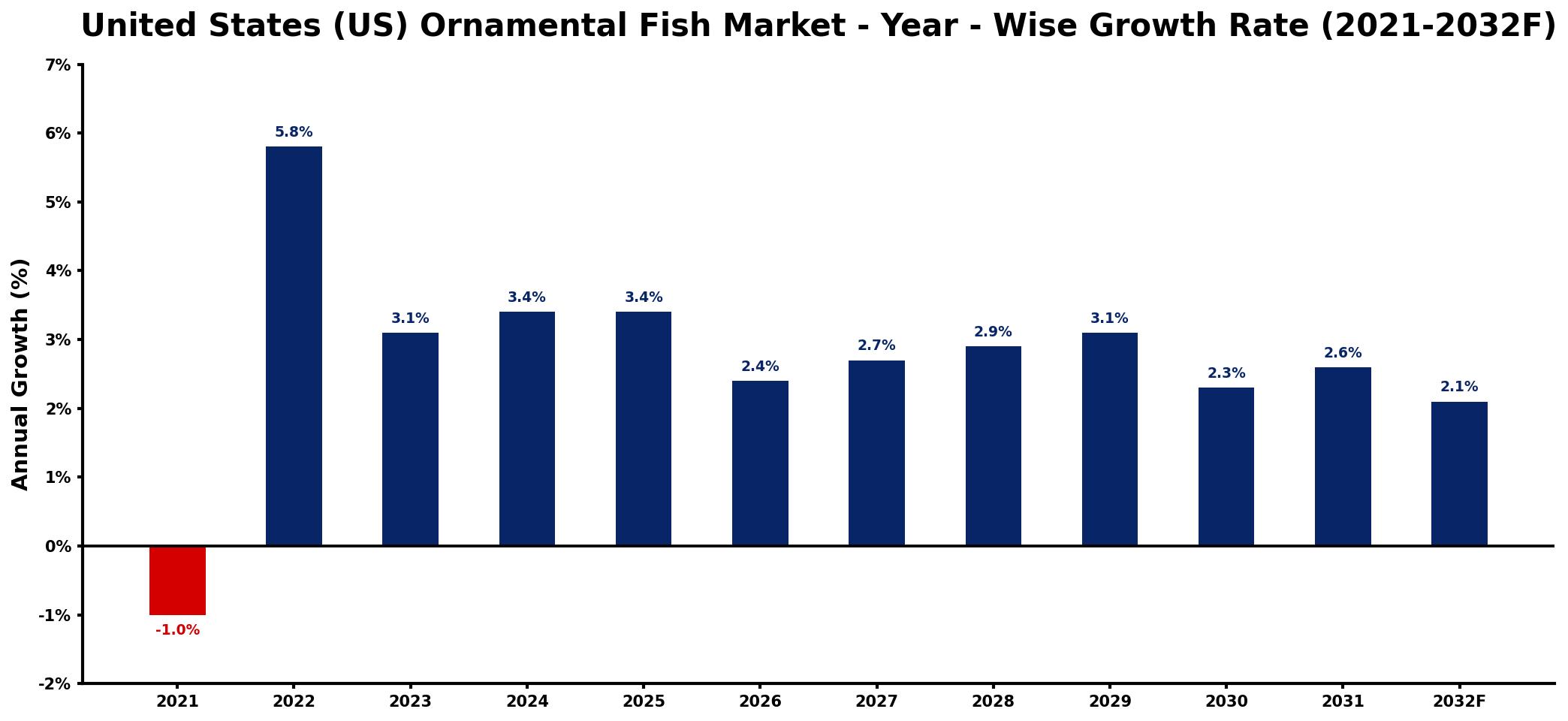
The table below presents the year‑wise growth rates along with the key drivers influencing the market
| Year | Growth Rate | Major Drivers |
| 2021 | -1.0% | Supply chain disruptions impact availability |
| 2022 | 5.8% | Increased consumer interest in aquariums |
| 2023 | 3.1% | Rise in home decor investments |
| 2024 | 3.4% | Growth in eco-friendly practices |
| 2025 | 3.4% | Expansion of online retail platforms |
| 2026 | 2.4% | Increase in urban gardening trends |
| 2027 | 2.7% | Surge in pet ownership rates |
| 2028 | 2.9% | Development of innovative aquarium technologies |
| 2029 | 3.1% | Higher disposable income among consumers |
| 2030 | 2.3% | rising export shipment volumes |
| 2031 | 2.6% | Rising popularity of DIY projects |
| 2032 | 2.1% | Emphasis on sustainable living practices |
Note: Market size estimations and growth projections presented in this report are based on 6Wresearch's proprietary forecasting methodology, utilizing the latest available industry data, government publications, and primary research inputs.
United States (US) Ornamental Fish Market Synopsis
Sustainability practices are currently the most significant force shaping the United States (US) Ornamental Fish Market. As consumers become more aware of environmental issues, they are prioritizing ethically sourced fish and eco-friendly products, prompting suppliers to adopt responsible sourcing practices.
Additionally, technological advancements in aquarium systems are enhancing the overall consumer experience, allowing for more complex aquatic ecosystems. The convenience of online sales is also a major driver, as e-commerce platforms provide easy access to diverse fish species and aquaculture supplies, appealing to both seasoned enthusiasts and newcomers.
United States (US) Ornamental Fish Market Key Takeaways
- The market is experiencing a notable shift towards sustainable practices and ethical sourcing.
- Customization and personalization of aquarium setups are increasingly in demand.
- Online sales channels are expanding, providing greater accessibility for consumers.
- Unique and exotic species are driving growth in consumer interest and purchasing behavior.
- Regulatory frameworks are evolving, affecting the importation and trade of certain fish species.
Evaluation of Restraints in United States (US) Ornamental Fish Market
Despite the promising outlook, the United States (US) Ornamental Fish Market faces several restraints that could hinder growth. Concerns surrounding the sustainability of wild-caught fish and the environmental implications of the aquarium industry are becoming increasingly prominent. Regulatory challenges, such as compliance with the Endangered Species Act and import restrictions, further complicate market dynamics. Moreover, fluctuating consumer demand driven by economic conditions can impact sales, emphasizing the need for businesses to remain agile and responsive to market trends.
United States (US) Ornamental Fish Market Trends
Current trends in the United States (US) Ornamental Fish Market include a strong emphasis on sustainability and responsible pet ownership. Consumers are increasingly attracted to rare and exotic fish, spurred by social media influencers showcasing stunning aquarium designs. Additionally, advancements in aquarium technology, such as automated water quality monitoring systems, are enhancing the care and maintenance of ornamental fish. As customers seek more personalized experiences, retailers are also offering customizable products that cater to individual preferences.
United States (US) Ornamental Fish Market Opportunities
The US ornamental fish market presents abundant investment opportunities across various sectors. Breeding facilities focusing on unique species and sustainable practices are particularly appealing, as the demand for eco-friendly options continues to rise. E-commerce platforms are also a lucrative avenue for reaching wider audiences, especially with the increase in online shopping habits. Additionally, innovations in aquarium technology, such as smart systems that facilitate easier fish care, are poised to attract investment and drive growth in this dynamic market.
Government Initiatives in the United States (US) Ornamental Fish Market
Government policies surrounding the United States (US) Ornamental Fish Market are primarily focused on regulating the importation and transportation of fish species. The US Fish and Wildlife Service oversees compliance with the Lacey Act, which aims to prevent the introduction of injurious species. Additionally, laws under the Endangered Species Act provide essential protections for threatened species that may be popular in the ornamental fish trade. These regulatory frameworks are designed to promote sustainability while allowing for a healthy market environment.
Future Insights of the United States (US) Ornamental Fish Market
Looking ahead to 2026-2032, the future of the United States (US) Ornamental Fish Market appears robust. The increasing popularity of aquarium hobbies, fueled by rising disposable incomes and greater consumer awareness of the therapeutic benefits of keeping fish, is likely to sustain market growth. Moreover, the integration of advanced technology in fish care and habitat maintenance is expected to diversify the range of fish species available. However, businesses must navigate regulatory challenges and evolving consumer preferences to seize growth opportunities effectively.
United States (US) Ornamental Fish Market Latest Developments (2025 - 2026)
Recent developments in the US ornamental fish market indicate a strong push towards adopting sustainable practices and enhancing consumer education. Industry stakeholders are increasingly engaging in initiatives that promote responsible sourcing and care for ornamental fish. Additionally, new online platforms are emerging, providing greater access to a broader range of exotic species while ensuring compliance with regulatory requirements. This shift towards sustainability and technology-driven solutions reflects the changing landscape of the market.
United States (US) Ornamental Fish Market - Key Attractiveness of the Report
- 10 Years of Market Numbers
- Historical Data Starting from 2022 to 2025
- Base Year: 2025
- Forecast Data until 2032
- Key Performance Indicators Impacting the Market
- Major Upcoming Developments and Projects
Key Highlights of the Report:
- United States (US) Ornamental Fish Market Outlook
- Market Size of United States (US) Ornamental Fish Market, 2025
- Forecast of United States (US) Ornamental Fish Market, 2032
- Historical Data and Forecast of United States (US) Ornamental Fish Revenues & Volume for the Period 2022-2032F
- United States (US) Ornamental Fish Market Trend Evolution
- United States (US) Ornamental Fish Market Drivers and Challenges
- United States (US) Ornamental Fish Price Trends
- United States (US) Ornamental Fish Porter's Five Forces
- United States (US) Ornamental Fish Industry Life Cycle
- Historical Data and Forecast of United States (US) Ornamental Fish Market Revenues & Volume By Product for the Period 2022-2032F
- Historical Data and Forecast of United States (US) Ornamental Fish Market Revenues & Volume By Tropical Freshwater for the Period 2022-2032F
- Historical Data and Forecast of United States (US) Ornamental Fish Market Revenues & Volume By Temperate for the Period 2022-2032F
- Historical Data and Forecast of United States (US) Ornamental Fish Market Revenues & Volume By Marine for the Period 2022-2032F
- Historical Data and Forecast of United States (US) Ornamental Fish Market Revenues & Volume By Application for the Period 2022-2032F
- Historical Data and Forecast of United States (US) Ornamental Fish Market Revenues & Volume By Commercial for the Period 2022-2032F
- Historical Data and Forecast of United States (US) Ornamental Fish Market Revenues & Volume By Household for the Period 2022-2032F
- United States (US) Ornamental Fish Import Export Trade Statistics
- Market Opportunity Assessment By Product
- Market Opportunity Assessment By Application
- United States (US) Ornamental Fish Top Companies Market Share
- United States (US) Ornamental Fish Competitive Benchmarking By Technical and Operational Parameters
- United States (US) Ornamental Fish Company Profiles
- United States (US) Ornamental Fish Key Strategic Recommendations






































