United States (US) Oven Market Top 5 Importing Countries and Market Competition (HHI) Analysis
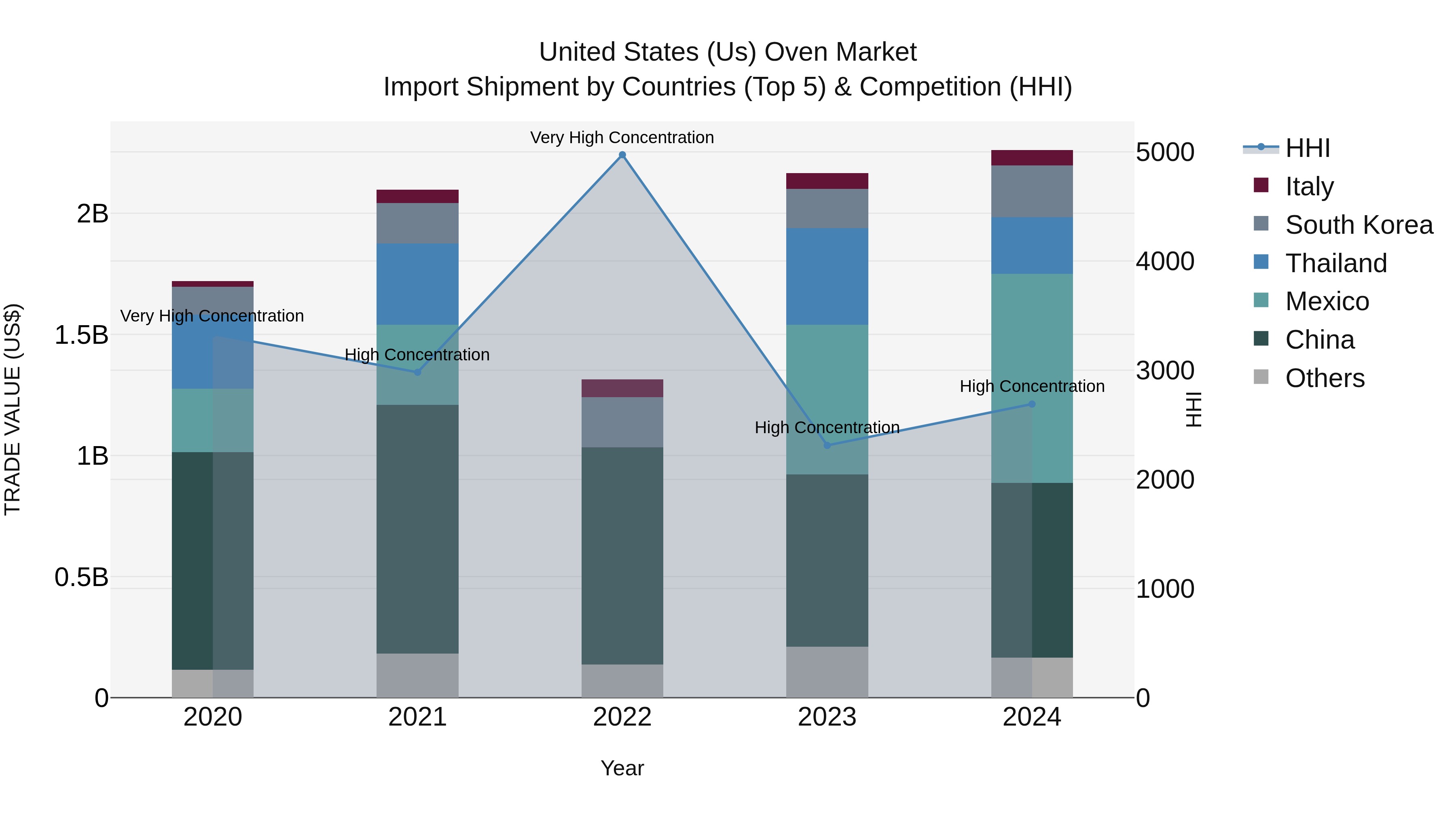
The United States continues to be a key destination for oven imports, with top exporting countries in 2024 including Mexico, China, Thailand, South Korea, and Italy. The market shows high concentration with a high HHI in 2024, indicating a competitive landscape dominated by these key players. The sector has demonstrated steady growth with a CAGR of 7.08% from 2020 to 2024, and a growth rate of 4.38% in 2024 alone. This data suggests a robust demand for imported ovens in the US market, driven by a variety of factors including technological advancements and consumer preferences.
United States (US) Oven Market Overview
The United States oven market is a mature and highly competitive industry driven by factors such as technological advancements, changing consumer preferences, and the growing trend towards smart home appliances. Key players in the market include Whirlpool Corporation, General Electric, Samsung Electronics, and LG Electronics. The market is segmented into different types of ovens such as gas, electric, convection, and microwave ovens, catering to a wide range of customer needs and preferences. Consumers are increasingly looking for energy-efficient and multifunctional ovens that offer convenience and advanced features. With the rise of online shopping and e-commerce platforms, the distribution channels for ovens have expanded, providing consumers with more options to choose from. Overall, the US oven market is expected to continue its steady growth trajectory, driven by innovation and evolving consumer lifestyles.
United States (US) Oven Market Trends and Opportunities
The US Oven Market is experiencing a shift towards smart and connected appliances, with consumers increasingly seeking convenience and efficiency in their cooking experience. Smart ovens that offer features like remote control, recipe suggestions, and cooking notifications are gaining popularity. Additionally, there is a growing demand for energy-efficient ovens that help reduce electricity consumption and operating costs. Consumers are also showing interest in versatile ovens that offer multiple cooking functions, such as convection, steam, and air frying. Manufacturers have opportunities to innovate in terms of design, technology, and sustainability to meet these evolving consumer preferences. With the continued emphasis on healthy eating and home cooking, there is potential for growth in the market for ovens that cater to these trends, such as those with specific cooking modes for healthier food preparation.
United States (US) Oven Market Challenges
In the US oven market, challenges are primarily driven by evolving consumer preferences and technological advancements. Consumers are increasingly seeking energy-efficient and smart appliances, which require manufacturers to invest in research and development to meet these demands. Additionally, the market is highly competitive, with both domestic and international players vying for market share. This competition puts pressure on manufacturers to differentiate their products through innovative features, designs, and pricing strategies. Moreover, economic fluctuations and regulatory changes can impact consumer spending and influence purchasing decisions, adding another layer of complexity to the market landscape. To succeed in the US oven market, manufacturers must stay attuned to consumer trends, invest in innovation, and adapt quickly to changing market conditions.
United States (US) Oven Market Drivers
The United States oven market is being driven by several key factors. One of the primary drivers is the increasing demand for energy-efficient and technologically advanced ovens that offer convenience and enhanced cooking capabilities. Consumers are seeking appliances that can save time and energy while providing consistent and high-quality cooking results. Additionally, the growing trend of home cooking and baking, especially during the COVID-19 pandemic, has boosted the demand for ovens as more people are spending time at home. Furthermore, the influence of design trends and the desire for stylish and modern kitchens have also contributed to the growth of the oven market in the US. Overall, a combination of factors such as convenience, technology, lifestyle changes, and design preferences are fueling the expansion of the US oven market.
United States (US) Oven Market Government Policy
The government policies related to the US Oven Market primarily focus on safety regulations, energy efficiency standards, and environmental considerations. The US Department of Energy regulates the energy efficiency of ovens through programs like Energy Star, which sets voluntary guidelines for manufacturers to meet. Additionally, the US Consumer Product Safety Commission oversees safety standards to ensure that ovens are safe for consumer use. Environmental regulations, such as those related to emissions and waste disposal, also impact oven manufacturers. Overall, these government policies aim to promote the production and use of ovens that are both safe for consumers and environmentally friendly, while also encouraging energy efficiency in the market.
United States (US) Oven Market Future Outlook
The future outlook for the United States Oven Market appears positive, driven by factors such as technological advancements, changing consumer preferences, and increasing demand for energy-efficient appliances. With the rise of smart home technology, ovens are expected to become more connected and user-friendly, offering features like remote control and automation. Additionally, as consumers become more health-conscious, there is a growing demand for ovens that promote healthier cooking methods such as steam ovens and air fryer ovens. The market is also likely to see a surge in demand for energy-efficient ovens as environmental sustainability becomes a priority for consumers. Overall, the US Oven Market is expected to experience steady growth and innovation in the coming years.
Key Highlights of the Report:
- United States (US) Oven Market Outlook
- Market Size of United States (US) Oven Market, 2024
- Forecast of United States (US) Oven Market, 2031
- Historical Data and Forecast of United States (US) Oven Revenues & Volume for the Period 2021- 2031
- United States (US) Oven Market Trend Evolution
- United States (US) Oven Market Drivers and Challenges
- United States (US) Oven Price Trends
- United States (US) Oven Porter's Five Forces
- United States (US) Oven Industry Life Cycle
- Historical Data and Forecast of United States (US) Oven Market Revenues & Volume By Type for the Period 2021- 2031
- Historical Data and Forecast of United States (US) Oven Market Revenues & Volume By Convection for the Period 2021- 2031
- Historical Data and Forecast of United States (US) Oven Market Revenues & Volume By Grill for the Period 2021- 2031
- Historical Data and Forecast of United States (US) Oven Market Revenues & Volume By Solo for the Period 2021- 2031
- Historical Data and Forecast of United States (US) Oven Market Revenues & Volume By Distribution Channel for the Period 2021- 2031
- Historical Data and Forecast of United States (US) Oven Market Revenues & Volume By Multi-brand Stores for the Period 2021- 2031
- Historical Data and Forecast of United States (US) Oven Market Revenues & Volume By Exclusive Stores for the Period 2021- 2031
- Historical Data and Forecast of United States (US) Oven Market Revenues & Volume By E-commerce for the Period 2021- 2031
- Historical Data and Forecast of United States (US) Oven Market Revenues & Volume By Other Distribution Channels for the Period 2021- 2031
- Historical Data and Forecast of United States (US) Oven Market Revenues & Volume By Structure for the Period 2021- 2031
- Historical Data and Forecast of United States (US) Oven Market Revenues & Volume By Built-in for the Period 2021- 2031
- Historical Data and Forecast of United States (US) Oven Market Revenues & Volume By Countertop for the Period 2021- 2031
- Historical Data and Forecast of United States (US) Oven Market Revenues & Volume By End Users for the Period 2021- 2031
- Historical Data and Forecast of United States (US) Oven Market Revenues & Volume By Residential for the Period 2021- 2031
- Historical Data and Forecast of United States (US) Oven Market Revenues & Volume By Commercial for the Period 2021- 2031
- United States (US) Oven Import Export Trade Statistics
- Market Opportunity Assessment By Type
- Market Opportunity Assessment By Distribution Channel
- Market Opportunity Assessment By Structure
- Market Opportunity Assessment By End Users
- United States (US) Oven Top Companies Market Share
- United States (US) Oven Competitive Benchmarking By Technical and Operational Parameters
- United States (US) Oven Company Profiles
- United States (US) Oven Key Strategic Recommendations






































