United States (US) Panty Liner Market (2025-2031) | Trends, Forecast, Companies, Analysis, Growth, Value, Share, Industry, Segmentation, Size & Revenue, Competitive Landscape, Outlook
Market Forecast By Product Type (Scented, Unscented), By Category (Organic, Non-organic) And Competitive Landscape
| Product Code: ETC9972812 | Publication Date: Sep 2024 | Updated Date: Nov 2025 | Product Type: Market Research Report | |
| Publisher: 6Wresearch | Author: Dhaval Chaurasia | No. of Pages: 75 | No. of Figures: 35 | No. of Tables: 20 |
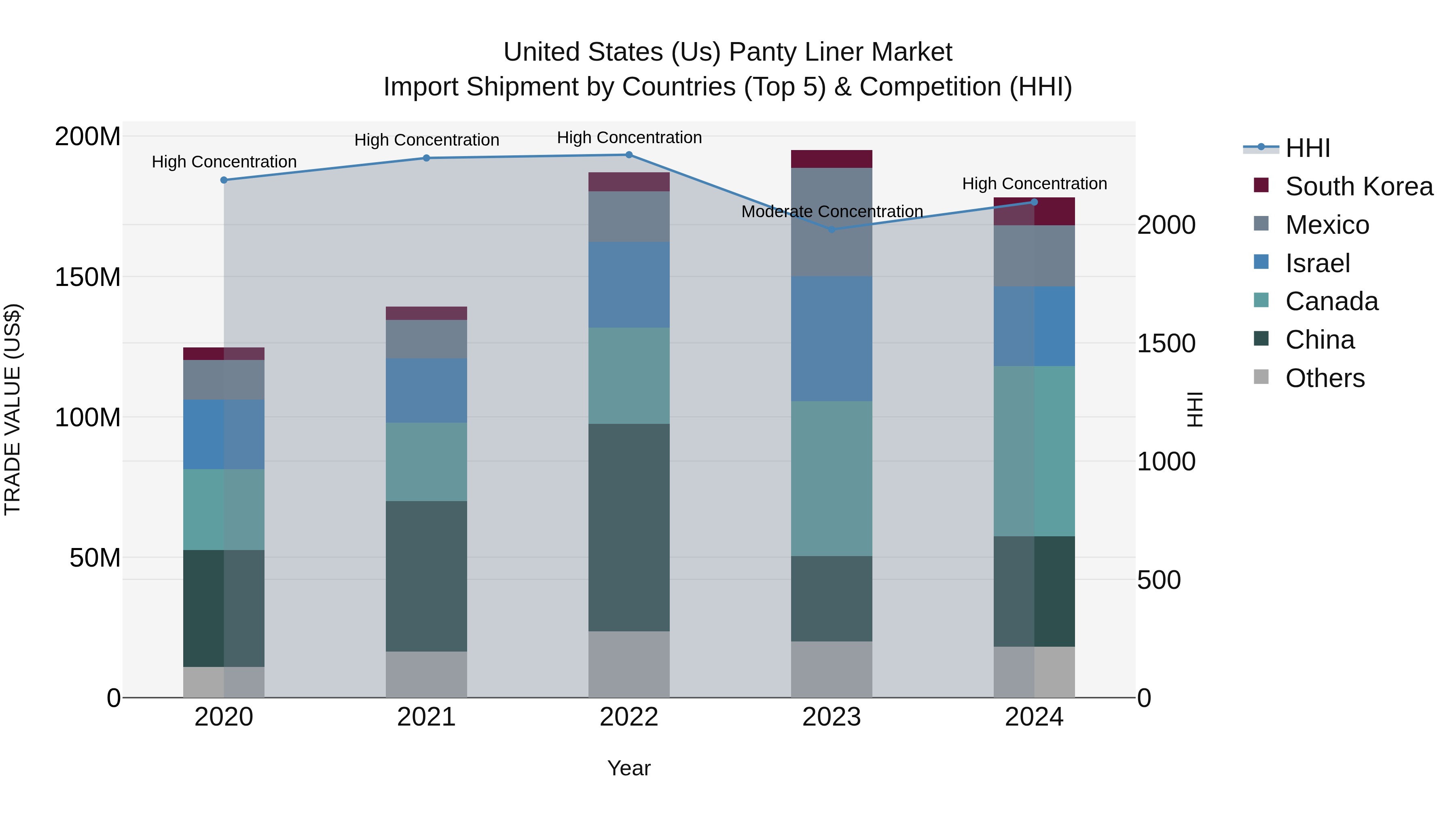
United States (US) Panty Liner Market Top 5 Importing Countries and Market Competition (HHI) Analysis
In 2024, the United States saw an increase in the concentration of panty liner import shipments, with Canada, China, Israel, Mexico, and South Korea being the top countries exporting to the USA. Despite a slight decrease in growth rate from 2023 to 2024, the compound annual growth rate (CAGR) over the period of 2020-2024 remained strong at 9.33%. This shift in concentration indicates a potential changing landscape in the panty liner market, with key players dominating the import market to the USA.
United States (US) Panty Liner Market Synopsis
The United States Panty Liner Market is a significant segment within the feminine hygiene industry, driven by factors such as increasing awareness about personal hygiene, rising disposable income, and changing lifestyle trends. Panty liners are used by women for everyday freshness, light menstrual flow, or as backup protection along with tampons or menstrual cups. The market is characterized by a wide range of product offerings, including scented and unscented variants, organic options, and different sizes and shapes to cater to diverse consumer preferences. Key players in the US panty liner market include major brands like Always, Kotex, and Carefree, as well as newer entrants focusing on natural and eco-friendly products. With a growing emphasis on sustainability and health-conscious choices among consumers, the market is witnessing a shift towards biodegradable and organic panty liners.
United States (US) Panty Liner Market Trends
The US Panty Liner Market is experiencing a shift towards more sustainable and eco-friendly products, driven by increasing consumer awareness of environmental impact. Brands are focusing on developing biodegradable and organic options to cater to this growing demand. Additionally, there is a rising trend towards innovative features such as ultra-thin designs, enhanced absorbency, and odor control technology to provide greater comfort and convenience to consumers. Opportunities exist for market players to expand their product lines with these eco-friendly and high-performance offerings, as well as to target specific consumer segments such as teenagers and women with sensitive skin. E-commerce channels are also gaining prominence in the distribution of panty liners, allowing for wider reach and convenience for consumers. Overall, the market is evolving to meet changing consumer preferences and demands for more sustainable and effective panty liner products.
United States (US) Panty Liner Market Challenges
In the US Panty Liner Market, challenges include increasing competition from both established and new entrants, driving the need for product differentiation and innovation. Consumer preferences are evolving towards eco-friendly and organic options, prompting manufacturers to invest in sustainable practices and materials. Pricing pressures also exist, with consumers seeking value for money without compromising on quality. Additionally, changing lifestyle patterns and hygiene awareness are influencing purchasing decisions, requiring companies to adapt their marketing strategies and product offerings accordingly. Regulatory requirements and compliance with safety standards further add complexity to the market landscape, necessitating companies to stay updated and compliant with changing regulations. Overall, the US Panty Liner Market presents challenges that demand strategic adaptation and a customer-centric approach to stay competitive.
United States (US) Panty Liner Market Investment Opportunities
The United States Panty Liner Market is primarily driven by factors such as increasing awareness about menstrual hygiene, growing emphasis on women`s health and wellness, rising disposable income levels, and the convenience offered by panty liners for daily use and light menstrual flow. Additionally, the trend of women seeking more comfortable and discreet period protection solutions is fueling the demand for panty liners. Innovations in product design, materials, and sustainability features are also influencing consumer preferences and driving market growth. Furthermore, the expanding availability of panty liners through various distribution channels and aggressive marketing strategies by key players are contributing to the market`s expansion in the US.
United States (US) Panty Liner Market Government Polices
Government policies related to the US Panty Liner Market primarily focus on regulations imposed by the Food and Drug Administration (FDA) to ensure the safety and efficacy of these products. The FDA regulates panty liners as medical devices, requiring manufacturers to adhere to strict guidelines for product labeling, composition, and manufacturing processes. Additionally, the Federal Trade Commission (FTC) oversees advertising and marketing practices to prevent deceptive claims and ensure consumer protection. Environmental regulations may also impact the market, with increasing emphasis on sustainable and eco-friendly materials in response to consumer demand for environmentally conscious products. Overall, government policies in the US Panty Liner Market aim to safeguard consumer health, promote transparency in product information, and encourage sustainability practices within the industry.
United States (US) Panty Liner Market Future Outlook
The United States Panty Liner Market is expected to see steady growth in the coming years, driven by factors such as increasing awareness about feminine hygiene, rising disposable income levels, and a growing emphasis on personal care products. Consumers are increasingly seeking products that offer comfort, convenience, and improved absorption, leading to a demand for innovative and eco-friendly panty liners. The market is also witnessing a shift towards organic and natural ingredients, as consumers become more conscious of the materials used in hygiene products. Manufacturers are likely to focus on product diversification, packaging innovations, and marketing strategies to cater to changing consumer preferences and stay competitive in the evolving market landscape. Overall, the future outlook for the US Panty Liner Market appears promising, with opportunities for growth and product development.
Key Highlights of the Report:
- United States (US) Panty Liner Market Outlook
- Market Size of United States (US) Panty Liner Market, 2024
- Forecast of United States (US) Panty Liner Market, 2031
- Historical Data and Forecast of United States (US) Panty Liner Revenues & Volume for the Period 2021- 2031
- United States (US) Panty Liner Market Trend Evolution
- United States (US) Panty Liner Market Drivers and Challenges
- United States (US) Panty Liner Price Trends
- United States (US) Panty Liner Porter's Five Forces
- United States (US) Panty Liner Industry Life Cycle
- Historical Data and Forecast of United States (US) Panty Liner Market Revenues & Volume By Product Type for the Period 2021- 2031
- Historical Data and Forecast of United States (US) Panty Liner Market Revenues & Volume By Scented for the Period 2021- 2031
- Historical Data and Forecast of United States (US) Panty Liner Market Revenues & Volume By Unscented for the Period 2021- 2031
- Historical Data and Forecast of United States (US) Panty Liner Market Revenues & Volume By Category for the Period 2021- 2031
- Historical Data and Forecast of United States (US) Panty Liner Market Revenues & Volume By Organic for the Period 2021- 2031
- Historical Data and Forecast of United States (US) Panty Liner Market Revenues & Volume By Non-organic for the Period 2021- 2031
- United States (US) Panty Liner Import Export Trade Statistics
- Market Opportunity Assessment By Product Type
- Market Opportunity Assessment By Category
- United States (US) Panty Liner Top Companies Market Share
- United States (US) Panty Liner Competitive Benchmarking By Technical and Operational Parameters
- United States (US) Panty Liner Company Profiles
- United States (US) Panty Liner Key Strategic Recommendations
Frequently Asked Questions About the Market Study (FAQs):
6Wresearch actively monitors the United States (US) Panty Liner Market and publishes its comprehensive annual report, highlighting emerging trends, growth drivers, revenue analysis, and forecast outlook. Our insights help businesses to make data-backed strategic decisions with ongoing market dynamics. Our analysts track relevent industries related to the United States (US) Panty Liner Market, allowing our clients with actionable intelligence and reliable forecasts tailored to emerging regional needs.
Yes, we provide customisation as per your requirements. To learn more, feel free to contact us on sales@6wresearch.com
1 Executive Summary |
2 Introduction |
2.1 Key Highlights of the Report |
2.2 Report Description |
2.3 Market Scope & Segmentation |
2.4 Research Methodology |
2.5 Assumptions |
3 United States (US) Panty Liner Market Overview |
3.1 United States (US) Country Macro Economic Indicators |
3.2 United States (US) Panty Liner Market Revenues & Volume, 2021 & 2031F |
3.3 United States (US) Panty Liner Market - Industry Life Cycle |
3.4 United States (US) Panty Liner Market - Porter's Five Forces |
3.5 United States (US) Panty Liner Market Revenues & Volume Share, By Product Type, 2021 & 2031F |
3.6 United States (US) Panty Liner Market Revenues & Volume Share, By Category, 2021 & 2031F |
4 United States (US) Panty Liner Market Dynamics |
4.1 Impact Analysis |
4.2 Market Drivers |
4.2.1 Increasing awareness about feminine hygiene and personal care among women |
4.2.2 Growing demand for convenient and discreet menstrual protection products |
4.2.3 Rising focus on sustainability and eco-friendly products in the personal care industry |
4.3 Market Restraints |
4.3.1 Intense competition from other feminine hygiene products such as menstrual cups and period panties |
4.3.2 Price sensitivity among consumers, especially in the lower-income segments |
4.3.3 Regulatory challenges related to product safety and labeling requirements |
5 United States (US) Panty Liner Market Trends |
6 United States (US) Panty Liner Market, By Types |
6.1 United States (US) Panty Liner Market, By Product Type |
6.1.1 Overview and Analysis |
6.1.2 United States (US) Panty Liner Market Revenues & Volume, By Product Type, 2021- 2031F |
6.1.3 United States (US) Panty Liner Market Revenues & Volume, By Scented, 2021- 2031F |
6.1.4 United States (US) Panty Liner Market Revenues & Volume, By Unscented, 2021- 2031F |
6.2 United States (US) Panty Liner Market, By Category |
6.2.1 Overview and Analysis |
6.2.2 United States (US) Panty Liner Market Revenues & Volume, By Organic, 2021- 2031F |
6.2.3 United States (US) Panty Liner Market Revenues & Volume, By Non-organic, 2021- 2031F |
7 United States (US) Panty Liner Market Import-Export Trade Statistics |
7.1 United States (US) Panty Liner Market Export to Major Countries |
7.2 United States (US) Panty Liner Market Imports from Major Countries |
8 United States (US) Panty Liner Market Key Performance Indicators |
8.1 Percentage increase in online searches for panty liners |
8.2 Growth in the number of partnerships with influencers and celebrities for product promotion |
8.3 Number of new product launches with innovative features and materials |
8.4 Percentage of sales attributed to eco-friendly panty liners |
8.5 Customer satisfaction ratings and reviews on social media platforms |
9 United States (US) Panty Liner Market - Opportunity Assessment |
9.1 United States (US) Panty Liner Market Opportunity Assessment, By Product Type, 2021 & 2031F |
9.2 United States (US) Panty Liner Market Opportunity Assessment, By Category, 2021 & 2031F |
10 United States (US) Panty Liner Market - Competitive Landscape |
10.1 United States (US) Panty Liner Market Revenue Share, By Companies, 2024 |
10.2 United States (US) Panty Liner Market Competitive Benchmarking, By Operating and Technical Parameters |
11 Company Profiles |
12 Recommendations |
13 Disclaimer |
Pricing
- Single User License$ 1,995
- Department License$ 2,400
- Site License$ 3,120
- Global License$ 3,795

Search
Thought Leadership and Analyst Meet





Our Clients








Related Reports
- Germany Breakfast Food Market (2026-2032) | Industry, Share, Growth, Size, Companies, Value, Analysis, Revenue, Trends, Forecast & Outlook
- Australia Briquette Market (2025-2031) | Growth, Size, Revenue, Forecast, Analysis, Trends, Value, Share, Industry & Companies
- Vietnam System Integrator Market (2025-2031) | Size, Companies, Analysis, Industry, Value, Forecast, Growth, Trends, Revenue & Share
- ASEAN and Thailand Brain Health Supplements Market (2025-2031) | Strategy, Consumer Insights, Analysis, Investment Trends, Opportunities, Growth, Size, Share, Industry, Revenue, Segments, Value, Segmentation, Supply, Forecast, Restraints, Outlook, Competition, Drivers, Trends, Demand, Pricing Analysis, Competitive, Strategic Insights, Companies, Challenges
- ASEAN Bearings Market (2025-2031) | Strategy, Consumer Insights, Analysis, Investment Trends, Opportunities, Growth, Size, Share, Industry, Revenue, Segments, Value, Segmentation, Supply, Forecast, Restraints, Outlook, Competition, Drivers, Trends, Demand, Pricing Analysis, Competitive, Strategic Insights, Companies, Challenges
- Europe Flooring Market (2025-2031) | Outlook, Share, Industry, Trends, Forecast, Companies, Revenue, Size, Analysis, Growth & Value
- Saudi Arabia Manlift Market (2025-2031) | Outlook, Size, Growth, Trends, Companies, Industry, Revenue, Value, Share, Forecast & Analysis
- Uganda Excavator, Crane, and Wheel Loaders Market (2025-2031) | Strategy, Consumer Insights, Analysis, Investment Trends, Opportunities, Growth, Size, Share, Industry, Revenue, Segments, Value, Segmentation, Supply, Forecast, Restraints, Outlook, Competition, Drivers, Trends, Demand, Pricing Analysis, Competitive, Strategic Insights, Companies, Challenges
- Rwanda Excavator, Crane, and Wheel Loaders Market (2025-2031) | Strategy, Consumer Insights, Analysis, Investment Trends, Opportunities, Growth, Size, Share, Industry, Revenue, Segments, Value, Segmentation, Supply, Forecast, Restraints, Outlook, Competition, Drivers, Trends, Demand, Pricing Analysis, Competitive, Strategic Insights, Companies, Challenges
- Kenya Excavator, Crane, and Wheel Loaders Market (2025-2031) | Strategy, Consumer Insights, Analysis, Investment Trends, Opportunities, Growth, Size, Share, Industry, Revenue, Segments, Value, Segmentation, Supply, Forecast, Restraints, Outlook, Competition, Drivers, Trends, Demand, Pricing Analysis, Competitive, Strategic Insights, Companies, Challenges
Industry Events and Analyst Meet

Stationery & Paper Expo Saudi Arabia 2026

Kids & Toys Expo Saudi Arabia 2026

Gifts & Homeware Expo Saudi Arabia 2026

Smart Home Expo 2026

Industrial Facilities Management Expo 2025
Whitepaper
- Middle East & Africa Commercial Security Market Click here to view more.
- Middle East & Africa Fire Safety Systems & Equipment Market Click here to view more.
- GCC Drone Market Click here to view more.
- Middle East Lighting Fixture Market Click here to view more.
- GCC Physical & Perimeter Security Market Click here to view more.
6WResearch In News
- Doha a strategic location for EV manufacturing hub: IPA Qatar
- Demand for luxury TVs surging in the GCC, says Samsung
- Empowering Growth: The Thriving Journey of Bangladesh’s Cable Industry
- Demand for luxury TVs surging in the GCC, says Samsung
- Video call with a traditional healer? Once unthinkable, it’s now common in South Africa
- Intelligent Buildings To Smooth GCC’s Path To Net Zero


