United States (US) Plastic Waste Management Market Size, Share & Growth Rate
The United States (US) Plastic Waste Management Market was estimated at USD 172 Million in 2025 and is projected to reach USD 203 Million by 2032, growing at a CAGR of 2.4% from 2026 to 2032. This growth trajectory is propelled by the increasing scrutiny on plastic pollution and the push for more sustainable practices across various sectors. Heightened regulatory frameworks and rising consumer demand for responsible waste management solutions further complement this positive outlook.
United States (US) Plastic Waste Management Market Year-wise Growth Rate and Key Drivers
This graph highlights how the United States (US) Plastic Waste Management Market has steadily grown over the years, supported by major growth factors.
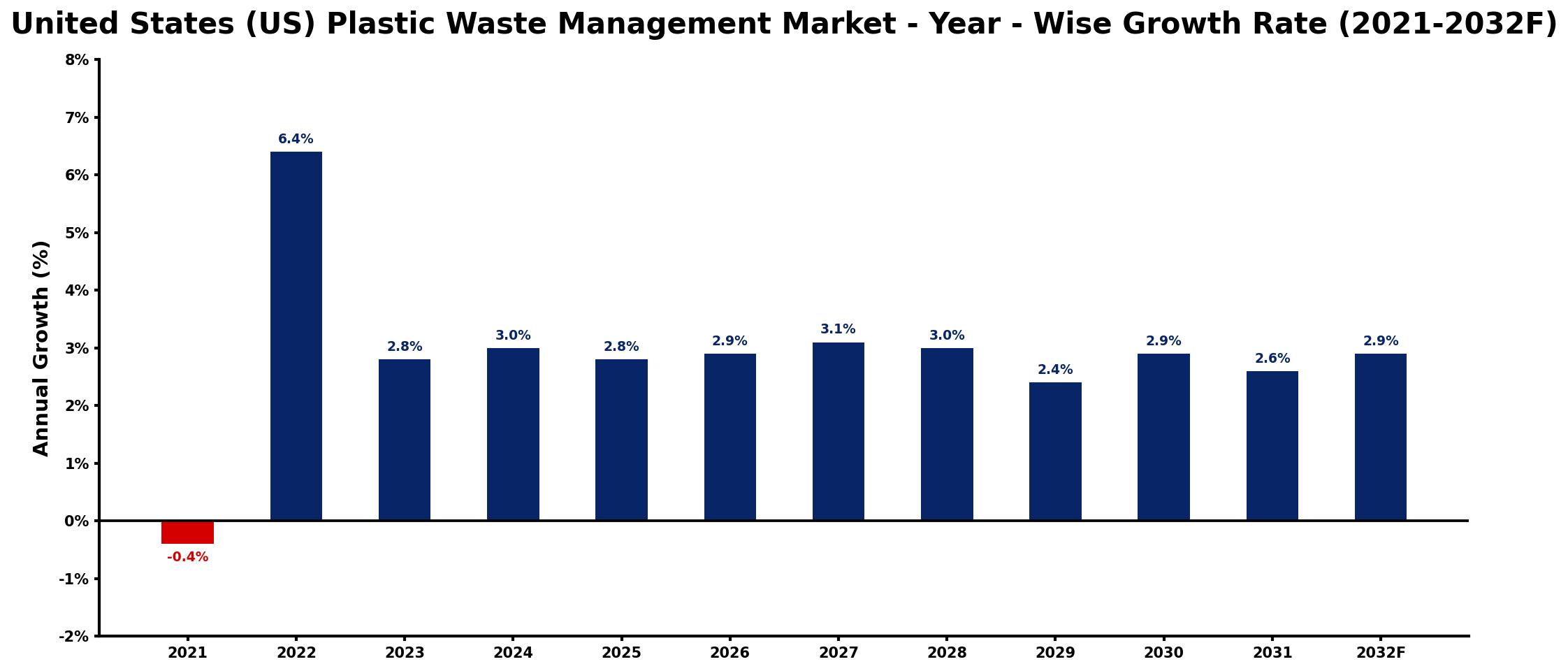
The table below presents the year‑wise growth rates along with the key drivers influencing the market
| Year | Growth Rate | Major Drivers |
| 2021 | -0.4% | Decreased recycling infrastructure investments |
| 2022 | 6.4% | Rising consumer environmental awareness |
| 2023 | 2.8% | Increased regulatory compliance requirements |
| 2024 | 3.0% | Expansion of biodegradable alternatives market |
| 2025 | 2.8% | Growing corporate sustainability initiatives |
| 2026 | 2.9% | Technological advancements in recycling processes |
| 2027 | 3.1% | Increase in circular economy adoption |
| 2028 | 3.0% | Higher demand for eco-friendly packaging |
| 2029 | 2.4% | Emergence of innovative recycling technologies |
| 2030 | 2.9% | Strengthened partnerships within industry sectors |
| 2031 | 2.6% | Enhanced public-private collaboration efforts |
| 2032 | 2.9% | Broader investment in green technologies |
Note: Market size estimations and growth projections presented in this report are based on 6Wresearch's proprietary forecasting methodology, utilizing the latest available industry data, government publications, and primary research inputs.
United States (US) Plastic Waste Management Market Synopsis
A pivotal force shaping the United States (US) Plastic Waste Management Market today is the growing emphasis on sustainability. As environmental concerns rise, businesses and consumers alike are demanding more from waste management strategies, propelling the need for advanced recycling and waste processing technologies.
The market is characterized by an increasing collaboration among various stakeholders, including government entities, private companies, and non-profit organizations. This cooperative approach aims to tackle the multifaceted challenges of plastic waste, ultimately fostering a circular economy that enhances resource efficiency and minimizes environmental impact.
United States (US) Plastic Waste Management Market Key Takeaways
- The market is projected to grow steadily, reflecting heightened consumer awareness and regulatory pressures.
- Advancements in recycling technologies, such as chemical recycling, are gaining traction.
- The push to reduce single-use plastics is reshaping packaging and product design.
- Government initiatives are increasingly focused on promoting recycling and reducing plastic waste generation.
- Investment opportunities abound, particularly in innovative recycling solutions and sustainable waste management services.
Evaluation of Restraints in United States (US) Plastic Waste Management Market
Despite the promising outlook, the United States (US) Plastic Waste Management Market grapples with significant challenges. A primary concern is the inadequate recycling infrastructure, which varies dramatically by region and impedes effective waste processing. Furthermore, many consumers remain unaware or disengaged from recycling programs, which exacerbates contamination issues in recycling streams. The inconsistency of regulations across states complicates compliance efforts, while the low market value of recycled plastics compared to their virgin counterparts discourages investment in recycling initiatives. Addressing these systemic issues is essential for the market to reach its full potential.
United States (US) Plastic Waste Management Market Trends
Current trends in the United States (US) Plastic Waste Management Market are heavily influenced by the principles of sustainability and the circular economy. Companies are increasingly investing in advanced recycling infrastructures that employ innovative technologies such as chemical recycling and pyrolysis to convert plastic waste into reusable materials. Moreover, regulatory measures are driving a shift away from single-use plastics, encouraging industries to adopt reusable alternatives. This evolving landscape reflects a broader societal shift towards environmental responsibility and sustainable resource management.
United States (US) Plastic Waste Management Market Opportunities
The United States (US) Plastic Waste Management Market offers a wealth of investment opportunities in the coming years. Companies focused on developing advanced recycling technologies, particularly in chemical recycling and biodegradable plastic alternatives, stand to benefit significantly from the increasing demand for sustainable materials. Moreover, investment in waste collection and sorting technologies will be crucial as municipalities and businesses look to enhance their recycling capabilities. As regulatory frameworks become more stringent, opportunities for consultancy and compliance services will also emerge, creating an avenue for growth and innovation in the sector.
Government Initiatives in the United States (US) Plastic Waste Management Market
The United States government has implemented various initiatives aimed at addressing plastic waste management challenges. Key policies, such as the Plastic Pollution Reduction Act, focus on reducing plastic waste and encouraging recycling through extended producer responsibility programs. Additionally, state-level regulations, including bans on plastic bags and container deposit laws, are being adopted to mitigate single-use plastic consumption. The Environmental Protection Agency (EPA) oversees waste management through the Resource Conservation and Recovery Act, which governs both hazardous and non-hazardous waste, reflecting a commitment to improving plastic waste management across the nation.
Future Insights of the United States (US) Plastic Waste Management Market
The outlook for the United States (US) Plastic Waste Management Market is positive, driven by an increasing awareness of environmental issues and the ongoing evolution towards sustainable practices. The market is expected to witness continuous innovation in recycling methods, alongside the adoption of biodegradable materials. Furthermore, collaboration among stakeholders is likely to strengthen, enhancing the efficiency of waste management systems. As the demand for eco-friendly solutions escalates, investment opportunities within this sector will undoubtedly expand, supporting the transition to a more sustainable economy.
United States (US) Plastic Waste Management Market Latest Developments (2025 - 2026)
Recent developments in the United States (US) Plastic Waste Management Market highlight a significant push towards enhancing recycling capabilities and technologies. Various state initiatives have emerged to streamline recycling processes, while there is a notable increase in public-private partnerships aimed at improving infrastructure. Additionally, several innovative projects focusing on the conversion of plastic waste to fuel are underway, reflecting a broader trend towards addressing the plastic waste crisis through technological advancement.
United States (US) Plastic Waste Management Market - Key Attractiveness of the Report
- 10 Years of Market Numbers
- Historical Data Starting from 2022 to 2025
- Base Year: 2025
- Forecast Data until 2032
- Key Performance Indicators Impacting the Market
- Major Upcoming Developments and Projects
Key Highlights of the Report:
- United States (US) Plastic Waste Management Market Outlook
- Market Size of United States (US) Plastic Waste Management Market, 2025
- Forecast of United States (US) Plastic Waste Management Market, 2032
- Historical Data and Forecast of United States (US) Plastic Waste Management Revenues & Volume for the Period 2022-2032F
- United States (US) Plastic Waste Management Market Trend Evolution
- United States (US) Plastic Waste Management Market Drivers and Challenges
- United States (US) Plastic Waste Management Price Trends
- United States (US) Plastic Waste Management Porter's Five Forces
- United States (US) Plastic Waste Management Industry Life Cycle
- Historical Data and Forecast of United States (US) Plastic Waste Management Market Revenues & Volume By Source for the Period 2022-2032F
- Historical Data and Forecast of United States (US) Plastic Waste Management Market Revenues & Volume By Industrial Waste for the Period 2022-2032F
- Historical Data and Forecast of United States (US) Plastic Waste Management Market Revenues & Volume By Municipal Waste for the Period 2022-2032F
- Historical Data and Forecast of United States (US) Plastic Waste Management Market Revenues & Volume By Material for the Period 2022-2032F
- Historical Data and Forecast of United States (US) Plastic Waste Management Market Revenues & Volume By Polyethylene for the Period 2022-2032F
- Historical Data and Forecast of United States (US) Plastic Waste Management Market Revenues & Volume By Polypropylene for the Period 2022-2032F
- Historical Data and Forecast of United States (US) Plastic Waste Management Market Revenues & Volume By Polyethylene Terephthalate for the Period 2022-2032F
- Historical Data and Forecast of United States (US) Plastic Waste Management Market Revenues & Volume By Polystyrene for the Period 2022-2032F
- Historical Data and Forecast of United States (US) Plastic Waste Management Market Revenues & Volume By Others for the Period 2022-2032F
- Historical Data and Forecast of United States (US) Plastic Waste Management Market Revenues & Volume By Product Type for the Period 2022-2032F
- Historical Data and Forecast of United States (US) Plastic Waste Management Market Revenues & Volume By Packaging for the Period 2022-2032F
- Historical Data and Forecast of United States (US) Plastic Waste Management Market Revenues & Volume By Construction for the Period 2022-2032F
- Historical Data and Forecast of United States (US) Plastic Waste Management Market Revenues & Volume By Automotive for the Period 2022-2032F
- Historical Data and Forecast of United States (US) Plastic Waste Management Market Revenues & Volume By Electrical & Electronics for the Period 2022-2032F
- Historical Data and Forecast of United States (US) Plastic Waste Management Market Revenues & Volume By Others for the Period 2022-2032F
- Historical Data and Forecast of United States (US) Plastic Waste Management Market Revenues & Volume By Treatment Method for the Period 2022-2032F
- Historical Data and Forecast of United States (US) Plastic Waste Management Market Revenues & Volume By Collection for the Period 2022-2032F
- Historical Data and Forecast of United States (US) Plastic Waste Management Market Revenues & Volume By Recycling for the Period 2022-2032F
- Historical Data and Forecast of United States (US) Plastic Waste Management Market Revenues & Volume By Disposal for the Period 2022-2032F
- United States (US) Plastic Waste Management Import Export Trade Statistics
- Market Opportunity Assessment By Source
- Market Opportunity Assessment By Material
- Market Opportunity Assessment By Product Type
- Market Opportunity Assessment By Treatment Method
- United States (US) Plastic Waste Management Top Companies Market Share
- United States (US) Plastic Waste Management Competitive Benchmarking By Technical and Operational Parameters
- United States (US) Plastic Waste Management Company Profiles
- United States (US) Plastic Waste Management Key Strategic Recommendations






































