United States (US) Position Sensor Market Size, Share & Growth Rate
The United States (US) Position Sensor Market was estimated at USD 127 Million in 2025 and is projected to reach USD 150 Million by 2032, growing at a CAGR of 2.4% from 2026 to 2032. This growth trajectory is fueled by the escalating demand for automation and the implementation of advanced technologies in sectors like automotive and manufacturing. As industries increasingly adopt Internet of Things (IoT) solutions and automated systems, the necessity for precise position sensing continues to surge, propelling market expansion.
United States (US) Position Sensor Market Year-wise Growth Rate and Key Drivers
This graph highlights how the United States (US) Position Sensor Market has steadily grown over the years, supported by major growth factors.
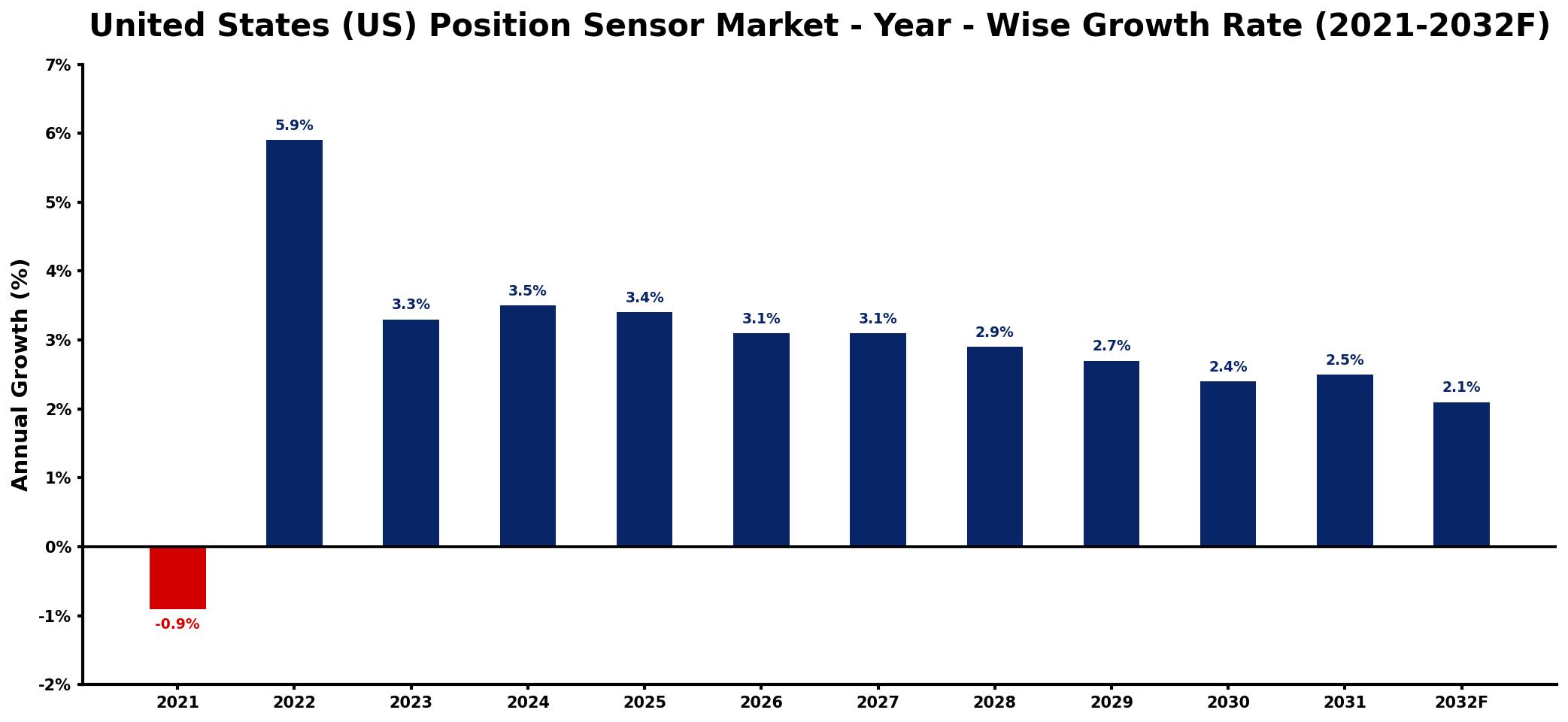
The table below presents the year‑wise growth rates along with the key drivers influencing the market
| Year | Growth Rate | Major Drivers |
| 2021 | -0.9% | Supply chain disruptions impact investments |
| 2022 | 5.9% | Increased automation in manufacturing processes |
| 2023 | 3.3% | Rising demand from automotive sector |
| 2024 | 3.5% | Expansion of smart home technologies |
| 2025 | 3.4% | Growth in renewable energy applications |
| 2026 | 3.1% | Advancements in robotics and AI |
| 2027 | 3.1% | Increase in IoT device integration |
| 2028 | 2.9% | Development of electric vehicle infrastructure |
| 2029 | 2.7% | Surge in healthcare monitoring systems |
| 2030 | 2.4% | strengthening international trade flows |
| 2031 | 2.5% | enhanced product quality standards |
| 2032 | 2.1% | expanding manufacturing base activity |
Note: Market size estimations and growth projections presented in this report are based on 6Wresearch's proprietary forecasting methodology, utilizing the latest available industry data, government publications, and primary research inputs.
United States (US) Position Sensor Market Synopsis
The demand for non-contact position sensors is gaining traction, particularly in critical applications that require high accuracy and reliability. These sensors, including optical and magnetic types, offer significant advantages over traditional contact sensors, making them increasingly preferred in various industrial applications.
Additionally, the automotive sector is witnessing a notable integration of position sensors for advanced driver assistance systems (ADAS) and autonomous vehicles. This integration not only enhances vehicle performance but also contributes significantly to the ongoing transformation towards smart and connected vehicles.
United States (US) Position Sensor Market Key Takeaways
- The market is driven by heightened automation and advancements in sensor technology.
- Non-contact position sensors are increasingly favored for their accuracy and reliability.
- The automotive industry is a key area of growth for position sensors, particularly in ADAS and autonomous applications.
- IoT integration is transforming how position sensors are utilized in various industrial settings.
- Investment in innovative sensor technology presents lucrative opportunities for market entrants.
Evaluation of Restraints in United States (US) Position Sensor Market
Despite its growth prospects, the US Position Sensor Market faces certain restraints that could hinder progress. Intense competition among manufacturers often leads to price wars, which can squeeze margins and impact profitability. Additionally, rapid technological advancements necessitate ongoing innovation, compelling companies to consistently upgrade their offerings to remain competitive. Regulatory requirements impose additional challenges, as firms must adapt to evolving standards affecting product development. Moreover, fluctuations in raw material prices and economic uncertainties present external pressures that necessitate strategic agility and foresight.
United States (US) Position Sensor Market Trends
A marked trend in the US Position Sensor Market is the shift towards the adoption of miniaturized sensors, driven by the demand from sectors like healthcare and consumer electronics. Companies are increasingly focused on developing cost-effective solutions that meet the precise requirements of emerging applications. Furthermore, as IoT continues to permeate industrial landscapes, the interconnectivity of sensors is being emphasized, allowing for improved real-time monitoring and control capabilities across various applications.
United States (US) Position Sensor Market Opportunities
Investment opportunities within the US Position Sensor Market are robust, especially as industries embrace automation and advanced sensor technologies. Companies focused on innovative developments in position sensing, particularly those that cater to the automotive and manufacturing sectors, stand to benefit significantly. The growing trend of autonomous vehicles presents a unique avenue for expansion, as does the emphasis on smart manufacturing solutions, making this market particularly attractive for investors seeking to capitalize on technological advancements.
Government Initiatives in the United States (US) Position Sensor Market
The US government plays a crucial role in shaping the Position Sensor Market through various regulations and incentives. Policies enforced by agencies such as the Department of Commerce focus on ensuring product reliability and safety standards, particularly in high-stakes industries like automotive and aerospace. Additionally, fiscal incentives aimed at supporting research and development in sensor technologies contribute to driving innovation and competitiveness within the sector. Trade policies and tariffs also influence market dynamics, impacting the pricing and availability of position sensor products.
Future Insights of the United States (US) Position Sensor Market
The outlook for the United States Position Sensor Market is optimistic, with growth anticipated over the next several years. Automation across various sectors, coupled with an increasing focus on precision measurement, is expected to drive demand for position sensors. The continued evolution of sensor technologies, particularly in the realms of MEMS and IoT integration, will further enhance market dynamics. As industries strive for improved operational efficiency, the role of position sensors will become increasingly pivotal in optimizing processes and driving innovation.
United States (US) Position Sensor Market Latest Developments (2025 - 2026)
Recent developments in the US Position Sensor Market indicate a shift towards enhanced capabilities, with many companies prioritizing R&D to create more advanced and integrated sensing solutions. The incorporation of AI and machine learning into sensor technology is paving the way for smarter applications, particularly in automation and real-time data analysis. Additionally, partnerships between technology firms and manufacturers are emerging to accelerate the development of next-generation sensors, ensuring alignment with industry needs and compliance with evolving regulatory standards.
United States (US) Position Sensor Market - Key Attractiveness of the Report
- 10 Years of Market Numbers
- Historical Data Starting from 2022 to 2025
- Base Year: 2025
- Forecast Data until 2032
- Key Performance Indicators Impacting the Market
- Major Upcoming Developments and Projects
Key Highlights of the Report:
- United States (US) Position Sensor Market Outlook
- Market Size of United States (US) Position Sensor Market, 2025
- Forecast of United States (US) Position Sensor Market, 2032
- Historical Data and Forecast of United States (US) Position Sensor Revenues & Volume for the Period 2022-2032F
- United States (US) Position Sensor Market Trend Evolution
- United States (US) Position Sensor Market Drivers and Challenges
- United States (US) Position Sensor Price Trends
- United States (US) Position Sensor Porter's Five Forces
- United States (US) Position Sensor Industry Life Cycle
- Historical Data and Forecast of United States (US) Position Sensor Market Revenues & Volume By Type for the Period 2022-2032F
- Historical Data and Forecast of United States (US) Position Sensor Market Revenues & Volume By Linear Position Sensors for the Period 2022-2032F
- Historical Data and Forecast of United States (US) Position Sensor Market Revenues & Volume By Rotary Position Sensors for the Period 2022-2032F
- Historical Data and Forecast of United States (US) Position Sensor Market Revenues & Volume By Contact Type for the Period 2022-2032F
- Historical Data and Forecast of United States (US) Position Sensor Market Revenues & Volume By Non-Contact Type for the Period 2022-2032F
- Historical Data and Forecast of United States (US) Position Sensor Market Revenues & Volume By Contact Type for the Period 2022-2032F
- Historical Data and Forecast of United States (US) Position Sensor Market Revenues & Volume By Output for the Period 2022-2032F
- Historical Data and Forecast of United States (US) Position Sensor Market Revenues & Volume By Digital Output for the Period 2022-2032F
- Historical Data and Forecast of United States (US) Position Sensor Market Revenues & Volume By Analog Output for the Period 2022-2032F
- Historical Data and Forecast of United States (US) Position Sensor Market Revenues & Volume By Application for the Period 2022-2032F
- Historical Data and Forecast of United States (US) Position Sensor Market Revenues & Volume By Machine Tools for the Period 2022-2032F
- Historical Data and Forecast of United States (US) Position Sensor Market Revenues & Volume By Robotics for the Period 2022-2032F
- Historical Data and Forecast of United States (US) Position Sensor Market Revenues & Volume By Motion Systems for the Period 2022-2032F
- Historical Data and Forecast of United States (US) Position Sensor Market Revenues & Volume By Material Handling for the Period 2022-2032F
- Historical Data and Forecast of United States (US) Position Sensor Market Revenues & Volume By Test Equipment for the Period 2022-2032F
- Historical Data and Forecast of United States (US) Position Sensor Market Revenues & Volume By Others for the Period 2022-2032F
- Historical Data and Forecast of United States (US) Position Sensor Market Revenues & Volume By End-user Industry for the Period 2022-2032F
- Historical Data and Forecast of United States (US) Position Sensor Market Revenues & Volume By Manufacturing for the Period 2022-2032F
- Historical Data and Forecast of United States (US) Position Sensor Market Revenues & Volume By Automotive for the Period 2022-2032F
- Historical Data and Forecast of United States (US) Position Sensor Market Revenues & Volume By Aerospace for the Period 2022-2032F
- Historical Data and Forecast of United States (US) Position Sensor Market Revenues & Volume By Packaging for the Period 2022-2032F
- Historical Data and Forecast of United States (US) Position Sensor Market Revenues & Volume By Healthcare for the Period 2022-2032F
- Historical Data and Forecast of United States (US) Position Sensor Market Revenues & Volume By Electronics for the Period 2022-2032F
- Historical Data and Forecast of United States (US) Position Sensor Market Revenues & Volume By Others for the Period 2022-2032F
- United States (US) Position Sensor Import Export Trade Statistics
- Market Opportunity Assessment By Type
- Market Opportunity Assessment By Contact Type
- Market Opportunity Assessment By Output
- Market Opportunity Assessment By Application
- Market Opportunity Assessment By End-user Industry
- United States (US) Position Sensor Top Companies Market Share
- United States (US) Position Sensor Competitive Benchmarking By Technical and Operational Parameters
- United States (US) Position Sensor Company Profiles
- United States (US) Position Sensor Key Strategic Recommendations






































