United States (US) Power Generation Market Top 5 Importing Countries and Market Competition (HHI) Analysis
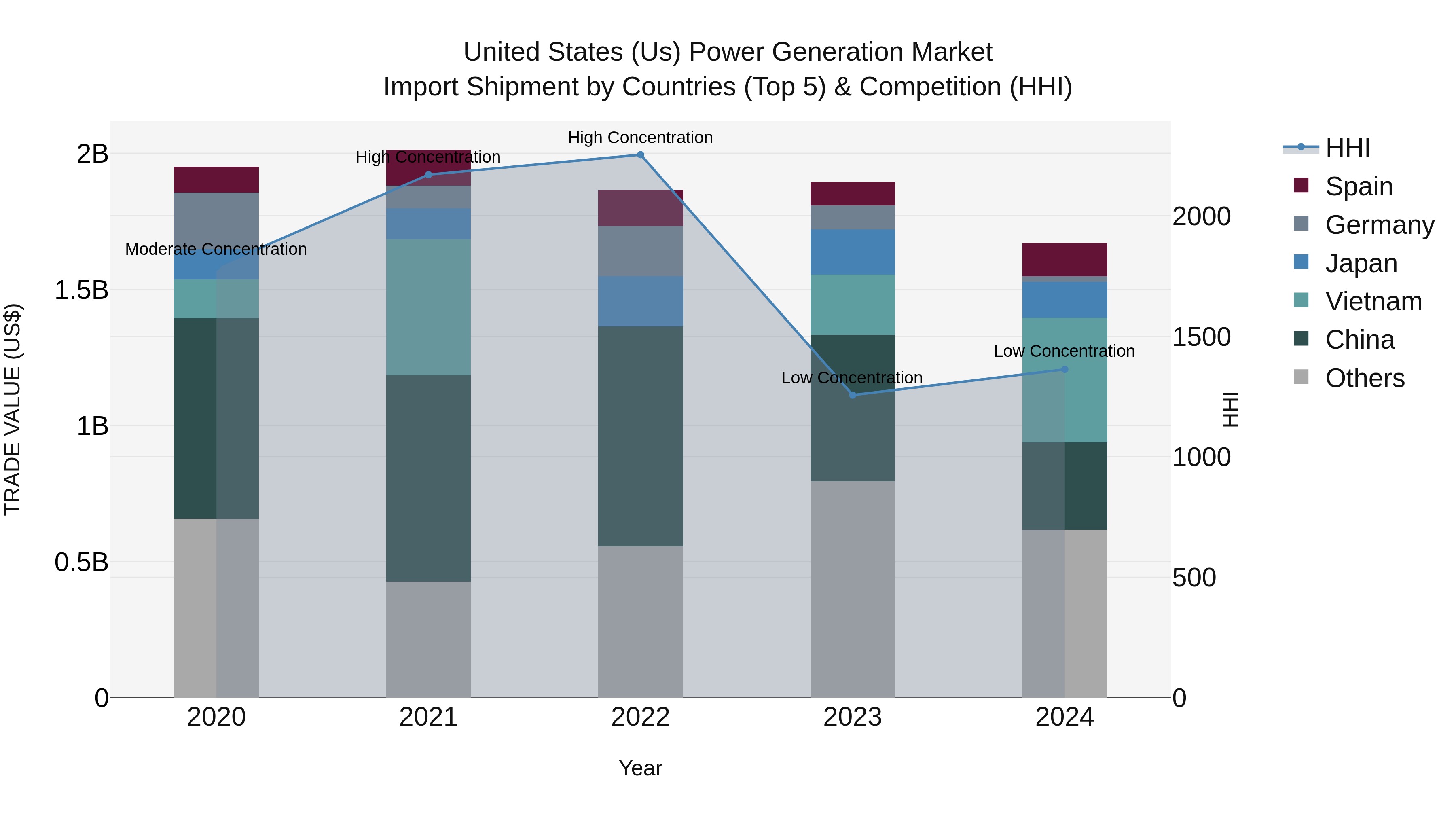
In 2024, the United States continued to rely on a diverse range of countries for its power generation import shipments, with Vietnam, China, Japan, Spain, and Brazil leading the way. Despite the low concentration indicated by the Herfindahl-Hirschman Index (HHI), the industry experienced a negative compound annual growth rate (CAGR) of -3.81% from 2020 to 2024. Furthermore, the growth rate for 2023-24 was particularly steep at -11.86%, reflecting a challenging environment for the US power generation import market.
United States (US) Power Generation Market Overview
The United States Power Generation Market is a critical sector of the country`s economy, encompassing a diverse range of energy sources including natural gas, coal, nuclear, renewables, and oil. Natural gas has been gaining prominence due to its abundant supply and lower emissions, displacing coal as a primary source of electricity generation. The shift towards renewable energy sources like wind and solar power is driven by environmental concerns and government incentives. Nuclear power continues to play a significant role in providing baseload electricity. Technological advancements and government policies are shaping the market dynamics, with a focus on increasing efficiency, reducing emissions, and promoting sustainable energy practices. Overall, the US power generation market is undergoing a transition towards cleaner and more diversified sources of energy to meet the growing demand for electricity in a sustainable manner.
United States (US) Power Generation Market Trends
In the US power generation market, a significant trend is the increasing shift towards renewable energy sources such as solar and wind power. This transition is driven by environmental concerns, government policies promoting clean energy, and the declining costs of renewable technologies. Another trend is the phasing out of coal-fired power plants and the growing investment in natural gas as a cleaner alternative. Energy storage solutions, such as batteries, are also gaining traction to support the integration of intermittent renewable sources into the grid. Additionally, there is a focus on modernizing aging infrastructure and improving grid resiliency to withstand extreme weather events. Overall, the US power generation market is evolving towards a more sustainable and resilient energy system.
United States (US) Power Generation Market Challenges
The US power generation market faces several challenges, including aging infrastructure that is in need of upgrades and modernization to improve efficiency and reliability. Transitioning to cleaner and more sustainable energy sources, such as renewable energy, presents a challenge due to the high initial costs of implementation and the need for extensive grid upgrades to accommodate intermittent sources like solar and wind. Regulatory uncertainty and changing government policies also pose challenges for power generation companies, impacting investment decisions and long-term planning. Additionally, increasing competition from alternative energy sources and technologies, as well as the need to address cybersecurity threats to the grid, further complicate the landscape for power generation in the US.
United States (US) Power Generation Market Investment Opportunities
The United States Power Generation Market offers diverse investment opportunities, with a shift towards renewable energy sources such as solar, wind, and hydroelectric power. Investing in renewable energy projects can provide long-term returns, as the country continues to prioritize clean energy and reduce carbon emissions. Additionally, modernizing and upgrading existing power infrastructure, including transmission and distribution systems, presents opportunities for investors. Energy storage technologies, such as batteries, are also gaining traction to support the integration of renewable energy sources into the grid. Furthermore, with the increasing focus on sustainability and environmental concerns, investments in energy efficiency solutions and smart grid technologies are likely to be lucrative in the US power generation market.
United States (US) Power Generation Market Government Policy
The US government has implemented several policies to drive the transformation of the power generation market towards cleaner and more sustainable sources. These policies include tax incentives for renewable energy projects, such as the Investment Tax Credit (ITC) and Production Tax Credit (PTC), as well as renewable portfolio standards in many states that mandate a certain percentage of electricity be generated from renewable sources. The Environmental Protection Agency (EPA) has also introduced regulations like the Clean Power Plan to reduce carbon emissions from power plants. Additionally, the Department of Energy (DOE) supports research and development efforts in advanced energy technologies to enhance grid reliability and efficiency. Overall, these policies aim to accelerate the transition to a more environmentally friendly and resilient power generation sector in the US.
United States (US) Power Generation Market Future Outlook
The future outlook for the US Power Generation Market is expected to be characterized by a continued shift towards renewable energy sources such as solar and wind power. Government policies promoting clean energy initiatives, declining costs of renewable technologies, and increasing public awareness of environmental concerns are driving this transition. The need to reduce carbon emissions and mitigate the impacts of climate change are also pushing utilities and energy companies to invest in cleaner energy alternatives. However, challenges such as intermittency of renewable sources, grid integration, and regulatory uncertainties may impact the pace of this transition. Overall, the US Power Generation Market is likely to see a gradual but steady increase in the share of renewable energy in its energy mix in the coming years.
Key Highlights of the Report:
- United States (US) Power Generation Market Outlook
- Market Size of United States (US) Power Generation Market, 2024
- Forecast of United States (US) Power Generation Market, 2031
- Historical Data and Forecast of United States (US) Power Generation Revenues & Volume for the Period 2021 - 2031
- United States (US) Power Generation Market Trend Evolution
- United States (US) Power Generation Market Drivers and Challenges
- United States (US) Power Generation Price Trends
- United States (US) Power Generation Porter's Five Forces
- United States (US) Power Generation Industry Life Cycle
- Historical Data and Forecast of United States (US) Power Generation Market Revenues & Volume By Application for the Period 2021 - 2031
- Historical Data and Forecast of United States (US) Power Generation Market Revenues & Volume By Commercial for the Period 2021 - 2031
- Historical Data and Forecast of United States (US) Power Generation Market Revenues & Volume By Industrial for the Period 2021 - 2031
- Historical Data and Forecast of United States (US) Power Generation Market Revenues & Volume By Residential for the Period 2021 - 2031
- Historical Data and Forecast of United States (US) Power Generation Market Revenues & Volume By Source for the Period 2021 - 2031
- Historical Data and Forecast of United States (US) Power Generation Market Revenues & Volume By Non-Renewable for the Period 2021 - 2031
- Historical Data and Forecast of United States (US) Power Generation Market Revenues & Volume By Renewable for the Period 2021 - 2031
- United States (US) Power Generation Import Export Trade Statistics
- Market Opportunity Assessment By Application
- Market Opportunity Assessment By Source
- United States (US) Power Generation Top Companies Market Share
- United States (US) Power Generation Competitive Benchmarking By Technical and Operational Parameters
- United States (US) Power Generation Company Profiles
- United States (US) Power Generation Key Strategic Recommendations






































