United States (US) Quantum Dot Market Top 5 Importing Countries and Market Competition (HHI) Analysis
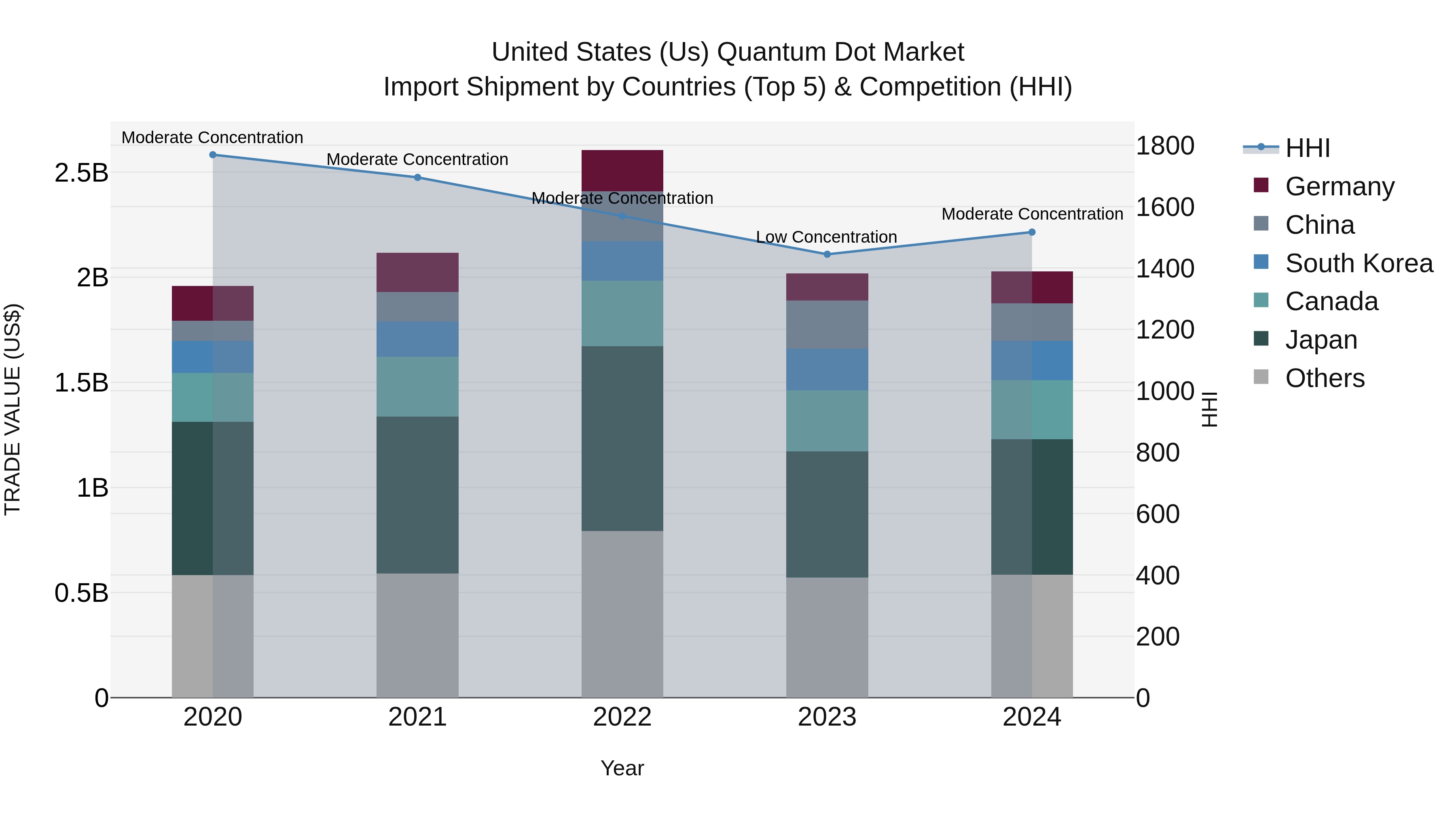
The United States saw a steady increase in quantum dot import shipments in 2024, with Japan, Canada, South Korea, China, and Taiwan being the top exporting countries. The market concentration, as measured by the HHI, shifted from low to moderate in 2024, indicating a more balanced distribution among suppliers. The compound annual growth rate (CAGR) from 2020 to 2024 stood at 0.87%, showing a gradual expansion in the market. Additionally, the growth rate from 2023 to 2024 was 0.44%, suggesting a slight acceleration in import volumes during that period.
United States (US) Quantum Dot Market Overview
The United States Quantum Dot Market is witnessing significant growth driven by increasing demand for quantum dot technology across various industries such as consumer electronics, healthcare, and defense. Quantum dots offer advantages such as high brightness, wide color gamut, and energy efficiency, making them ideal for applications in displays, LED lighting, and medical imaging. The market is characterized by the presence of key players like Nanosys Inc., Quantum Materials Corporation, and QD Vision Inc., who are investing in research and development to enhance product offerings and expand their market presence. With ongoing advancements in quantum dot technology and rising adoption in different sectors, the US Quantum Dot Market is expected to experience continued growth in the coming years.
United States (US) Quantum Dot Market Trends and Opportunities
The US Quantum Dot Market is experiencing rapid growth due to the increasing demand for high-quality displays in electronic devices, particularly in the television and smartphone sectors. Quantum dots offer superior color accuracy, brightness, and energy efficiency compared to traditional display technologies, driving their adoption in the market. Additionally, the rising focus on sustainability and environmental concerns is fueling the demand for quantum dot technology as it enables energy savings and reduced carbon footprint. Opportunities in the US Quantum Dot Market lie in expanding applications beyond displays to areas such as healthcare, solar cells, and security tagging. Companies investing in research and development to enhance quantum dot performance and production processes are poised to benefit from this growing market.
United States (US) Quantum Dot Market Challenges
The United States Quantum Dot Market faces several challenges, including regulatory hurdles related to the safe use and disposal of quantum dots due to their potential environmental impact. Additionally, there is a need for increased awareness and education among consumers and businesses about the benefits and applications of quantum dots to drive market adoption. Competition from other advanced display technologies and the high cost of production are also significant challenges that hinder the growth of the market. Furthermore, the lack of standardization in manufacturing processes and quality control measures poses a risk to the consistency and reliability of quantum dot products in the market. Overcoming these challenges will require collaboration between industry stakeholders, government bodies, and research institutions to address regulatory concerns, improve production efficiency, and enhance market understanding.
United States (US) Quantum Dot Market Drivers
The United States Quantum Dot Market is being primarily driven by the increasing demand for high-quality displays in consumer electronics such as smartphones, TVs, and laptops. Quantum dots offer superior color accuracy, brightness, and energy efficiency compared to traditional display technologies, making them a popular choice among manufacturers and consumers. Additionally, the growing adoption of quantum dots in healthcare for applications such as bioimaging and drug delivery is fueling market growth. Advancements in quantum dot technology, such as the development of cadmium-free quantum dots, are also driving market expansion by addressing environmental concerns and regulatory restrictions. Overall, the US Quantum Dot Market is expected to continue growing due to the increasing need for advanced display technologies and the expanding applications of quantum dots across various industries.
United States (US) Quantum Dot Market Government Policies
The US government has shown a commitment to supporting the Quantum Dot Market through various policies and initiatives. These include investments in research and development, funding for technology commercialization, and strategic partnerships with industry stakeholders. Additionally, regulatory efforts have been focused on ensuring the safety and security of Quantum Dot technologies, as well as promoting domestic manufacturing and supply chain resilience. Overall, the government`s policies are aimed at fostering innovation, driving economic growth, and maintaining competitiveness in the global Quantum Dot Market.
United States (US) Quantum Dot Market Future Outlook
The future outlook for the United States Quantum Dot Market appears promising, with significant growth potential projected in the coming years. Factors such as increasing demand for quantum dot technology in applications such as displays, healthcare, and energy efficiency, coupled with ongoing research and development efforts to enhance quantum dot performance, are expected to drive market expansion. The US market is likely to benefit from collaborations between industry players and research institutions to develop innovative quantum dot-based products. Additionally, the growing focus on sustainability and environmental concerns is anticipated to further boost the adoption of quantum dots in various sectors. Overall, the US Quantum Dot Market is forecasted to experience robust growth and technological advancements in the foreseeable future.
Key Highlights of the Report:
- United States (US) Quantum Dot Market Outlook
- Market Size of United States (US) Quantum Dot Market, 2024
- Forecast of United States (US) Quantum Dot Market, 2031
- Historical Data and Forecast of United States (US) Quantum Dot Revenues & Volume for the Period 2021 - 2031
- United States (US) Quantum Dot Market Trend Evolution
- United States (US) Quantum Dot Market Drivers and Challenges
- United States (US) Quantum Dot Price Trends
- United States (US) Quantum Dot Porter's Five Forces
- United States (US) Quantum Dot Industry Life Cycle
- Historical Data and Forecast of United States (US) Quantum Dot Market Revenues & Volume By Material for the Period 2021 - 2031
- Historical Data and Forecast of United States (US) Quantum Dot Market Revenues & Volume By Cadmium-based for the Period 2021 - 2031
- Historical Data and Forecast of United States (US) Quantum Dot Market Revenues & Volume By Cadmium-free for the Period 2021 - 2031
- Historical Data and Forecast of United States (US) Quantum Dot Market Revenues & Volume By Product for the Period 2021 - 2031
- Historical Data and Forecast of United States (US) Quantum Dot Market Revenues & Volume By Displays for the Period 2021 - 2031
- Historical Data and Forecast of United States (US) Quantum Dot Market Revenues & Volume By Other Products for the Period 2021 - 2031
- Historical Data and Forecast of United States (US) Quantum Dot Market Revenues & Volume By Vertical for the Period 2021 - 2031
- Historical Data and Forecast of United States (US) Quantum Dot Market Revenues & Volume By Consumer for the Period 2021 - 2031
- Historical Data and Forecast of United States (US) Quantum Dot Market Revenues & Volume By Commercial for the Period 2021 - 2031
- Historical Data and Forecast of United States (US) Quantum Dot Market Revenues & Volume By Healthcare for the Period 2021 - 2031
- Historical Data and Forecast of United States (US) Quantum Dot Market Revenues & Volume By Defense for the Period 2021 - 2031
- Historical Data and Forecast of United States (US) Quantum Dot Market Revenues & Volume By Telecommunications for the Period 2021 - 2031
- Historical Data and Forecast of United States (US) Quantum Dot Market Revenues & Volume By Others for the Period 2021 - 2031
- United States (US) Quantum Dot Import Export Trade Statistics
- Market Opportunity Assessment By Material
- Market Opportunity Assessment By Product
- Market Opportunity Assessment By Vertical
- United States (US) Quantum Dot Top Companies Market Share
- United States (US) Quantum Dot Competitive Benchmarking By Technical and Operational Parameters
- United States (US) Quantum Dot Company Profiles
- United States (US) Quantum Dot Key Strategic Recommendations






































