United States (US) RegTech Market Size & Growth Rate (2026-2032)
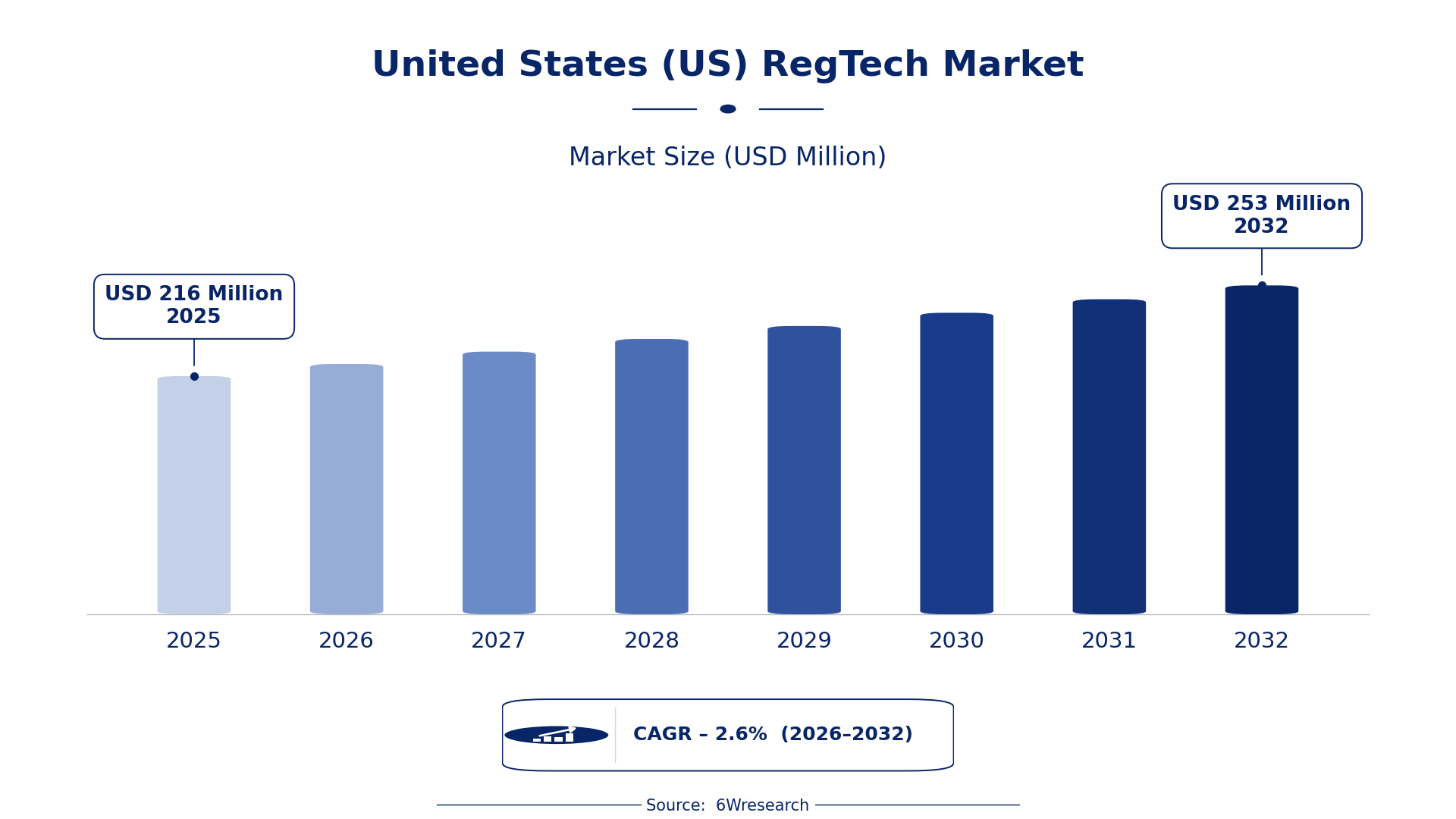
The United States (US) RegTech Market was estimated at USD 216 Million in 2025 and is projected to reach USD 253 Million by 2032, growing at a CAGR of 2.6% from 2026 to 2032.
United States (US) RegTech Market Synopsis
The demand for RegTech solutions in the United States is driven by an increasingly complex regulatory environment. Businesses across various sectors, especially finance and healthcare, are seeking automated compliance tools to manage their obligations efficiently.
RegTech firms are stepping up by integrating advanced technologies like AI and blockchain into their offerings. This not only enhances compliance efficiency but also helps mitigate risks associated with non-compliance in a rapidly evolving landscape.
United States (US) RegTech Market Year-wise Growth Rate and Key Drivers
This graph illustrates the annual growth rates of the United States (US) RegTech Market from 2021 to 2032, highlighting a steady upward trajectory and projected expansion over the forecast period.
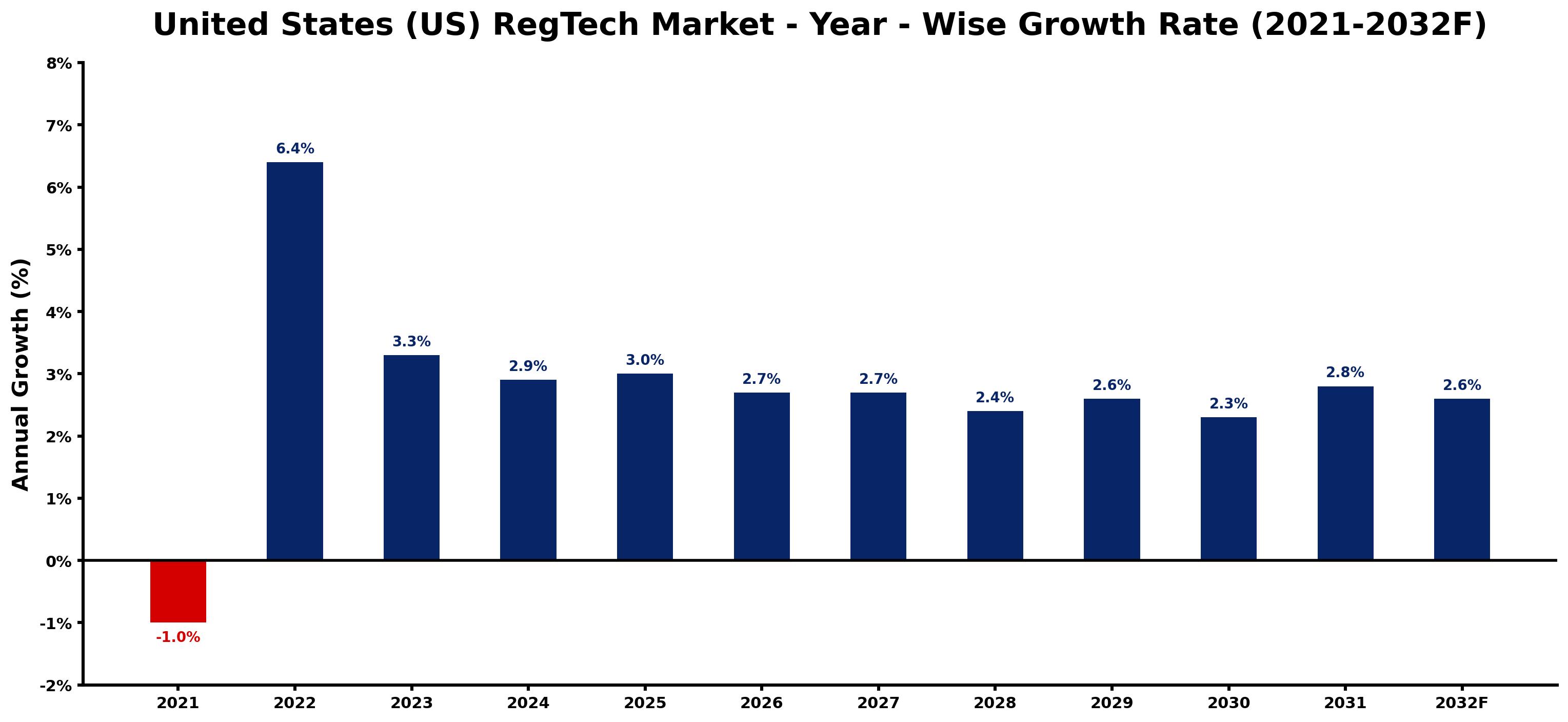
The table below presents the year‑wise growth rates along with the key drivers influencing the market
| Year | Growth Rate | Major Drivers |
| 2021 | -1.0% | Increased focus on data privacy regulations by SEC |
| 2022 | 6.4% | SEC regulatory changes increase compliance technology demand. |
| 2023 | 3.3% | Rising focus on anti-money laundering technologies by banks. |
| 2024 | 2.9% | Increased scrutiny on data privacy regulations boosts solutions. |
| 2025 | 3.0% | State-level fintech innovation initiatives drive RegTech adoption. |
| 2026 | 2.7% | Growing cybersecurity threats elevate regulatory compliance needs. |
| 2027 | 2.7% | Biden administration’s focus on financial transparency supports growth. |
| 2028 | 2.4% | Continued digital transformation necessitates risk management tools. |
| 2029 | 2.6% | Emergence of crypto regulations fuels demand for compliance solutions. |
| 2030 | 2.3% | Increased fraud prevention measures stimulate regulatory technology adoption. |
| 2031 | 2.8% | Investments in KYC technologies driven by stricter laws. |
| 2032 | 2.6% | Financial institutions prioritize tech to meet evolving regulations. |
Note: Market size estimations and growth projections presented in this report are based on 6Wresearch's proprietary forecasting methodology, utilizing the latest available industry data, government publications, and primary research inputs.
United States (US) RegTech Market Key Takeaways
Below are some of the specific key takeaways from the market, including:
- The market is characterized by a diverse mix of startups and established players focused on regulatory compliance.
- Cloud-based solutions are becoming increasingly popular for their scalability and flexibility.
- AI and machine learning are essential technologies driving improvements in regulatory monitoring.
- Investment opportunities exist in compliance automation and data analytics platforms.
- Government initiatives are fostering innovation in the RegTech sector, encouraging the development of new solutions.
Evaluation of Restraints in United States (US) RegTech Market
The US RegTech market faces notable challenges that may impede its growth trajectory. One primary concern is the constantly shifting regulatory landscape, which requires RegTech solutions to be frequently updated to ensure compliance. This ongoing need for adaptation can strain resources for both developers and clients alike.
Additionally, integrating RegTech solutions into existing organizational systems poses a significant hurdle. Companies often find themselves grappling with data privacy and security issues while trying to align new technologies with their current processes. The absence of standardized regulations can further complicate the selection of appropriate compliance tools.
United States (US) RegTech Market Trends
The RegTech sector is witnessing a marked shift towards cloud-based solutions, which offer greater flexibility and scalability to users. This trend enables organizations to adapt quickly to regulatory changes without significant upfront investments in infrastructure.
on top of that, the integration of AI and machine learning is transforming regulatory reporting and monitoring capabilities. Companies are increasingly focused on developing tools that automate compliance processes, thereby reducing operational costs and enhancing overall risk management.
United States (US) RegTech Market Opportunities
The RegTech market in the United States presents numerous investment opportunities, particularly in areas that facilitate compliance automation and regulatory reporting. Companies specializing in identity verification solutions and data analytics are likely to attract significant attention from investors looking to capitalize on this growing demand.
on top of that, as regulatory scrutiny increases across various sectors, there is a pressing need for solutions that streamline compliance processes. Investors can explore partnerships with innovative startups or consider funding R&D initiatives to develop next-generation compliance technologies.
Government Initiatives in the United States (US) RegTech Market
Government policies are playing a crucial role in shaping the direction of the RegTech market in the United States. The regulatory posture emphasizes the importance of innovation and efficiency in compliance practices across various industries. Initiatives aimed at fostering technological adoption are becoming increasingly relevant.
- A recently launched Regulatory Sandbox by the Office of the Comptroller of the Currency (OCC) allows companies to test RegTech solutions in a controlled environment.
- Current initiatives by the Securities and Exchange Commission (SEC) focus on enhancing regulatory compliance and oversight within the financial industry through the adoption of new technologies.
- Ongoing efforts include collaboration between regulatory bodies and private firms to develop standards for RegTech solutions.
- Planned initiatives aim to expand access to compliance tools for small and medium enterprises by 2026, promoting a more equitable regulatory environment.
Future Insights of the United States (US) RegTech Market
Looking ahead to 2026-2032, the US RegTech market is set for substantial growth. The increasing complexity of regulatory requirements across various sectors will drive demand for innovative solutions that enhance compliance, risk management, and data security.
Advanced technologies such as artificial intelligence and blockchain will continue to push boundaries in regulatory technology, enabling organizations to streamline processes and ensure real-time compliance monitoring. This evolution will make the RegTech sector a focal point for investment and innovation.
United States (US) RegTech Market Latest Developments
The past 12-14 months have seen a surge in activity within the US RegTech market. Companies are increasingly launching innovative solutions to meet the rising demand for efficient compliance tools. This trend is characterized by both technological advancements and strategic partnerships aimed at enhancing service delivery.
- A leading technology vendor launched a new AI-driven compliance management platform in early 2025, designed to automate regulatory reporting processes.
- An initiative that began in mid-2025 focuses on collaboration with universities to develop research-driven RegTech solutions.
- A rollout of a comprehensive data privacy compliance solution is expected to begin in the second half of 2026, targeting healthcare organizations.
- Partnerships between RegTech firms and financial institutions are currently ongoing, aimed at improving anti-money laundering (AML) compliance capabilities.
United States (US) RegTech Market - Key Attractiveness of the Report
- 10 Years of Market Numbers
- Historical Data Starting from 2022 to 2025
- Base Year: 2025
- Forecast Data until 2032
- Key Performance Indicators Impacting the Market
- Major Upcoming Developments and Projects
Key Highlights of the Report:
- United States (US) RegTech Market Outlook
- Market Size of United States (US) RegTech Market, 2025
- Forecast of United States (US) RegTech Market, 2032
- Historical Data and Forecast of United States (US) RegTech Revenues & Volume for the Period 2022-2032F
- United States (US) RegTech Market Trend Evolution
- United States (US) RegTech Market Drivers and Challenges
- United States (US) RegTech Price Trends
- United States (US) RegTech Porter's Five Forces
- United States (US) RegTech Industry Life Cycle
- Historical Data and Forecast of United States (US) RegTech Market Revenues & Volume By Component for the Period 2022-2032F
- Historical Data and Forecast of United States (US) RegTech Market Revenues & Volume By Solutions for the Period 2022-2032F
- Historical Data and Forecast of United States (US) RegTech Market Revenues & Volume By Services for the Period 2022-2032F
- Historical Data and Forecast of United States (US) RegTech Market Revenues & Volume By Application for the Period 2022-2032F
- Historical Data and Forecast of United States (US) RegTech Market Revenues & Volume By Risk & Compliance Management for the Period 2022-2032F
- Historical Data and Forecast of United States (US) RegTech Market Revenues & Volume By Identity Management for the Period 2022-2032F
- Historical Data and Forecast of United States (US) RegTech Market Revenues & Volume By Regulatory Reporting for the Period 2022-2032F
- Historical Data and Forecast of United States (US) RegTech Market Revenues & Volume By AML and Fraud Management for the Period 2022-2032F
- Historical Data and Forecast of United States (US) RegTech Market Revenues & Volume By Regulatory Intelligence for the Period 2022-2032F
- Historical Data and Forecast of United States (US) RegTech Market Revenues & Volume By Organization Size for the Period 2022-2032F
- Historical Data and Forecast of United States (US) RegTech Market Revenues & Volume By SMEs for the Period 2022-2032F
- Historical Data and Forecast of United States (US) RegTech Market Revenues & Volume By Large Enterprises for the Period 2022-2032F
- Historical Data and Forecast of United States (US) RegTech Market Revenues & Volume By Deployment Mode for the Period 2022-2032F
- Historical Data and Forecast of United States (US) RegTech Market Revenues & Volume By On-Premises for the Period 2022-2032F
- Historical Data and Forecast of United States (US) RegTech Market Revenues & Volume By Cloud for the Period 2022-2032F
- Historical Data and Forecast of United States (US) RegTech Market Revenues & Volume By Vertical for the Period 2022-2032F
- Historical Data and Forecast of United States (US) RegTech Market Revenues & Volume By Banking for the Period 2022-2032F
- Historical Data and Forecast of United States (US) RegTech Market Revenues & Volume By Insurance for the Period 2022-2032F
- Historical Data and Forecast of United States (US) RegTech Market Revenues & Volume By Non-Financial for the Period 2022-2032F
- United States (US) RegTech Import Export Trade Statistics
- Market Opportunity Assessment By Component
- Market Opportunity Assessment By Application
- Market Opportunity Assessment By Organization Size
- Market Opportunity Assessment By Deployment Mode
- Market Opportunity Assessment By Vertical
- United States (US) RegTech Top Companies Market Share
- United States (US) RegTech Competitive Benchmarking By Technical and Operational Parameters
- United States (US) RegTech Company Profiles
- United States (US) RegTech Key Strategic Recommendations






































