United States (US) Security Door Market Top 5 Importing Countries and Market Competition (HHI) Analysis
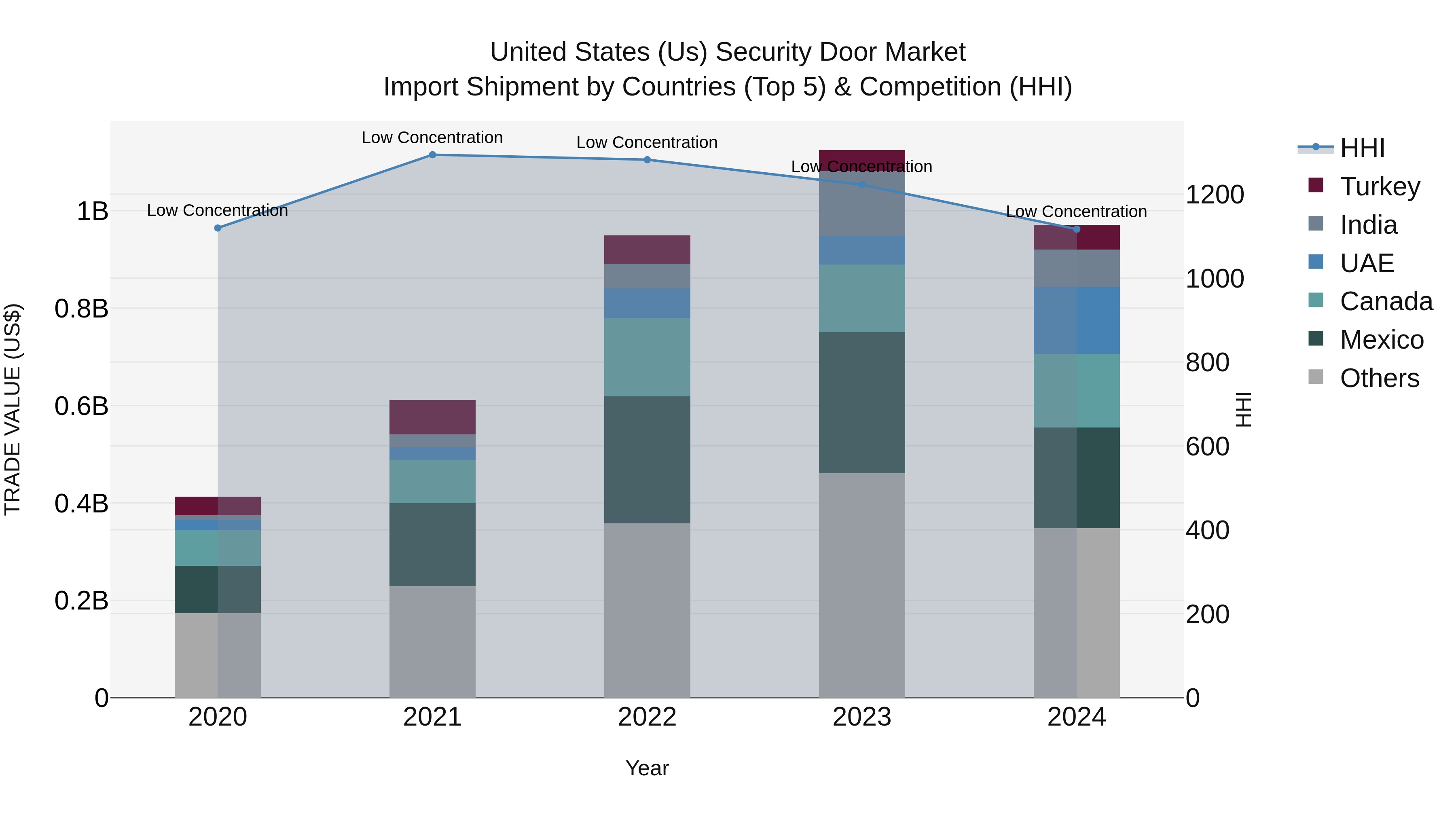
The United States security door import market continues to show strong growth with a significant Compound Annual Growth Rate (CAGR) of 23.84% from 2020 to 2024. Despite a slight decline in growth rate from 2023 to 2024, the market remains robust. Top exporting countries such as Mexico, Canada, UAE, India, and South Korea play a vital role in supplying security doors to the US market. With a low concentration level indicated by the Herfindahl-Hirschman Index (HHI) in 2024, the market offers opportunities for a diverse range of suppliers to cater to the growing demand for security doors in the United States.
United States (US) Security Door Market Synopsis
The United States Security Door Market is a thriving industry driven by increased concerns about safety and security among homeowners. Security doors are designed to provide enhanced protection against break-ins, intruders, and extreme weather conditions. The market offers a wide range of security door options, including steel doors, aluminum doors, and iron doors, with varying levels of security features such as reinforced frames, multiple locks, and impact-resistant panels. Key players in the market include companies like Larson Manufacturing, Unique Home Designs, and Grisham Security Doors. The market is also influenced by technological advancements, with smart security doors gaining popularity for their integration with home automation systems. With a growing emphasis on home security, the US Security Door Market is expected to continue its steady growth trajectory in the coming years.
United States (US) Security Door Market Trends
The US Security Door Market is currently experiencing growth driven by increasing concerns about home security and safety. Consumers are increasingly investing in security doors to protect their homes against break-ins, vandalism, and extreme weather events. Key trends in the market include the rising adoption of smart security doors equipped with advanced features such as keyless entry, remote monitoring, and integration with home automation systems. Energy efficiency is also a growing consideration, with demand for security doors that offer both protection and insulation. Manufacturers are focusing on innovative designs and materials to meet consumer preferences for both aesthetics and functionality. Additionally, the market is witnessing a shift towards customization, with more options available for personalized security door solutions tailored to individual needs and preferences.
United States (US) Security Door Market Challenges
In the US Security Door Market, challenges include increasing competition from both domestic and international manufacturers, pricing pressure due to the presence of low-cost alternatives, and the need for continuous innovation to meet evolving security threats. Additionally, fluctuating raw material prices can impact profit margins, while regulatory requirements and standards compliance add complexity to product development and marketing efforts. The market also faces the challenge of educating consumers about the benefits of high-quality security doors over traditional options, as well as addressing concerns related to installation and maintenance costs. Overall, companies operating in the US Security Door Market must navigate these challenges to maintain a competitive edge and drive growth in a dynamic and demanding industry landscape.
United States (US) Security Door Market Investment Opportunities
The United States security door market presents a promising investment opportunity due to increasing concerns about safety and security among residential and commercial property owners. The market is driven by factors such as rising crime rates, technological advancements in security door systems, and a growing emphasis on home security. Investors can explore opportunities in the manufacturing, distribution, and installation of various types of security doors, including steel doors, aluminum doors, and composite doors. Additionally, there is potential for growth in the customization and integration of smart security features into these doors, catering to the demand for advanced security solutions. With a favorable economic environment and a strong focus on security, the US security door market offers a lucrative investment landscape for those looking to capitalize on the growing demand for enhanced safety measures.
Jordan Agar Market Government Policies
Government policies related to the US Security Door Market primarily focus on building codes and regulations to ensure the safety and security of buildings and occupants. The US government sets standards for security doors to meet specific requirements in terms of material quality, durability, and resistance to forced entry. These standards are often developed by organizations such as the National Institute of Standards and Technology (NIST) and the American National Standards Institute (ANSI). Additionally, government initiatives promote the use of security doors in critical infrastructure facilities, government buildings, and public spaces to enhance national security and protect against potential threats. Compliance with these regulations is mandatory for manufacturers and building owners to ensure the effectiveness of security measures in safeguarding properties and individuals.
United States (US) Security Door Market Future Outlook
The United States Security Door Market is expected to experience steady growth in the coming years due to increasing concerns about safety and security among residential and commercial property owners. Factors such as rising crime rates, growing awareness of the importance of home security, and advancements in door technology are driving the demand for security doors. Additionally, the construction industry`s recovery from the impact of the COVID-19 pandemic is expected to boost market growth as new residential and commercial buildings are constructed or renovated with enhanced security features. Manufacturers in the US security door market are focusing on innovation, offering a wide range of designs, materials, and smart features to cater to diverse customer preferences. Overall, the market is likely to witness sustained growth as security remains a top priority for property owners.
Key Highlights of the Report:
- United States (US) Security Door Market Outlook
- Market Size of United States (US) Security Door Market, 2024
- Forecast of United States (US) Security Door Market, 2031
- Historical Data and Forecast of United States (US) Security Door Revenues & Volume for the Period 2021 - 2031
- United States (US) Security Door Market Trend Evolution
- United States (US) Security Door Market Drivers and Challenges
- United States (US) Security Door Price Trends
- United States (US) Security Door Porter's Five Forces
- United States (US) Security Door Industry Life Cycle
- Historical Data and Forecast of United States (US) Security Door Market Revenues & Volume By Product Type for the Period 2021 - 2031
- Historical Data and Forecast of United States (US) Security Door Market Revenues & Volume By Wood Security Door for the Period 2021 - 2031
- Historical Data and Forecast of United States (US) Security Door Market Revenues & Volume By Metal Security Door for the Period 2021 - 2031
- Historical Data and Forecast of United States (US) Security Door Market Revenues & Volume By Industry for the Period 2021 - 2031
- Historical Data and Forecast of United States (US) Security Door Market Revenues & Volume By Individual Purchaser for the Period 2021 - 2031
- Historical Data and Forecast of United States (US) Security Door Market Revenues & Volume By Corporate Buyers for the Period 2021 - 2031
- Historical Data and Forecast of United States (US) Security Door Market Revenues & Volume By Channel for the Period 2021 - 2031
- Historical Data and Forecast of United States (US) Security Door Market Revenues & Volume By Direct Sales for the Period 2021 - 2031
- Historical Data and Forecast of United States (US) Security Door Market Revenues & Volume By Distributor for the Period 2021 - 2031
- United States (US) Security Door Import Export Trade Statistics
- Market Opportunity Assessment By Product Type
- Market Opportunity Assessment By Industry
- Market Opportunity Assessment By Channel
- United States (US) Security Door Top Companies Market Share
- United States (US) Security Door Competitive Benchmarking By Technical and Operational Parameters
- United States (US) Security Door Company Profiles
- United States (US) Security Door Key Strategic Recommendations






































