United States (US) Sunflower Seeds Market Top 5 Importing Countries and Market Competition (HHI) Analysis
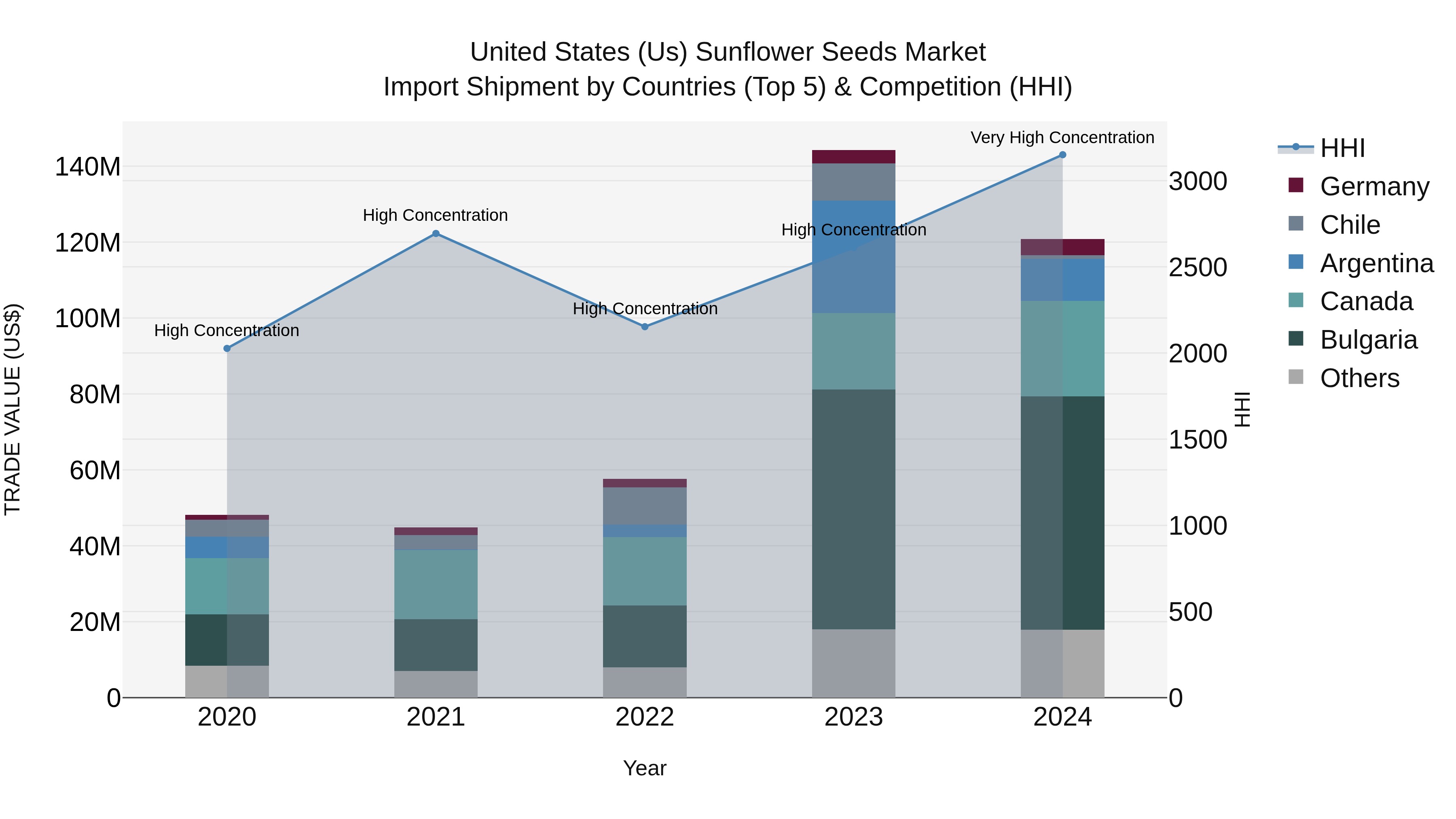
The United States continued to see a significant influx of sunflower seeds imports in 2024, with top exporting countries including Bulgaria, Canada, Argentina, Turkey, and Germany. The Herfindahl-Hirschman Index (HHI) indicated a shift towards very high concentration in the market from the already high concentration seen in 2023. Despite a strong compound annual growth rate (CAGR) of 25.82% from 2020 to 2024, there was a notable decrease in growth rate from 2023 to 2024 at -16.26%. This trend suggests a complex market dynamic that may warrant further analysis to understand the factors at play.
United States (US) Sunflower Seeds Market Overview
The United States sunflower seeds market is witnessing steady growth due to increasing consumer awareness about the health benefits of sunflower seeds, which are rich in nutrients like Vitamin E, magnesium, and antioxidants. The market is driven by the rising demand for healthy snacking options, as sunflower seeds are considered a convenient and nutritious choice. Various product innovations, such as flavored sunflower seeds and organic varieties, are also contributing to market expansion. Additionally, the popularity of sunflower seeds as a versatile ingredient in various culinary applications further boosts market growth. Key players in the US sunflower seeds market are focusing on product quality, packaging innovations, and marketing strategies to cater to evolving consumer preferences and maintain a competitive edge in the market.
United States (US) Sunflower Seeds Market Trends
The US sunflower seeds market is experiencing a trend towards healthier snacking options, driving an increased demand for flavored and seasoned sunflower seeds. Consumers are seeking out products that are not only tasty but also nutritious, leading to a rise in the popularity of organic, non-GMO, and gluten-free sunflower seeds. Additionally, there is a growing interest in innovative packaging formats and convenient, on-the-go snack options within the sunflower seeds market. With a focus on sustainability and transparency in sourcing, consumers are also looking for products that are ethically produced and environmentally friendly. Overall, the US sunflower seeds market is witnessing a shift towards premium, health-conscious products that offer a variety of flavors and packaging options to cater to the evolving preferences of consumers.
United States (US) Sunflower Seeds Market Challenges
In the US Sunflower Seeds Market, challenges primarily stem from increasing competition, fluctuating raw material prices, and changing consumer preferences. As more players enter the market, companies are facing pressure to differentiate their products through innovation and marketing strategies. The volatility in raw material prices, influenced by factors such as weather conditions and global trade dynamics, poses a risk to the profitability of sunflower seed producers. Additionally, shifts in consumer preferences towards healthier snack options and sustainable sourcing practices require companies to adapt and invest in product development and sustainability initiatives. Meeting these challenges requires a deep understanding of market trends, effective supply chain management, and strategic decision-making to stay competitive in the dynamic US sunflower seeds market.
United States (US) Sunflower Seeds Market Investment Opportunities
The United States Sunflower Seeds Market offers promising investment opportunities due to the increasing consumer demand for healthy snacks and the rising popularity of plant-based and natural food products. Investing in the production and distribution of sunflower seeds can be lucrative, especially with the growing awareness of their health benefits such as being a good source of vitamins and minerals. Additionally, the versatility of sunflower seeds as an ingredient in various food products further expands market potential. With the market projected to continue growing, investing in innovative packaging, marketing strategies, and product development to cater to changing consumer preferences can yield significant returns in the US Sunflower Seeds Market.
United States (US) Sunflower Seeds Market Government Policy
Government policies related to the US Sunflower Seeds Market primarily focus on agricultural regulations, trade agreements, and food safety standards. The US Department of Agriculture (USDA) provides support to sunflower seed farmers through programs such as crop insurance and subsidies. Trade policies, including tariffs and import/export regulations, impact the flow of sunflower seeds in and out of the country. Additionally, the Food and Drug Administration (FDA) sets standards for food safety and labeling requirements for sunflower seed products to ensure consumer protection. Overall, government policies play a key role in shaping the operations and competitiveness of the US sunflower seeds market, affecting farmers, manufacturers, and consumers alike.
United States (US) Sunflower Seeds Market Future Outlook
The United States Sunflower Seeds Market is expected to witness steady growth in the coming years due to increasing consumer awareness of the health benefits associated with sunflower seeds, such as their high content of essential nutrients and antioxidants. The growing popularity of plant-based snacks and the rising demand for healthy and convenient snack options will further drive market growth. Additionally, the use of sunflower seeds in various food products like baked goods, salads, and snack bars is expected to contribute to market expansion. Manufacturers are likely to focus on product innovation, such as introducing flavored and seasoned sunflower seeds, to cater to evolving consumer preferences. Overall, the US Sunflower Seeds Market is poised for positive growth driven by health-conscious consumer trends and product diversification strategies.
Key Highlights of the Report:
- United States (US) Sunflower Seeds Market Outlook
- Market Size of United States (US) Sunflower Seeds Market, 2021
- Forecast of United States (US) Sunflower Seeds Market, 2031
- Historical Data and Forecast of United States (US) Sunflower Seeds Revenues & Volume for the Period 2018 - 2031
- United States (US) Sunflower Seeds Market Trend Evolution
- United States (US) Sunflower Seeds Market Drivers and Challenges
- United States (US) Sunflower Seeds Price Trends
- United States (US) Sunflower Seeds Porter's Five Forces
- United States (US) Sunflower Seeds Industry Life Cycle
- Historical Data and Forecast of United States (US) Sunflower Seeds Market Revenues & Volume By Type for the Period 2018 - 2031
- Historical Data and Forecast of United States (US) Sunflower Seeds Market Revenues & Volume By Open Pollinated for the Period 2018 - 2031
- Historical Data and Forecast of United States (US) Sunflower Seeds Market Revenues & Volume By Hybrids for the Period 2018 - 2031
- United States (US) Sunflower Seeds Import Export Trade Statistics
- Market Opportunity Assessment By Type
- United States (US) Sunflower Seeds Top Companies Market Share
- United States (US) Sunflower Seeds Competitive Benchmarking By Technical and Operational Parameters
- United States (US) Sunflower Seeds Company Profiles
- United States (US) Sunflower Seeds Key Strategic Recommendations






































