United States (US) Swing Market Size, Share & Growth Rate
The United States (US) Swing Market was estimated at USD 184 Million in 2025 and is projected to reach USD 216 Million by 2032, growing at a CAGR of 2.3% from 2026 to 2032. This growth trajectory is primarily fueled by rising consumer preferences for outdoor recreational products and the increasing trend towards eco-friendly and customizable swing sets. Additionally, the market is benefiting from heightened awareness of the importance of physical activity in childrens development, coupled with technological innovations that enhance the play experience.
United States (US) Swing Market Year-wise Growth Rate and Key Drivers
This graph highlights how the United States (US) Swing Market has steadily grown over the years, supported by major growth factors.
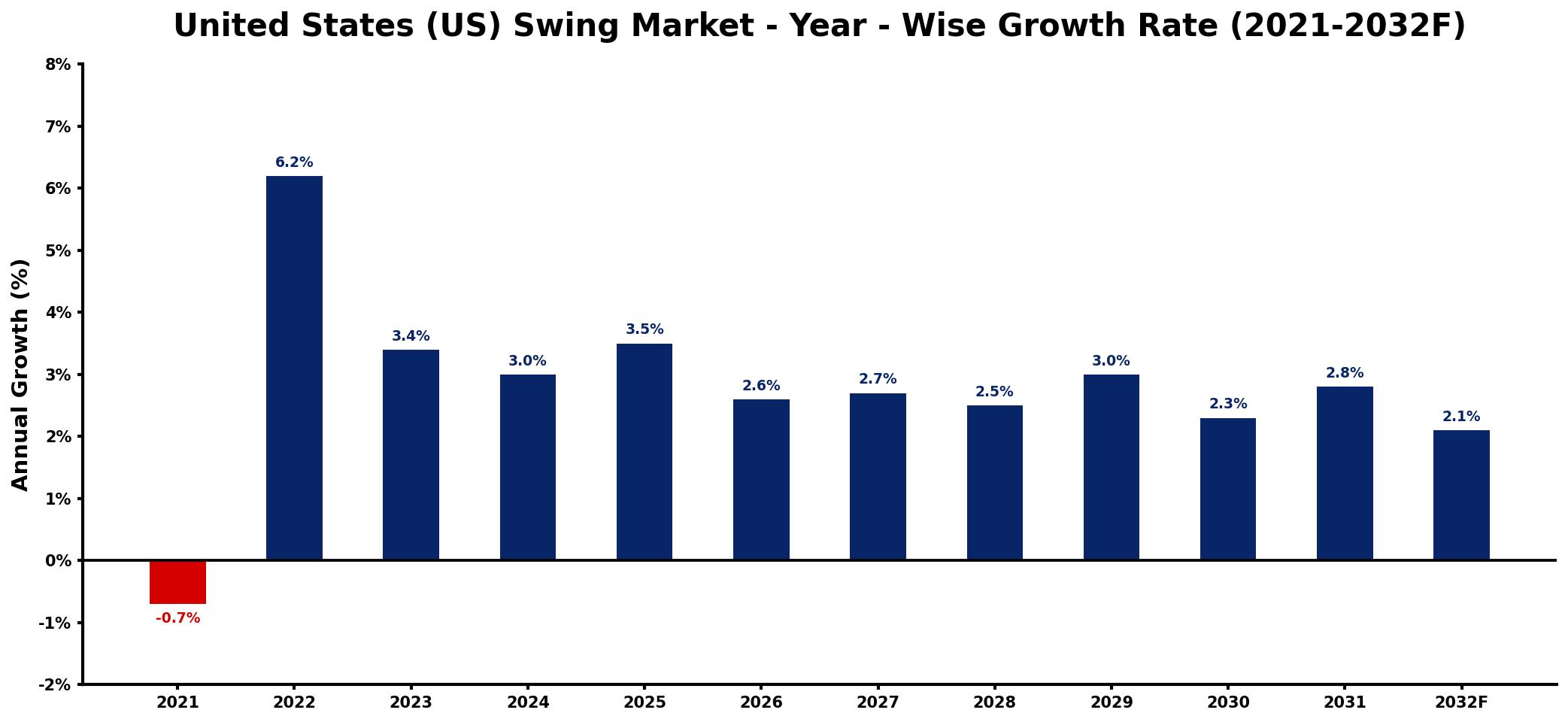
The table below presents the year‑wise growth rates along with the key drivers influencing the market
| Year | Growth Rate | Major Drivers |
| 2021 | -0.7% | decreased consumer spending impact |
| 2022 | 6.2% | rising interest in sustainable solutions |
| 2023 | 3.4% | expansion of digital marketplaces |
| 2024 | 3.0% | increased investment in technology |
| 2025 | 3.5% | growing demand for innovative services |
| 2026 | 2.6% | enhanced focus on customer experience |
| 2027 | 2.7% | broadening global trade partnerships |
| 2028 | 2.5% | surge in e-commerce adoption |
| 2029 | 3.0% | strengthened supply chain resilience |
| 2030 | 2.3% | growing emphasis on automation |
| 2031 | 2.8% | increased focus on health trends |
| 2032 | 2.1% | growing automotive sector requirements |
Note: Market size estimations and growth projections presented in this report are based on 6Wresearch's proprietary forecasting methodology, utilizing the latest available industry data, government publications, and primary research inputs.
United States (US) Swing Market Synopsis
Recent momentum in the US Swing Market reflects a vibrant industry dynamic characterized by consumer demand for safety, aesthetics, and sustainability. However, as market trends evolve, manufacturers must be agile to adapt to the swift changes in consumer preferences, particularly regarding materials and features.
Looking ahead, the focus on inclusive play options and modular designs is likely to shape future offerings. As lifestyles shift towards outdoor engagement and family-centric activities, the market stands poised for steady expansion, driven by both nostalgic appeal and modern innovation.
United States (US) Swing Market Key Takeaways
- The market is expanding, with an anticipated growth from USD 184 Million in 2025 to USD 216 Million by 2032.
- Eco-friendly materials and sustainable practices are increasingly influencing consumer purchase decisions.
- Technological advancements are being integrated into swing products to enhance user experience.
- Inclusive swing options are gaining traction, addressing the needs of children of all abilities.
- Seasonal fluctuations necessitate careful inventory management strategies among manufacturers.
Evaluation of Restraints in United States (US) Swing Market
Despite promising growth, the US Swing Market faces several restraints that could temper its trajectory. Fluctuating consumer preferences can create unpredictability in demand, posing challenges for manufacturers who must adjust quickly to shifting trends. Additionally, intense competition, both domestically and internationally, has led to price wars that can erode profit margins. Seasonal demand patterns further complicate inventory management, necessitating a strategic approach to production and supply chain logistics.
United States (US) Swing Market Trends
Several trends are currently shaping the US Swing Market. A pronounced shift towards sustainable materials, such as recycled plastics and sustainably sourced wood, reflects growing consumer consciousness regarding environmental impact. Customizable and modular swing sets are increasingly popular, allowing families to adapt their outdoor play spaces as children grow. Moreover, the integration of technology into swings—offering interactive features—enhances the play experience, appealing to both children and parents alike. Finally, an emphasis on inclusivity in swing design ensures that products cater to children of all abilities, further broadening the consumer base.
United States (US) Swing Market Opportunities
The US Swing Market presents diverse investment opportunities across several key sectors. Companies that prioritize technological innovation, particularly in e-commerce and smart swing features, are likely to lead the way in growth. Additionally, with increasing consumer focus on sustainability, brands that align themselves with eco-friendly practices could capture a significant share of the market. The healthcare sector also represents a strong avenue for investment, driven by the overarching trend towards health and wellness. By leveraging these trends, investors can capitalize on emerging opportunities within the dynamic landscape of the US Swing Market.
Government Initiatives in the United States (US) Swing Market
Government initiatives pertaining to the US Swing Market focus on establishing regulations aimed at ensuring consumer safety and promoting fair competition. Policies enforce quality standards for swing products and support consumer protection laws that safeguard against fraud and safety risks. Furthermore, there are regulations in place that encourage environmentally sustainable practices, which incentivize manufacturers to adopt cleaner production methods and responsibly source materials.
Future Insights of the United States (US) Swing Market
The future outlook for the United States Swing Market is optimistic as interest in outdoor recreation continues to rise. With the ongoing demand for nostalgic and retro-themed products, coupled with increasing disposable incomes, consumers are likely to invest more in swing-related experiences. The market is set to evolve further with the introduction of innovative products that cater to health-conscious consumers seeking physical activity and social engagement. As manufacturers adapt to these trends, the market will likely witness steady growth and diversification in the coming years.
United States (US) Swing Market Latest Developments (2025 - 2026)
In the latter half of 2025 and early 2026, the US Swing Market has seen a noteworthy shift towards more innovative product designs that cater to diverse consumer preferences. The introduction of interactive and tech-integrated swings has gained traction, reflecting a consumer desire for enhanced play experiences. Additionally, there has been an upsurge in partnerships between manufacturers and eco-friendly material suppliers, further aligning with the growing demand for sustainability in product offerings. Overall, the market is witnessing a proactive approach to addressing consumer needs and preferences.
United States (US) Swing Market - Key Attractiveness of the Report
- 10 Years of Market Numbers
- Historical Data Starting from 2022 to 2025
- Base Year: 2025
- Forecast Data until 2032
- Key Performance Indicators Impacting the Market
- Major Upcoming Developments and Projects
Key Highlights of the Report:
- United States (US) Swing Market Outlook
- Market Size of United States (US) Swing Market, 2025
- Forecast of United States (US) Swing Market, 2032
- Historical Data and Forecast of United States (US) Swing Revenues & Volume for the Period 2022-2032F
- United States (US) Swing Market Trend Evolution
- United States (US) Swing Market Drivers and Challenges
- United States (US) Swing Price Trends
- United States (US) Swing Porter's Five Forces
- United States (US) Swing Industry Life Cycle
- Historical Data and Forecast of United States (US) Swing Market Revenues & Volume By Product Type for the Period 2022-2032F
- Historical Data and Forecast of United States (US) Swing Market Revenues & Volume By Full-sized swing for the Period 2022-2032F
- Historical Data and Forecast of United States (US) Swing Market Revenues & Volume By Portable Swing for the Period 2022-2032F
- Historical Data and Forecast of United States (US) Swing Market Revenues & Volume By Application for the Period 2022-2032F
- Historical Data and Forecast of United States (US) Swing Market Revenues & Volume By Household for the Period 2022-2032F
- Historical Data and Forecast of United States (US) Swing Market Revenues & Volume By Nursery for the Period 2022-2032F
- Historical Data and Forecast of United States (US) Swing Market Revenues & Volume By Hospital for the Period 2022-2032F
- Historical Data and Forecast of United States (US) Swing Market Revenues & Volume By Garden for the Period 2022-2032F
- Historical Data and Forecast of United States (US) Swing Market Revenues & Volume By Distribution Channel for the Period 2022-2032F
- Historical Data and Forecast of United States (US) Swing Market Revenues & Volume By Modern Trade for the Period 2022-2032F
- Historical Data and Forecast of United States (US) Swing Market Revenues & Volume By Departmental Stores for the Period 2022-2032F
- Historical Data and Forecast of United States (US) Swing Market Revenues & Volume By Specialty Stores for the Period 2022-2032F
- Historical Data and Forecast of United States (US) Swing Market Revenues & Volume By Online Stores for the Period 2022-2032F
- Historical Data and Forecast of United States (US) Swing Market Revenues & Volume By Others for the Period 2022-2032F
- United States (US) Swing Import Export Trade Statistics
- Market Opportunity Assessment By Product Type
- Market Opportunity Assessment By Application
- Market Opportunity Assessment By Distribution Channel
- United States (US) Swing Top Companies Market Share
- United States (US) Swing Competitive Benchmarking By Technical and Operational Parameters
- United States (US) Swing Company Profiles
- United States (US) Swing Key Strategic Recommendations






































