United States (US) Synthetic Fiber Market Top 5 Importing Countries and Market Competition (HHI) Analysis
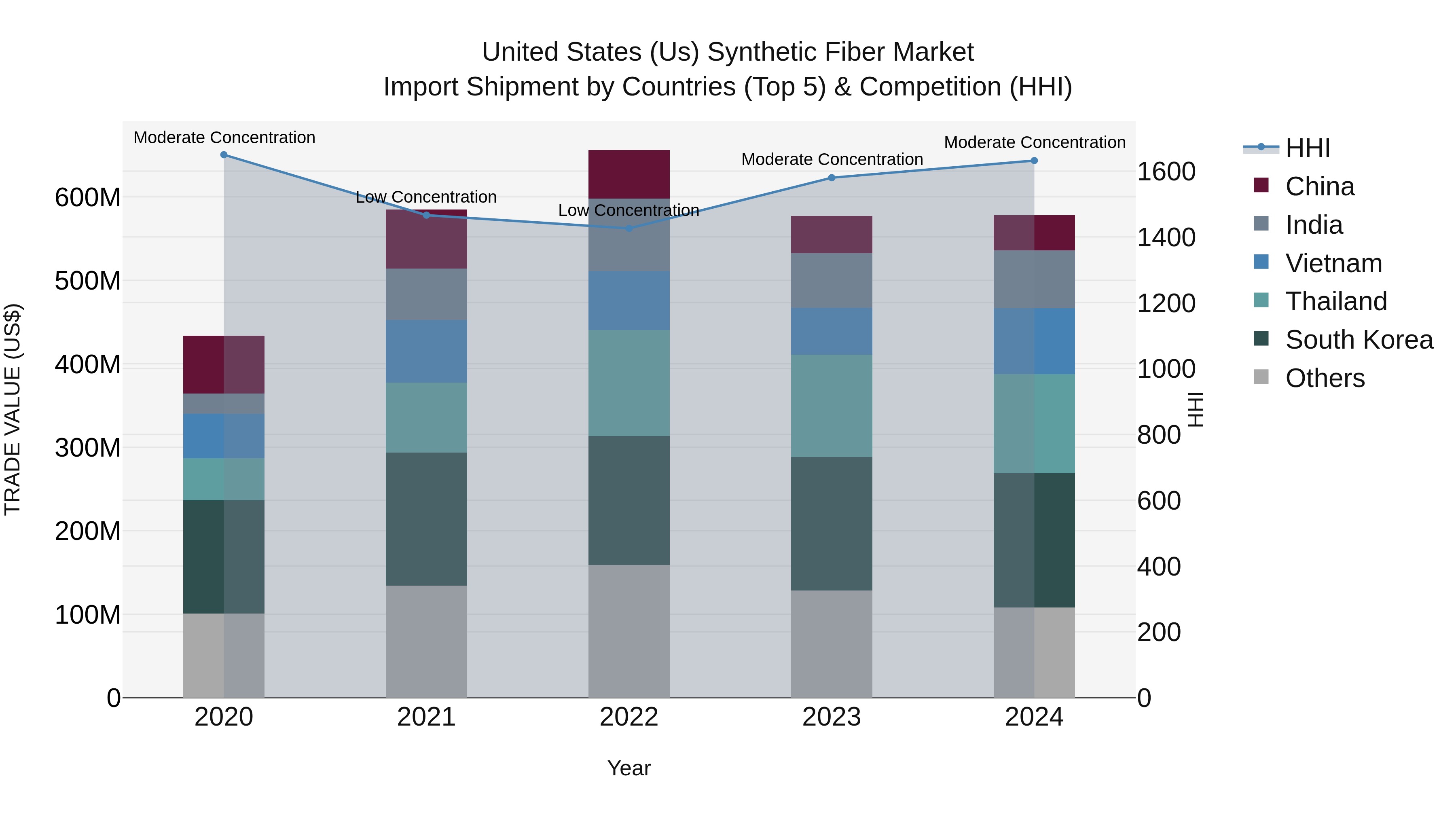
In 2024, the United States saw steady growth in synthetic fiber import shipments, with key exporting countries including South Korea, Thailand, Vietnam, India, and China. The market remained moderately concentrated, as indicated by the HHI, with a healthy compound annual growth rate (CAGR) of 7.44% from 2020 to 2024. Although the growth rate dipped slightly from 2023 to 2024 at 0.18%, the overall trend suggests a resilient and expanding market for synthetic fibers in the USA.
United States (US) Synthetic Fiber Market Synopsis
The United States Synthetic Fiber Market is a thriving industry driven by the growing demand for synthetic fibers in various applications such as textiles, automotive, packaging, and more. The market is characterized by a wide range of synthetic fibers including polyester, nylon, acrylic, and polypropylene, among others. Factors contributing to the market growth include the durability, versatility, and cost-effectiveness of synthetic fibers compared to natural fibers. Technological advancements in fiber production techniques and increasing awareness about sustainability are also influencing market trends. The US Synthetic Fiber Market is highly competitive, with key players focusing on product innovation, strategic partnerships, and expanding their product portfolios to cater to evolving consumer preferences. Overall, the market is projected to continue its growth trajectory driven by the increasing adoption of synthetic fibers in various end-use industries.
United States (US) Synthetic Fiber Market Trends
In the United States Synthetic Fiber Market, some current trends include the growing demand for sustainable and eco-friendly synthetic fibers as consumers become more environmentally conscious. Additionally, there is a rising preference for performance-oriented synthetic fibers in activewear and athleisure segments due to their moisture-wicking and quick-drying properties. The market is also witnessing an increasing focus on innovation and technological advancements in the development of new synthetic fibers with enhanced properties such as improved durability and comfort. Furthermore, the trend towards customization and personalization in textile products is driving the demand for specialty synthetic fibers that offer unique features and aesthetics to cater to diverse consumer preferences. Overall, the US Synthetic Fiber Market is evolving to meet the changing needs and preferences of consumers while also addressing sustainability concerns.
United States (US) Synthetic Fiber Market Challenges
The US Synthetic Fiber Market faces several challenges, including fluctuating raw material prices, increasing competition from natural fibers like cotton and wool, and growing environmental concerns related to the use of synthetic fibers. Additionally, changing consumer preferences towards sustainable and eco-friendly products have led to a shift in demand towards more environmentally friendly alternatives. The industry also grapples with the need for continuous innovation and technological advancements to stay competitive in the market. Furthermore, geopolitical factors, trade policies, and global economic conditions can impact the supply chain and production costs in the synthetic fiber market, adding another layer of complexity to the challenges faced by industry players. Overall, navigating these hurdles requires strategic planning, market intelligence, and a deep understanding of consumer trends and preferences.
United States (US) Synthetic Fiber Market Investment Opportunities
The US Synthetic Fiber Market presents promising investment opportunities due to growing demand across various industries such as textiles, apparel, automotive, and healthcare. With increasing awareness about sustainability and eco-friendly practices, there is a rising preference for synthetic fibers over traditional materials. Additionally, technological advancements in the production of synthetic fibers have led to improved quality, durability, and performance, further driving market growth. Investors can consider opportunities in companies involved in the manufacturing, distribution, and innovation of synthetic fibers, as well as those focusing on recycling and sustainable practices within the industry. With the market projected to continue expanding, investing in the US Synthetic Fiber Market offers potential for long-term growth and profitability.
Jordan Agar Market Government Policies
The United States government has various policies that impact the synthetic fiber market, including trade agreements, tariffs, and environmental regulations. Trade agreements, such as the USMCA, influence the import and export of synthetic fibers, affecting market dynamics. Tariffs on imports of synthetic fibers from countries like China can impact pricing and competition within the market. Additionally, environmental regulations, such as restrictions on certain chemicals used in the production of synthetic fibers, can drive innovation and sustainability efforts within the industry. Overall, government policies play a significant role in shaping the US synthetic fiber market by influencing trade relationships, pricing, and sustainability practices.
United States (US) Synthetic Fiber Market Future Outlook
The United States Synthetic Fiber Market is projected to experience steady growth in the coming years, driven by increasing demand from various end-use industries such as textiles, automotive, and healthcare. Factors such as the versatility of synthetic fibers, their cost-effectiveness, and technological advancements in production processes are expected to fuel market growth. Additionally, the growing trend towards sustainable and eco-friendly fibers is likely to create opportunities for innovations in the synthetic fiber market. However, challenges such as fluctuating raw material prices and increasing competition from alternative materials may pose potential obstacles to market expansion. Overall, the US Synthetic Fiber Market is anticipated to witness moderate growth, with a focus on product innovation and sustainability driving future developments in the industry.
Key Highlights of the Report:
- United States (US) Synthetic Fiber Market Outlook
- Market Size of United States (US) Synthetic Fiber Market, 2021
- Forecast of United States (US) Synthetic Fiber Market, 2031
- Historical Data and Forecast of United States (US) Synthetic Fiber Revenues & Volume for the Period 2018 - 2031
- United States (US) Synthetic Fiber Market Trend Evolution
- United States (US) Synthetic Fiber Market Drivers and Challenges
- United States (US) Synthetic Fiber Price Trends
- United States (US) Synthetic Fiber Porter's Five Forces
- United States (US) Synthetic Fiber Industry Life Cycle
- Historical Data and Forecast of United States (US) Synthetic Fiber Market Revenues & Volume By Type for the Period 2018 - 2031
- Historical Data and Forecast of United States (US) Synthetic Fiber Market Revenues & Volume By Polyester for the Period 2018 - 2031
- Historical Data and Forecast of United States (US) Synthetic Fiber Market Revenues & Volume By Nylon for the Period 2018 - 2031
- Historical Data and Forecast of United States (US) Synthetic Fiber Market Revenues & Volume By Acrylics for the Period 2018 - 2031
- Historical Data and Forecast of United States (US) Synthetic Fiber Market Revenues & Volume By Polyolefin for the Period 2018 - 2031
- Historical Data and Forecast of United States (US) Synthetic Fiber Market Revenues & Volume By Others for the Period 2018 - 2031
- Historical Data and Forecast of United States (US) Synthetic Fiber Market Revenues & Volume By Application for the Period 2018 - 2031
- Historical Data and Forecast of United States (US) Synthetic Fiber Market Revenues & Volume By Clothing for the Period 2018 - 2031
- Historical Data and Forecast of United States (US) Synthetic Fiber Market Revenues & Volume By Home Furnishing for the Period 2018 - 2031
- Historical Data and Forecast of United States (US) Synthetic Fiber Market Revenues & Volume By Automotive for the Period 2018 - 2031
- Historical Data and Forecast of United States (US) Synthetic Fiber Market Revenues & Volume By Filtration for the Period 2018 - 2031
- Historical Data and Forecast of United States (US) Synthetic Fiber Market Revenues & Volume By Others for the Period 2018 - 2031
- United States (US) Synthetic Fiber Import Export Trade Statistics
- Market Opportunity Assessment By Type
- Market Opportunity Assessment By Application
- United States (US) Synthetic Fiber Top Companies Market Share
- United States (US) Synthetic Fiber Competitive Benchmarking By Technical and Operational Parameters
- United States (US) Synthetic Fiber Company Profiles
- United States (US) Synthetic Fiber Key Strategic Recommendations






































