United States Tobacco Market Year-wise Growth Rate (2021-2031F)
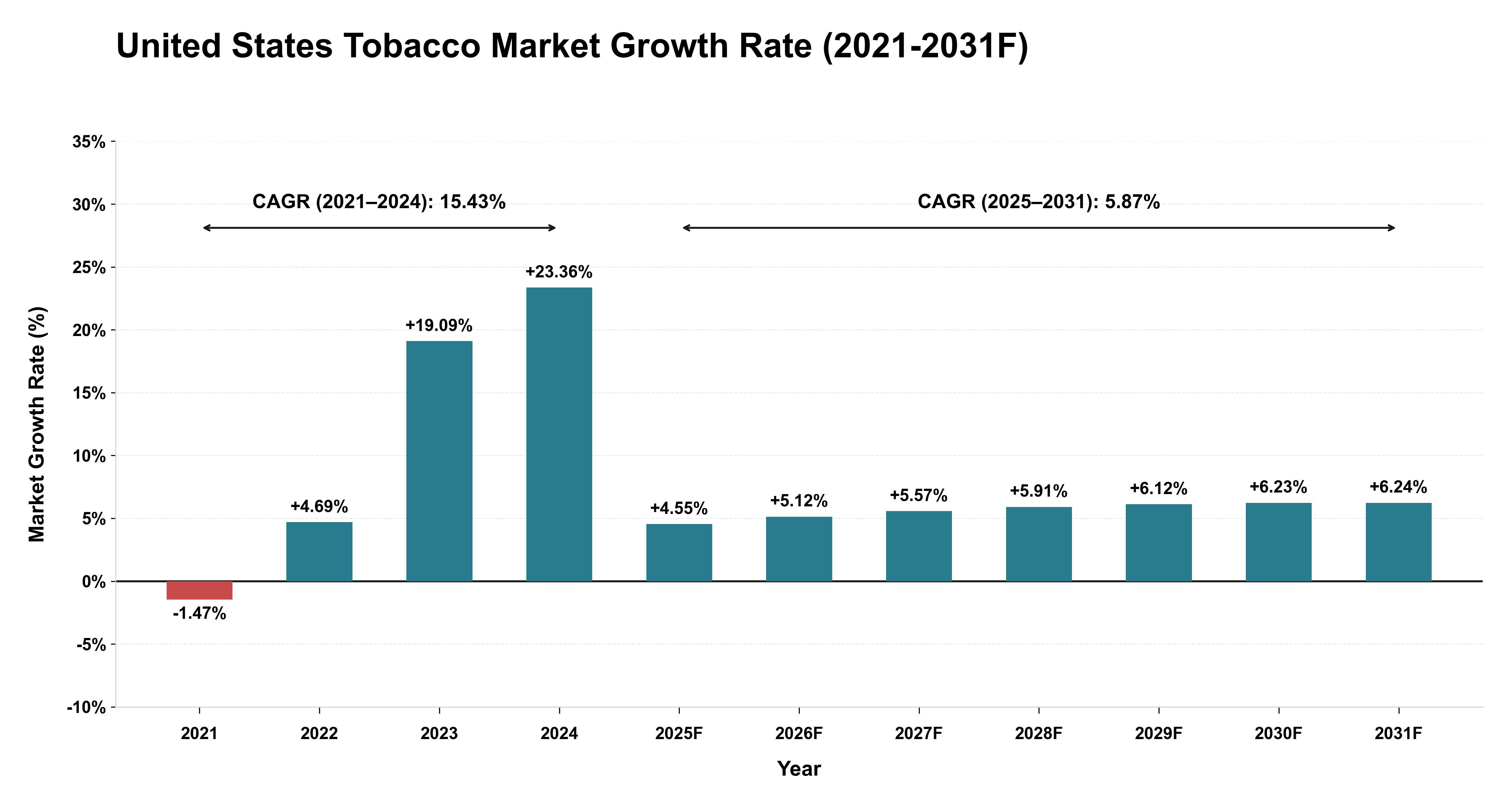
In the United States Tobacco Market, the period from 2021 to 2024 saw a fluctuating trajectory, starting with a slight decline in 2021 followed by moderate growth in 2022, a significant surge in 2023, and a substantial increase in 2024. These varied growth rates indicate shifting consumer preferences, regulatory interventions, and industry innovations impacting demand dynamics. Looking ahead to 2025-2031, the forecasted CAGR of 5.87% suggests a more stable but slower growth phase compared to the historical period's CAGR of 15.43%. The consistent acceleration in growth rates from 2025 onwards reflects potential market expansion opportunities, increased adoption of alternative tobacco products, and evolving consumer habits towards healthier choices amidst stricter regulations on traditional tobacco consumption.
United States (US) Tobacco Market Overview
The United States Tobacco Market is a mature industry with a diverse product range including cigarettes, cigars, smokeless tobacco, and electronic cigarettes. Despite declining cigarette consumption due to increased awareness of health risks and regulatory measures, the market remains significant with an estimated value of over $100 billion. Major players in the industry include Altria Group (Philip Morris USA), Reynolds American (R.J. Reynolds Tobacco Company), and British American Tobacco. The demand for alternative tobacco products like e-cigarettes and vaping devices is on the rise among younger consumers, presenting growth opportunities for companies in the market. However, increasing government regulations, public health campaigns, and anti-smoking initiatives continue to challenge the industry`s growth prospects.
United States (US) Tobacco Market Trends
In the US Tobacco Market, there is a growing trend towards reduced-risk products such as e-cigarettes and vaping devices as consumers become more health-conscious and seek alternatives to traditional cigarettes. There has also been a rise in the popularity of premium and flavored tobacco products among certain demographic groups. Additionally, stricter regulations on tobacco advertising and packaging have influenced companies to focus on innovative marketing strategies to reach their target audiences. The market has seen consolidation among major players as they adapt to changing consumer preferences and regulatory environment. Overall, the US Tobacco Market is experiencing a shift towards alternative products and evolving marketing tactics in response to changing consumer behaviors and regulations.
United States (US) Tobacco Market Challenges
The United States Tobacco Market faces several challenges, including declining cigarette consumption due to health concerns and increased regulation, particularly around advertising and packaging. The rise of alternative tobacco products like e-cigarettes and vaping devices has also created competition for traditional tobacco companies. Additionally, changing societal attitudes towards smoking and increasing awareness of the health risks associated with tobacco use have led to a decline in tobacco sales. The industry also grapples with ongoing legal battles, such as lawsuits from individuals and government entities seeking to hold tobacco companies accountable for the health consequences of smoking. Overall, the US Tobacco Market must navigate a complex landscape of regulations, shifting consumer preferences, and legal challenges in order to maintain profitability and market share.
United States (US) Tobacco Market Investment Opportunities
Investment opportunities in the US Tobacco Market include investing in established tobacco companies that have a strong track record of performance and stable cash flows, as well as diversifying into alternative tobacco products such as e-cigarettes and vaping devices to capture changing consumer preferences. Additionally, investing in companies that focus on developing reduced-risk products or innovative technologies for tobacco consumption could offer growth potential in a shifting regulatory landscape. With increasing health awareness leading to a decline in traditional cigarette consumption, there is also an opportunity for investment in tobacco harm reduction products and smoking cessation aids. Overall, a diversified approach that considers both traditional and emerging segments within the US Tobacco Market could provide investors with various avenues for potential returns and growth.
United States (US) Tobacco Market Government Policy
Government policies related to the US Tobacco Market primarily focus on regulating the manufacturing, marketing, and sales of tobacco products to reduce their negative health impacts. The Food and Drug Administration (FDA) has authority over the industry and has implemented measures such as requiring health warnings on packaging, restricting advertising aimed at youth, and enforcing age restrictions for purchasing tobacco products. Additionally, federal and state governments have imposed excise taxes on tobacco products to discourage consumption and fund healthcare programs. The US also has laws prohibiting smoking in public places to protect non-smokers from secondhand smoke exposure. Overall, these policies aim to reduce smoking rates, prevent youth from starting smoking, and improve public health outcomes related to tobacco use.
United States (US) Tobacco Market Future Outlook
The future outlook for the United States Tobacco Market is expected to face challenges due to increasing health awareness, stringent regulations, and declining smoking rates. As more consumers are becoming health-conscious, there is a growing trend towards tobacco alternatives such as e-cigarettes and vaping products. Additionally, government regulations on tobacco advertising, packaging, and sales restrictions are becoming more strict, making it harder for tobacco companies to market their products. The declining smoking rates, especially among younger generations, further pose a threat to the traditional tobacco market. However, opportunities still exist in the growing demand for reduced-risk products and innovations in the tobacco industry. Overall, the US Tobacco Market is likely to continue facing headwinds but may find avenues for growth through adaptation to changing consumer preferences and regulatory landscapes.
Key Highlights of the Report:
- United States (US) Tobacco Market Outlook
- Market Size of United States (US) Tobacco Market, 2021
- Forecast of United States (US) Tobacco Market, 2031
- Historical Data and Forecast of United States (US) Tobacco Revenues & Volume for the Period 2018 - 2031
- United States (US) Tobacco Market Trend Evolution
- United States (US) Tobacco Market Drivers and Challenges
- United States (US) Tobacco Price Trends
- United States (US) Tobacco Porter's Five Forces
- United States (US) Tobacco Industry Life Cycle
- Historical Data and Forecast of United States (US) Tobacco Market Revenues & Volume By Product for the Period 2018 - 2031
- Historical Data and Forecast of United States (US) Tobacco Market Revenues & Volume By Smokeless for the Period 2018 - 2031
- Historical Data and Forecast of United States (US) Tobacco Market Revenues & Volume By Cigarettes for the Period 2018 - 2031
- Historical Data and Forecast of United States (US) Tobacco Market Revenues & Volume By Cigar & Cigarillos for the Period 2018 - 2031
- Historical Data and Forecast of United States (US) Tobacco Market Revenues & Volume By Next Generation Products for the Period 2018 - 2031
- Historical Data and Forecast of United States (US) Tobacco Market Revenues & Volume By Waterpipes for the Period 2018 - 2031
- Historical Data and Forecast of United States (US) Tobacco Market Revenues & Volume By Distribution Channel for the Period 2018 - 2031
- Historical Data and Forecast of United States (US) Tobacco Market Revenues & Volume By Offline for the Period 2018 - 2031
- Historical Data and Forecast of United States (US) Tobacco Market Revenues & Volume By Online for the Period 2018 - 2031
- United States (US) Tobacco Import Export Trade Statistics
- Market Opportunity Assessment By Product
- Market Opportunity Assessment By Distribution Channel
- United States (US) Tobacco Top Companies Market Share
- United States (US) Tobacco Competitive Benchmarking By Technical and Operational Parameters
- United States (US) Tobacco Company Profiles
- United States (US) Tobacco Key Strategic Recommendations






































