United States (US) Trade management Market Size & Growth Rate (2026-2032)
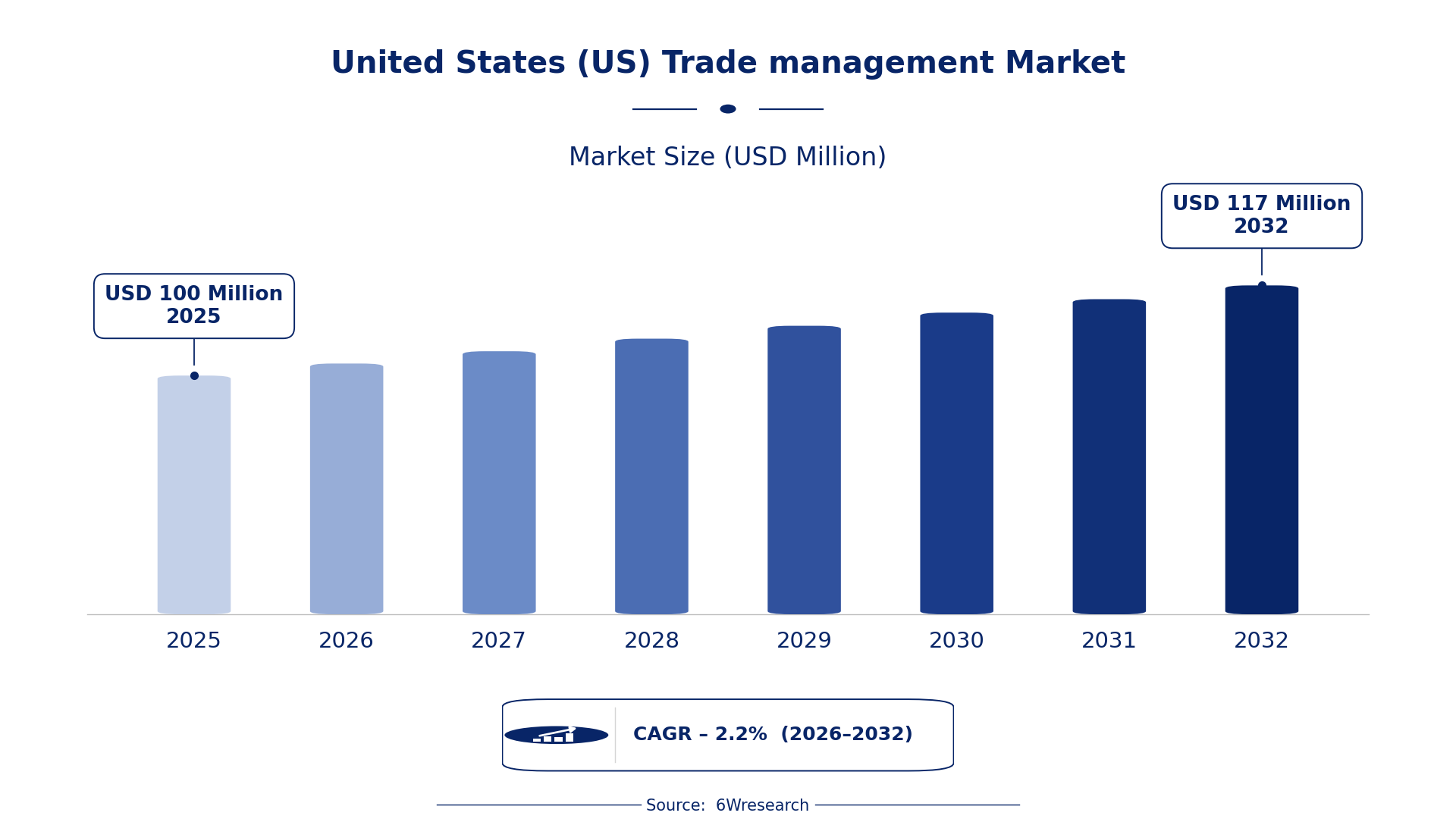
The United States (US) Trade management Market was estimated at USD 100 Million in 2025 and is projected to reach USD 117 Million by 2032, growing at a CAGR of 2.2% from 2026 to 2032.
United States (US) Trade management Market Synopsis
The United States Trade management market is currently experiencing a surge in demand as businesses adapt to intricate international trade regulations. While recent years have shown significant momentum due to rising global trade complexities, the future trajectory points toward even greater reliance on advanced trade management solutions.
As organizations seek to streamline their import and export processes, the focus on digitalization and automation is becoming paramount. This trend positions the US trade management market for sustained growth as companies increasingly prioritize compliance and efficiency in their international operations.
United States (US) Trade management Market Year-wise Growth Rate and Key Drivers
This graph illustrates the annual growth rates of the United States (US) Trade management Market from 2021 to 2032, highlighting a steady upward trajectory and projected expansion over the forecast period.
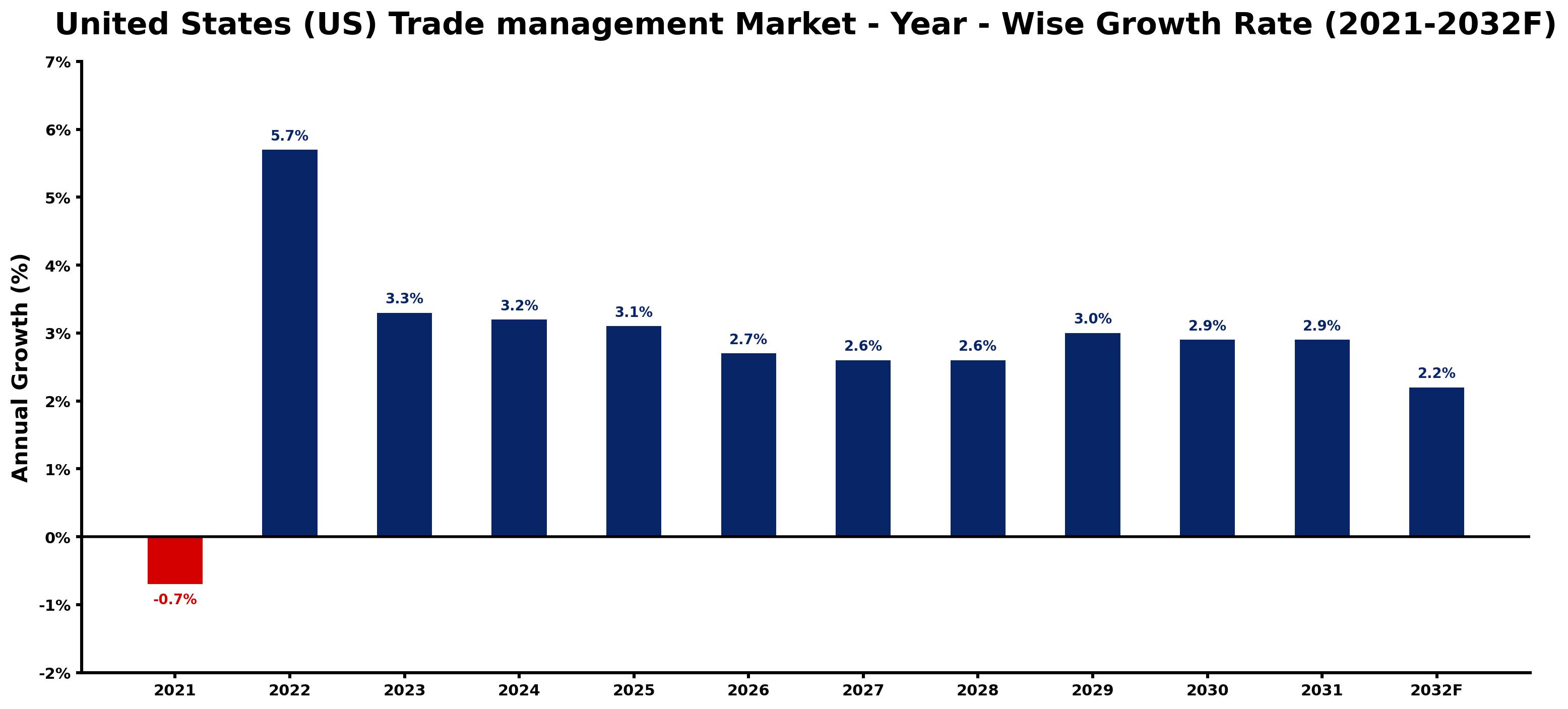
The table below presents the year‑wise growth rates along with the key drivers influencing the market
| Year | Growth Rate | Major Drivers |
| 2021 | -0.7% | Increased tariffs under Biden administration policies affected imports. |
| 2022 | 5.7% | Trade Facilitation Action Plan streamlining customs processes |
| 2023 | 3.3% | Resilience of supply chains boosting demand for cloud solutions |
| 2024 | 3.2% | Implementation of USMCA enhancing trade compliance capabilities |
| 2025 | 3.1% | Increased investments in AI for trade data analytics |
| 2026 | 2.7% | Growing focus on cybersecurity enhancing trade platform reliability |
| 2027 | 2.6% | Rising interest in sustainable sourcing influencing trade management |
| 2028 | 2.6% | New tariffs prompting companies to optimize import strategies |
| 2029 | 3.0% | Shift towards digital documentation improving operational efficiencies |
| 2030 | 2.9% | Changes in international trade regulations driving technology adoption |
| 2031 | 2.9% | Increased focus on trade sanctions compliance boosting services |
| 2032 | 2.2% | Ongoing efforts to improve interoperability in trade systems |
Note: Market size estimations and growth projections presented in this report are based on 6Wresearch's proprietary forecasting methodology, utilizing the latest available industry data, government publications, and primary research inputs.
United States (US) Trade management Market Key Takeaways
Below are some of the specific key takeaways from the market, including:
- Increasing global trade complexities are driving demand for specialized trade management solutions.
- Digital transformation and automation are key trends reshaping market dynamics.
- Investment opportunities abound in trade compliance software and logistics sectors.
- Sustainability initiatives are influencing business practices and supplier selection.
- Government policies are actively shaping the market through regulations and tariffs.
Evaluation of Restraints in United States (US) Trade management Market
The United States Trade management market faces several restraints that can hinder its growth trajectory. A primary concern is the rapidly changing regulatory environment, which demands that businesses remain vigilant and adaptive to new compliance requirements. The complexities of managing global supply chains also present challenges, as companies must coordinate trade activities across diverse jurisdictions. Additionally, the specter of trade wars and tariffs introduces a layer of uncertainty, prompting organizations to reassess their international strategies. These factors require a proactive approach to compliance and risk management, which can be resource-intensive and costly for many businesses.
United States (US) Trade management Market Trends
Several trends are currently shaping the United States Trade management market. A marked shift towards digital solutions is evident, with companies increasingly adopting sophisticated trade management software that enhances visibility and compliance. Real-time monitoring of trade activities is becoming essential as businesses strive for efficiency and accuracy.
on top of that, sustainability and ethical sourcing practices are gaining traction, as businesses recognize the need for transparency in their supply chains. The ongoing trade tensions are further compelling companies to invest in advanced tools that enable them to navigate these complexities while optimizing their global operations.
United States (US) Trade management Market Opportunities
The United States Trade management market presents numerous growth and investment opportunities. As regulations become more intricate, there is a rising demand for trade compliance software, creating a fertile ground for investment in innovative technology solutions. Companies involved in freight forwarding and customs brokerage services are well-positioned to capitalize on this demand, as businesses seek to simplify their trade processes.
The increasing adoption of blockchain technology and artificial intelligence also opens avenues for investment in startups and technology providers focused on trade management solutions. Consulting firms that specialize in trade advisory services are increasingly sought after, as organizations seek expert guidance in navigating international trade challenges.
Government Initiatives in the United States (US) Trade management Market
The regulatory environment in the United States plays a crucial role in shaping the Trade management market. Government policies are focused on promoting fair trade practices and safeguarding domestic industries. Recent initiatives highlight the administration's commitment to creating a favorable trading environment while addressing trade imbalances and compliance challenges.
- A newly introduced regulatory framework mandates enhanced reporting standards for trade compliance, aimed at streamlining processes for businesses.
- Current efforts include a national program to upgrade customs infrastructure, enhancing efficiency in import and export activities.
- A planned initiative seeks to strengthen partnerships between public and private sectors to improve trade facilitation measures by 2028.
- Recent increases in tariffs on select imports demonstrate the government's strategy to protect domestic production while incentivizing local industries.
Future Insights of the United States (US) Trade management Market
Looking ahead to 2026-2032, the United States Trade management market is set for a promising trajectory. The growing complexity of global trade regulations will continue to drive demand for sophisticated trade management solutions. Companies are expected to increasingly integrate advanced technologies such as artificial intelligence and blockchain into their operations, which will enhance efficiency and reduce costs.
As industries undergo digital transformation, the need for tools that improve supply chain transparency and compliance will remain critical. The market's evolution will likely be influenced by ongoing government initiatives and the necessity for businesses to adapt swiftly to changing regulatory landscapes.
United States (US) Trade management Market Latest Developments
In the last 12-14 months, the United States Trade management market has seen dynamic developments across various sectors. Companies are increasingly focusing on enhancing their trade management capabilities through technology adoption and strategic partnerships.
- A major technology vendor launched an advanced trade compliance solution in early 2025, designed to automate compliance checks and reduce operational risks.
- A leading logistics provider initiated a program in mid-2025 to integrate blockchain technology into its supply chain processes, improving transparency and efficiency.
- A consulting firm recently completed a comprehensive analysis of trade policies, providing insights to businesses on navigating new regulatory challenges.
- An expansion of customs processing facilities began in early 2025, aimed at reducing delays in import/export operations and improving overall efficiency.
United States (US) Trade management Market - Key Attractiveness of the Report
- 10 Years of Market Numbers
- Historical Data Starting from 2022 to 2025
- Base Year: 2025
- Forecast Data until 2032
- Key Performance Indicators Impacting the Market
- Major Upcoming Developments and Projects
Key Highlights of the Report:
- United States (US) Trade management Market Outlook
- Market Size of United States (US) Trade management Market, 2025
- Forecast of United States (US) Trade management Market, 2032
- Historical Data and Forecast of United States (US) Trade management Revenues & Volume for the Period 2022-2032F
- United States (US) Trade management Market Trend Evolution
- United States (US) Trade management Market Drivers and Challenges
- United States (US) Trade management Price Trends
- United States (US) Trade management Porter's Five Forces
- United States (US) Trade management Industry Life Cycle
- Historical Data and Forecast of United States (US) Trade management Market Revenues & Volume By Component for the Period 2022-2032F
- Historical Data and Forecast of United States (US) Trade management Market Revenues & Volume By Solutions for the Period 2022-2032F
- Historical Data and Forecast of United States (US) Trade management Market Revenues & Volume By Services for the Period 2022-2032F
- Historical Data and Forecast of United States (US) Trade management Market Revenues & Volume By Organization Size for the Period 2022-2032F
- Historical Data and Forecast of United States (US) Trade management Market Revenues & Volume By Large enterprises for the Period 2022-2032F
- Historical Data and Forecast of United States (US) Trade management Market Revenues & Volume By Small and medium-sized enterprises for the Period 2022-2032F
- Historical Data and Forecast of United States (US) Trade management Market Revenues & Volume By Deployment Mode for the Period 2022-2032F
- Historical Data and Forecast of United States (US) Trade management Market Revenues & Volume By On-Premises for the Period 2022-2032F
- Historical Data and Forecast of United States (US) Trade management Market Revenues & Volume By Cloud for the Period 2022-2032F
- Historical Data and Forecast of United States (US) Trade management Market Revenues & Volume By Vertical for the Period 2022-2032F
- Historical Data and Forecast of United States (US) Trade management Market Revenues & Volume By Transportation and Logistics for the Period 2022-2032F
- Historical Data and Forecast of United States (US) Trade management Market Revenues & Volume By Government and Public Sector for the Period 2022-2032F
- Historical Data and Forecast of United States (US) Trade management Market Revenues & Volume By Manufacturing for the Period 2022-2032F
- Historical Data and Forecast of United States (US) Trade management Market Revenues & Volume By Healthcare and Life Science for the Period 2022-2032F
- Historical Data and Forecast of United States (US) Trade management Market Revenues & Volume By Retail and Consumer Goods for the Period 2022-2032F
- Historical Data and Forecast of United States (US) Trade management Market Revenues & Volume By Energy and Utilities for the Period 2022-2032F
- Historical Data and Forecast of United States (US) Trade management Market Revenues & Volume By Other Verticals for the Period 2022-2032F
- United States (US) Trade management Import Export Trade Statistics
- Market Opportunity Assessment By Component
- Market Opportunity Assessment By Organization Size
- Market Opportunity Assessment By Deployment Mode
- Market Opportunity Assessment By Vertical
- United States (US) Trade management Top Companies Market Share
- United States (US) Trade management Competitive Benchmarking By Technical and Operational Parameters
- United States (US) Trade management Company Profiles
- United States (US) Trade management Key Strategic Recommendations






































