United States (US) Transformer Market Top 5 Importing Countries and Market Competition (HHI) Analysis
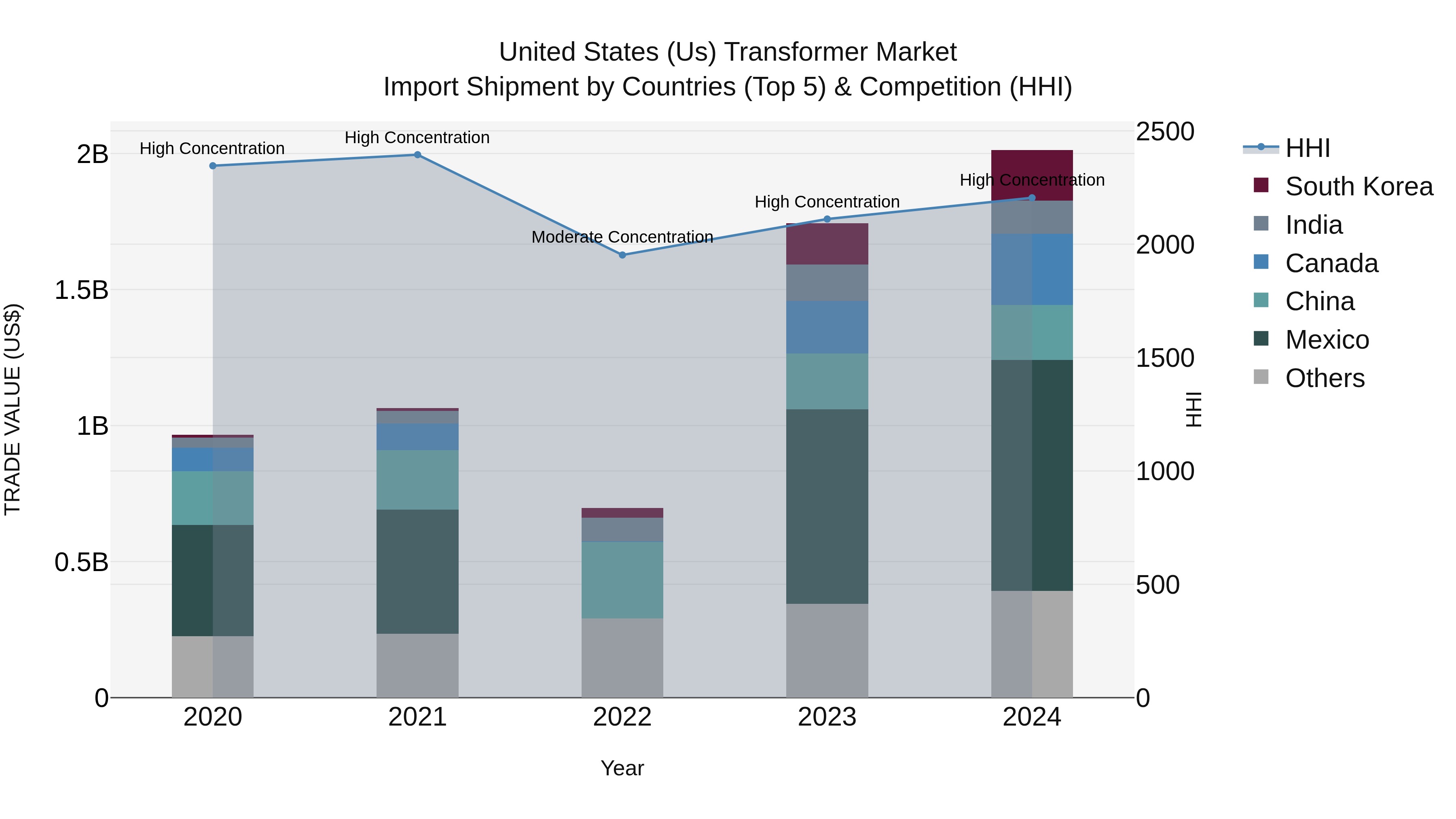
The United States continues to be a key importer of transformers, with Mexico, Canada, China, South Korea, and India leading the pack in 2024. Despite high concentration levels indicated by the Herfindahl-Hirschman Index (HHI), the market has seen impressive growth with a CAGR of 20.13% from 2020 to 2024. The growth momentum remained strong in 2024 with a growth rate of 15.45% compared to the previous year, reflecting sustained demand and robust trade relationships with key exporting countries.
US Transformer Market Growth Rate
According to 6Wresearch internal database and industry insights, the US Transformer Market is projected to grow at a compound annual growth rate (CAGR) of 4.7% during the forecast period from 2026 to 2032.
Topics Covered in the US Transformer Market Report
The US Transformer Market report covers the market comprehensively by core, product type, winding, application, cooling, phase, and rating. The report provides an in-depth and unbiased analysis of ongoing market trends, opportunities, challenges, and market drivers, assisting stakeholders in aligning strategies with current and future market dynamics.
US Transformer Market Highlights
| Report Name | US Transformer Market |
| Forecast period | 2026-2032 |
| CAGR | 4.7% |
| Growing Sector | Power Transmission and Distribution |
US Transformer Market Synopsis
The US Transformer Market is expected to expand steadily owing to an increase in the demand for energy-efficient power transmission systems and the expansion of renewable energy projects. With new developments in transformer technology, the ongoing modernization of the power grid, and the rising focus on efficient energy use, the market will see significant growth in the coming years. Here are some key trends that are influencing the market include the growing adoption rate of renewable energy and the demand for energy-efficient transformers that reduce environmental impact.
Evaluation of Growth Drivers in the US Transformer Market
Some prominent drivers and their impact on the US Transformer Market dynamics:
| Drivers | Primary Segment Affected | Why It Matters (Evidence) |
| Renewable Energy Expansion | By Application (Utility, Industrial) | The rise in solar, wind, and other renewable energy sources increases the need for power transformers. |
| Smart Grid Development | By Application (Residential & Commercial, Utility) | Smart grid deployment needs advanced transformers for efficient energy distribution. |
| Infrastructure Development | By Application (Residential & Commercial, Industrial) | Increased demand for energy infrastructure growth due to rapid urbanization. |
| Technological Advancements | By Core (Closed, Shell, Berry), By Product (Power transformer, Distribution transformer) | Technological improvements make transformers more efficient and cost-effective. |
| Increased Industrial Activity | By Application (Industrial, Utility) | Rising industrial production needs robust transformer solutions. |
The US Transformer Market is expected to grow at a CAGR of 4.7% during the forecast period from 2026–2032, driven by the increasing the demand for electricity, fueled by population growth, industrialization, and the increasing adoption of electric vehicles (EVs), requires robust power distribution and transmission infrastructure, thereby increasing transformer demand. Other than that, the push for renewable energy sources such as wind and solar power necessitates the modernization of power grids to accommodate decentralized energy generation, further increasing the need for advanced transformers. There is an increasing focus on energy efficiency and smart grids, which also contributes to the US Transformer Market growth.
Restraints in the US Transformer Market
Below mentioned are some major restraints and their influence on the US Transformer Market dynamics:
| Restraints | Primary Segment Affected | What This Means |
| Supply Chain Shortages & Extended Lead Times | By Product (Power Transformer, Distribution Transformer) | Ongoing supply constraints and long lead times hinder timely delivery and project execution. |
| Limited Domestic Manufacturing Capacity | By Product (Power Transformer, Distribution Transformer) | Domestic capacity has not kept pace with rising demand, forcing reliance on imports. |
| Rising Raw Material Costs | By Core & Product | Increased costs for critical materials increase transformer production costs, which impact pricing and project budgets. |
| Regulatory & Tariff Pressures | By Application (Utility, Industrial) | New tariffs and regulatory changes can raise costs, slowing market responsiveness. |
| Skilled Labor Shortages | By Core & Winding | A shortage of trained manufacturing and installation personnel limits production expansion. |
Challenges in the US Transformer Market
The US Transformer Market faces a number of challenges that could limit its growth and operational efficiency. Supply chain disruptions have caused longer lead times and delays, which affect grid modernization projects. The market for large power transformers continues to rely heavily on imports, making it vulnerable to global trade risks and cost fluctuations. Furthermore, rising raw material prices, such as copper and electrical steel, have raised production costs, putting pressure on profit margins. The need to replace aging infrastructure adds to the strain, as manufacturers find it difficult to meet increasing demand for new transformers.
Trends Shaping the US Transformer Market
Some of the major trends increasing the US Transformer Market share include:
- Grid Modernization and Smart Grid Integration: As the United States seeks to modernize its electrical grid, there is a growing trend toward smart transformers with integrated digital monitoring, which improves operational efficiency.
- Energy-Efficient Transformers: There is a rising focus on transformers that meet high energy efficiency standards to reduce losses and improve overall grid performance.
- Rising Adoption of High-Voltage Transformers: Due to the expansion of large-scale industrial projects and the need for efficient power transmission, there is an increase in the demand for high-voltage and high-capacity transformers.
Major Investment Opportunities in the US Transformer Market
Key investment opportunities in the US Transformer Market include:
- Increasing Investment in Smart Transformer Technologies: There is a rising shift toward smart grids and IoT integration, which creates significant opportunities for investment in digital transformers that offer real-time monitoring and predictive maintenance.
- An Increase in Renewable Energy Grid Integration: As renewable energy generation rises, there is a significant opportunity to invest in transformers that efficiently integrate renewable power sources into the national grid.
- An Expansion of Industrial and Utility Infrastructure: As industrial and utility industries continue to expand, making investment in high-capacity transformers and supporting infrastructure projects offers long term growth potential.
Top 5 Leading Players in the US Transformer Market
Here are some top companies contributing to the US transformer market share:
1. GE Vernova (formerly GE Power)
| Company Name | GE Vernova (formerly GE Power) |
|---|---|
| Established Year | 1892 |
| Headquarters | Cambridge, Massachusetts |
| Official Website | Click Here |
GE Vernova is the leading domestic manufacturer of large power transformers. They are essential to the US grid modernization initiative, producing high-voltage units that facilitate the transmission of renewable energy across state lines.
2. Hitachi Energy US
| Company Name | Hitachi Energy US |
|---|---|
| Established Year | 2020 |
| Headquarters | Raleigh, North Carolina |
| Official Website | Click Here |
Hitachi Energy operates several major manufacturing hubs in the US. They are a primary supplier of distribution transformers and HVDC technology, pairing global scale with significant domestic production in Virginia and Missouri.
3. Eaton Corporation
| Company Name | Eaton Corporation |
|---|---|
| Established Year | 1911 |
| Headquarters | Beachwood, Ohio |
| Official Website | Click Here |
Eaton is a leader in medium and low-voltage transformers. Their focus is on the industrial and commercial sectors, providing specialized units for data centers, EV charging networks, and hospitals.
4. Prolec GE
| Company Name | Prolec GE |
|---|---|
| Established Year | 1969 |
| Headquarters | Waukesha, Wisconsin |
| Official Website | Click Here |
A joint venture between Xignux and GE, Prolec GE is one of the largest transformer manufacturers in the Americas. They recently expanded their US manufacturing footprint to address the rising demand for grid infrastructure.
5. Howard Industries
| Company Name | Howard Industries |
|---|---|
| Established Year | 1968 |
| Headquarters | Ellisville, Mississippi |
| Official Website | Click Here |
As the largest manufacturer of distribution transformers in the United States, Howard Industries is a critical domestic source for rural electric cooperatives and major investor-owned utilities nationwide.
Government Regulations in the US Transformer Market
According to US government data, the transformer market is subject to specific government rules that are aimed at ensuring safety and sustainability. Key regulatory bodies like the Federal Energy Regulatory Commission (FERC) and the Department of Energy (DOE) set guidelines for transformer efficiency, safety, and environmental impact. For instance, the DOE has established Energy Efficiency Standards for transformers, making sure that power transformers have a minimum energy loss criterion. Along with that, the National Electrical Manufacturers Association (NEMA) offers some specific guidelines for the design, manufacturing, and testing of transformers to make sure a compliance with national safety standards.
Future Insights of the US Transformer Market
The US Transformer Market is poised for growth, which is driven by ongoing investments in power grid modernization, the rising shift toward more energy-efficient, and sustainable technologies and the rise of renewable energy projects. The demand for smarter transformers that can support advanced grid systems and integrate renewable energy sources such as solar and wind is expected to rise. Lastly, smart grid technologies and automation are likely to drive innovations in transformer design, resulting in more adaptive and digitally connected solutions.
Segmentation Analysis
The report offers a comprehensive study of the following market segments and their leading categories:
Closed Core to Lead the Market – By Core
According to Ashutosh, Senior Research Analyst at 6Wresearch, In the US Transformer Market, the closed core segment is expected to be a key leader among core types due to its efficient magnetic flux containment, lower losses, and wide applicability in both power and distribution transformer designs.
Power Transformer to Lead the Market – By Product
The power transformer segment is forecasted to dominate by product category. Power transformers are critical for high voltage transmission and large grid connections, which make them essential for utility and infrastructure projects across the country.
Two winding to Lead the Market – By Winding
Within winding types, two winding transformers are expected to maintain a significant share on account of their widespread use in standard power distribution networks and ease of integration across utility and industrial applications.
Residential & Commercial to Lead the Market – By Application
The residential & commercial application segment is likely to hold a major share of the market, which is backed by ongoing urban development, new construction, and upgrades to building power infrastructure that require reliable power conversion solutions.
Three Phase to Lead the Market – By Phase
In the phase segment, the three phase category typically leads the market owing to its extensive use in industrial applications, larger buildings, and utility systems that need efficient power delivery with balanced loads.
Key Attractiveness of the Report
- 10 Years of Market Numbers
- Historical Data Starting from 2022 to 2025
- Base Year: 2025
- Forecast Data until 2032
- Key Performance Indicators Impacting the Market
- Major Upcoming Developments and Projects
Key Highlights of the Report:
- US Transformer Market Outlook
- Market Size of US Transformer Market, 2025
- Forecast of US Transformer Market, 2032
- Historical Data and Forecast of US Transformer Revenues & Volume for the Period 2022- 2032
- US Transformer Market Trend Evolution
- US Transformer Market Drivers and Challenges
- US Transformer Price Trends
- US Transformer Porter's Five Forces
- US Transformer Industry Life Cycle
- Historical Data and Forecast of US Transformer Market Revenues & Volume By Core for the Period 2022- 2032
- Historical Data and Forecast of US Transformer Market Revenues & Volume By Closed for the Period 2022- 2032
- Historical Data and Forecast of US Transformer Market Revenues & Volume By Shell for the Period 2022- 2032
- Historical Data and Forecast of US Transformer Market Revenues & Volume By Berry for the Period 2022- 2032
- Historical Data and Forecast of US Transformer Market Revenues & Volume By Product for the Period 2022- 2032
- Historical Data and Forecast of US Transformer Market Revenues & Volume By Power transformer for the Period 2022- 2032
- Historical Data and Forecast of US Transformer Market Revenues & Volume By Distribution transformer for the Period 2022- 2032
- Historical Data and Forecast of US Transformer Market Revenues & Volume By Instrument transformer for the Period 2022- 2032
- Historical Data and Forecast of US Transformer Market Revenues & Volume By Others for the Period 2022- 2032
- Historical Data and Forecast of US Transformer Market Revenues & Volume By Winding for the Period 2022- 2032
- Historical Data and Forecast of US Transformer Market Revenues & Volume By Two-winding for the Period 2022- 2032
- Historical Data and Forecast of US Transformer Market Revenues & Volume By Auto-transformer for the Period 2022- 2032
- Historical Data and Forecast of US Transformer Market Revenues & Volume By Application for the Period 2022- 2032
- Historical Data and Forecast of US Transformer Market Revenues & Volume By Residential & Commercial for the Period 2022- 2032
- Historical Data and Forecast of US Transformer Market Revenues & Volume By Utility for the Period 2022- 2032
- Historical Data and Forecast of US Transformer Market Revenues & Volume By Industrial for the Period 2022- 2032
- Historical Data and Forecast of US Transformer Market Revenues & Volume By Cooling for the Period 2022- 2032
- Historical Data and Forecast of US Transformer Market Revenues & Volume By Dry type for the Period 2022- 2032
- Historical Data and Forecast of US Transformer Market Revenues & Volume By Oil Immersed for the Period 2022- 2032
- Historical Data and Forecast of US Transformer Market Revenues & Volume By Insulation for the Period 2022- 2032
- Historical Data and Forecast of US Transformer Market Revenues & Volume By Gas for the Period 2022- 2032
- Historical Data and Forecast of US Transformer Market Revenues & Volume By Oil for the Period 2022- 2032
- Historical Data and Forecast of US Transformer Market Revenues & Volume By Solid for the Period 2022- 2032
- Historical Data and Forecast of US Transformer Market Revenues & Volume By Air for the Period 2022- 2032
- Historical Data and Forecast of US Transformer Market Revenues & Volume By Others for the Period 2022- 2032
- Historical Data and Forecast of US Transformer Market Revenues & Volume By Phase for the Period 2022- 2032
- Historical Data and Forecast of US Transformer Market Revenues & Volume By Single phase for the Period 2022- 2032
- Historical Data and Forecast of US Transformer Market Revenues & Volume By 3 - phase for the Period 2022- 2032
- Historical Data and Forecast of US Transformer Market Revenues & Volume By Rating for the Period 2022- 2032
- Historical Data and Forecast of US Transformer Market Revenues & Volume By ? 10 MVA for the Period 2022- 2032
- Historical Data and Forecast of US Transformer Market Revenues & Volume By 11 MVA to 60 MVA for the Period 2022- 2032
- Historical Data and Forecast of US Transformer Market Revenues & Volume By 61 MVA to 600 MVA for the Period 2022- 2032
- Historical Data and Forecast of US Transformer Market Revenues & Volume By > 600 MVA for the Period 2022- 2032
- US Transformer Import Export Trade Statistics
- Market Opportunity Assessment By Core
- Market Opportunity Assessment By Product
- Market Opportunity Assessment By Winding
- Market Opportunity Assessment By Application
- Market Opportunity Assessment By Cooling
- Market Opportunity Assessment By Insulation
- Market Opportunity Assessment By Phase
- Market Opportunity Assessment By Rating
- US Transformer Top Companies Market Share
- US Transformer Competitive Benchmarking By Technical and Operational Parameters
- US Transformer Company Profiles
- US Transformer Key Strategic Recommendations
Market Scope and Segmentation
The report provides a detailed analysis of the following market segments:
By Core
- Closed
- Shell
- Berry
By Product
- Power Transformer
- Distribution Transformer
- Instrument Transformer
- Others
By Winding
- Two-Winding
- Auto-Transformer
By Application
- Residential & Commercial
- Utility
- Industrial
By Cooling
- Dry-Type
- Oil Immersed
By Phase
- Single Phase
- 3 – Phase
By Rating
- 10 MVA
- 11 MVA To 60 MVA
- 61 MVA To 600 MVA
- 600 MVA






































