United States (US) Vending machines Market Summary
The united states (us) vending machines market was estimated at USD 213 Million in 2025 and is projected to reach USD 250 Million by 2032, growing at a CAGR of 2.4% from 2026 to 2032.
United States (US) Vending machines Market Year-wise Growth Rate and Key Drivers
This graph highlights how the United States (US) Vending machines Market has steadily grown over the past five years, supported by major growth factors.
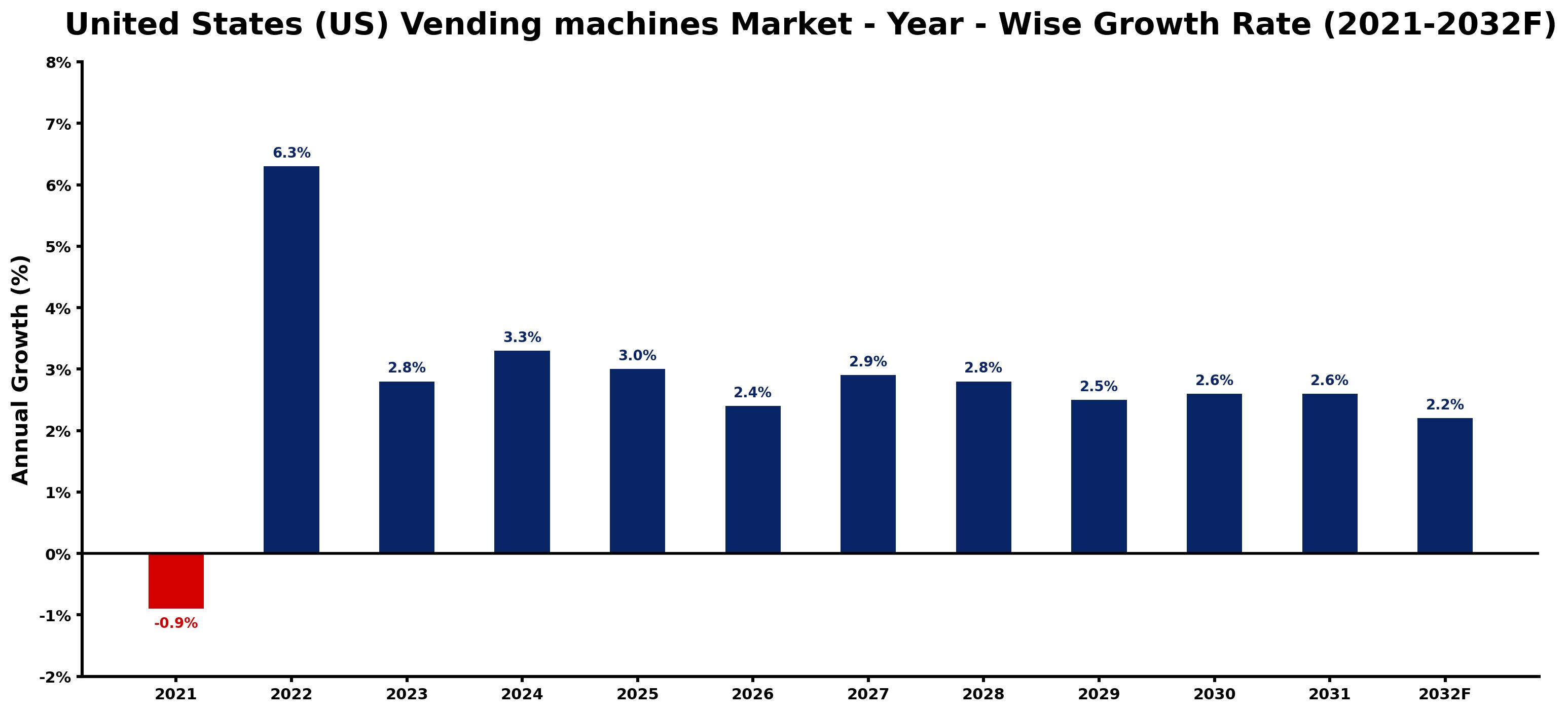
The table below presents the year wise growth rates along with the key drivers influencing the market
| Year | Growth Rate | Major Drivers |
| 2021 | -0.9% | Heightened health concerns prompted consumers to avoid shared touchpoints, diminishing vending machine utilization significantly. |
| 2022 | 6.3% | Major players began integrating smart technology, enhancing user experience and operational efficiency. |
| 2023 | 2.8% | Consumer preferences shifted towards healthier snack options, prompting new product offerings. |
| 2024 | 3.3% | Corporate wellness programs increasingly incorporated vending solutions to improve employee satisfaction. |
| 2025 | 3.0% | Emerging technologies facilitated inventory tracking, reducing waste and optimizing restocking processes. |
| 2026 | 2.4% | Partnerships with local suppliers enhanced product diversity and resonated with regional consumers. |
| 2027 | 2.9% | A surge in remote work led to vending machines installed in home office settings. |
| 2028 | 2.8% | Sustainability initiatives prompted manufacturers to adopt eco-friendly materials for machines. |
| 2029 | 2.5% | E-commerce growth encouraged hybrid vending models combining online ordering and physical machines. |
| 2030 | 2.6% | Increased urbanization created opportunities for vending solutions in densely populated areas. |
| 2031 | 2.6% | Technological advancements allowed for real-time data analytics, improving sales forecasting accuracy. |
| 2032 | 2.2% | Vending machine franchises expanded dramatically, leveraging strong brand recognition for growth. |
Note - Market size estimations and growth projections presented in this report are based on 6Wresearch's advanced forecasting approach, validated with industry datasets as of June 2026.
United States (US) Vending machines Market Synopsis
The United States (US) Vending machines Market is projected to reach 2.4% and witness significant growth during the forecast period (2026-2032). This market encompasses a broad spectrum of automated self-service solutions, providing consumers with a variety of products ranging from traditional snacks and beverages to non-traditional items like electronics and personal care products. The evolution of this industry has been significantly influenced by technological advancements, which have integrated cashless payment options, touchscreen interfaces, and data analytics capabilities into vending machine operations.
United States (US) Vending machines Market Growth Drivers
Several key drivers are contributing to the robust growth of the United States vending machines market. Notably:
- Consumer demand for convenience is pushing the market towards more automated solutions that allow for easy access to food and beverage options.
- Technological advancements facilitate a shift from traditional cash transactions to cashless payment methods, making purchases more efficient.
- The growing trend of healthy eating is encouraging operators to diversify their offerings with nutritious snack options, capitalizing on the changing preferences of health-conscious consumers.
- The expansion of vending machines into new sectors, such as healthcare and education, opens up fresh revenue streams and market penetration opportunities.
- Data analytics tools are becoming essential for inventory management and consumer behavior tracking, enabling operators to optimize stock levels and enhance customer satisfaction.
United States (US) Vending machines Market Trends and Opportunities
The United States vending machines market is undergoing notable trends that reflect the evolving landscape of consumer preferences and technological innovations. Key trends include:
- The increasing popularity of healthier vending options is compelling operators to include a wider range of organic snacks, fresh produce, and low-calorie beverages.
- Integration of technology, such as mobile apps for transaction processing and real-time sales tracking, is enhancing the consumer experience, making it more seamless and efficient.
- Contactless payment solutions are becoming standard, further driving convenience for consumers who favor quick and hygienic transactions.
- Environmental concerns are prompting some operators to transition toward eco-friendly vending machines and packaging, which cater to the growing demand for sustainable products.
- Niche markets, like specialty beverages or CBD-infused products, represent unique opportunities for growth within the vending segment.
United States (US) Vending machines Market Challenges and Restraints
Despite its growth potential, the United States vending machines market faces several challenges:
- The shift toward healthier options means that operators must continually adapt their product offerings to meet consumer expectations.
- Increased competition from convenience stores and online delivery services poses a significant threat to traditional vending operations, necessitating innovation and differentiation.
- High operating costs associated with machine maintenance and restocking can limit profitability for vending machine operators.
- Issues such as vandalism and theft remain a concern, often leading to increased insurance and security expenses for operators.
- The challenge of managing inventory effectively to minimize spoilage is critical, especially with fresh food offerings gaining traction in the market.
United States (US) Vending machines Market Investment Opportunities
The dynamic nature of the United States vending machines market presents several lucrative investment opportunities:
- Investing in smart vending machines equipped with advanced technologies for payment and inventory management can lead to enhanced operational efficiency.
- Operators can capitalize on the demand for healthier options by offering curated selections that cater to health-conscious consumers.
- Exploring emerging sectors such as fresh food vending or specialized beverages offers unique avenues for growth and differentiation.
- Companies focusing on contactless payment solutions can position themselves favorably in a market that increasingly prioritizes convenience.
- Investing in eco-friendly practices and sustainable products may attract consumers who value environmental responsibility.
United States (US) Vending machines Market Government Investment and Initiatives
Government policies in the United States play a pivotal role in shaping the vending machines market. Regulations from the Food and Drug Administration (FDA) focus on the nutritional content and labeling of food products, encouraging healthier choices. Local and state health departments enforce sanitation and safety standards for vending operations, ensuring consumer protection. Moreover, taxation policies vary across jurisdictions, impacting how vending operators manage their pricing strategies and compliance processes. Government initiatives often promote food safety and compliance, which, in turn, influences the operational landscape of vending machine operators.
United States (US) Vending machines Market Latest Developments (May 2025 - June 2026)
Recent developments in the United States vending machines market indicate an ongoing evolution toward greater innovation and efficiency. Key advancements include an increased adoption of touchless technology, responding to consumer demand for hygienic and convenient transaction options. The integration of AI-driven analytics tools is gaining traction, allowing operators to understand customer preferences better and optimize inventory management. Additionally, many operators are focusing on expanding their healthy product lines, aligning with the growing desire for nutritious snack options. These developments reflect a market that is rapidly adapting to both consumer demands and technological advancements.
United States (US) Vending machines Market - Key Attractiveness of the Report
- 10 Years of Market Numbers
- Historical Data Starting from 2022 to 2025
- Base Year: 2025
- Forecast Data until 2032
- Key Performance Indicators Impacting the Market
- Major Upcoming Developments and Projects
Key Highlights of the Report:
- United States (US) Vending machines Market Outlook
- Market Size of United States (US) Vending machines Market, 2025
- Forecast of United States (US) Vending machines Market, 2032F
- Historical Data and Forecast of United States (US) Vending machines Revenues & Volume for the Period 2022-2032F
- United States (US) Vending machines Market Trend Evolution
- United States (US) Vending machines Market Drivers and Challenges
- United States (US) Vending machines Price Trends
- United States (US) Vending machines Porter's Five Forces
- United States (US) Vending machines Industry Life Cycle
- Historical Data and Forecast of United States (US) Vending machines Market Revenues & Volume By Applications for the Period 2022-2032F
- Historical Data and Forecast of United States (US) Vending machines Market Revenues & Volume By Commercial Places for the Period 2022-2032F
- Historical Data and Forecast of United States (US) Vending machines Market Revenues & Volume By Offices for the Period 2022-2032F
- Historical Data and Forecast of United States (US) Vending machines Market Revenues & Volume By Public Places for the Period 2022-2032F
- Historical Data and Forecast of United States (US) Vending machines Market Revenues & Volume By Others for the Period 2022-2032F
- Historical Data and Forecast of United States (US) Vending machines Market Revenues & Volume By Payment Mode for the Period 2022-2032F
- Historical Data and Forecast of United States (US) Vending machines Market Revenues & Volume By Cash for the Period 2022-2032F
- Historical Data and Forecast of United States (US) Vending machines Market Revenues & Volume By Cashless for the Period 2022-2032F
- United States (US) Vending machines Import Export Trade Statistics
- Market Opportunity Assessment By Applications
- Market Opportunity Assessment By Payment Mode
- United States (US) Vending machines Top Companies Market Share
- United States (US) Vending machines Competitive Benchmarking By Technical and Operational Parameters
- United States (US) Vending machines Company Profiles
- United States (US) Vending machines Key Strategic Recommendations






































