United States (US) Virtual Fitting Room Market Size & Growth Rate (2026-2032)
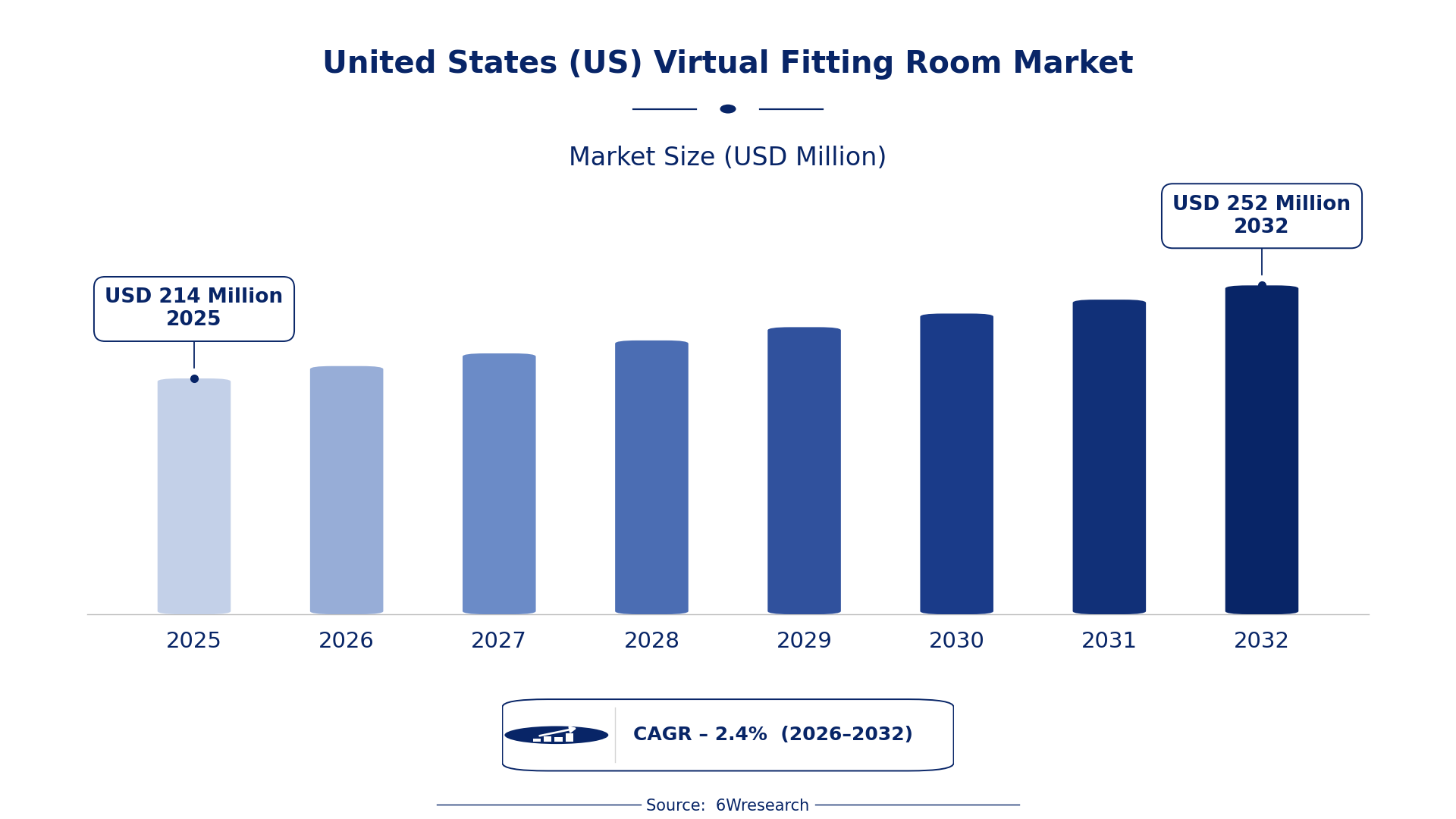
The United States (US) Virtual Fitting Room Market was estimated at USD 214 Million in 2025 and is projected to reach USD 252 Million by 2032, growing at a CAGR of 2.4% from 2026 to 2032.
United States (US) Virtual Fitting Room Market Synopsis
The demand for virtual fitting rooms is surging as consumers increasingly prioritize convenience and personalization in their shopping experiences. This technology allows shoppers to visualize how clothing and accessories will fit, significantly reducing the likelihood of returns and boosting customer satisfaction.
Retailers are swiftly adopting these solutions not only to enhance engagement but also to streamline their operations. As competition intensifies, the integration of virtual fitting rooms is becoming a strategic necessity for brands aiming to cater to the tech-savvy consumer base in the US.
United States (US) Virtual Fitting Room Market Year-wise Growth Rate and Key Drivers
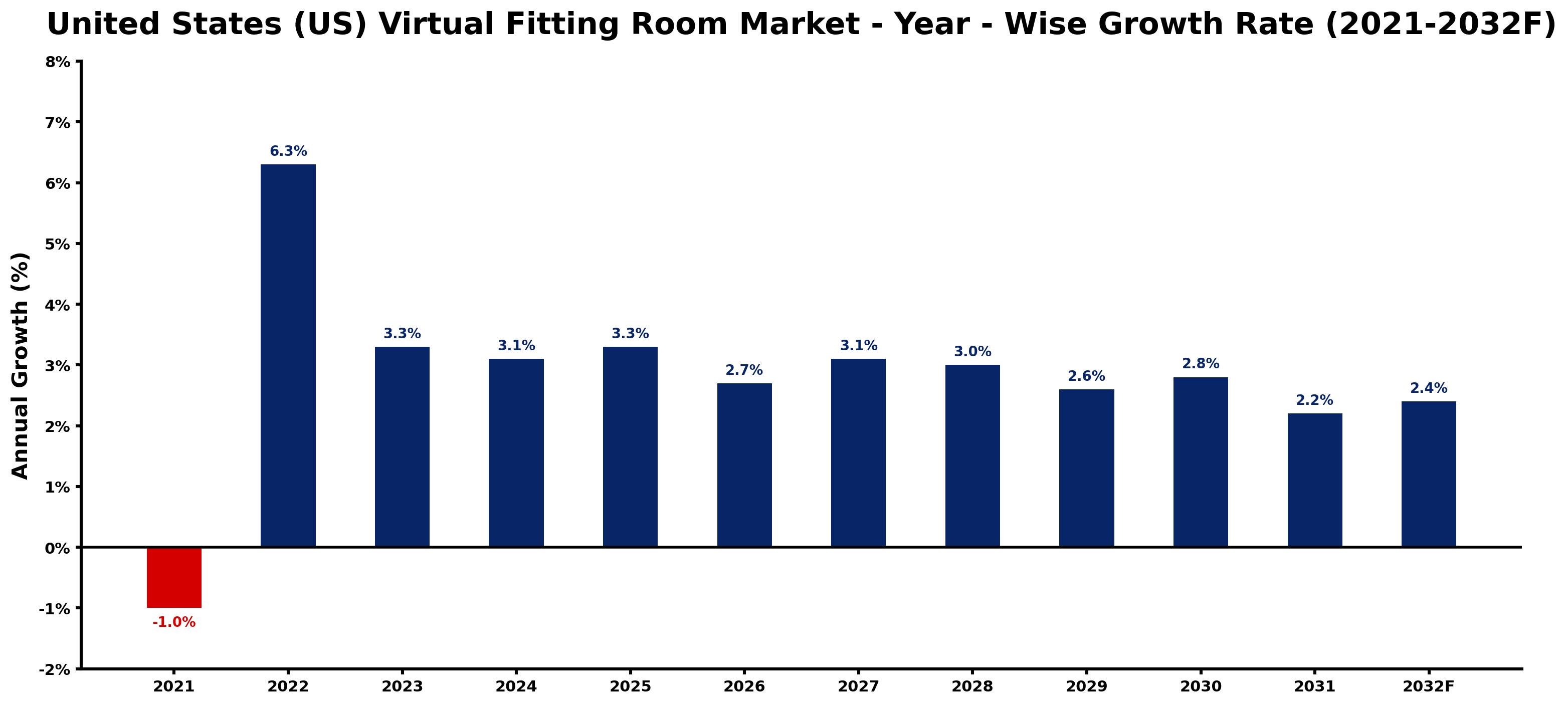
This graph illustrates the annual growth rates of the United States (US) Virtual Fitting Room Market from 2021 to 2032, highlighting a steady upward trajectory and projected expansion over the forecast period.
The table below presents the year‑wise growth rates along with the key drivers influencing the market
| Year | Growth Rate | Major Drivers |
| 2021 | -1.0% | Lack of investment in AR technology advancements. |
| 2022 | 6.3% | Retailers investing in immersive tech for customer engagement |
| 2023 | 3.3% | Increased consumer interest in personalized online shopping experiences |
| 2024 | 3.1% | Growth in partnerships between retailers and tech startups |
| 2025 | 3.3% | Retail innovation initiatives supported by Small Business Administration |
| 2026 | 2.7% | Adoption of AI-driven fitting solutions among fashion brands |
| 2027 | 3.1% | Surge in digitally-native brands optimizing virtual fitting rooms |
| 2028 | 3.0% | Increasing use of augmented reality in fashion marketing |
| 2029 | 2.6% | Focus on sustainability driving virtual clothing try-on tools |
| 2030 | 2.8% | Demand for safer shopping experiences enhances digital fittings |
| 2031 | 2.2% | Consumer preference for interactive fitting experiences rises |
| 2032 | 2.4% | Fashion tech grants from government encouraging startup growth |
Note: Market size estimations and growth projections presented in this report are based on 6Wresearch's proprietary forecasting methodology, utilizing the latest available industry data, government publications, and primary research inputs.
United States (US) Virtual Fitting Room Market Key Takeaways
Below are some of the specific key takeaways from the market, including:
- The market is anticipated to grow steadily, driven by rising online shopping trends.
- Advanced technologies like AI and 3D body scanning are gaining traction in virtual fitting solutions.
- Consumer concerns about privacy and data security remain significant hurdles for widespread adoption.
- Investment opportunities are emerging as retailers seek to enhance customer experiences through technology.
- Government regulations around data privacy are shaping how virtual fitting room platforms operate.
Evaluation of Restraints in United States (US) Virtual Fitting Room Market
The United States Virtual Fitting Room Market faces several hurdles that could limit its growth. One of the primary constraints is the technology’s current inability to accurately capture the nuances of body measurements and fit. While some advancements have been made, discrepancies between virtual fittings and actual fit can lead to consumer dissatisfaction.
Additionally, privacy concerns loom large, as consumers are wary of sharing their personal data with virtual fitting platforms. This hesitation can hinder the adoption of these technologies. The absence of uniform sizing standards across various brands further complicates the accuracy of recommendations, which could frustrate shoppers. These factors necessitate ongoing innovation and transparency in the market.
United States (US) Virtual Fitting Room Market Trends
A notable trend in the US Virtual Fitting Room Market is the increasing incorporation of artificial intelligence for tailored recommendations. This technology not only personalizes the shopping experience but also enhances user engagement. on top of that, the implementation of 3D body scanning is proving effective in providing accurate sizing, addressing one of the critical pain points for online shoppers.
The COVID-19 pandemic has accelerated the shift toward online shopping, making virtual fitting rooms more relevant than ever. As consumers seek safe and convenient shopping solutions, retailers are prioritizing the integration of these technologies to meet evolving preferences.
United States (US) Virtual Fitting Room Market Opportunities
Investment opportunities are ripe in the United States Virtual Fitting Room Market as more retailers recognize the benefits of digital solutions. Companies that develop and implement virtual fitting technologies can capitalize on the growing demand for personalized shopping experiences. Collaborations between tech firms and retailers to enhance virtual try-on capabilities can lead to lucrative partnerships.
With a projected increase in online shopping, the market is set for expansion, creating further avenues for innovation and investment. Retailers focusing on customer engagement through virtual fitting solutions are likely to gain a competitive edge.
Government Initiatives in the United States (US) Virtual Fitting Room Market
Government policies are increasingly shaping the framework within which the United States Virtual Fitting Room Market operates. Consumer protection, data privacy, and intellectual property rights are focal points for regulation, directly impacting how businesses engage with technology and customer data. As the market evolves, maintaining consumer trust through robust regulatory practices will be crucial.
- A regulatory framework introduced in 2025 emphasizes consumer data protection for virtual fitting room platforms.
- Current initiatives are underway to improve data transparency standards across e-commerce platforms.
- Recent legislation mandates stricter compliance with data storage protocols to protect consumer privacy.
- Ongoing discussions about intellectual property rights aim to foster innovation in virtual fitting technologies.
- Upcoming guidelines are expected to standardize sizing practices in virtual fitting rooms, enhancing user experience.
Future Insights of the United States (US) Virtual Fitting Room Market
Looking ahead to 2026-2032, the United States Virtual Fitting Room Market is likely to witness substantial growth fueled by technological advancements and changing consumer behavior. As consumers demand greater personalization and convenience, retailers will increasingly integrate virtual fitting solutions into their e-commerce strategies.
The focus will shift towards enhancing the accuracy of virtual fittings and improving user experiences. With the ongoing emphasis on digital innovation, companies that can effectively address privacy concerns while offering seamless virtual try-on experiences will lead the market.
United States (US) Virtual Fitting Room Market Latest Developments
Recent activity in the United States Virtual Fitting Room Market showcases a trend towards innovation and enhanced consumer engagement. Companies are prioritizing the development of advanced technologies that improve virtual fitting experiences. As retailers adapt to changing consumer expectations, the market is becoming increasingly dynamic.
- A major technology vendor launched a new virtual fitting solution in early 2025, emphasizing AI-driven personalization.
- Currently underway is a collaborative initiative between retail and tech companies to enhance body scanning accuracy, expected to complete by late 2025.
- A planned rollout of a user-friendly interface for virtual fitting rooms is set to begin in Q3 2026, aimed at improving customer interaction.
- Several retailers are testing augmented reality features in virtual fitting rooms, with pilot programs that commenced in early 2025.
- Ongoing enhancements in data privacy measures are being integrated into existing virtual fitting technologies, addressing consumer concerns.
United States (US) Virtual Fitting Room Market - Key Attractiveness of the Report
- 10 Years of Market Numbers
- Historical Data Starting from 2022 to 2025
- Base Year: 2025
- Forecast Data until 2032
- Key Performance Indicators Impacting the Market
- Major Upcoming Developments and Projects
Key Highlights of the Report:
- United States (US) Virtual Fitting Room Market Outlook
- Market Size of United States (US) Virtual Fitting Room Market, 2025
- Forecast of United States (US) Virtual Fitting Room Market, 2032
- Historical Data and Forecast of United States (US) Virtual Fitting Room Revenues & Volume for the Period 2022-2032F
- United States (US) Virtual Fitting Room Market Trend Evolution
- United States (US) Virtual Fitting Room Market Drivers and Challenges
- United States (US) Virtual Fitting Room Price Trends
- United States (US) Virtual Fitting Room Porter's Five Forces
- United States (US) Virtual Fitting Room Industry Life Cycle
- Historical Data and Forecast of United States (US) Virtual Fitting Room Market Revenues & Volume By Component for the Period 2022-2032F
- Historical Data and Forecast of United States (US) Virtual Fitting Room Market Revenues & Volume By Hardware for the Period 2022-2032F
- Historical Data and Forecast of United States (US) Virtual Fitting Room Market Revenues & Volume By Software for the Period 2022-2032F
- Historical Data and Forecast of United States (US) Virtual Fitting Room Market Revenues & Volume By Services for the Period 2022-2032F
- Historical Data and Forecast of United States (US) Virtual Fitting Room Market Revenues & Volume By End-User for the Period 2022-2032F
- Historical Data and Forecast of United States (US) Virtual Fitting Room Market Revenues & Volume By Physical Store for the Period 2022-2032F
- Historical Data and Forecast of United States (US) Virtual Fitting Room Market Revenues & Volume By Virtual Store for the Period 2022-2032F
- Historical Data and Forecast of United States (US) Virtual Fitting Room Market Revenues & Volume By Use Case for the Period 2022-2032F
- Historical Data and Forecast of United States (US) Virtual Fitting Room Market Revenues & Volume By Apparel for the Period 2022-2032F
- Historical Data and Forecast of United States (US) Virtual Fitting Room Market Revenues & Volume By Accessories for the Period 2022-2032F
- Historical Data and Forecast of United States (US) Virtual Fitting Room Market Revenues & Volume By Eye Wear for the Period 2022-2032F
- Historical Data and Forecast of United States (US) Virtual Fitting Room Market Revenues & Volume By Jewelry and Watches for the Period 2022-2032F
- Historical Data and Forecast of United States (US) Virtual Fitting Room Market Revenues & Volume By Beauty and Cosmetics for the Period 2022-2032F
- Historical Data and Forecast of United States (US) Virtual Fitting Room Market Revenues & Volume By Others for the Period 2022-2032F
- Historical Data and Forecast of United States (US) Virtual Fitting Room Market Revenues & Volume By End User for the Period 2022-2032F
- Historical Data and Forecast of United States (US) Virtual Fitting Room Market Revenues & Volume By Physical store for the Period 2022-2032F
- Historical Data and Forecast of United States (US) Virtual Fitting Room Market Revenues & Volume By Virtual Store for the Period 2022-2032F
- United States (US) Virtual Fitting Room Import Export Trade Statistics
- Market Opportunity Assessment By Component
- Market Opportunity Assessment By End-User
- Market Opportunity Assessment By Use Case
- Market Opportunity Assessment By End User
- United States (US) Virtual Fitting Room Top Companies Market Share
- United States (US) Virtual Fitting Room Competitive Benchmarking By Technical and Operational Parameters
- United States (US) Virtual Fitting Room Company Profiles
- United States (US) Virtual Fitting Room Key Strategic Recommendations






































