United States (US) Wooden Toys Market Size, Share & Growth Rate
The United States (US) Wooden Toys Market was estimated at USD 153 Million in 2025 and is projected to reach USD 181 Million by 2032, growing at a CAGR of 2.4% from 2026 to 2032. This growth trajectory is significantly influenced by the rising consumer preference for sustainable and eco-friendly products, as parents seek alternatives to plastic toys. Additionally, the increasing awareness of the developmental benefits of wooden toys further boosts their appeal among health-conscious and environmentally aware consumers.
United States (US) Wooden Toys Market Year-wise Growth Rate and Key Drivers
This graph highlights how the United States (US) Wooden Toys Market has steadily grown over the years, supported by major growth factors.
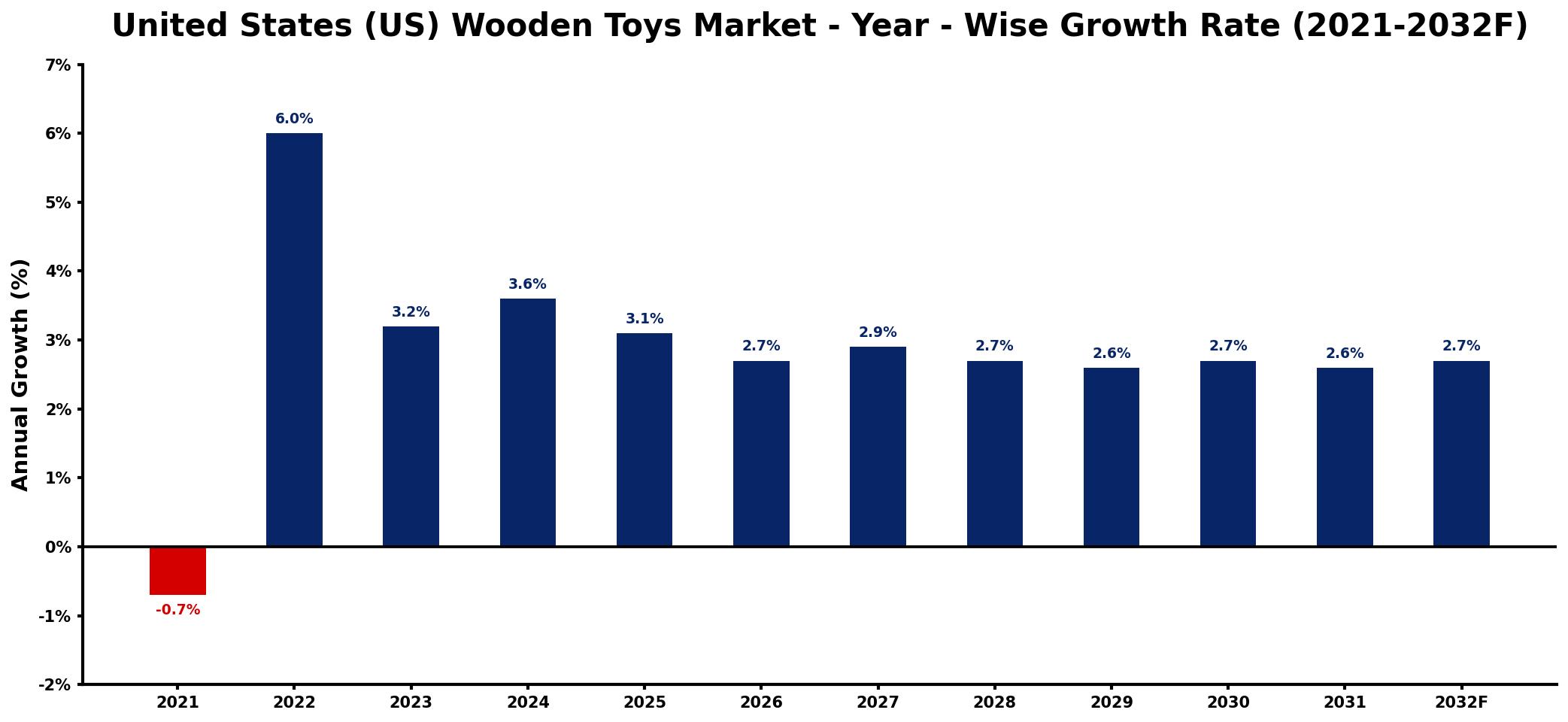
The table below presents the year‑wise growth rates along with the key drivers influencing the market
| Year | Growth Rate | Major Drivers |
| 2021 | -0.7% | Consumer interest in alternatives declines |
| 2022 | 6.0% | Sustainable materials gain popularity rapidly |
| 2023 | 3.2% | New marketing strategies attract families |
| 2024 | 3.6% | Online retail channels expand significantly |
| 2025 | 3.1% | Educational initiatives promote creative play |
| 2026 | 2.7% | Social media influence drives sales |
| 2027 | 2.9% | Collaborations with influencers increase visibility |
| 2028 | 2.7% | Rising eco-consciousness boosts demand |
| 2029 | 2.6% | Product diversification captures new audiences |
| 2030 | 2.7% | Investment in local manufacturing increases |
| 2031 | 2.6% | Enhanced distribution networks improve access |
| 2032 | 2.7% | expanding healthcare application demand |
Note: Market size estimations and growth projections presented in this report are based on 6Wresearch's proprietary forecasting methodology, utilizing the latest available industry data, government publications, and primary research inputs.
United States (US) Wooden Toys Market Synopsis
The demand for wooden toys in the United States is being fueled by a growing emphasis on quality and safety. Consumers are increasingly inclined to choose toys that not only engage children's imaginations but also promote cognitive and physical development. This trend is supported by the introduction of innovative designs that incorporate educational aspects into traditional wooden toys.
Moreover, the supply side is adapting to these changing preferences, with manufacturers emphasizing the use of non-toxic and sustainably sourced materials. This shift not only aligns with consumer expectations but also addresses the larger issue of environmental sustainability, making wooden toys a favored choice among parents who value both safety and ecological responsibility.
United States (US) Wooden Toys Market Key Takeaways
- The market is witnessing a consistent upward trend driven by increased consumer awareness of sustainable products.
- Parents prioritize durability and safety, which contribute to the rising demand for wooden toys.
- Online retail channels are becoming pivotal for market expansion, offering greater accessibility and variety.
- Manufacturers are innovating to incorporate educational features into their wooden toy designs.
- Compliance with safety regulations is a significant focus for companies in the wooden toys sector.
Evaluation of Restraints in United States (US) Wooden Toys Market
Despite the positive growth outlook, several restraints hinder the expansion of the US wooden toys market. The primary challenge stems from intense competition with plastic and electronic toys, which often have lower production costs and more appealing features. Additionally, the higher price point of wooden toys compared to mass-produced alternatives can deter budget-conscious consumers. Limited visibility in mainstream retail channels also poses a significant barrier for wooden toy manufacturers, making effective distribution and marketing strategies crucial for success.
United States (US) Wooden Toys Market Trends
One prominent trend in the US wooden toys market is the increasing demand for eco-friendly products, driven by consumer concerns about the environmental impact of plastic waste. This has prompted manufacturers to focus on creating toys made from renewable materials. Moreover, the popularity of educational toys that foster creativity and hands-on learning experiences continues to rise, encouraging brands to innovate by integrating technology with traditional designs, thus enhancing interactivity.
United States (US) Wooden Toys Market Opportunities
The US wooden toys market offers attractive investment opportunities, particularly in the realm of sustainable toy production. Companies that specialize in high-quality, educational toys can capitalize on the growing consumer demand for non-toxic options. Moreover, there is potential for expanding product lines to include innovative interactive features, appealing to tech-savvy families. As the shift towards sustainability continues, investors have the chance to support businesses committed to eco-friendly practices, positioning themselves for long-term profitability.
Government Initiatives in the United States (US) Wooden Toys Market
Government policies significantly impact the US wooden toys market, particularly through safety regulations enforced by the Consumer Product Safety Commission (CPSC). These regulations ensure that wooden toys adhere to stringent safety standards, fostering consumer trust. Additionally, the government supports small businesses within the toy industry through various programs and tax incentives, encouraging innovation and growth in this sector. Environmental initiatives also promote sustainable practices in production, aligning with the market's overall trajectory towards eco-friendliness.
Future Insights of the United States (US) Wooden Toys Market
Looking ahead to 2026-2032, the US wooden toys market is poised for significant growth, primarily fueled by the enduring consumer trend towards sustainability and quality. Parents' increasing recognition of the developmental advantages of wooden toys positions the market well for continued expansion. Nostalgia associated with traditional toys further enhances their appeal, while manufacturers are likely to innovate with diverse product offerings tailored to various interests and developmental stages. This evolving landscape suggests a vibrant future for the wooden toys segment in the US.
United States (US) Wooden Toys Market Latest Developments (2025 - 2026)
Recent developments in the US wooden toys market indicate a strong push towards sustainability, with several manufacturers unveiling new product lines made from organic materials. The integration of educational technology into traditional wooden toys is gaining momentum, with brands experimenting with interactive features that enhance play experiences. Additionally, the online retail landscape is becoming increasingly competitive, prompting companies to enhance their digital marketing strategies to reach a broader audience effectively.
United States (US) Wooden Toys Market - Key Attractiveness of the Report
- 10 Years of Market Numbers
- Historical Data Starting from 2022 to 2025
- Base Year: 2025
- Forecast Data until 2032
- Key Performance Indicators Impacting the Market
- Major Upcoming Developments and Projects
Key Highlights of the Report:
- United States (US) Wooden Toys Market Outlook
- Market Size of United States (US) Wooden Toys Market, 2025
- Forecast of United States (US) Wooden Toys Market, 2032
- Historical Data and Forecast of United States (US) Wooden Toys Revenues & Volume for the Period 2022-2032F
- United States (US) Wooden Toys Market Trend Evolution
- United States (US) Wooden Toys Market Drivers and Challenges
- United States (US) Wooden Toys Price Trends
- United States (US) Wooden Toys Porter's Five Forces
- United States (US) Wooden Toys Industry Life Cycle
- Historical Data and Forecast of United States (US) Wooden Toys Market Revenues & Volume By Product Type for the Period 2022-2032F
- Historical Data and Forecast of United States (US) Wooden Toys Market Revenues & Volume By Educational Toys for the Period 2022-2032F
- Historical Data and Forecast of United States (US) Wooden Toys Market Revenues & Volume By Construction Toys for the Period 2022-2032F
- Historical Data and Forecast of United States (US) Wooden Toys Market Revenues & Volume By Musical Toys for the Period 2022-2032F
- Historical Data and Forecast of United States (US) Wooden Toys Market Revenues & Volume By Game Toys for the Period 2022-2032F
- Historical Data and Forecast of United States (US) Wooden Toys Market Revenues & Volume By Dolls & Miniatures for the Period 2022-2032F
- Historical Data and Forecast of United States (US) Wooden Toys Market Revenues & Volume By Automotive Toys for the Period 2022-2032F
- Historical Data and Forecast of United States (US) Wooden Toys Market Revenues & Volume By Pretend Play Toys for the Period 2022-2032F
- Historical Data and Forecast of United States (US) Wooden Toys Market Revenues & Volume By Wood Type for the Period 2022-2032F
- Historical Data and Forecast of United States (US) Wooden Toys Market Revenues & Volume By Softwood for the Period 2022-2032F
- Historical Data and Forecast of United States (US) Wooden Toys Market Revenues & Volume By Hardwood for the Period 2022-2032F
- Historical Data and Forecast of United States (US) Wooden Toys Market Revenues & Volume By Age Group for the Period 2022-2032F
- Historical Data and Forecast of United States (US) Wooden Toys Market Revenues & Volume By Below 1 Year for the Period 2022-2032F
- Historical Data and Forecast of United States (US) Wooden Toys Market Revenues & Volume By Age 1-3 for the Period 2022-2032F
- Historical Data and Forecast of United States (US) Wooden Toys Market Revenues & Volume By Age 3-5 for the Period 2022-2032F
- Historical Data and Forecast of United States (US) Wooden Toys Market Revenues & Volume By Age 5-12 for the Period 2022-2032F
- Historical Data and Forecast of United States (US) Wooden Toys Market Revenues & Volume By Age 12+ for the Period 2022-2032F
- Historical Data and Forecast of United States (US) Wooden Toys Market Revenues & Volume By Distribution Channel for the Period 2022-2032F
- Historical Data and Forecast of United States (US) Wooden Toys Market Revenues & Volume By Online for the Period 2022-2032F
- Historical Data and Forecast of United States (US) Wooden Toys Market Revenues & Volume By Offline for the Period 2022-2032F
- United States (US) Wooden Toys Import Export Trade Statistics
- Market Opportunity Assessment By Product Type
- Market Opportunity Assessment By Wood Type
- Market Opportunity Assessment By Age Group
- Market Opportunity Assessment By Distribution Channel
- United States (US) Wooden Toys Top Companies Market Share
- United States (US) Wooden Toys Competitive Benchmarking By Technical and Operational Parameters
- United States (US) Wooden Toys Company Profiles
- United States (US) Wooden Toys Key Strategic Recommendations






































