Venezuela Benzoic Acid Market Size, Share & Growth Rate
The Venezuela Benzoic Acid Market was estimated at USD 475 Million in 2025 and is projected to reach USD 695 Million by 2032, growing at a CAGR of 5.6% from 2026 to 2032. This upward trajectory is primarily fueled by the surging demand for benzoic acid in the food and beverage sector, where it serves as a vital preservative. Additionally, the pharmaceutical industry's reliance on benzoic acid for producing various medical products is further driving growth as consumers prioritize quality and safety.
Venezuela Benzoic Acid Market Year-wise Growth Rate and Key Drivers
This graph highlights how the Venezuela Benzoic Acid Market has steadily grown over the years, supported by major growth factors.
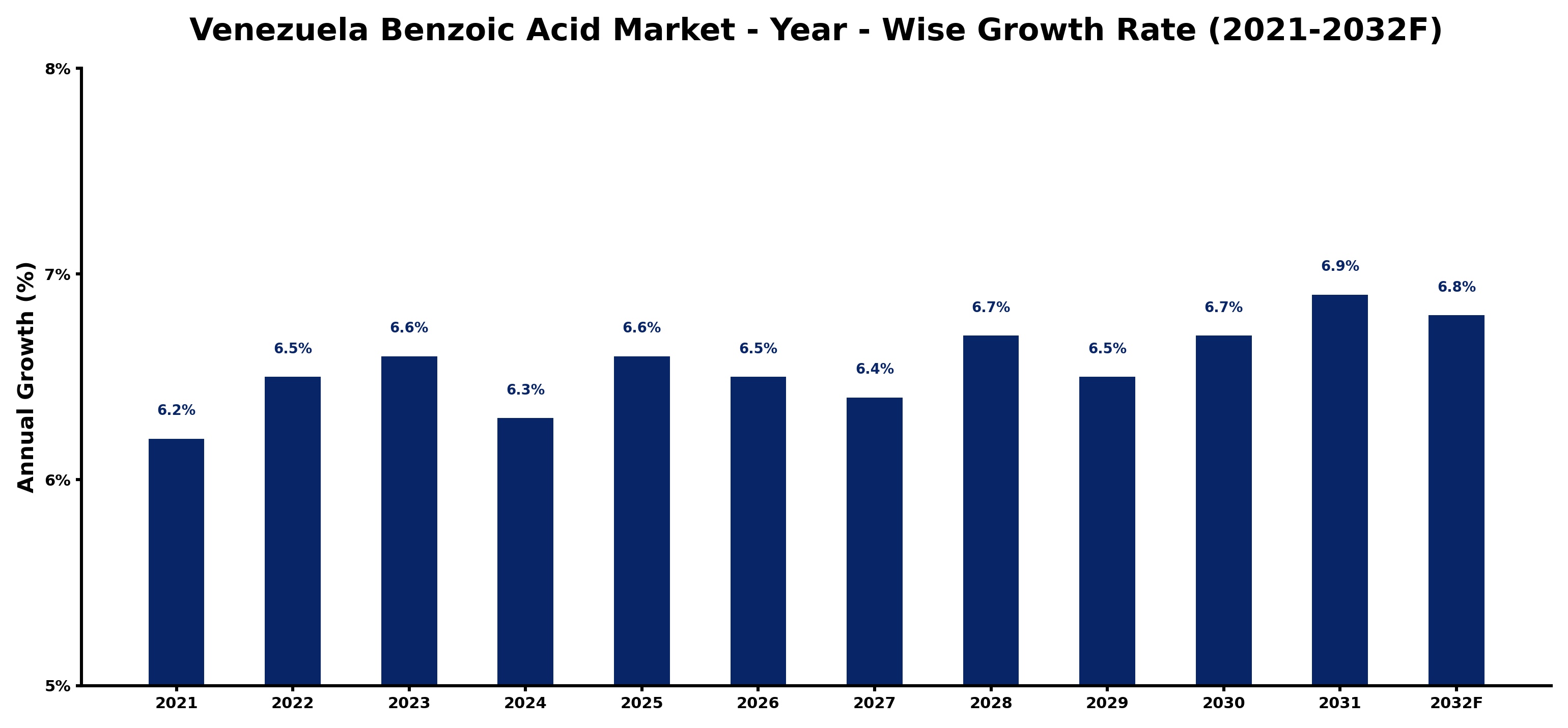
The table below presents the year‑wise growth rates along with the key drivers influencing the market
| Year | Growth Rate | Major Drivers |
| 2021 | 6.2% | Venezuelan chemical plants boost benzoic acid production capacities |
| 2022 | 6.5% | Local manufacturers invest in upgraded facilities for benzoic acid production |
| 2023 | 6.6% | Domestic chemical production recovery bolstered benzoic acid manufacturing capacity |
| 2024 | 6.3% | Government infrastructure projects boost domestic benzoic acid manufacturing capacity |
| 2025 | 6.6% | Digital transformation in chemical plants boosts benzoic acid production efficiency |
| 2026 | 6.5% | Manufacturing investments in benzoic acid enhance local supply chain efficiency |
| 2027 | 6.4% | Domestic production adjustments boosted local benzoic acid availability |
| 2028 | 6.7% | Domestic manufacturing investments boosted benzoic acid production capabilities |
| 2029 | 6.5% | Local manufacturers boost benzoic acid output to meet export demands |
| 2030 | 6.7% | Domestic chemical manufacturers invest in advanced benzoic acid production technologies |
| 2031 | 6.9% | New benzoic acid plant operations boost regional supply reliability |
| 2032 | 6.8% | Advanced technology adoption streamlined benzoic acid production efficiency |
Note - Market size estimations and growth projections presented in this report are based on 6Wresearch’s advanced forecasting approach, validated with industry datasets as of June 2026.
Venezuela Benzoic Acid Market Synopsis
The most significant force shaping the Venezuela Benzoic Acid Market is the increasing emphasis on food safety and preservation among consumers. As the demand for processed foods rises, manufacturers are keen to leverage benzoic acid's properties to extend shelf life and maintain product integrity. This trend is bolstered by a growing awareness of health and safety standards within the food and beverage industry.
Moreover, the pharmaceutical sector's expansion is acting as a critical driver for benzoic acid consumption. The substance is not only pivotal in medicine formulation but also finds applications in personal care products. As these industries thrive, the benzoic acid market is well-positioned to benefit from their growth dynamics.
Venezuela Benzoic Acid Market Key Takeaways
- The market is poised for steady growth, with an expected CAGR of 5.6% from 2026 to 2032.
- Benzoic acid is increasingly favored as a preservative in food and beverage products.
- Pharmaceutical applications of benzoic acid are expanding, reflecting a robust healthcare sector.
- Challenges related to economic instability and political uncertainties impact market growth prospects.
- Investment opportunities exist, particularly in the burgeoning food and beverage and pharmaceutical sectors.
Evaluation of Restraints in Venezuela Benzoic Acid Market
Despite its potential for growth, the Venezuela Benzoic Acid Market faces several significant restraints. Volatility in raw material prices creates a challenging environment for manufacturers, complicating cost management and pricing strategies. Additionally, the ongoing economic crisis in Venezuela has curtailed consumer purchasing power, leading to decreased demand for products containing benzoic acid. Political instability further complicates operations, causing uncertainty in supply chains and market forecasting. To thrive, companies must navigate these obstacles with strategic agility and robust risk management.
Venezuela Benzoic Acid Market Trends
Emerging trends in the Venezuela Benzoic Acid Market include a pronounced shift towards sustainable and natural preservatives. Consumers are becoming increasingly health-conscious, driving demand for products that are perceived as safer and more environmentally friendly. Furthermore, advancements in production technologies are enhancing the efficiency and quality of benzoic acid, enabling manufacturers to meet evolving market needs. Investments in R&D are also on the rise, reflecting a commitment to innovation in product formulations.
Venezuela Benzoic Acid Market Opportunities
The Venezuela Benzoic Acid Market presents genuine opportunities for growth in the food and beverage sector. As the demand for packaged and processed food continues to rise, benzoic acid's role as a preservative becomes increasingly critical. Similarly, the pharmaceutical industry offers substantial investment prospects, with benzoic acid being integral in the development of various medications and topical products. Additionally, Venezuela's abundant natural resources could facilitate cost-effective production methods, further incentivizing investment in the market.
Government Initiatives in the Venezuela Benzoic Acid Market
Government policies significantly influence the Venezuela Benzoic Acid Market, with various measures aimed at regulating production and ensuring quality. Price controls have been established to maintain affordability, although these often lead to market distortions and shortages. Import restrictions aim to bolster domestic production, but challenges in local manufacturing capacity remain prevalent. Additionally, quality and safety standards are enforced through regulatory frameworks, though bureaucratic inefficiencies may impede effective implementation.
Future Insights of the Venezuela Benzoic Acid Market
Looking ahead to 2026-2032, the future of the Venezuela Benzoic Acid Market is rife with uncertainty, stemming from the country's ongoing economic and political challenges. Supply chain disruptions and regulatory changes are likely to affect production and distribution capabilities. Nonetheless, there are potential avenues for growth if the government undertakes reforms to stabilize the economy and create a favorable environment for foreign investment. Market players must stay vigilant and adaptable to navigate this evolving landscape effectively.
Venezuela Benzoic Acid Market Latest Developments (May 2025 - June 2026)
Recent developments in the Venezuela Benzoic Acid Market indicate a focused effort towards enhancing production capacity and distribution networks. Local manufacturers are actively seeking partnerships to improve supply chain efficiency and expand their market reach. In parallel, the industry is witnessing a wave of innovation, with companies investing in advanced production technologies to enhance the quality of benzoic acid. Such advancements could pave the way for greater competitiveness within the region.
Venezuela Benzoic Acid Market - Key Attractiveness of the Report
- 10 Years of Market Numbers
- Historical Data Starting from 2022 to 2025
- Base Year: 2025
- Forecast Data until 2032
- Key Performance Indicators Impacting the Market
- Major Upcoming Developments and Projects
Key Highlights of the Report:
- Venezuela Benzoic Acid Market Outlook
- Market Size of Venezuela Benzoic Acid Market, 2025
- Forecast of Venezuela Benzoic Acid Market, 2032
- Historical Data and Forecast of Venezuela Benzoic Acid Revenues & Volume for the Period 2022-2032F
- Venezuela Benzoic Acid Market Trend Evolution
- Venezuela Benzoic Acid Market Drivers and Challenges
- Venezuela Benzoic Acid Price Trends
- Venezuela Benzoic Acid Porter's Five Forces
- Venezuela Benzoic Acid Industry Life Cycle
- Historical Data and Forecast of Venezuela Benzoic Acid Market Revenues & Volume By End-use Industry for the Period 2022-2032F
- Historical Data and Forecast of Venezuela Benzoic Acid Market Revenues & Volume By Food & Beverages for the Period 2022-2032F
- Historical Data and Forecast of Venezuela Benzoic Acid Market Revenues & Volume By Chemical for the Period 2022-2032F
- Historical Data and Forecast of Venezuela Benzoic Acid Market Revenues & Volume By Pharmaceutical for the Period 2022-2032F
- Historical Data and Forecast of Venezuela Benzoic Acid Market Revenues & Volume By Application for the Period 2022-2032F
- Historical Data and Forecast of Venezuela Benzoic Acid Market Revenues & Volume By Benzoates for the Period 2022-2032F
- Historical Data and Forecast of Venezuela Benzoic Acid Market Revenues & Volume By Benzoate plasticizers for the Period 2022-2032F
- Historical Data and Forecast of Venezuela Benzoic Acid Market Revenues & Volume By Benzoyl Chloride for the Period 2022-2032F
- Historical Data and Forecast of Venezuela Benzoic Acid Market Revenues & Volume By Alkyd Resins for the Period 2022-2032F
- Historical Data and Forecast of Venezuela Benzoic Acid Market Revenues & Volume By Animal Feed Additive for the Period 2022-2032F
- Venezuela Benzoic Acid Import Export Trade Statistics
- Market Opportunity Assessment By End-use Industry
- Market Opportunity Assessment By Application
- Venezuela Benzoic Acid Top Companies Market Share
- Venezuela Benzoic Acid Competitive Benchmarking By Technical and Operational Parameters
- Venezuela Benzoic Acid Company Profiles
- Venezuela Benzoic Acid Key Strategic Recommendations






































