Venezuela Bicycles Market Summary
The venezuela bicycles market was estimated at USD 474 Million in 2025 and is projected to reach USD 636 Million by 2032, growing at a CAGR of 4.9% from 2026 to 2032.
Venezuela Bicycles Market Year-wise Growth Rate and Key Drivers
This graph highlights how the Venezuela Bicycles Market has steadily grown over the past five years, supported by major growth factors.
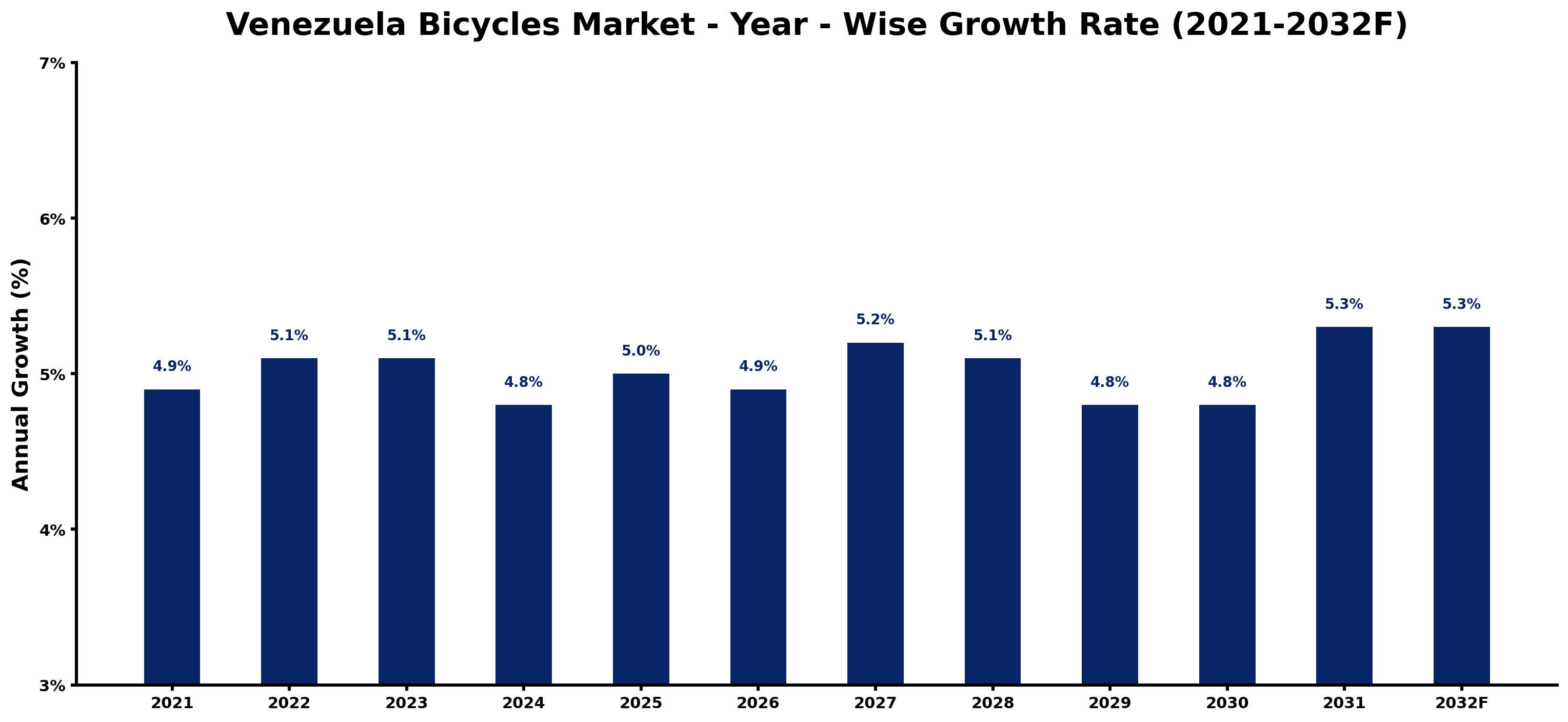
The table below presents the year wise growth rates along with the key drivers influencing the market
| Year | Growth Rate | Major Drivers |
| 2021 | 4.9% | Economic challenges prompted many Venezuelans to seek affordable transportation alternatives. |
| 2022 | 5.1% | Inflationary pressures affected public transport, pushing bicycle purchases higher. |
| 2023 | 5.1% | Urban infrastructure gradually improved, enhancing cycling safety and accessibility. |
| 2024 | 4.8% | Local manufacturing initiatives began supporting the production of budget-friendly bicycles. |
| 2025 | 5.0% | Health and fitness trends fostered a growing cycling culture among Venezuelans. |
| 2026 | 4.9% | E-commerce platforms expanded, facilitating easier access to a variety of bicycles. |
| 2027 | 5.2% | Environmental awareness increased, leading more citizens to consider sustainable transport options. |
| 2028 | 5.1% | Tourism development projects highlighted cycling as an attraction in scenic areas. |
| 2029 | 4.8% | Community bike-sharing programs emerged, promoting cycling as a viable transport solution. |
| 2030 | 4.8% | Collaborations with international NGOs introduced cycling education and infrastructure support. |
| 2031 | 5.3% | Youth interest in cycling spurred by social media and influencer campaigns. |
| 2032 | 5.3% | Investment in road safety initiatives further encouraged bicycle usage across urban regions. |
Note - Market size estimations and growth projections presented in this report are based on 6Wresearch's advanced forecasting approach, validated with industry datasets as of June 2026.
Venezuela Bicycles Market Synopsis
The Venezuela Bicycles Market is projected to reach 4.9% and witness significant growth during the forecast period (2026-2032). Driven by heightened awareness of the health benefits associated with cycling and environmental sustainability, this market is largely characterized by a preference for locally manufactured bicycles due to import restrictions and ongoing economic challenges. Traditional bicycles remain the primary choice for consumers, while electric bicycles are gradually gaining traction as a practical solution for urban commuting.
Venezuela Bicycles Market Growth Drivers
The growth of the Venezuela Bicycles Market can be attributed to several interrelated factors:
- The increasing public consciousness regarding health and fitness has led many Venezuelans to consider cycling as a viable exercise option. This shift in lifestyle emphasizes the benefits of cycling, promoting overall wellness.
- Environmental concerns are prompting a significant push towards eco-friendly transportation alternatives. Cycling reduces carbon footprints, making it an appealing option for environmentally-conscious consumers.
- Government initiatives aimed at improving cycling infrastructure, such as the development of bike lanes and public cycling events, are fostering a more conducive environment for growth in the bicycles market.
- The burgeoning interest in urban mobility solutions has increased the appeal of electric bicycles, which offer a practical alternative for commuting in congested urban areas.
- Local manufacturers are focused on providing affordable bicycles to cater to the price-sensitive Venezuelan consumer base, enhancing accessibility within the market.
Venezuela Bicycles Market Trends and Opportunities
In light of evolving consumer preferences, several key trends are emerging in the Venezuela Bicycles Market:
- There is a notable increase in demand for electric bicycles, attributed to their convenience and efficiency in urban commuting settings. This trend indicates a shift in consumer needs towards more modern transportation solutions.
- An increasing interest in specialized bicycles, such as mountain and road bikes, reflects a growing enthusiasm for outdoor activities and sports among local consumers.
- The rise in community-based cycling events and initiatives promotes cycling culture, enhancing the market's visibility and appeal.
- Growth opportunities exist in developing bike sharing services, capitalizing on the demand for accessible and sustainable transport options in urban environments.
- Local manufacturers are innovating to produce durable and cost-effective bicycles tailored to the specific needs and economic realities of Venezuelan consumers.
Venezuela Bicycles Market Challenges and Restraints
Despite the positive trends, the Venezuela Bicycles Market is encountering significant challenges:
- Economic instability, characterized by hyperinflation and currency devaluation, has created an environment where affordability is a considerable concern for consumers and businesses alike.
- Access to imported bicycle parts and accessories has become increasingly restricted, limiting the ability of manufacturers to offer diverse product ranges and maintain quality standards.
- Political unrest and social volatility contribute to an unstable market atmosphere, adversely affecting consumer confidence, which dampens demand for non-essential goods like bicycles.
- Infrastructure challenges, such as poorly maintained roads and a lack of safe cycling lanes, further inhibit the growth potential of the bicycles market.
- The overall unpredictability of the market necessitates robust strategies from industry players to navigate these obstacles and ensure sustainable operations.
Venezuela Bicycles Market Investment Opportunities
The Venezuela Bicycles Market offers several avenues for investment, especially in the wake of increasing demand for cycling as a transportation and recreational option:
- Investing in electric bicycle production caters to urban commuters seeking sustainable mobility solutions, as well as recreational users.
- High-performance bicycles present opportunities for investments targeting cycling enthusiasts and competitive riders who prioritize quality and innovation.
- The bike sharing service model can attract investment, allowing entry into the market while promoting green transportation in densely populated areas.
- Development of local supply chains for parts and accessories can enhance profitability and operational resilience amid economic stringency.
- Investment in community cycling projects and events can not only strengthen brand presence but also foster local engagement and awareness around cycling.
Venezuela Bicycles Market Government Investment and Initiatives
Government policies impacting the Venezuela Bicycles Market are pivotal in shaping its future. Authorities have imposed import restrictions on bicycles and related components, which has considerably influenced the local manufacturing landscape. To counterbalance these challenges, the government has introduced incentives and subsidies for domestic bicycle production, aiming to bolster the local industry. Furthermore, policies promoting cycling as a sustainable mode of transportation are being implemented, emphasizing the development of cycling infrastructure and public engagement programs to encourage bicycle use among the populace. Although the economic climate poses challenges, these initiatives reflect a concerted effort to support the domestic bicycles industry while promoting an environmentally friendly transportation alternative.
Venezuela Bicycles Market Latest Developments (May 2025 - June 2026)
Recent developments in the Venezuela Bicycles Market indicate a continued focus on expanding local manufacturing capabilities amid import restrictions. The government is actively promoting cycling initiatives and infrastructure improvements, which have captured the interest of potential investors. Additionally, community engagement in cycling events has led to increased awareness and participation in recreational cycling, fostering a more vibrant cycling culture. Challenges such as currency instability and economic hurdles remain prevalent; however, stakeholders within the industry are cautiously optimistic about the prospects of electrifying the bicycles segment and investing in innovative solutions tailored to local preferences.
Venezuela Bicycles Market - Key Attractiveness of the Report
- 10 Years of Market Numbers
- Historical Data Starting from 2022 to 2025
- Base Year: 2025
- Forecast Data until 2032
- Key Performance Indicators Impacting the Market
- Major Upcoming Developments and Projects
Key Highlights of the Report:
- Venezuela Bicycles Market Outlook
- Market Size of Venezuela Bicycles Market, 2025
- Forecast of Venezuela Bicycles Market, 2032F
- Historical Data and Forecast of Venezuela Bicycles Revenues & Volume for the Period 2022-2032F
- Venezuela Bicycles Market Trend Evolution
- Venezuela Bicycles Market Drivers and Challenges
- Venezuela Bicycles Price Trends
- Venezuela Bicycles Porter's Five Forces
- Venezuela Bicycles Industry Life Cycle
- Historical Data and Forecast of Venezuela Bicycles Market Revenues & Volume By Product for the Period 2022-2032F
- Historical Data and Forecast of Venezuela Bicycles Market Revenues & Volume By Mountain for the Period 2022-2032F
- Historical Data and Forecast of Venezuela Bicycles Market Revenues & Volume By Hybrid for the Period 2022-2032F
- Historical Data and Forecast of Venezuela Bicycles Market Revenues & Volume By Road for the Period 2022-2032F
- Historical Data and Forecast of Venezuela Bicycles Market Revenues & Volume By Others for the Period 2022-2032F
- Historical Data and Forecast of Venezuela Bicycles Market Revenues & Volume By Technology for the Period 2022-2032F
- Historical Data and Forecast of Venezuela Bicycles Market Revenues & Volume By Electric for the Period 2022-2032F
- Historical Data and Forecast of Venezuela Bicycles Market Revenues & Volume By Conventional for the Period 2022-2032F
- Historical Data and Forecast of Venezuela Bicycles Market Revenues & Volume By End-users for the Period 2022-2032F
- Historical Data and Forecast of Venezuela Bicycles Market Revenues & Volume By Men for the Period 2022-2032F
- Historical Data and Forecast of Venezuela Bicycles Market Revenues & Volume By Women for the Period 2022-2032F
- Historical Data and Forecast of Venezuela Bicycles Market Revenues & Volume By Kids for the Period 2022-2032F
- Venezuela Bicycles Import Export Trade Statistics
- Market Opportunity Assessment By Product
- Market Opportunity Assessment By Technology
- Market Opportunity Assessment By End-users
- Venezuela Bicycles Top Companies Market Share
- Venezuela Bicycles Competitive Benchmarking By Technical and Operational Parameters
- Venezuela Bicycles Company Profiles
- Venezuela Bicycles Key Strategic Recommendations






































