Venezuela Ethylene Glycol Market Size, Share & Growth Rate
The Venezuela Ethylene Glycol Market was estimated at USD 473 Million in 2025 and is projected to reach USD 619 Million by 2032, growing at a CAGR of 3.9% from 2026 to 2032. This growth trajectory is largely driven by the increasing consumption of ethylene glycol across key sectors, particularly automotive and textiles, where it is essential for applications such as antifreeze and polyester fiber production. As industries seek reliable coolant solutions and sustainable materials, the demand for ethylene glycol is poised to strengthen further in the coming years.
Venezuela Ethylene Glycol Market Year-wise Growth Rate and Key Drivers
This graph highlights how the Venezuela Ethylene Glycol Market has steadily grown over the years, supported by major growth factors.
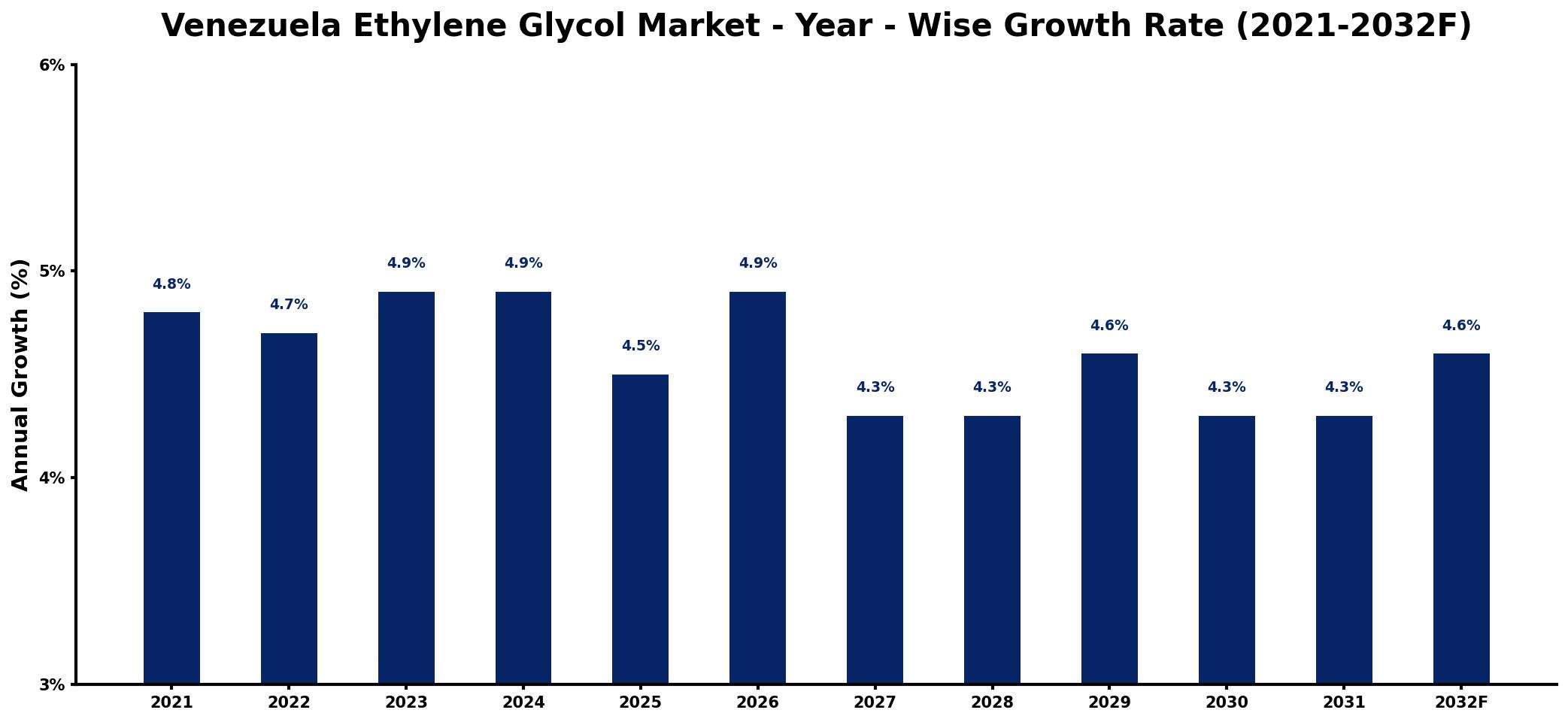
The table below presents the year‑wise growth rates along with the key drivers influencing the market
| Year | Growth Rate | Major Drivers |
| 2021 | 4.8% | Increased demand from packaging sector |
| 2022 | 4.7% | Growth in automotive production levels |
| 2023 | 4.9% | Expansion in textile manufacturing capacity |
| 2024 | 4.9% | Rising investments in construction projects |
| 2025 | 4.5% | growing emerging market penetration |
| 2026 | 4.9% | Boost in chemical processing activities |
| 2027 | 4.3% | Demand from renewable energy sector |
| 2028 | 4.3% | Increased usage in agricultural applications |
| 2029 | 4.6% | strengthening underlying market demand |
| 2030 | 4.3% | Rising need for electronic components |
| 2031 | 4.3% | increased domestic production output |
| 2032 | 4.6% | Increased focus on sustainable packaging |
Note: Market size estimations and growth projections presented in this report are based on 6Wresearch's proprietary forecasting methodology, utilizing the latest available industry data, government publications, and primary research inputs.
Venezuela Ethylene Glycol Market Synopsis
The Venezuelan market for ethylene glycol has shown signs of resilience despite ongoing challenges linked to economic and political instability. Current trends indicate a steady uptick in demand, particularly from the automotive sector, which utilizes ethylene glycol for critical applications such as cooling and antifreeze formulations. As Venezuela's automotive production rebounds, the market for ethylene glycol is expected to flourish alongside.
Moreover, the textile industry is significantly contributing to market growth, driven by the rising production of polyester fibers. The shift towards more sustainable practices and bio-based alternatives within various industries adds another layer to the demand dynamics. Overall, the Venezuela Ethylene Glycol market demonstrates potential for expansion amidst a complex backdrop of political and economic uncertainties.
Venezuela Ethylene Glycol Market Key Takeaways
- The market is poised for growth, propelled by increasing demand from the automotive and textile sectors.
- Ongoing political and economic challenges present volatility but also opportunities for agile market players.
- Environmental concerns are driving interest in bio-based ethylene glycol solutions.
- Government policies aim to bolster domestic production, impacting the market landscape.
- Investing in production facilities could yield significant returns given the country's abundant crude oil reserves.
Evaluation of Restraints in Venezuela Ethylene Glycol Market
The Venezuela Ethylene Glycol market is significantly hampered by the prevailing economic and political turbulence, characterized by hyperinflation and erratic policy shifts. These factors introduce a level of uncertainty that complicates supply chain management and impacts demand forecasting. The reliance on oil revenues further ties the ethylene glycol market to volatile global oil prices, while the lack of foreign investment hampers technological advancements, creating additional barriers to growth. This challenging landscape necessitates strategic agility and robust risk management approaches for companies aiming to navigate the Venezuelan market successfully.
Venezuela Ethylene Glycol Market Trends
Current trends in the Venezuela Ethylene Glycol market showcase a notable increase in demand for antifreeze products, primarily driven by the automotive industry's growth. As vehicle production ramps up, the need for efficient cooling solutions remains critical. Moreover, the industry is experiencing a shift towards eco-friendly practices, with companies increasingly investing in the development of bio-based ethylene glycol products to meet the rising consumer demand for sustainable alternatives. This blend of traditional and innovative approaches is reshaping the market landscape.
Venezuela Ethylene Glycol Market Opportunities
There exist significant investment opportunities within the Venezuela Ethylene Glycol market, primarily driven by the countrys vast crude oil reserves, which are essential for ethylene glycol production. As industries such as automotive, textiles, and packaging expand, potential investors can find value in establishing production facilities or forming partnerships with local manufacturers. However, a keen understanding of the regulatory environment and potential infrastructure challenges is crucial for successful investment decisions in this market.
Government Initiatives in the Venezuela Ethylene Glycol Market
The Venezuelan government is actively implementing policies aimed at promoting domestic ethylene glycol production, reducing reliance on imports, and enhancing local self-sufficiency. Regulatory frameworks are designed to ensure quality standards, monitor pricing, and prevent monopolistic practices within the market. Tariffs and import restrictions further protect local producers, creating an environment conducive to the stabilization and growth of the ethylene glycol industry.
Future Insights of the Venezuela Ethylene Glycol Market
Looking ahead to the years 2026 to 2032, the future of the Venezuela Ethylene Glycol market remains uncertain but holds potential for recovery as the nation addresses its economic challenges. With an evolving global landscape increasingly favoring sustainability, there could be a significant impact on market dynamics, especially as eco-friendly alternatives gain traction. The industrys ability to adapt to these shifts, combined with a stabilization of the political environment, will be crucial in determining the markets long-term trajectory.
Venezuela Ethylene Glycol Market Latest Developments (2025 - 2026)
Recent developments in the Venezuela Ethylene Glycol market indicate a growing interest from local manufacturers to expand production capabilities amidst an evolving regulatory landscape. Enhanced focus on sustainability has led several companies to explore bio-based ethylene glycol production methods, aligning with global trends toward eco-friendly materials. Additionally, strategic partnerships are beginning to form between local producers and international entities aiming to navigate the complexities of the market effectively.
Venezuela Ethylene Glycol Market - Key Attractiveness of the Report
- 10 Years of Market Numbers
- Historical Data Starting from 2022 to 2025
- Base Year: 2025
- Forecast Data until 2032
- Key Performance Indicators Impacting the Market
- Major Upcoming Developments and Projects
Key Highlights of the Report:
- Venezuela Ethylene Glycol Market Outlook
- Market Size of Venezuela Ethylene Glycol Market, 2025
- Forecast of Venezuela Ethylene Glycol Market, 2032
- Historical Data and Forecast of Venezuela Ethylene Glycol Revenues & Volume for the Period 2022-2032F
- Venezuela Ethylene Glycol Market Trend Evolution
- Venezuela Ethylene Glycol Market Drivers and Challenges
- Venezuela Ethylene Glycol Price Trends
- Venezuela Ethylene Glycol Porter's Five Forces
- Venezuela Ethylene Glycol Industry Life Cycle
- Historical Data and Forecast of Venezuela Ethylene Glycol Market Revenues & Volume By Product for the Period 2022-2032F
- Historical Data and Forecast of Venezuela Ethylene Glycol Market Revenues & Volume By MEG for the Period 2022-2032F
- Historical Data and Forecast of Venezuela Ethylene Glycol Market Revenues & Volume By DEG for the Period 2022-2032F
- Historical Data and Forecast of Venezuela Ethylene Glycol Market Revenues & Volume By TEG for the Period 2022-2032F
- Historical Data and Forecast of Venezuela Ethylene Glycol Market Revenues & Volume By Application for the Period 2022-2032F
- Historical Data and Forecast of Venezuela Ethylene Glycol Market Revenues & Volume By PET for the Period 2022-2032F
- Historical Data and Forecast of Venezuela Ethylene Glycol Market Revenues & Volume By Polyester Fiber for the Period 2022-2032F
- Historical Data and Forecast of Venezuela Ethylene Glycol Market Revenues & Volume By Antifreeze for the Period 2022-2032F
- Historical Data and Forecast of Venezuela Ethylene Glycol Market Revenues & Volume By Films for the Period 2022-2032F
- Venezuela Ethylene Glycol Import Export Trade Statistics
- Market Opportunity Assessment By Product
- Market Opportunity Assessment By Application
- Venezuela Ethylene Glycol Top Companies Market Share
- Venezuela Ethylene Glycol Competitive Benchmarking By Technical and Operational Parameters
- Venezuela Ethylene Glycol Company Profiles
- Venezuela Ethylene Glycol Key Strategic Recommendations






































