Venezuela Formic Acid Market Size, Share & Growth Rate
The Venezuela Formic Acid Market was estimated at USD 366 Million in 2025 and is projected to reach USD 479 Million by 2032, growing at a CAGR of 3.9% from 2026 to 2032. This steady growth is primarily fueled by robust demand from the agricultural sector, where formic acid serves as a critical preservative in animal feed. Furthermore, its application in leather processing continues to bolster market demand, despite ongoing economic challenges.
Venezuela Formic Acid Market Year-wise Growth Rate and Key Drivers
This graph highlights how the Venezuela Formic Acid Market has steadily grown over the years, supported by major growth factors.
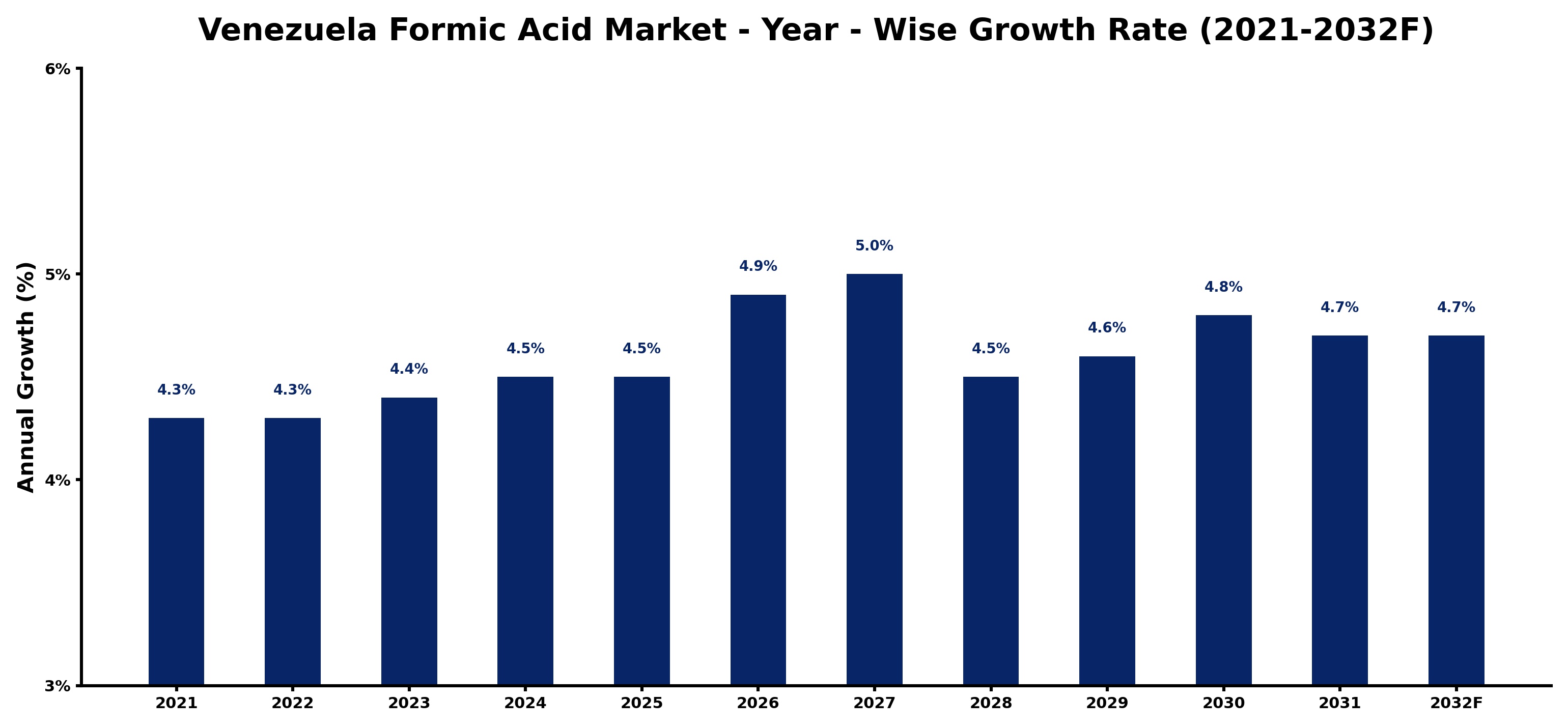
The table below presents the year‑wise growth rates along with the key drivers influencing the market
| Year | Growth Rate | Major Drivers |
| 2021 | 4.3% | Expansion of manufacturing activities |
| 2022 | 4.3% | Expansion of manufacturing activities |
| 2023 | 4.4% | Increasing smart city development projects |
| 2024 | 4.5% | Increasing adoption of advanced technologies |
| 2025 | 4.5% | Expansion of manufacturing activities |
| 2026 | 4.9% | Increasing industrial automation investments |
| 2027 | 5.0% | Rising electricity demand across industries |
| 2028 | 4.5% | Government infrastructure modernization initiatives |
| 2029 | 4.6% | Growing urbanization and commercial development |
| 2030 | 4.8% | Increasing adoption of advanced technologies |
| 2031 | 4.7% | Growing urbanization and commercial development |
| 2032 | 4.7% | Expansion of manufacturing activities |
Note - Market size estimations and growth projections presented in this report are based on 6Wresearch's advanced forecasting approach, validated with industry datasets as of June 2026.
Venezuela Formic Acid Market Synopsis
In Venezuela, the agricultural sector remains a cornerstone of formic acid consumption, largely due to its effectiveness as an antibacterial agent in silage production. The demand for high-quality animal feed is intensifying, compelling producers to seek out preservatives that enhance feed stability.
Additionally, the leather industry plays a vital role in formic acid utilization, especially as a tanning agent. This reliance underscores formic acid's significance as a versatile compound, further encouraging manufacturers to expand their production capabilities amidst a challenging economic landscape.
Venezuela Formic Acid Market Key Takeaways
- The market is primarily driven by demand from agriculture, leather, and rubber industries.
- Economic instability and hyperinflation create pricing volatility and supply chain concerns.
- Product innovation is key, with manufacturers striving to enhance their offerings in a competitive environment.
- Government policies and price controls significantly influence market dynamics.
- Investment opportunities exist in production facilities and local partnerships to meet rising demand.
Evaluation of Restraints in Venezuela Formic Acid Market
The Venezuelan Formic Acid Market faces considerable restraints due to the ongoing economic crisis and political instability. Hyperinflation has resulted in unpredictable pricing and limited purchasing power within the market. Furthermore, political unrest and international sanctions create hurdles for importing necessary raw materials, directly impacting production capabilities. Additionally, aging infrastructure and a lack of technological advancements hinder efficient manufacturing processes, further complicating the operational landscape for businesses involved in formic acid production.
Venezuela Formic Acid Market Trends
There is a discernible trend towards sustainable agricultural practices, which significantly increases the demand for formic acid as a preservative in animal feed and silage production. The awareness around food safety and quality continues to promote its usage. Furthermore, innovations in chemical processing technologies are poised to enhance the application of formic acid across various sectors, including rubber and textiles, indicating a shift towards more versatile and efficient production methodologies.
Venezuela Formic Acid Market Opportunities
Investment opportunities abound in the Venezuela Formic Acid Market, particularly in the agricultural and chemical sectors. The ongoing demand for high-quality feed additives and preservatives creates avenues for new entrants and existing players to establish production facilities. Collaborations with local manufacturers can prove beneficial, allowing investors to tap into the market's growth potential while navigating the complex economic landscape. The growing focus on domestic production also presents opportunities to reduce dependency on imports.
Government Initiatives in the Venezuela Formic Acid Market
Venezuelan government policies regarding the Formic Acid Market are largely shaped by the country's economic challenges and political environment. Price controls and regulations on the chemical industry create a regulated atmosphere for production and distribution. Moreover, the government has implemented initiatives aimed at revitalizing the agricultural sector, indirectly benefiting the demand for formic acid as a feed preservative. However, restrictions on imports and foreign exchange still pose challenges for the industry.
Future Insights of the Venezuela Formic Acid Market
The future outlook for the Venezuela Formic Acid Market is marked by uncertainty due to existing political and economic challenges. While there are positive indicators in terms of agricultural potential and industrial growth, the reliance on oil exports and fluctuating global oil prices introduce volatility. The market is expected to evolve, driven by increasing domestic demand, innovation in applications, and a gradual recovery in economic stability, although significant obstacles remain.
Venezuela Formic Acid Market Latest Developments (May 2025 - June 2026)
Recent developments in the Venezuela Formic Acid Market include a renewed focus on expanding production capabilities among local manufacturers. Efforts to innovate in production technologies are being observed, as companies aim to enhance efficiency and product quality. Moreover, as the agricultural sector begins to recover from prior economic strains, there are emerging partnerships aimed at boosting the supply chain for formic acid, indicating a cautiously optimistic trajectory for the market.
Venezuela Formic Acid Market - Key Attractiveness of the Report
- 10 Years of Market Numbers
- Historical Data Starting from 2022 to 2025
- Base Year: 2025
- Forecast Data until 2032
- Key Performance Indicators Impacting the Market
- Major Upcoming Developments and Projects
Key Highlights of the Report:
- Venezuela Formic Acid Market Outlook
- Market Size of Venezuela Formic Acid Market, 2025
- Forecast of Venezuela Formic Acid Market, 2032
- Historical Data and Forecast of Venezuela Formic Acid Revenues & Volume for the Period 2022-2032F
- Venezuela Formic Acid Market Trend Evolution
- Venezuela Formic Acid Market Drivers and Challenges
- Venezuela Formic Acid Price Trends
- Venezuela Formic Acid Porter's Five Forces
- Venezuela Formic Acid Industry Life Cycle
- Historical Data and Forecast of Venezuela Formic Acid Market Revenues & Volume By Grade Type for the Period 2022-2032F
- Historical Data and Forecast of Venezuela Formic Acid Market Revenues & Volume By 0.75 for the Period 2022-2032F
- Historical Data and Forecast of Venezuela Formic Acid Market Revenues & Volume By 0.8 for the Period 2022-2032F
- Historical Data and Forecast of Venezuela Formic Acid Market Revenues & Volume By 0.85 for the Period 2022-2032F
- Historical Data and Forecast of Venezuela Formic Acid Market Revenues & Volume By 0.94 for the Period 2022-2032F
- Historical Data and Forecast of Venezuela Formic Acid Market Revenues & Volume By 0.99 for the Period 2022-2032F
- Historical Data and Forecast of Venezuela Formic Acid Market Revenues & Volume By Application for the Period 2022-2032F
- Historical Data and Forecast of Venezuela Formic Acid Market Revenues & Volume By Animal Feed for the Period 2022-2032F
- Historical Data and Forecast of Venezuela Formic Acid Market Revenues & Volume By Leather Tanning for the Period 2022-2032F
- Historical Data and Forecast of Venezuela Formic Acid Market Revenues & Volume By Textile Dyeing and Finishing for the Period 2022-2032F
- Historical Data and Forecast of Venezuela Formic Acid Market Revenues & Volume By Intermediary in Pharmaceuticals for the Period 2022-2032F
- Historical Data and Forecast of Venezuela Formic Acid Market Revenues & Volume By Other Applications for the Period 2022-2032F
- Venezuela Formic Acid Import Export Trade Statistics
- Market Opportunity Assessment By Grade Type
- Market Opportunity Assessment By Application
- Venezuela Formic Acid Top Companies Market Share
- Venezuela Formic Acid Competitive Benchmarking By Technical and Operational Parameters
- Venezuela Formic Acid Company Profiles
- Venezuela Formic Acid Key Strategic Recommendations






































