Venezuela General Merchandise Market Summary
The venezuela general merchandise market was estimated at USD 1452 Million in 2025 and is projected to reach USD 2064 Million by 2032, growing at a CAGR of 5.9% from 2026 to 2032.
Venezuela General Merchandise Market Year-wise Growth Rate and Key Drivers
This graph highlights how the Venezuela General Merchandise Market has steadily grown over the past five years, supported by major growth factors.
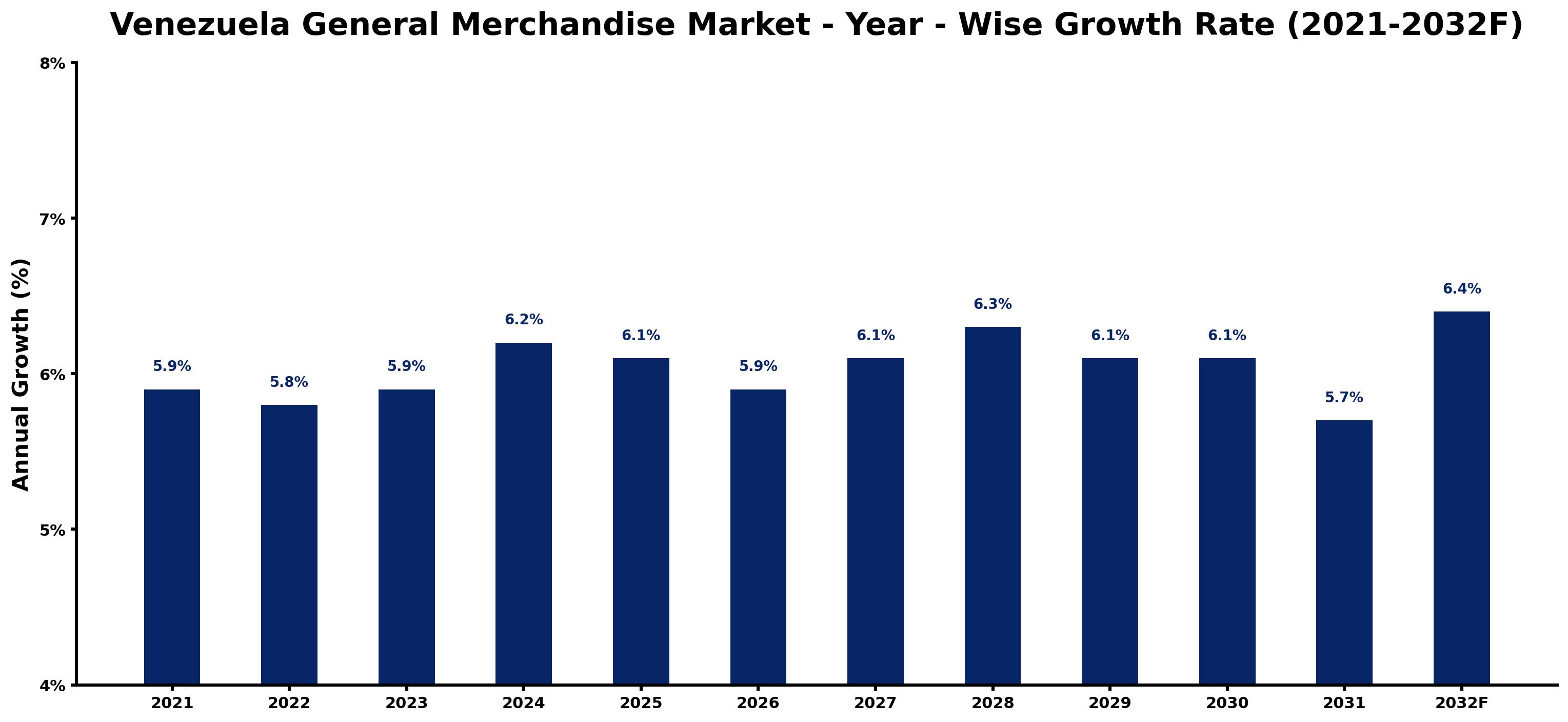
The table below presents the year wise growth rates along with the key drivers influencing the market
| Year | Growth Rate | Major Drivers |
| 2021 | 5.9% | Economic instability continues to push consumers towards affordable general merchandise options. |
| 2022 | 5.8% | Hyperinflation and currency devaluation reshape purchasing behaviors in the general merchandise sector. |
| 2023 | 5.9% | Supply chain disruptions pose challenges, yet resilience emerges through local sourcing initiatives. |
| 2024 | 6.2% | Digital platforms expand, increasing access to diverse general merchandise offerings in Venezuela. |
| 2025 | 6.1% | Consumer preference shifts towards essential goods, reflecting ongoing economic hardships. |
| 2026 | 5.9% | Innovative retail formats emerge, blending online and offline shopping experiences for convenience. |
| 2027 | 6.1% | Local entrepreneurs leverage community insights to cater effectively to evolving consumer needs. |
| 2028 | 6.3% | E-commerce infrastructure improves, facilitating smoother transactions and broader market reach. |
| 2029 | 6.1% | Increased focus on sustainability influences product offerings across the general merchandise landscape. |
| 2030 | 6.1% | International collaborations enhance product variety, appealing to consumer desire for quality. |
| 2031 | 5.7% | Investment in logistics infrastructure strengthens supply chains in response to market demands. |
| 2032 | 6.4% | Consumer confidence gradually recovers, driving a more vibrant general merchandise market. |
Note - Market size estimations and growth projections presented in this report are based on 6Wresearch's advanced forecasting approach, validated with industry datasets as of June 2026.
Venezuela General Merchandise Market Synopsis
The Venezuela General Merchandise Market is projected to reach 5.9% and witness significant growth during the forecast period (2026-2032). This sector encompasses a wide range of products, including clothing, electronics, household items, and personal care products. Despite the ongoing economic challenges characterized by hyperinflation and supply chain disruptions, there remains a persistent consumer demand for affordable goods, fostering a dynamic retail environment. The market dynamics are influenced by various factors including consumer preferences, government policies, and the evolving e-commerce landscape.
Venezuela General Merchandise Market Trends and Opportunities
In recent years, the Venezuela General Merchandise Market has demonstrated a shift in consumer behavior towards prioritizing essential over discretionary goods. This trend has resulted in a substantial increase in demand for basic necessities such as food, hygiene products, and household essentials. Moreover, the growing acceptance of e-commerce is reshaping the retail landscape, providing consumers greater access to a diverse range of products without the constraints of traditional brick-and-mortar retailing.
- The increasing focus on affordability across all categories is driving consumers to opt for budget-friendly products, creating opportunities for retailers who can effectively source and market these items.
- As inflation continues to impact consumer spending, businesses are adapting by emphasizing promotions and loyalty programs to retain and attract customers seeking value.
- The expansion of digital payment solutions is facilitating online shopping, enhancing the overall shopping experience and providing consumers with more options to purchase general merchandise.
- There is a noticeable rise in local production as businesses attempt to mitigate supply chain disruptions, thereby reducing reliance on imported goods and enhancing product availability.
- Retailers who embrace social media marketing and online engagement strategies are likely to tap into younger demographics that are increasingly shopping online.
Venezuela General Merchandise Market Challenges and Restraints
The Venezuela General Merchandise Market faces numerous challenges that stem primarily from the country's economic landscape. Hyperinflation remains a critical issue, significantly reducing purchasing power and consumer sentiment. Additionally, political instability and governmental restrictions complicate market dynamics, resulting in limited access to foreign currency and disrupted supply chains.
- Strict price controls imposed by the government have led to shortages and inconsistencies in product availability, creating challenges for retailers looking to maintain inventory levels.
- Import restrictions have further strained the supply chain, making it difficult for businesses to offer a comprehensive range of products to consumers.
- Ongoing sociopolitical unrest continues to create a volatile operating environment, presenting risks related to safety and property rights for businesses.
- The devaluation of the currency makes pricing strategies complicated, as businesses must consider both local and international market conditions.
- Consumer trends indicate a shift in spending away from non-essential goods, leading to a market contraction in certain categories.
Venezuela General Merchandise Market Investment Opportunities
Even amidst the challenges, the Venezuela General Merchandise Market holds promising investment opportunities. With a population exceeding 30 million, there exists a substantial consumer base eager for general merchandise products, particularly within the middle to upper-income segments. Investors should consider strategies that center around local market needs and preferences to capitalize on the current landscape.
- Investments in local manufacturing and sourcing can reduce reliance on imports, enabling businesses to provide consumers with affordable options while navigating currency constraints.
- Moreover, enhancing distribution networks and exploring innovative logistics solutions can improve product accessibility in various regions.
- Targeting untapped segments of the market, such as eco-friendly products, could cater to the emerging consumer preferences for sustainability.
- Utilizing data analytics and consumer insights can bolster marketing strategies, facilitating tailored offerings that resonate with local shopper preferences.
- Collaboration with local businesses and communities can foster goodwill and enhance brand loyalty, critical in a market characterized by economic turbulence.
Venezuela General Merchandise Market Government Investment and Initiatives
Government policies in Venezuela related to the General Merchandise Market primarily focus on regulating prices and stabilizing the economy. Recent initiatives have included strict price control measures to ensure essential goods remain affordable for the population. However, these regulations often lead to market shortages and can encourage black market activities, undermining their intended purpose.
Furthermore, the government's restrictive import policies have limited businesses' ability to operate effectively, particularly in sourcing a diverse range of products. Public spending has been directed toward social welfare programs, impacting the availability of funds for infrastructure development essential for enhancing market operations. The nationalization of certain industries continues to shape the landscape of the general merchandise market, with state-owned entities often dominating critical sectors.
Venezuela General Merchandise Market Latest Developments (May 2025 - June 2026)
In the period from May 2025 to June 2026, the Venezuela General Merchandise Market has reflected ongoing adaptations to economic challenges while demonstrating resilience. Retailers have increasingly focused on building robust e-commerce platforms, allowing consumers to access products more conveniently. This shift has been supported by strategic partnerships with logistics providers aimed at improving delivery efficiency.
Additionally, government policies have shown some adjustment, with initiatives aimed at addressing supply chain disruptions, although challenges remain. Businesses are exploring alternative sourcing strategies to minimize import dependence, resulting in a noticeable increase in locally manufactured goods.
Venezuela General Merchandise Market - Key Attractiveness of the Report
- 10 Years of Market Numbers
- Historical Data Starting from 2022 to 2025
- Base Year: 2025
- Forecast Data until 2032
- Key Performance Indicators Impacting the Market
- Major Upcoming Developments and Projects
Key Highlights of the Report:
- Venezuela General Merchandise Market Outlook
- Market Size of Venezuela General Merchandise Market, 2025
- Forecast of Venezuela General Merchandise Market, 2032F
- Historical Data and Forecast of Venezuela General Merchandise Revenues & Volume for the Period 2022-2032F
- Venezuela General Merchandise Market Trend Evolution
- Venezuela General Merchandise Market Drivers and Challenges
- Venezuela General Merchandise Price Trends
- Venezuela General Merchandise Porter's Five Forces
- Venezuela General Merchandise Industry Life Cycle
- Historical Data and Forecast of Venezuela General Merchandise Market Revenues & Volume By Types for the Period 2022-2032F
- Historical Data and Forecast of Venezuela General Merchandise Market Revenues & Volume By Home and Furniture for the Period 2022-2032F
- Historical Data and Forecast of Venezuela General Merchandise Market Revenues & Volume By Garden for the Period 2022-2032F
- Historical Data and Forecast of Venezuela General Merchandise Market Revenues & Volume By Electrical for the Period 2022-2032F
- Historical Data and Forecast of Venezuela General Merchandise Market Revenues & Volume By Food and Drink for the Period 2022-2032F
- Historical Data and Forecast of Venezuela General Merchandise Market Revenues & Volume By Others for the Period 2022-2032F
- Historical Data and Forecast of Venezuela General Merchandise Market Revenues & Volume By Applications for the Period 2022-2032F
- Historical Data and Forecast of Venezuela General Merchandise Market Revenues & Volume By Supermarket for the Period 2022-2032F
- Historical Data and Forecast of Venezuela General Merchandise Market Revenues & Volume By Retail market for the Period 2022-2032F
- Historical Data and Forecast of Venezuela General Merchandise Market Revenues & Volume By Specialty store for the Period 2022-2032F
- Historical Data and Forecast of Venezuela General Merchandise Market Revenues & Volume By E-tailer for the Period 2022-2032F
- Historical Data and Forecast of Venezuela General Merchandise Market Revenues & Volume By Others for the Period 2022-2032F
- Venezuela General Merchandise Import Export Trade Statistics
- Market Opportunity Assessment By Types
- Market Opportunity Assessment By Applications
- Venezuela General Merchandise Top Companies Market Share
- Venezuela General Merchandise Competitive Benchmarking By Technical and Operational Parameters
- Venezuela General Merchandise Company Profiles
- Venezuela General Merchandise Key Strategic Recommendations






































