Venezuela Hair Conditioner Market Size, Share & Growth Rate
The Venezuela Hair Conditioner Market was estimated at USD 699 Million in 2025 and is projected to reach USD 1272 Million by 2032, growing at a CAGR of 8.9% from 2026 to 2032. This trajectory is primarily fueled by a growing consumer emphasis on personal care and hair health, with more individuals turning to conditioners that feature natural and organic ingredients. In addition, the increasing focus on sustainability and eco-friendly practices among brands is also contributing to market growth as consumers are more inclined to choose products that align with their values.
Venezuela Hair Conditioner Market Year-wise Growth Rate and Key Drivers
This graph highlights how the Venezuela Hair Conditioner Market has steadily grown over the years, supported by major growth factors.
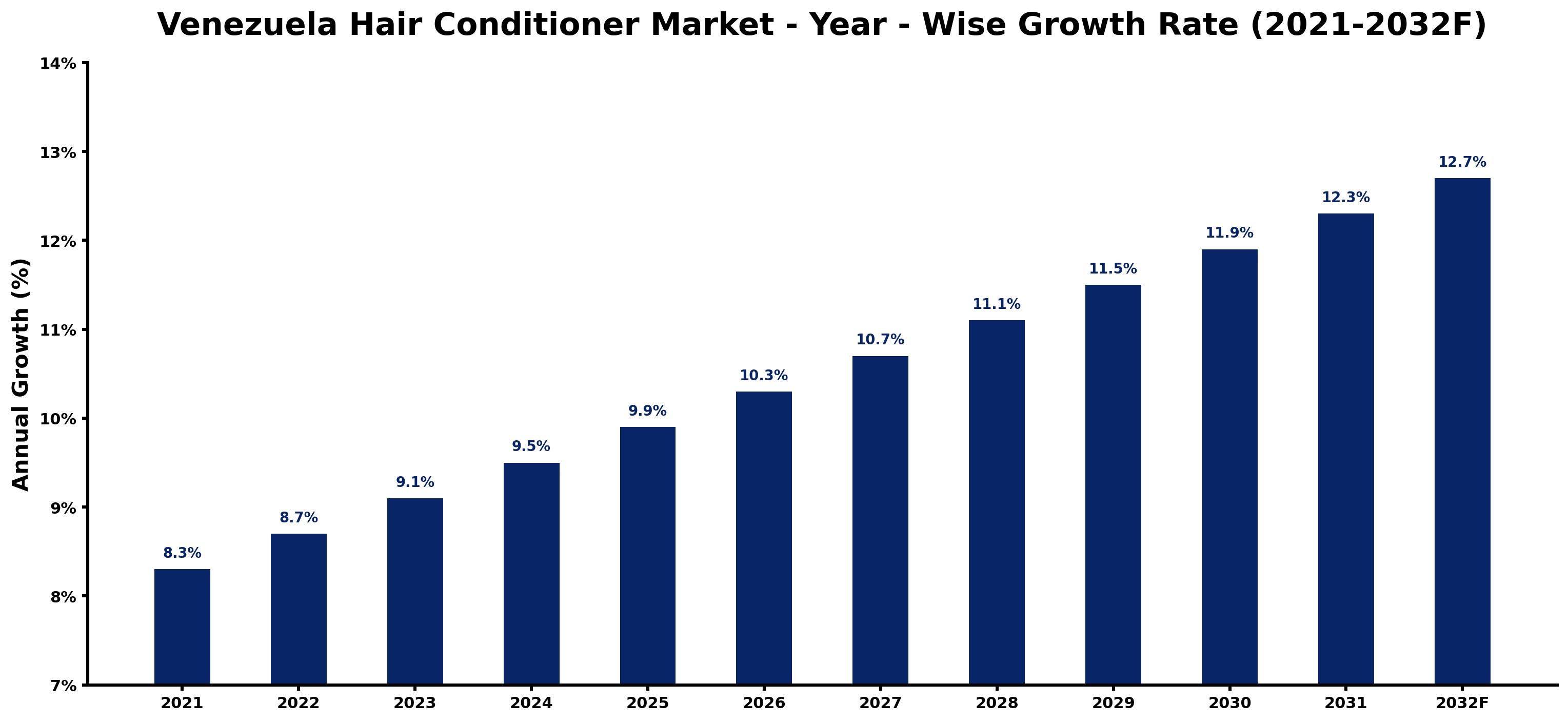
The table below presents the year‑wise growth rates along with the key drivers influencing the market
| Year | Growth Rate | Major Drivers |
| 2021 | 8.3% | Increasing industrial infrastructure investments |
| 2022 | 8.7% | Rapid growth in telecom and data center sectors |
| 2023 | 9.1% | Government infrastructure modernization initiatives |
| 2024 | 9.5% | Increasing adoption of advanced technologies |
| 2025 | 9.9% | Government infrastructure modernization initiatives |
| 2026 | 10.3% | Expansion of manufacturing activities |
| 2027 | 10.7% | Expansion of transportation and logistics networks |
| 2028 | 11.1% | Growing renewable energy integration projects |
| 2029 | 11.5% | Expansion of transportation and logistics networks |
| 2030 | 11.9% | Rising electricity demand across industries |
| 2031 | 12.3% | Growing renewable energy integration projects |
| 2032 | 12.7% | Rising electricity demand across industries |
Note - Market size estimations and growth projections presented in this report are based on 6Wresearch's advanced forecasting approach, validated with industry datasets as of June 2026.
Venezuela Hair Conditioner Market Synopsis
The Venezuela Hair Conditioner Market has undergone significant transformations over the past few years, reflecting the unique socio-economic landscape of the country. Rising awareness about hair health is driving consumers to seek out effective products, particularly those that promise nourishing and reparative benefits.
Moreover, the burgeoning trend toward eco-friendly and organic formulations is reshaping product offerings in this market. Brands are striving to meet the needs of a more informed consumer base that is increasingly wary of synthetic ingredients and harmful chemicals, thereby creating a demand for conditioners that deliver multiple benefits.
Venezuela Hair Conditioner Market Key Takeaways
- Natural and organic hair conditioners are witnessing a surge in demand.
- Affordability and product efficacy significantly influence consumer choices.
- Specialized conditioners targeting specific hair concerns are gaining traction.
- Government regulations and economic challenges present unique market dynamics.
- Sustainability practices in packaging are increasingly valued by consumers.
Evaluation of Restraints in Venezuela Hair Conditioner Market
The Venezuela Hair Conditioner Market is grappling with substantial challenges stemming from the country's ongoing economic turbulence. Hyperinflation and political instability have led to decreased consumer purchasing power, affecting the demand for non-essential goods like hair care products. Scarcity of quality raw materials complicates manufacturing processes, while high production costs hinder market growth. Compounding these issues, limited access to foreign currency restricts the import of international brands, creating a competitive imbalance that local manufacturers struggle to navigate.
Venezuela Hair Conditioner Market Trends
Several key trends are shaping the Venezuela Hair Conditioner Market. Firstly, the shift toward products that incorporate natural ingredients is accelerating, with consumers actively avoiding formulations that contain sulfates and parabens. Additionally, there is a rising preference for multi-benefit conditioners that not only moisturize but also promote hair health and volume. Brands are increasingly focused on sustainability, with eco-friendly packaging and ethical sourcing practices appealing to a conscientious consumer base.
Venezuela Hair Conditioner Market Opportunities
Investment opportunities in the Venezuela Hair Conditioner Market are promising, particularly for companies introducing innovative products that cater to the evolving needs of consumers. The growing interest in organic formulations opens avenues for brands to develop specialized conditioners targeting color-treated hair, frizz control, and scalp health. Furthermore, collaborating with local salons for product endorsement can enhance credibility, while strategic partnerships with distributors will expand market reach, ensuring that high-quality products become accessible to a broader audience.
Government Initiatives in the Venezuela Hair Conditioner Market
Government policies play a vital role in shaping the Venezuela Hair Conditioner Market, primarily through regulations on product importation and distribution. To protect local manufacturing, stringent regulations have been imposed on imported hair care products. Additionally, price controls aim to maintain affordability for consumers. However, regulatory fluctuations due to economic challenges and political instability also impact the market's dynamics, creating a complex environment for both manufacturers and consumers.
Future Insights of the Venezuela Hair Conditioner Market
Looking ahead to 2026-2032, the Venezuela Hair Conditioner Market presents an intriguing outlook. While economic and political challenges are expected to persist, the market's resilience is likely to foster opportunities for growth, particularly within the organic and sustainable segments. Consumer priorities are shifting toward health-conscious and environmentally friendly products, suggesting that brands that adapt to these preferences will flourish in a competitive landscape. The potential for regulatory reforms may also create a more stable environment for market players.
Venezuela Hair Conditioner Market Latest Developments (May 2025 - June 2026)
Recently, the Venezuela Hair Conditioner Market has been witnessing a shift as brands introduce more innovative formulations focused on natural ingredients and sustainable practices. Consumer interest in eco-friendly packaging solutions is driving brands to rethink their approach to product presentation. Additionally, market players are beginning to explore localized production methods to mitigate supply chain disruptions, enhancing their ability to respond to consumer demands efficiently.
Venezuela Hair Conditioner Market - Key Attractiveness of the Report
- 10 Years of Market Numbers
- Historical Data Starting from 2022 to 2025
- Base Year: 2025
- Forecast Data until 2032
- Key Performance Indicators Impacting the Market
- Major Upcoming Developments and Projects
Key Highlights of the Report:
- Venezuela Hair Conditioner Market Outlook
- Market Size of Venezuela Hair Conditioner Market, 2025
- Forecast of Venezuela Hair Conditioner Market, 2032
- Historical Data and Forecast of Venezuela Hair Conditioner Revenues & Volume for the Period 2022-2032F
- Venezuela Hair Conditioner Market Trend Evolution
- Venezuela Hair Conditioner Market Drivers and Challenges
- Venezuela Hair Conditioner Price Trends
- Venezuela Hair Conditioner Porter's Five Forces
- Venezuela Hair Conditioner Industry Life Cycle
- Historical Data and Forecast of Venezuela Hair Conditioner Market Revenues & Volume By Product Type for the Period 2022-2032F
- Historical Data and Forecast of Venezuela Hair Conditioner Market Revenues & Volume By Dry Hair for the Period 2022-2032F
- Historical Data and Forecast of Venezuela Hair Conditioner Market Revenues & Volume By Oily Hair for the Period 2022-2032F
- Historical Data and Forecast of Venezuela Hair Conditioner Market Revenues & Volume By Normal Hair for the Period 2022-2032F
- Historical Data and Forecast of Venezuela Hair Conditioner Market Revenues & Volume By Professional for the Period 2022-2032F
- Historical Data and Forecast of Venezuela Hair Conditioner Market Revenues & Volume By Non-professional for the Period 2022-2032F
- Historical Data and Forecast of Venezuela Hair Conditioner Market Revenues & Volume By Application for the Period 2022-2032F
- Historical Data and Forecast of Venezuela Hair Conditioner Market Revenues & Volume By Online Retail for the Period 2022-2032F
- Historical Data and Forecast of Venezuela Hair Conditioner Market Revenues & Volume By Offline Retail for the Period 2022-2032F
- Historical Data and Forecast of Venezuela Hair Conditioner Market Revenues & Volume By Personal Use for the Period 2022-2032F
- Historical Data and Forecast of Venezuela Hair Conditioner Market Revenues & Volume By Personal Use for the Period 2022-2032F
- Historical Data and Forecast of Venezuela Hair Conditioner Market Revenues & Volume By Barber shop for the Period 2022-2032F
- Historical Data and Forecast of Venezuela Hair Conditioner Market Revenues & Volume By Hotel for the Period 2022-2032F
- Venezuela Hair Conditioner Import Export Trade Statistics
- Market Opportunity Assessment By Product Type
- Market Opportunity Assessment By Application
- Venezuela Hair Conditioner Top Companies Market Share
- Venezuela Hair Conditioner Competitive Benchmarking By Technical and Operational Parameters
- Venezuela Hair Conditioner Company Profiles
- Venezuela Hair Conditioner Key Strategic Recommendations






































