Venezuela Holster Market Size, Share & Growth Rate
The Venezuela Holster Market was estimated at USD 930 Million in 2025 and is projected to reach USD 1321 Million by 2032, growing at a CAGR of 5.1% from 2026 to 2032. This growth trajectory is fueled by a consistent demand for personal protection amidst ongoing social challenges and high crime rates. Additionally, evolving consumer preferences for more versatile and customizable holsters are driving innovation and variety within the market.
Venezuela Holster Market Year-wise Growth Rate and Key Drivers
This graph highlights how the Venezuela Holster Market has steadily grown over the years, supported by major growth factors.
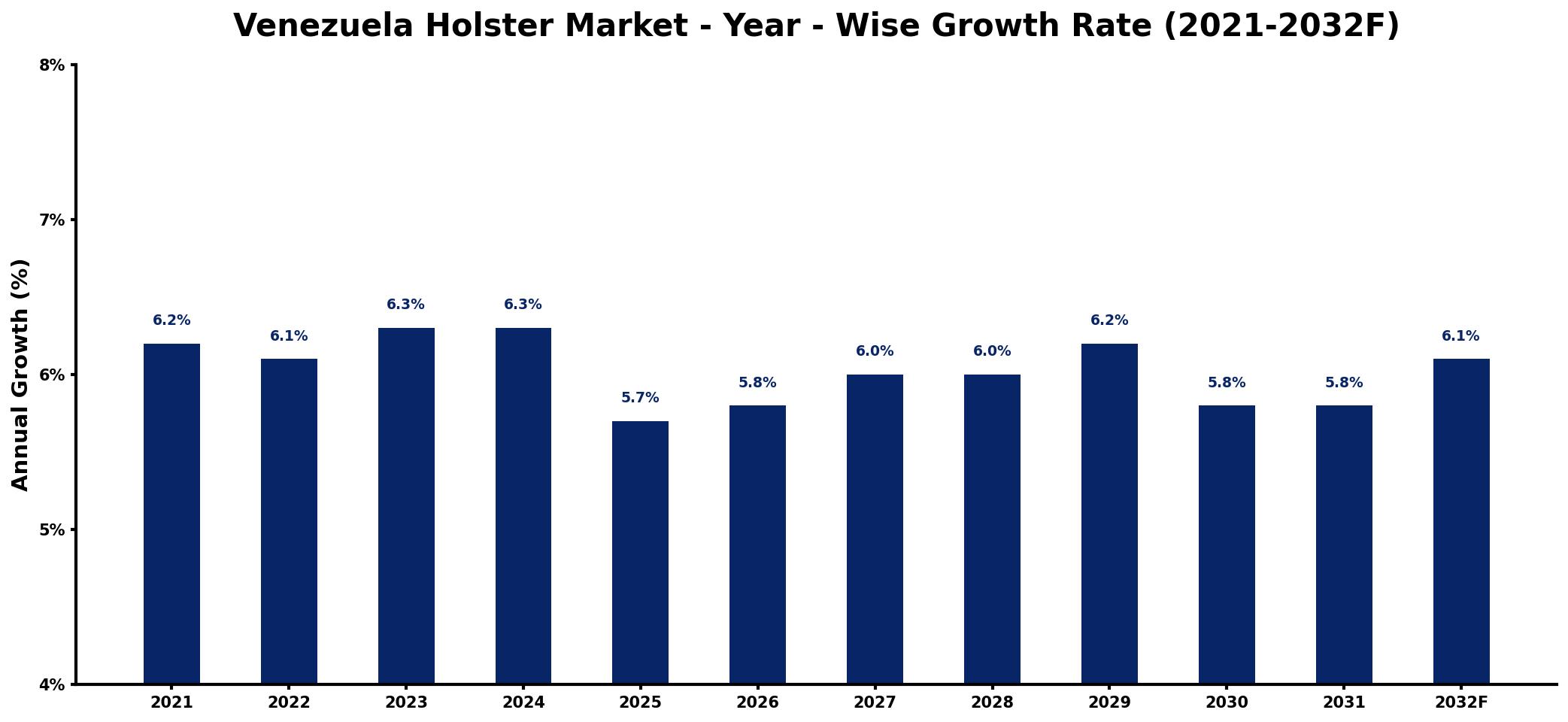
The table below presents the year‑wise growth rates along with the key drivers influencing the market
| Year | Growth Rate | Major Drivers |
| 2021 | 6.2% | Increased security forces investments |
| 2022 | 6.1% | Rising personal protection awareness |
| 2023 | 6.3% | Growing outdoor recreational activities |
| 2024 | 6.3% | Expansion of law enforcement agencies |
| 2025 | 5.7% | Emergence of self-defense training |
| 2026 | 5.8% | Surge in tactical gear popularity |
| 2027 | 6.0% | Heightened demand for customization |
| 2028 | 6.0% | Growth in hunting sports participation |
| 2029 | 6.2% | Increased military modernization efforts |
| 2030 | 5.8% | Rise in urban safety initiatives |
| 2031 | 5.8% | Boost in recreational shooting events |
| 2032 | 6.1% | Growing trend in personal safety |
Note: Market size estimations and growth projections presented in this report are based on 6Wresearch's proprietary forecasting methodology, utilizing the latest available industry data, government publications, and primary research inputs.
Venezuela Holster Market Synopsis
In Venezuela, there is a notable demand for specialized holsters that cater to various carrying preferences, especially given the increased focus on personal safety. The market features a range of options that include both local and international products, with consumers showing a keen interest in high-quality materials such as Kydex and premium leather.
Despite economic challenges, the dedication of the Venezuelan gun owner community supports sustained market engagement. Holsters that emphasize functionality, style, and customization options are particularly well-received, reflecting a shift towards consumer empowerment in the selection of firearm accessories.
Venezuela Holster Market Key Takeaways
- The market is experiencing a shift towards customizable and versatile holster options.
- Economic and political factors significantly influence consumer purchasing power.
- High-quality materials are increasingly preferred among consumers for durability.
- Government regulations heavily impact the sale and distribution of holsters.
- Potential growth opportunities exist within law enforcement and civilian sectors.
Evaluation of Restraints in Venezuela Holster Market
The Venezuela Holster Market is significantly restrained by the country's ongoing economic instability and currency devaluation. These factors diminish consumers' purchasing power, making them less inclined to invest in non-essential items like holsters. Furthermore, political unrest and high crime rates foster an environment of insecurity that may deter potential buyers. Supply chain disruptions due to import restrictions further complicate market dynamics, leading to inconsistent product availability and price fluctuations.
Venezuela Holster Market Trends
There is an emerging trend toward holsters featuring adjustable retention systems and compatibility with various attachment methods, such as belt loops and clips. Customization is a growing theme, with consumers increasingly seeking options for personalized colors and designs. The move towards premium materials like Kydex and leather signifies a demand for durability and aesthetics, indicating a blend of functionality and style in contemporary holster design.
Venezuela Holster Market Opportunities
Investment opportunities within the Venezuela Holster Market lie in addressing the specialized needs of law enforcement and military personnel, as well as civilian gun owners. Manufacturers can focus on creating holsters that boast advanced features, such as quick-draw mechanisms or customizable retention. Moreover, leveraging e-commerce platforms can help brands reach a wider audience, making high-quality holsters more accessible despite local market challenges.
Government Initiatives in the Venezuela Holster Market
The Venezuelan government has implemented strict regulations governing the production and distribution of firearms and accessories, including holsters. These measures aim to control firearm possession due to ongoing concerns about violence and crime. Licensing requirements for gun owners and specific oversight of imports and exports are designed to promote public safety. Consequently, these policies can affect market operations and influence consumer behavior.
Future Insights of the Venezuela Holster Market
Looking forward to 2026-2032, the Venezuela Holster Market may encounter continued volatility due to economic and political uncertainties. However, as concerns over personal safety remain a priority, there is a potential for growth in the demand for high-quality, functional holsters. Companies that can adapt to the evolving needs of consumers and navigate the challenging landscape through innovative designs and cost-effective solutions will likely thrive in this niche market.
Venezuela Holster Market Latest Developments (2025 - 2026)
In recent months, the Venezuela Holster Market has seen a trend towards increased online engagement, as retailers pivot to e-commerce platforms to reach a broader customer base. Additionally, some manufacturers are exploring partnerships with local gun retailers to improve distribution efficiency. With economic pressures continuing, there is an emphasis on affordability without compromising quality, leading to a rise in demand for budget-friendly holsters.
Venezuela Holster Market - Key Attractiveness of the Report
- 10 Years of Market Numbers
- Historical Data Starting from 2022 to 2025
- Base Year: 2025
- Forecast Data until 2032
- Key Performance Indicators Impacting the Market
- Major Upcoming Developments and Projects
Key Highlights of the Report:
- Venezuela Holster Market Outlook
- Market Size of Venezuela Holster Market, 2025
- Forecast of Venezuela Holster Market, 2032
- Historical Data and Forecast of Venezuela Holster Revenues & Volume for the Period 2022-2032F
- Venezuela Holster Market Trend Evolution
- Venezuela Holster Market Drivers and Challenges
- Venezuela Holster Price Trends
- Venezuela Holster Porter's Five Forces
- Venezuela Holster Industry Life Cycle
- Historical Data and Forecast of Venezuela Holster Market Revenues & Volume By Type for the Period 2022-2032F
- Historical Data and Forecast of Venezuela Holster Market Revenues & Volume By Leather for the Period 2022-2032F
- Historical Data and Forecast of Venezuela Holster Market Revenues & Volume By Nylon for the Period 2022-2032F
- Historical Data and Forecast of Venezuela Holster Market Revenues & Volume By Plastic for the Period 2022-2032F
- Historical Data and Forecast of Venezuela Holster Market Revenues & Volume By Other for the Period 2022-2032F
- Historical Data and Forecast of Venezuela Holster Market Revenues & Volume By Application for the Period 2022-2032F
- Historical Data and Forecast of Venezuela Holster Market Revenues & Volume By Civil for the Period 2022-2032F
- Historical Data and Forecast of Venezuela Holster Market Revenues & Volume By Armed Forces for the Period 2022-2032F
- Historical Data and Forecast of Venezuela Holster Market Revenues & Volume By others for the Period 2022-2032F
- Venezuela Holster Import Export Trade Statistics
- Market Opportunity Assessment By Type
- Market Opportunity Assessment By Application
- Venezuela Holster Top Companies Market Share
- Venezuela Holster Competitive Benchmarking By Technical and Operational Parameters
- Venezuela Holster Company Profiles
- Venezuela Holster Key Strategic Recommendations






































