Venezuela Hydrochloric Acid Market Size, Share & Growth Rate
The Venezuela Hydrochloric Acid Market was estimated at USD 434 Million in 2025 and is projected to reach USD 632 Million by 2032, growing at a CAGR of 5.5% from 2026 to 2032. This growth trajectory is primarily driven by the expanding demand from the mining and agricultural sectors, where hydrochloric acid is essential for ore processing and fertilizer production. Additionally, the nation's rich natural resources, particularly salt, are bolstering local production capabilities, further supporting market expansion.
Venezuela Hydrochloric Acid Market Year-wise Growth Rate and Key Drivers
This graph highlights how the Venezuela Hydrochloric Acid Market has steadily grown over the years, supported by major growth factors.
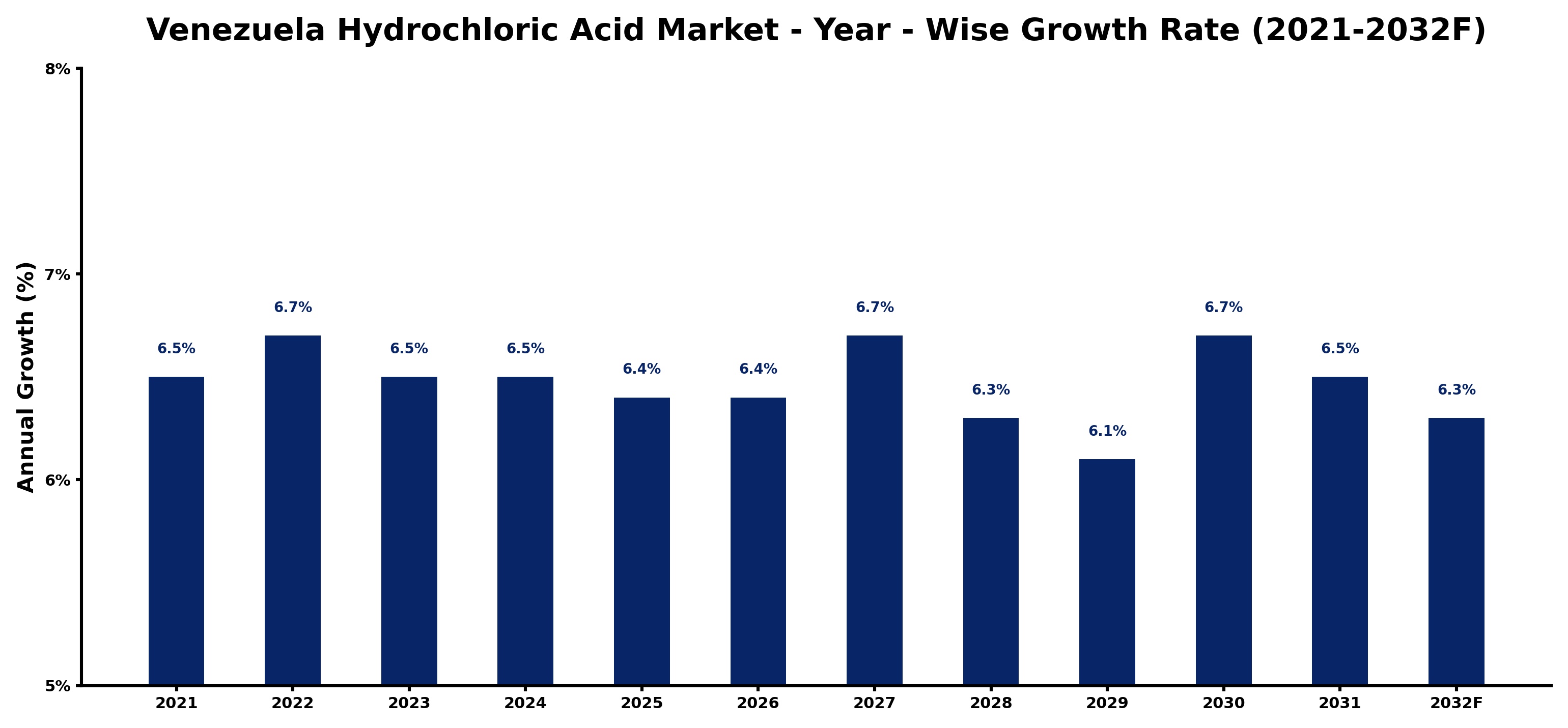
The table below presents the year‑wise growth rates along with the key drivers influencing the market
| Year | Growth Rate | Major Drivers |
| 2021 | 6.5% | Industrial demand for chemicals increased |
| 2022 | 6.7% | Construction sector growth stimulated usage |
| 2023 | 6.5% | Agricultural applications expanded significantly |
| 2024 | 6.5% | Pharmaceutical production requirements rose |
| 2025 | 6.4% | Water treatment needs drove consumption |
| 2026 | 6.4% | Oil and gas industry growth |
| 2027 | 6.7% | Food processing sector expanded demand |
| 2028 | 6.3% | Electronics manufacturing boosted requirements |
| 2029 | 6.1% | Mining operations increased chemical use |
| 2030 | 6.7% | Automotive sector growth enhanced demand |
| 2031 | 6.5% | Cosmetics industry expanded product range |
| 2032 | 6.3% | Research and development investments increased |
Note - Market size estimations and growth projections presented in this report are based on 6Wresearch’s advanced forecasting approach, validated with industry datasets as of June 2026.
Venezuela Hydrochloric Acid Market Synopsis
The Venezuela Hydrochloric Acid Market is uniquely positioned amid the complexities of a struggling economy and a politically unstable environment. Nonetheless, the intrinsic demand for hydrochloric acid across various industries, particularly mining and agriculture, remains robust. As such, local production becomes critical, allowing manufacturers to cater to a strong demand despite the challenges posed by fluctuating supply chains.
With a significant portion of hydrochloric acid applications rooted in industries pivotal to Venezuela's economic recovery, the market reflects both resilience and potential. Strategic investments and partnerships in production and technology are necessary for adapting to changing market conditions while maximizing the use of abundant local resources.
Venezuela Hydrochloric Acid Market Key Takeaways
- The market is primarily driven by the mining sector's increasing demand for ore processing.
- Hydrochloric acid's role in agriculture, particularly in fertilizer production, is also growing.
- Domestic manufacturers dominate due to readily available local resources.
- Political and economic instability poses risks to supply and pricing dynamics.
- Investment in technology and strategic partnerships will be essential for future growth.
Evaluation of Restraints in Venezuela Hydrochloric Acid Market
The Venezuela Hydrochloric Acid Market is substantially constrained by the ongoing political unrest and the economic crisis, which have created an unpredictable business environment. These conditions lead to fluctuations in both supply and demand for hydrochloric acid, complicating operational planning for manufacturers. Coupled with a declining industrial sector, particularly in petroleum refining and mining, the ability to maintain production levels and meet market needs is severely hampered. Furthermore, the erosion of purchasing power among consumers impacts overall consumption of industrial chemicals, constraining the growth potential of this vital market.
Venezuela Hydrochloric Acid Market Trends
A prominent trend within the Venezuela Hydrochloric Acid Market is the increasing reliance on locally sourced raw materials, particularly salt, to support domestic production. Additionally, technological advancements in production processes are emerging as manufacturers seek to enhance efficiency and reduce operational costs. The mining sector's push for sustainable practices is also influencing demand, as companies aim to adopt more environmentally friendly methods in ore processing.
Venezuela Hydrochloric Acid Market Opportunities
Opportunities for investment in the Venezuela Hydrochloric Acid Market are primarily found in expanding production capacities and improving technological frameworks. With a diverse range of applications in mining, agriculture, and chemical manufacturing, stakeholders can leverage the abundant natural resources to optimize operations. Moreover, establishing strategic partnerships with industry players presents a pathway for sustained growth. If political and economic stability can be achieved, significant potential exists for market expansion.
Government Initiatives in the Venezuela Hydrochloric Acid Market
Government policies in Venezuela regarding the hydrochloric acid market focus primarily on regulating production and ensuring environmental compliance. Recent initiatives have been aimed at promoting local manufacturing to bolster domestic supply and reduce reliance on imports. Monitoring and regulatory frameworks are in place to maintain safety and quality standards in hydrochloric acid production, reflecting the government's commitment to public health and environmental sustainability.
Future Insights of the Venezuela Hydrochloric Acid Market
The future of the Venezuela Hydrochloric Acid Market remains closely tied to the country's political and economic landscape. While short-term challenges will likely persist, an upturn in industrial activity in the mining and agricultural sectors could catalyze market recovery and growth. Strategic investments in infrastructure and technology are crucial for enhancing production capabilities and supporting the evolving needs of end-users. Ultimately, the market's trajectory will hinge on a stabilizing environment and effective responses to the existing economic challenges.
Venezuela Hydrochloric Acid Market Latest Developments (May 2025 - June 2026)
Recent developments in the Venezuela Hydrochloric Acid Market highlight a renewed focus on increasing production efficiencies and sustainability practices. As domestic companies adapt to shifting market demands, there is a noticeable trend towards investing in advanced production technologies. Furthermore, collaborative efforts within the industry to stabilize supply chains are becoming crucial as manufacturers navigate the complexities of the market.
Venezuela Hydrochloric Acid Market - Key Attractiveness of the Report
- 10 Years of Market Numbers
- Historical Data Starting from 2022 to 2025
- Base Year: 2025
- Forecast Data until 2032
- Key Performance Indicators Impacting the Market
- Major Upcoming Developments and Projects
Key Highlights of the Report:
- Venezuela Hydrochloric Acid Market Outlook
- Market Size of Venezuela Hydrochloric Acid Market, 2025
- Forecast of Venezuela Hydrochloric Acid Market, 2032
- Historical Data and Forecast of Venezuela Hydrochloric Acid Revenues & Volume for the Period 2022-2032F
- Venezuela Hydrochloric Acid Market Trend Evolution
- Venezuela Hydrochloric Acid Market Drivers and Challenges
- Venezuela Hydrochloric Acid Price Trends
- Venezuela Hydrochloric Acid Porter's Five Forces
- Venezuela Hydrochloric Acid Industry Life Cycle
- Historical Data and Forecast of Venezuela Hydrochloric Acid Market Revenues & Volume By End-user Industry for the Period 2022-2032F
- Historical Data and Forecast of Venezuela Hydrochloric Acid Market Revenues & Volume By Food and Beverage for the Period 2022-2032F
- Historical Data and Forecast of Venezuela Hydrochloric Acid Market Revenues & Volume By Steel for the Period 2022-2032F
- Historical Data and Forecast of Venezuela Hydrochloric Acid Market Revenues & Volume By Oil and Gas for the Period 2022-2032F
- Historical Data and Forecast of Venezuela Hydrochloric Acid Market Revenues & Volume By Chemical for the Period 2022-2032F
- Historical Data and Forecast of Venezuela Hydrochloric Acid Market Revenues & Volume By Textile for the Period 2022-2032F
- Historical Data and Forecast of Venezuela Hydrochloric Acid Market Revenues & Volume By Other End-user Industries (Leather, Rubber, etc.) for the Period 2022-2032F
- Venezuela Hydrochloric Acid Import Export Trade Statistics
- Market Opportunity Assessment By End-user Industry
- Venezuela Hydrochloric Acid Top Companies Market Share
- Venezuela Hydrochloric Acid Competitive Benchmarking By Technical and Operational Parameters
- Venezuela Hydrochloric Acid Company Profiles
- Venezuela Hydrochloric Acid Key Strategic Recommendations






































