Venezuela Iron Market Summary
The venezuela iron market was estimated at USD 1401 Million in 2025 and is projected to reach USD 2026 Million by 2032, growing at a CAGR of 6.2% from 2026 to 2032.
Venezuela Iron Market Year-wise Growth Rate and Key Drivers
This graph highlights how the Venezuela Iron Market has steadily grown over the past five years, supported by major growth factors.
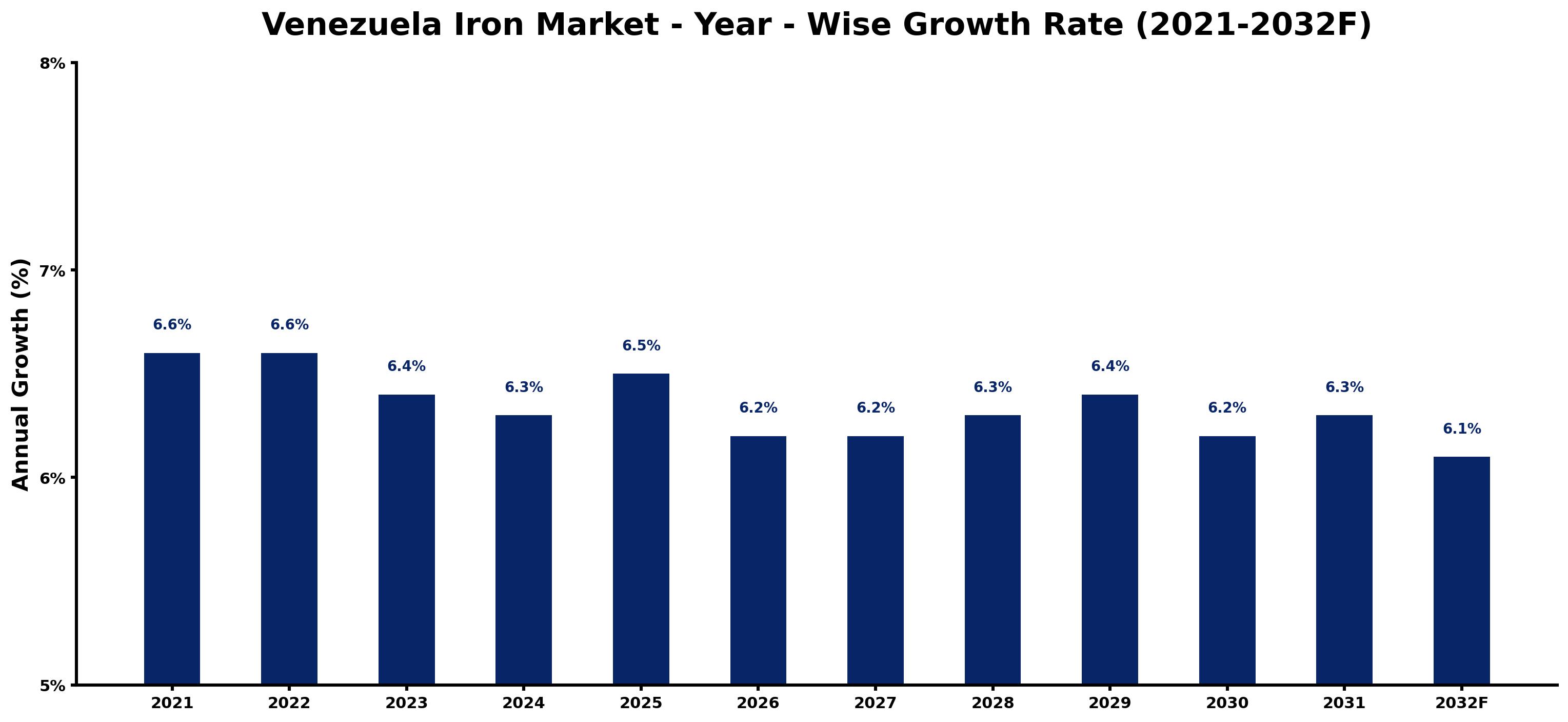
The table below presents the year wise growth rates along with the key drivers influencing the market
| Year | Growth Rate | Major Drivers |
| 2021 | 6.6% | Economic reforms begin to stabilize inflation, creating a more predictable market environment. |
| 2022 | 6.6% | Increased foreign investments start to enhance local production capabilities and infrastructure. |
| 2023 | 6.4% | Political shifts encourage public-private partnerships, driving innovation within the iron sector. |
| 2024 | 6.3% | Revival of construction projects sparks a notable uptick in iron consumption across industries. |
| 2025 | 6.5% | Focus on energy efficiency leads manufacturers to explore high-strength iron alternatives. |
| 2026 | 6.2% | Improved logistics and transportation networks facilitate smoother iron distribution nationwide. |
| 2027 | 6.2% | The demand for infrastructure renewal opens new opportunities for local iron producers. |
| 2028 | 6.3% | Technological advancements in extraction methods reduce costs and increase output significantly. |
| 2029 | 6.4% | Emerging construction standards prioritize quality, benefiting producers with superior materials. |
| 2030 | 6.2% | Collaboration with international firms introduces modern practices, boosting overall sector productivity. |
| 2031 | 6.3% | Resilience in market dynamics attracts further investments, enhancing innovation and competition. |
| 2032 | 6.1% | Evolving consumer preferences shift towards sustainable practices, influencing iron production methods. |
Note - Market size estimations and growth projections presented in this report are based on 6Wresearch's advanced forecasting approach, validated with industry datasets as of June 2026.
Venezuela Iron Market Synopsis
The Venezuela Iron Market is projected to reach 6.2% and witness significant growth during the forecast period (2026-2032). This market is characterized by its vast reserves of high-quality iron ore, particularly concentrated in the Guayana region, which has historically attracted interest from international mining entities. Despite its potential, the market faces a multitude of challenges stemming from political instability, economic turmoil, and infrastructural limitations.
Venezuela Iron Market Growth Drivers
The growth potential of the Venezuela iron market is driven by several critical factors:
- Venezuela's substantial iron ore reserves, estimated at 14.3 billion metric tons, provide a strong foundation for future production and export capabilities.
- International demand from major economies, particularly China, remains robust, creating opportunities for Venezuelan iron ore to penetrate global markets.
- Strategic investments in mining technologies and infrastructure could significantly enhance production capacity and operational efficiency.
- Improvements in government policy that favor private-sector participation could stimulate investment in the iron industry.
- Potential geopolitical shifts may lead to increased global market accessibility for Venezuelan iron, setting the stage for recovery and expansion.
Venezuela Iron Market Challenges and Restraints
Despite the advantages, the Venezuela Iron Market is hindered by various challenges that must be addressed for sustainable growth:
- The ongoing political instability raises concerns among investors and disrupts operational consistency, impacting production rates adversely.
- Hyperinflation and severe economic contraction have exacerbated resource shortages, limiting companies' ability to invest and upgrade technology.
- Infrastructure deficits in transportation and logistics create bottlenecks, impeding effective supply chain management and timely distribution.
- Government policies marked by nationalization and export quotas foster an unpredictable regulatory environment that complicates operational planning.
- The imposition of currency controls can inhibit foreign investment, further limiting the financial resources necessary for expansion and modernization.
Venezuela Iron Market Investment Opportunities
Investment opportunities within the Venezuela iron market are present, particularly for those willing to navigate the associated risks:
- Venezuela's rich mineral endowment represents untapped potential for growth in iron ore production, provided that infrastructure and technology investments are made.
- Global market demand trends indicate an increasing appetite for iron ore, especially from emerging economies, bolstering the attractiveness of Venezuelan exports.
- Innovations in mining practices and efficiency improvements present avenues for cost reduction and enhanced productivity.
- Engagement with international partners could facilitate technology transfer and investment, promoting modernization efforts within the sector.
- Long-term perspectives supported by strategic risk management can yield significant returns as political and economic conditions evolve.
Venezuela Iron Market Government Investment and Initiatives
The Venezuelan government has implemented a range of policies aimed at bolstering the iron market through strategic initiatives:
- The state maintains a significant role in the iron industry, often prioritizing national control and regulating production to ensure alignment with development goals.
- Recent initiatives have focused on enhancing public spending for infrastructure development aimed at improving the logistics and supply chain for the iron sector.
- Incentives for local and international investors have been introduced to stimulate growth in the iron mining sector, although challenges remain due to regulatory uncertainties.
- Efforts to modernize mining operations through public-private partnerships have begun to emerge, which could lead to increased production efficiency.
- Long-term strategic plans reveal a commitment to address infrastructural deficiencies, critical for sustaining the iron industry amid global market fluctuations.
Venezuela Iron Market Latest Developments (May 2025 - June 2026)
From May 2025 to June 2026, the Venezuela iron market witnessed a series of noteworthy developments:
- The government reaffirmed its commitment to revitalizing the mining sector through targeted investments aimed at enhancing operational efficiencies.
- Discussions regarding potential foreign partnerships gained traction, focusing on technology sharing to bolster production capabilities.
- Despite ongoing challenges, there were reports of incremental improvements in production levels, indicating a slight recovery phase for the iron industry.
- Regulatory updates contributed to a more transparent operational environment, potentially encouraging international interest in the market.
- Infrastructure projects, although slow-paced, began to show signs of progress, aimed at improving transportation routes critical for iron ore distribution.
Venezuela Iron Market - Key Attractiveness of the Report
- 10 Years of Market Numbers
- Historical Data Starting from 2022 to 2025
- Base Year: 2025
- Forecast Data until 2032
- Key Performance Indicators Impacting the Market
- Major Upcoming Developments and Projects
Key Highlights of the Report:
- Venezuela Iron Market Outlook
- Market Size of Venezuela Iron Market, 2025
- Forecast of Venezuela Iron Market, 2032F
- Historical Data and Forecast of Venezuela Iron Revenues & Volume for the Period 2022-2032F
- Venezuela Iron Market Trend Evolution
- Venezuela Iron Market Drivers and Challenges
- Venezuela Iron Price Trends
- Venezuela Iron Porter's Five Forces
- Venezuela Iron Industry Life Cycle
- Historical Data and Forecast of Venezuela Iron Market Revenues & Volume By Material Types for the Period 2022-2032F
- Historical Data and Forecast of Venezuela Iron Market Revenues & Volume By Pure?Iron for the Period 2022-2032F
- Historical Data and Forecast of Venezuela Iron Market Revenues & Volume By Wrought?Iron for the Period 2022-2032F
- Historical Data and Forecast of Venezuela Iron Market Revenues & Volume By Cast Iron for the Period 2022-2032F
- Historical Data and Forecast of Venezuela Iron Market Revenues & Volume By Pig Iron for the Period 2022-2032F
- Historical Data and Forecast of Venezuela Iron Market Revenues & Volume By Direct Reduced Iron for the Period 2022-2032F
- Historical Data and Forecast of Venezuela Iron Market Revenues & Volume By Applications for the Period 2022-2032F
- Historical Data and Forecast of Venezuela Iron Market Revenues & Volume By Building for the Period 2022-2032F
- Historical Data and Forecast of Venezuela Iron Market Revenues & Volume By Construction for the Period 2022-2032F
- Historical Data and Forecast of Venezuela Iron Market Revenues & Volume By Railways for the Period 2022-2032F
- Historical Data and Forecast of Venezuela Iron Market Revenues & Volume By Fertilizers for the Period 2022-2032F
- Historical Data and Forecast of Venezuela Iron Market Revenues & Volume By Industrial Uses for the Period 2022-2032F
- Historical Data and Forecast of Venezuela Iron Market Revenues & Volume By Others for the Period 2022-2032F
- Venezuela Iron Import Export Trade Statistics
- Market Opportunity Assessment By Material Types
- Market Opportunity Assessment By Applications
- Venezuela Iron Top Companies Market Share
- Venezuela Iron Competitive Benchmarking By Technical and Operational Parameters
- Venezuela Iron Company Profiles
- Venezuela Iron Key Strategic Recommendations






































