Venezuela Leather Market Summary
The venezuela leather market was estimated at USD 253 Million in 2025 and is projected to reach USD 351 Million by 2032, growing at a CAGR of 5.7% from 2026 to 2032.
Venezuela Leather Market Year-wise Growth Rate and Key Drivers
This graph highlights how the Venezuela Leather Market has steadily grown over the past five years, supported by major growth factors.
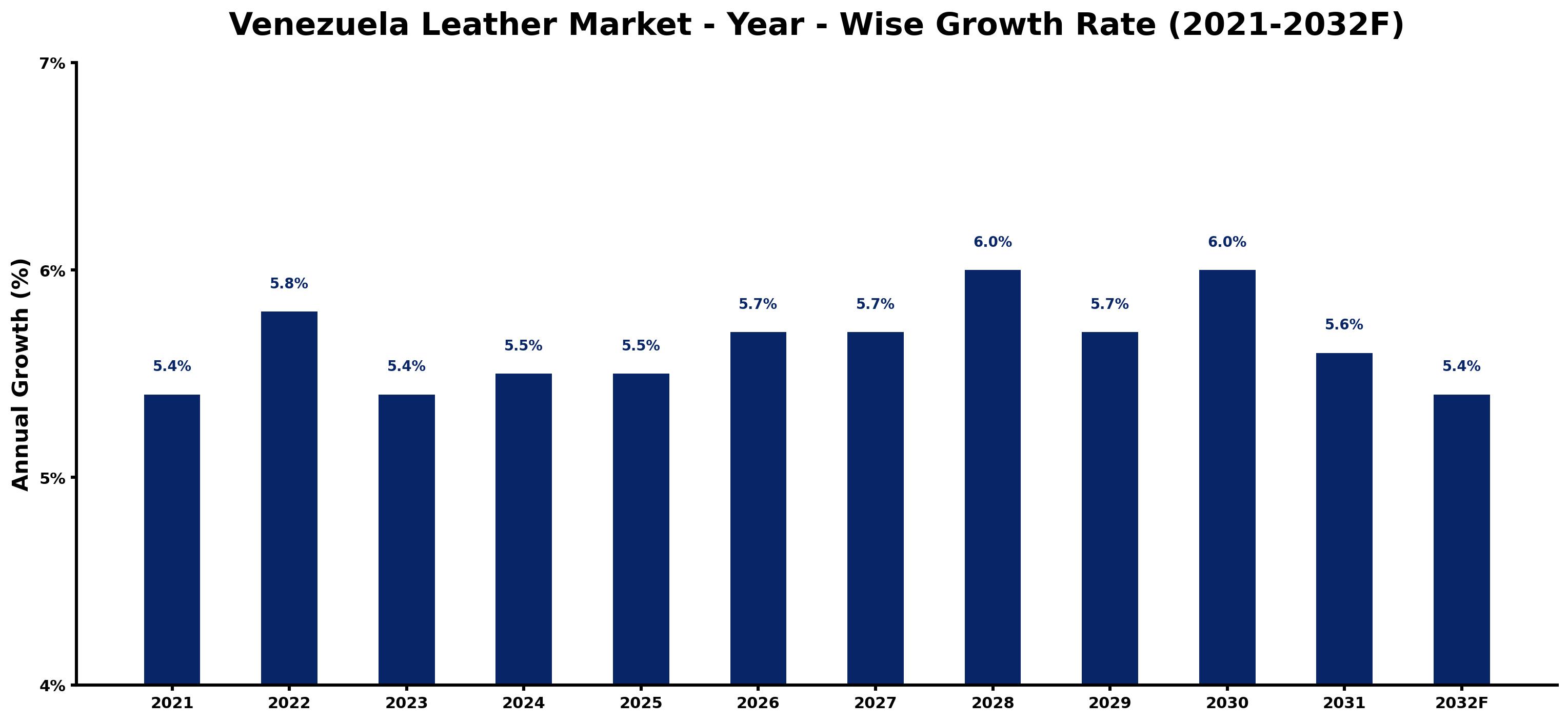
The table below presents the year wise growth rates along with the key drivers influencing the market
| Year | Growth Rate | Major Drivers |
| 2021 | 5.4% | Supply chain challenges led to increased local leather sourcing initiatives across Venezuela. |
| 2022 | 5.8% | Shifts towards sustainable fashion influenced consumer interest in ethically sourced leather products. |
| 2023 | 5.4% | Cultural revitalization projects encouraged artisans to innovate traditional leather crafting techniques. |
| 2024 | 5.5% | Emerging e-commerce platforms facilitated broader access to Venezuela's leather goods market. |
| 2025 | 5.5% | Investments in local manufacturing created job opportunities, boosting leather production capabilities significantly. |
| 2026 | 5.7% | Tourism recovery resulted in heightened demand for unique leather souvenirs and artisanal products. |
| 2027 | 5.7% | Collaboration with international brands opened channels for Venezuela's leather into global markets. |
| 2028 | 6.0% | Digital marketing strategies enabled small leather businesses to reach diverse consumer demographics effectively. |
| 2029 | 5.7% | Increased emphasis on quality and craftsmanship heightened the reputation of Venezuelan leather goods. |
| 2030 | 6.0% | A resurgence in local fashion designers emphasized the importance of high-quality leather materials. |
| 2031 | 5.6% | Interest in heritage and traditional craftsmanship led to a dedicated consumer base for leather. |
| 2032 | 5.4% | Emerging trends in customization created higher demand for personalized leather products across demographics. |
Note - Market size estimations and growth projections presented in this report are based on 6Wresearch's advanced forecasting approach, validated with industry datasets as of June 2026.
Venezuela Leather Market Synopsis
The Venezuela Leather Market is projected to reach 5.7% and witness significant growth during the forecast period (2026-2032). This market is characterized by a strong demand for high-quality leather products, including shoes, bags, and various accessories. The increasing fashion consciousness among the population and a distinct preference for durable, stylish leather goods drive the market dynamics. Venezuela's long-standing tradition of craftsmanship and expertise in leather tanning processes supports its domestic production capabilities. Despite these strengths, the industry faces substantial barriers, including political instability and economic crises that restrain its growth potential.
Venezuela Leather Market Growth Drivers
The growth of the Venezuela Leather Market is influenced by several key factors:
- The rising affluent consumer base is leading to higher demand for luxury and high-end leather products, which aligns with contemporary fashion trends.
- Consumer awareness regarding the quality and durability of leather goods has amplified preferences for premium products, further stimulating market growth.
- Traditional craftsmanship, combined with modern designs, enhances the unique appeal of Venezuelan leather products, attracting both local and international buyers.
- The shift towards sustainability has spurred interest in ethically sourced and vegetable-tanned leather, catering to environmentally conscious consumers.
- Growing interest in exotic leather products, such as crocodile and snake skins, supports the luxury segment of the leather market in Venezuela.
Venezuela Leather Market Trends and Opportunities
In recent years, the Venezuela Leather Market has observed notable trends shaping its landscape:
- There is an increasing inclination towards sustainable practices, with artisans and manufacturers exploring eco-friendly tanning methods that avoid harmful chemicals.
- Artisanal leather goods are gaining traction as consumers seek unique, handcrafted products that reflect Venezuelan heritage and culture.
- The market's adaptation to global luxury trends indicates potential for growth, especially in regions with an appreciation for premium quality leather goods.
- Innovations in design and production techniques are becoming essential for businesses aiming to enhance competitiveness in both local and international markets.
- The demand for customization and personalized leather goods is on the rise, allowing consumers to express individuality through tailored products.
Venezuela Leather Market Challenges and Restraints
While the Venezuela Leather Market holds significant growth potential, it faces several challenges:
- Political instability has led to persistent economic crises, resulting in unpredictable currency fluctuations that adversely impact production costs and profitability.
- Limited access to high-quality raw materials due to stringent import restrictions hampers the capacity for consistent product quality and availability.
- The absence of modern technological investment restricts the operational efficiency of local producers, affecting their competitiveness in the global market.
- High inflation and reduced consumer purchasing power challenge the market's growth as consumers prioritize basic needs over luxury items.
- The regulatory environment, including export tariffs and import restrictions, can deter foreign investment and complicate trade for local businesses.
Venezuela Leather Market Investment Opportunities
Despite the challenges, the Venezuela Leather Market presents various investment opportunities:
- With an abundance of local raw materials such as cattle hides and goatskins, there is potential for establishing leather processing facilities that capitalize on these resources.
- Exporting high-quality leather goods to international markets could be lucrative, provided that thorough market analysis and strategic partnerships are established.
- There is significant room for investment in technology to modernize production methods, enhancing quality and efficiency while meeting international standards.
- Building capacity for sustainable practices could position businesses favorably in a market that increasingly values eco-friendly products.
- Engaging in marketing initiatives focused on promoting Venezuelan craftsmanship and heritage may attract niche markets willing to pay a premium for authentic goods.
Venezuela Leather Market Government Investment and Initiatives
Government policies have a crucial impact on the Venezuela Leather Market, focusing on several strategic initiatives:
- The government implements import restrictions on raw materials and machinery to safeguard local industries against foreign competition, thereby encouraging domestic production.
- Export tariffs on finished leather products aim to protect local manufacturers and ensure that value addition occurs within the country.
- Public spending is directed toward promoting sustainable practices and fair labor standards within the leather industry to enhance its credibility and competitiveness.
- Development plans emphasize investing in training programs for artisans to preserve traditional craftsmanship while embracing modern business practices.
- Increased governmental focus on environmental sustainability aims to improve the overall reputation of the leather sector, aligning it with global eco-friendly trends.
Venezuela Leather Market Latest Developments (May 2025 - June 2026)
Between May 2025 and June 2026, the Venezuela Leather Market has witnessed several pivotal developments:
- Increased efforts by local producers to adopt sustainable practices have led to a rise in the availability of vegetable-tanned leather products in the market.
- Artisanal initiatives focusing on unique leather designs have emerged, attracting attention at regional trade shows and boosting local economies.
- Government enforcement of labor regulations has encouraged adherence to fair practices, improving conditions for workers in the leather industry.
- There has been a push for technological upgrades in production facilities, with some businesses beginning to invest in modern tools to enhance quality.
- The luxury segment of the leather market has shown resilience, with increasing interest from consumers seeking premium products that highlight artisanal craftsmanship.
Venezuela Leather Market - Key Attractiveness of the Report
- 10 Years of Market Numbers
- Historical Data Starting from 2022 to 2025
- Base Year: 2025
- Forecast Data until 2032
- Key Performance Indicators Impacting the Market
- Major Upcoming Developments and Projects
Key Highlights of the Report:
- Venezuela Leather Market Outlook
- Market Size of Venezuela Leather Market, 2025
- Forecast of Venezuela Leather Market, 2032F
- Historical Data and Forecast of Venezuela Leather Revenues & Volume for the Period 2022-2032F
- Venezuela Leather Market Trend Evolution
- Venezuela Leather Market Drivers and Challenges
- Venezuela Leather Price Trends
- Venezuela Leather Porter's Five Forces
- Venezuela Leather Industry Life Cycle
- Historical Data and Forecast of Venezuela Leather Market Revenues & Volume By Type for the Period 2022-2032F
- Historical Data and Forecast of Venezuela Leather Market Revenues & Volume By Luggage for the Period 2022-2032F
- Historical Data and Forecast of Venezuela Leather Market Revenues & Volume By Footwear for the Period 2022-2032F
- Historical Data and Forecast of Venezuela Leather Market Revenues & Volume By Accessories for the Period 2022-2032F
- Historical Data and Forecast of Venezuela Leather Market Revenues & Volume By Distribution Channel for the Period 2022-2032F
- Historical Data and Forecast of Venezuela Leather Market Revenues & Volume By Online for the Period 2022-2032F
- Historical Data and Forecast of Venezuela Leather Market Revenues & Volume By Offline for the Period 2022-2032F
- Venezuela Leather Import Export Trade Statistics
- Market Opportunity Assessment By Type
- Market Opportunity Assessment By Distribution Channel
- Venezuela Leather Top Companies Market Share
- Venezuela Leather Competitive Benchmarking By Technical and Operational Parameters
- Venezuela Leather Company Profiles
- Venezuela Leather Key Strategic Recommendations






































