Venezuela Lingerie Market Summary
The venezuela lingerie market was estimated at USD 393 Million in 2025 and is projected to reach USD 533 Million by 2032, growing at a CAGR of 5.2% from 2026 to 2032.
Venezuela Lingerie Market Year-wise Growth Rate and Key Drivers
This graph highlights how the Venezuela Lingerie Market has steadily grown over the past five years, supported by major growth factors.
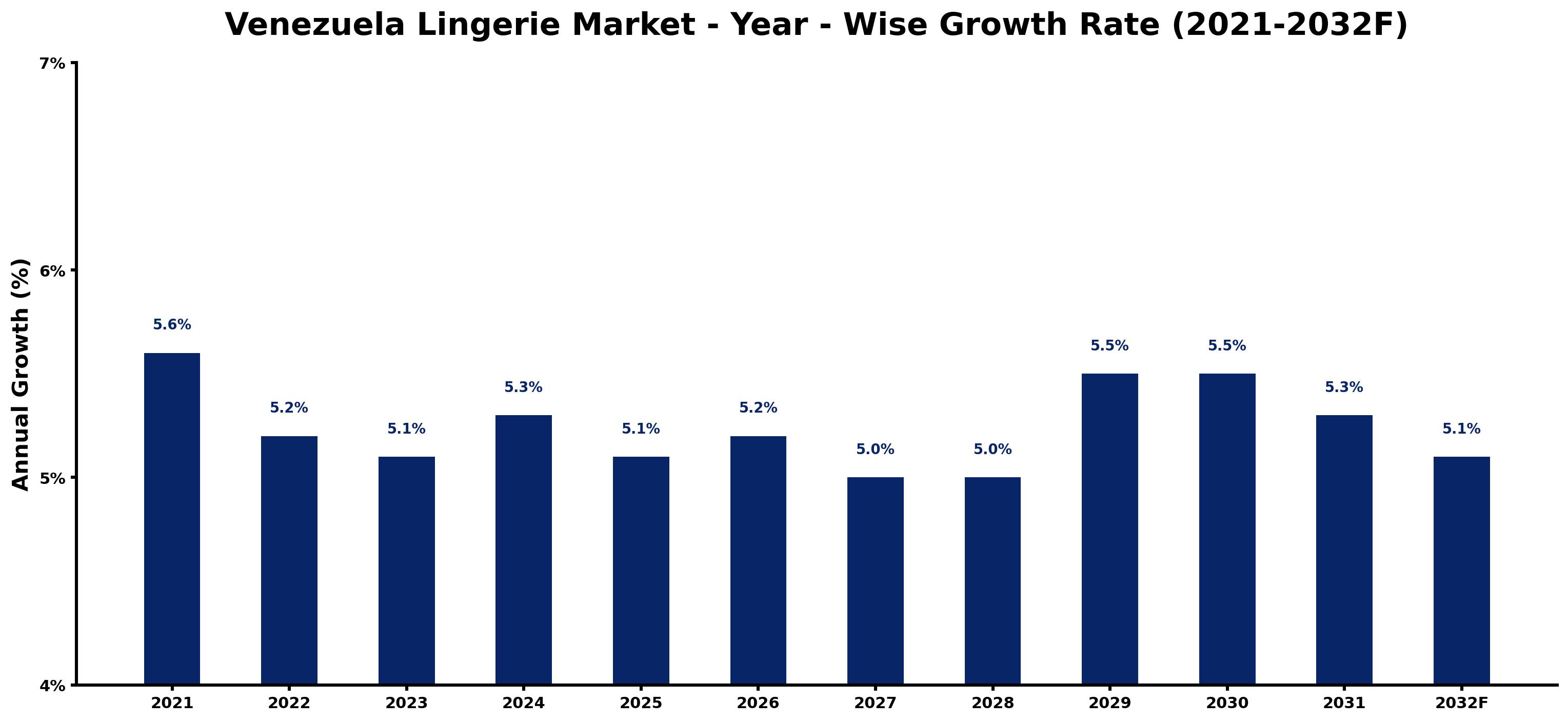
The table below presents the year wise growth rates along with the key drivers influencing the market
| Year | Growth Rate | Major Drivers |
| 2021 | 5.6% | Economic instability leads to increased interest in affordable lingerie options among consumers. |
| 2022 | 5.2% | E-commerce platforms emerge, simplifying access to lingerie brands in urban areas. |
| 2023 | 5.1% | Local designers gain popularity, reflecting cultural influences and consumer preferences in designs. |
| 2024 | 5.3% | Health and wellness trends drive demand for comfortable and functional lingerie products. |
| 2025 | 5.1% | Fashion collaborations with influencers elevate brand visibility and attract younger demographics. |
| 2026 | 5.2% | International brands explore local manufacturing partnerships, reducing costs and improving distribution. |
| 2027 | 5.0% | Social media marketing evolves, emphasizing body positivity and diverse representation in campaigns. |
| 2028 | 5.0% | Increased disposable income among middle-class women expands purchasing options for luxury lingerie. |
| 2029 | 5.5% | Sustainable practices in production attract eco-conscious consumers, reshaping brand loyalty. |
| 2030 | 5.5% | Innovations in fabric technology enhance comfort, appealing to modern consumer expectations. |
| 2031 | 5.3% | Cultural shifts embrace lingerie as a fashion statement, encouraging more public visibility. |
| 2032 | 5.1% | Retail spaces adapt to experiential shopping, integrating technology for personalized consumer experiences. |
Note - Market size estimations and growth projections presented in this report are based on 6Wresearch's advanced forecasting approach, validated with industry datasets as of June 2026.
Venezuela Lingerie Market Synopsis
The Venezuela Lingerie Market is projected to reach 5.2% and witness significant growth during the forecast period (2026-2032). This market segment is characterized by a blend of evolving consumer tastes, increased adaptability of brands, and a notable shift towards online retail platforms. Despite facing numerous challenges due to economic fluctuations and political instability, the demand for lingerie persists, showcasing a resilient consumer base that prioritizes both comfort and style.
Venezuela Lingerie Market Growth Drivers
Several key factors are propelling the growth of the Venezuela lingerie market. Firstly, the rising disposable income in certain demographics allows consumers to invest in higher-quality lingerie. Secondly, a noticeable shift towards body positivity has led to diverse consumer needs, prompting brands to cater to a myriad of body types and preferences. Additionally, the increasing popularity of e-commerce has transformed the retail landscape, providing consumers easier access to a wide array of lingerie options. Moreover, trends towards sustainable and ethically produced products are influencing purchasing decisions, aligning consumer consciousness with market offerings. Lastly, adapting to local cultural nuances has become essential for brands aiming to establish a foothold in this competitive market.
Venezuela Lingerie Market Trends and Opportunities
The Venezuela lingerie market is currently undergoing significant transformation influenced by various trends. The following points encapsulate these dynamics:
- The interest in personalized lingerie options is on the rise, with consumers seeking custom designs that reflect their individual tastes and needs.
- Brands are embracing inclusivity, offering wider size ranges and styles that promote body positivity and cater to diverse demographics.
- Sustainable fashion continues to gain traction, as many consumers are opting for lingerie that is produced ethically and with environmentally friendly materials.
- The integration of technology in shopping experiences, such as virtual fitting rooms, is enhancing consumer engagement and satisfaction during online purchases.
- Ultimately, there is a notable shift towards combining comfort with fashionable designs, appealing to a broader audience eager for dual functionality in lingerie products.
Venezuela Lingerie Market Challenges and Restraints
Despite its growth potential, the Venezuela lingerie market faces several challenges. The ongoing hyperinflation and economic turmoil significantly impact consumers' purchasing power, making luxury lingerie less accessible. Import restrictions and currency control policies further limit the availability of high-quality lingerie products, driving up prices and reducing variety. Additionally, the volatile political climate creates an uncertain business environment, deterring both local and foreign investment. Cultural shifts and evolving consumer preferences also necessitate rapid adaptation from brands, which can be challenging in a fluctuating market. These factors combined underscore the need for strategic innovation and adaptability among lingerie brands operating in Venezuela.
Venezuela Lingerie Market Investment Opportunities
Opportunities abound in the Venezuela lingerie market for investors willing to navigate its complexities. Targeting the demand for high-quality and stylish lingerie at accessible price points presents lucrative prospects. Investors can focus on brands that prioritize inclusivity and cater to various body types, which resonates well with changing consumer dynamics. Furthermore, the increasing emphasis on sustainability in fashion underscores the need for environmentally responsible lingerie options in the market. Engaging with online retail strategies and expanding e-commerce capabilities can also enable brands to reach a broader audience, tapping into the growing digital landscape. Aligning investment strategies with market trends and consumer behavior will be crucial for success in this evolving environment.
Venezuela Lingerie Market Government Investment and Initiatives
Government policies play a pivotal role in shaping the landscape of the Venezuela lingerie market. Regulations concerning importation, tariffs on foreign products, and quality control measures impact the market dynamics significantly. The government may impose restrictions on advertising strategies within the lingerie sector that require adherence to local cultural norms. Additionally, public spending initiatives aimed at boosting domestic production capabilities could provide investment incentives for local manufacturers. Attention to consumer safety through quality control regulations can enhance trust in the industry while potentially improving the overall competitiveness of local brands. These policies are vital in establishing a balanced environment for both domestic and international players in the lingerie market.
Venezuela Lingerie Market Latest Developments (May 2025 - June 2026)
Recent developments in the Venezuela lingerie market from May 2025 to June 2026 showcase a blend of resilience and adaptability amid economic challenges. Brands are responding to heightened consumer engagement by introducing innovative online shopping experiences, including enhanced virtual fitting options. The trend towards sustainability continues to be prominent, with several brands launching eco-friendly collections to appeal to conscious consumers. Additionally, the focus on inclusivity remains strong, with new designs catering to an expanding range of body types. There has also been a marked increase in collaborations among brands and local influencers, aiming to bolster awareness and promote diverse product lines. These developments indicate a proactive approach in navigating the prevailing market challenges while positioning brands for future growth.
Venezuela Lingerie Market - Key Attractiveness of the Report
- 10 Years of Market Numbers
- Historical Data Starting from 2022 to 2025
- Base Year: 2025
- Forecast Data until 2032
- Key Performance Indicators Impacting the Market
- Major Upcoming Developments and Projects
Key Highlights of the Report:
- Venezuela Lingerie Market Outlook
- Market Size of Venezuela Lingerie Market, 2025
- Forecast of Venezuela Lingerie Market, 2032F
- Historical Data and Forecast of Venezuela Lingerie Revenues & Volume for the Period 2022-2032F
- Venezuela Lingerie Market Trend Evolution
- Venezuela Lingerie Market Drivers and Challenges
- Venezuela Lingerie Price Trends
- Venezuela Lingerie Porter's Five Forces
- Venezuela Lingerie Industry Life Cycle
- Historical Data and Forecast of Venezuela Lingerie Market Revenues & Volume By Type for the Period 2022-2032F
- Historical Data and Forecast of Venezuela Lingerie Market Revenues & Volume By Brassiere for the Period 2022-2032F
- Historical Data and Forecast of Venezuela Lingerie Market Revenues & Volume By Knickers for the Period 2022-2032F
- Historical Data and Forecast of Venezuela Lingerie Market Revenues & Volume By Shape Wear for the Period 2022-2032F
- Historical Data and Forecast of Venezuela Lingerie Market Revenues & Volume By Others for the Period 2022-2032F
- Historical Data and Forecast of Venezuela Lingerie Market Revenues & Volume By Distribution Channel for the Period 2022-2032F
- Historical Data and Forecast of Venezuela Lingerie Market Revenues & Volume By Specialty Stores for the Period 2022-2032F
- Historical Data and Forecast of Venezuela Lingerie Market Revenues & Volume By Multi Brands Stores for the Period 2022-2032F
- Historical Data and Forecast of Venezuela Lingerie Market Revenues & Volume By Online for the Period 2022-2032F
- Venezuela Lingerie Import Export Trade Statistics
- Market Opportunity Assessment By Type
- Market Opportunity Assessment By Distribution Channel
- Venezuela Lingerie Top Companies Market Share
- Venezuela Lingerie Competitive Benchmarking By Technical and Operational Parameters
- Venezuela Lingerie Company Profiles
- Venezuela Lingerie Key Strategic Recommendations






































