Venezuela Liqueurs Market (2026-2032) | Companies, Revenue, Industry, Outlook, Forecast, Analysis, Value, Size, Growth, Trends & Share
Market Forecast By Type (Neutrals/Bitters, Creams, Fruit Flavored, Others), By Distribution Channel (Convenience Stores, On Premises, Retailers, Supermarkets), By Packaging (Glass, PET Bottle, Metal Can, Others) And Competitive Landscape
| Product Code: ETC044327 | Publication Date: Jan 2021 | Updated Date: Jun 2026 | Product Type: Report | |
| Publisher: 6Wresearch | Author: Sumit Sagar | No. of Pages: 70 | No. of Figures: 35 | No. of Tables: 5 |
Venezuela Liqueurs Market Summary
The venezuela liqueurs market was estimated at USD 226 Million in 2025 and is projected to reach USD 298 Million by 2032, growing at a CAGR of 4.7% from 2026 to 2032.
Venezuela Liqueurs Market Growth Rate Analysis (2021-2032)
The Venezuela liqueurs market has shown a stable growth pattern, starting at 4.9% in 2021 and maintaining this figure through 2022 and 2023. Factors driving this growth include a resurgence in consumer interest and investments in local production capabilities, as well as an increase in tourism, which has bolstered the demand for premium liqueurs. In 2024, the growth rate remains steady at 4.9%, but it dips slightly to 4.4% in 2025 due to minor supply chain disruptions. However, resilience is noted with a rebound to 4.7% in 2026, likely fueled by renewed marketing strategies and innovative product offerings. By 2030, the market reaches its peak growth of 5%, reflecting strong consumer confidence and a growing appreciation for Venezuelan liqueurs on the international stage.
Venezuela Liqueurs Market Year-wise Growth Rate and Key Drivers
This graph highlights how the Venezuela Liqueurs Market has steadily grown over the past five years, supported by major growth factors.
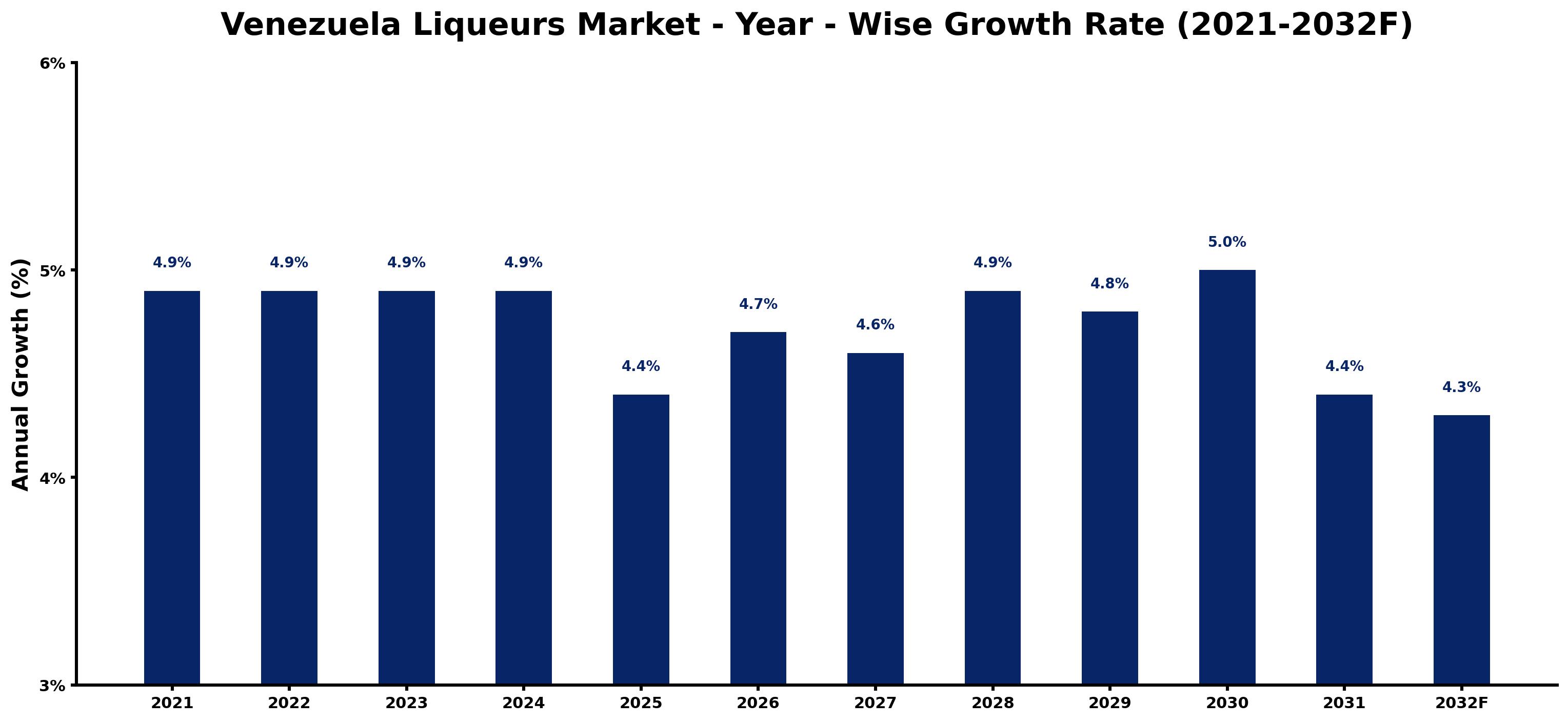
The table below presents the year wise growth rates along with the key drivers influencing the market
| Year | Growth Rate | Major Drivers |
| 2021 | 4.9% | High inflation rates have shifted consumer preferences towards affordable liqueurs. |
| 2022 | 4.9% | Local distilleries are increasingly producing unique flavors to cater to regional tastes. |
| 2023 | 4.9% | Tourism recovery initiates interest in Venezuelan liqueurs, enhancing brand visibility internationally. |
| 2024 | 4.9% | Social media influencers are driving awareness for artisanal liqueur brands in Venezuela. |
| 2025 | 4.4% | Increased interest in sustainable practices influences traditional liqueur production methods. |
| 2026 | 4.7% | Premium segments see growth as consumers seek quality over quantity in beverages. |
| 2027 | 4.6% | Collaborations between bartenders and local producers create innovative cocktail experiences. |
| 2028 | 4.9% | Emerging export opportunities motivate producers to expand product lines and reach abroad. |
| 2029 | 4.8% | Cultural festivals celebrate local liqueurs, boosting community engagement and sales. |
| 2030 | 5.0% | Young consumers increasingly prefer craft beverages, prioritizing authenticity and local sourcing. |
| 2031 | 4.4% | E-commerce developments enable smaller brands to access broader market segments effectively. |
| 2032 | 4.3% | Health-conscious trends prompt innovations in low-sugar and organic liqueur options. |
Note - Market size estimations and growth projections presented in this report are based on 6Wresearch's advanced forecasting approach, validated with industry datasets as of June 2026.
Venezuela Liqueurs Market Synopsis
The Venezuela Liqueurs Market is projected to reach 4.7% and witness significant growth during the forecast period (2026-2032). This market segment, embedded in the broader beverage industry, showcases a rich assortment of traditional and innovative flavors that cater to the diverse palate of Venezuelan consumers. The interplay between local distilleries and international brands has fostered a unique environment conducive to the production of both premium and artisanal liqueurs, particularly those influenced by the nation's renowned rum heritage.
Venezuela Liqueurs Market Trends and Opportunities
The Venezuela Liqueurs Market is currently undergoing a significant transformation, spurred by the growing consumer inclination towards premium and craft offerings. This trend is characterized by several key factors:
- Increased consumer interest in artisanal products is driving demand for liqueurs made from locally sourced ingredients, offering unique flavors that resonate with notions of authenticity.
- The rise of health-conscious consumption patterns has led to a demand for liqueurs with natural ingredients and lower sugar content, thereby influencing product development and marketing strategies.
- The burgeoning cocktail culture in Venezuela has generated a need for versatile liqueurs that can enhance mixed drink experiences, making the appeal of these products broader and more diverse.
- Brand differentiation through innovative packaging and marketing has become essential as companies strive to capture the attention of discerning consumers in a competitive landscape.
- The overall evolution within the liqueurs market aligns with a global trend where consumers prioritize quality over quantity, seeking unique flavors and experiences in their beverage choices.
Venezuela Liqueurs Market Challenges and Restraints
The Venezuela Liqueurs Market operates under significant pressures that impact its growth trajectory. These challenges include:
- The economic instability and hyperinflation that have plagued the country have severely affected consumer purchasing power, resulting in reduced affordability for premium and imported liqueurs.
- Strict government regulations and controls concerning the importation of alcohol products have curtailed the diversity of liqueurs available to consumers, inhibiting market expansion.
- Ongoing supply chain disruptions have hindered local producers' ability to secure essential raw materials, jeopardizing production consistency and quality.
- The political uncertainty surrounding the country has deterred foreign investment, further complicating the operational landscape for businesses within the liqueurs sector.
- As consumer spending pivots towards essential goods amid economic challenges, discretionary spending on luxury items, including high-quality liqueurs, is often deprioritized.
Venezuela Liqueurs Market Investment Opportunities
Despite the challenges faced, the Venezuela Liqueurs Market presents several avenues for investment that could lead to fruitful outcomes:
- The ongoing consumer trend towards premium and craft liqueurs opens opportunities for investors to capitalize on the production of unique offerings that meet evolving tastes.
- Investing in artisanal liqueurs crafted from locally sourced ingredients could resonate with consumers looking for authenticity and sustainability in their beverage choices.
- Exploring export opportunities to international markets may provide a profitable outlet for Venezuela's rich cultural heritage and traditional liqueur recipes, appealing to global consumers.
- Innovative branding and packaging strategies can significantly enhance product visibility, encouraging consumer engagement and purchase in a competitive market landscape.
- Investors may also focus on the development of healthier liqueur options, tapping into the growing demand for products that align with wellness trends among consumers.
Venezuela Liqueurs Market Government Investment and Initiatives
Government policies play a pivotal role in shaping the Venezuela Liqueurs Market. The Venezuelan government has implemented various regulations affecting the production, distribution, and pricing of alcoholic beverages. Measures such as price controls, import restrictions, and licensing requirements impact all market participants, influencing operational capabilities. Additionally, stringent advertising regulations aim to promote responsible consumption. While such measures are put in place for consumer protection, the adverse effects of ongoing economic challenges, including hyperinflation and supply chain disruptions, have created market volatility. Overall, government interventions are significant factors that mold the dynamics of the Venezuela Liqueurs Market.
Venezuela Liqueurs Market Latest Developments (May 2025 - June 2026)
Recent months have seen notable developments in the Venezuela Liqueurs Market, as producers adapt to the evolving landscape. The trend toward premiumization has intensified, with a growing emphasis on crafting distinctive, high-quality liqueurs. Many local distilleries have begun to innovate in their flavor profiles and production techniques, creating unique offerings that appeal to emerging consumer preferences. The market has also witnessed a gradual shift in branding initiatives, with companies investing in modern marketing strategies to capture the attention of a younger demographic. However, the overarching economic challenges continue to stifle growth and limit the potential for expansion in both domestic and international markets.
Venezuela Liqueurs Market - Key Attractiveness of the Report
- 10 Years of Market Numbers
- Historical Data Starting from 2022 to 2025
- Base Year: 2025
- Forecast Data until 2032
- Key Performance Indicators Impacting the Market
- Major Upcoming Developments and Projects
Key Highlights of the Report:
- Venezuela Liqueurs Market Outlook
- Market Size of Venezuela Liqueurs Market, 2025
- Forecast of Venezuela Liqueurs Market, 2032F
- Historical Data and Forecast of Venezuela Liqueurs Revenues & Volume for the Period 2022-2032F
- Venezuela Liqueurs Market Trend Evolution
- Venezuela Liqueurs Market Drivers and Challenges
- Venezuela Liqueurs Price Trends
- Venezuela Liqueurs Porter's Five Forces
- Venezuela Liqueurs Industry Life Cycle
- Historical Data and Forecast of Venezuela Liqueurs Market Revenues & Volume By Type for the Period 2022-2032F
- Historical Data and Forecast of Venezuela Liqueurs Market Revenues & Volume By Neutrals/Bitters for the Period 2022-2032F
- Historical Data and Forecast of Venezuela Liqueurs Market Revenues & Volume By Creams for the Period 2022-2032F
- Historical Data and Forecast of Venezuela Liqueurs Market Revenues & Volume By Fruit Flavored for the Period 2022-2032F
- Historical Data and Forecast of Venezuela Liqueurs Market Revenues & Volume By Others for the Period 2022-2032F
- Historical Data and Forecast of Venezuela Liqueurs Market Revenues & Volume By Distribution Channel for the Period 2022-2032F
- Historical Data and Forecast of Venezuela Liqueurs Market Revenues & Volume By Convenience Stores for the Period 2022-2032F
- Historical Data and Forecast of Venezuela Liqueurs Market Revenues & Volume By On Premises for the Period 2022-2032F
- Historical Data and Forecast of Venezuela Liqueurs Market Revenues & Volume By Retailers for the Period 2022-2032F
- Historical Data and Forecast of Venezuela Liqueurs Market Revenues & Volume By Supermarkets for the Period 2022-2032F
- Historical Data and Forecast of Venezuela Liqueurs Market Revenues & Volume By Packaging for the Period 2022-2032F
- Historical Data and Forecast of Venezuela Liqueurs Market Revenues & Volume By Glass for the Period 2022-2032F
- Historical Data and Forecast of Venezuela Liqueurs Market Revenues & Volume By PET Bottle for the Period 2022-2032F
- Historical Data and Forecast of Venezuela Liqueurs Market Revenues & Volume By Metal Can for the Period 2022-2032F
- Historical Data and Forecast of Venezuela Liqueurs Market Revenues & Volume By Others for the Period 2022-2032F
- Venezuela Liqueurs Import Export Trade Statistics
- Market Opportunity Assessment By Type
- Market Opportunity Assessment By Distribution Channel
- Market Opportunity Assessment By Packaging
- Venezuela Liqueurs Top Companies Market Share
- Venezuela Liqueurs Competitive Benchmarking By Technical and Operational Parameters
- Venezuela Liqueurs Company Profiles
- Venezuela Liqueurs Key Strategic Recommendations
Frequently Asked Questions About the Market Study (FAQs):
A1: Growing consumer demand for premium and craft liqueurs, along with the rise of cocktail culture and an interest in artisanal products, are significant growth drivers in the market.
A2: Government regulations, including price controls and import restrictions, heavily influence the production, distribution, and pricing of liqueurs, shaping market dynamics.
A3: Local producers face economic instability, supply chain disruptions, and limited access to raw materials, which impede their ability to compete effectively in the market.
A4: Yes, there are several opportunities, particularly in premium and artisanal liqueurs, as well as potential for export and innovative product development focused on health-conscious trends.
6Wresearch actively monitors the Venezuela Liqueurs Market and publishes its comprehensive annual report, highlighting emerging trends, growth drivers, revenue analysis, and forecast outlook. Our insights help businesses to make data-backed strategic decisions with ongoing market dynamics. Our analysts track relevent industries related to the Venezuela Liqueurs Market, allowing our clients with actionable intelligence and reliable forecasts tailored to emerging regional needs.
Yes, we provide customisation as per your requirements. To learn more, feel free to contact us on sales@6wresearch.com
1 Executive Summary |
2 Introduction |
2.1 Key Highlights of the Report |
2.2 Report Description |
2.3 Market Scope & Segmentation |
2.4 Research Methodology |
2.5 Assumptions |
3 Venezuela Liqueurs Market Overview |
3.1 Venezuela Country Macro Economic Indicators |
3.2 Venezuela Liqueurs Market Revenues & Volume, 2022 & 2032F |
3.3 Venezuela Liqueurs Market - Industry Life Cycle |
3.4 Venezuela Liqueurs Market - Porter's Five Forces |
3.5 Venezuela Liqueurs Market Revenues & Volume Share, By Type, 2022 & 2032F |
3.6 Venezuela Liqueurs Market Revenues & Volume Share, By Distribution Channel, 2022 & 2032F |
3.7 Venezuela Liqueurs Market Revenues & Volume Share, By Packaging, 2022 & 2032F |
4 Venezuela Liqueurs Market Dynamics |
4.1 Impact Analysis |
4.2 Market Drivers |
4.3 Market Restraints |
5 Venezuela Liqueurs Market Trends |
6 Venezuela Liqueurs Market, By Types |
6.1 Venezuela Liqueurs Market, By Type |
6.1.1 Overview and Analysis |
6.1.2 Venezuela Liqueurs Market Revenues & Volume, By Type, 2022-2032F |
6.1.3 Venezuela Liqueurs Market Revenues & Volume, By Neutrals/Bitters, 2022-2032F |
6.1.4 Venezuela Liqueurs Market Revenues & Volume, By Creams, 2022-2032F |
6.1.5 Venezuela Liqueurs Market Revenues & Volume, By Fruit Flavored, 2022-2032F |
6.1.6 Venezuela Liqueurs Market Revenues & Volume, By Others, 2022-2032F |
6.2 Venezuela Liqueurs Market, By Distribution Channel |
6.2.1 Overview and Analysis |
6.2.2 Venezuela Liqueurs Market Revenues & Volume, By Convenience Stores, 2022-2032F |
6.2.3 Venezuela Liqueurs Market Revenues & Volume, By On Premises, 2022-2032F |
6.2.4 Venezuela Liqueurs Market Revenues & Volume, By Retailers, 2022-2032F |
6.2.5 Venezuela Liqueurs Market Revenues & Volume, By Supermarkets, 2022-2032F |
6.3 Venezuela Liqueurs Market, By Packaging |
6.3.1 Overview and Analysis |
6.3.2 Venezuela Liqueurs Market Revenues & Volume, By Glass, 2022-2032F |
6.3.3 Venezuela Liqueurs Market Revenues & Volume, By PET Bottle, 2022-2032F |
6.3.4 Venezuela Liqueurs Market Revenues & Volume, By Metal Can, 2022-2032F |
6.3.5 Venezuela Liqueurs Market Revenues & Volume, By Others, 2022-2032F |
7 Venezuela Liqueurs Market Import-Export Trade Statistics |
7.1 Venezuela Liqueurs Market Export to Major Countries |
7.2 Venezuela Liqueurs Market Imports from Major Countries |
8 Venezuela Liqueurs Market Key Performance Indicators |
9 Venezuela Liqueurs Market - Opportunity Assessment |
9.1 Venezuela Liqueurs Market Opportunity Assessment, By Type, 2022 & 2032F |
9.2 Venezuela Liqueurs Market Opportunity Assessment, By Distribution Channel, 2022 & 2032F |
9.3 Venezuela Liqueurs Market Opportunity Assessment, By Packaging, 2022 & 2032F |
10 Venezuela Liqueurs Market - Competitive Landscape |
10.1 Venezuela Liqueurs Market Revenue Share, By Companies, 2025 |
10.2 Venezuela Liqueurs Market Competitive Benchmarking, By Operating and Technical Parameters |
11 Company Profiles |
12 Recommendations |
13 Disclaimer |
Global Go To Market Strategy - 2030
Export potential enables firms to identify high-growth global markets with greater confidence by combining advanced trade intelligence with a structured quantitative methodology. The framework analyzes emerging demand trends and country-level import patterns while integrating macroeconomic and trade datasets such as GDP and population forecasts, bilateral import–export flows, tariff structures, elasticity differentials between developed and developing economies, geographic distance, and import demand projections. Using weighted trade values from 2020–2024 as the base period to project country-to-country export potential for 2030, these inputs are operationalized through calculated drivers such as gravity model parameters, tariff impact factors, and projected GDP per-capita growth. Through an analysis of hidden potentials, demand hotspots, and market conditions that are most favorable to success, this method enables firms to focus on target countries, maximize returns, and global expansion with data, backed by accuracy.
By factoring in the projected importer demand gap that is currently unmet and could be potential opportunity, it identifies the potential for the Exporter (Country) among 190 countries, against the general trade analysis, which identifies the biggest importer or exporter.
To discover high-growth global markets and optimize your business strategy:
Click Here
Pricing
- Single User License$ 1,995
- Department License$ 2,400
- Site License$ 3,120
- Global License$ 3,795

Leadership Perspectives from Industry Events
Search
Thought Leadership and Analyst Meet





Our Clients








6WResearch In News
- India Air Conditioner Market Set for Strong Rebound in 2026 After Weather-Led Correction and GST-Driven Recovery: 6Wresearch
- ADAS in India: How Automatic Emergency Braking, Blind Spot Detection & Driver Monitoring are Transforming Road Safety
- Doha a strategic location for EV manufacturing hub: IPA Qatar
- Demand for luxury TVs surging in the GCC, says Samsung
- Empowering Growth: The Thriving Journey of Bangladesh’s Cable Industry
- Demand for luxury TVs surging in the GCC, says Samsung
Latest Reports
- Nicaragua RPG Gaming Market (2026-2032)
- New Zealand RPG Gaming Market (2026-2032)
- Netherlands RPG Gaming Market (2026-2032)
- Nauru RPG Gaming Market (2026-2032)
- Namibia RPG Gaming Market (2026-2032)
- Mozambique RPG Gaming Market (2026-2032)
- Montenegro RPG Gaming Market (2026-2032)
- Mongolia RPG Gaming Market (2026-2032)
- Monaco RPG Gaming Market (2026-2032)
- Micronesia RPG Gaming Market (2026-2032)
Industry Events and Analyst Meet

HIMTEX 2026

India Refining Summit 2026

India EV Show 2026

EV tech India Expo 2026

Auto Tech Asia 2026
Whitepaper
- Middle East & Africa Commercial Security Market Click here to view more.
- Middle East & Africa Fire Safety Systems & Equipment Market Click here to view more.
- GCC Drone Market Click here to view more.
- Middle East Lighting Fixture Market Click here to view more.
- GCC Physical & Perimeter Security Market Click here to view more.


