Venezuela Mineral Wool Market Summary
The venezuela mineral wool market was estimated at USD 949 Million in 2025 and is projected to reach USD 1359 Million by 2032, growing at a CAGR of 5.9% from 2026 to 2032.
Venezuela Mineral Wool Market Year-wise Growth Rate and Key Drivers
This graph highlights how the Venezuela Mineral Wool Market has steadily grown over the past five years, supported by major growth factors.
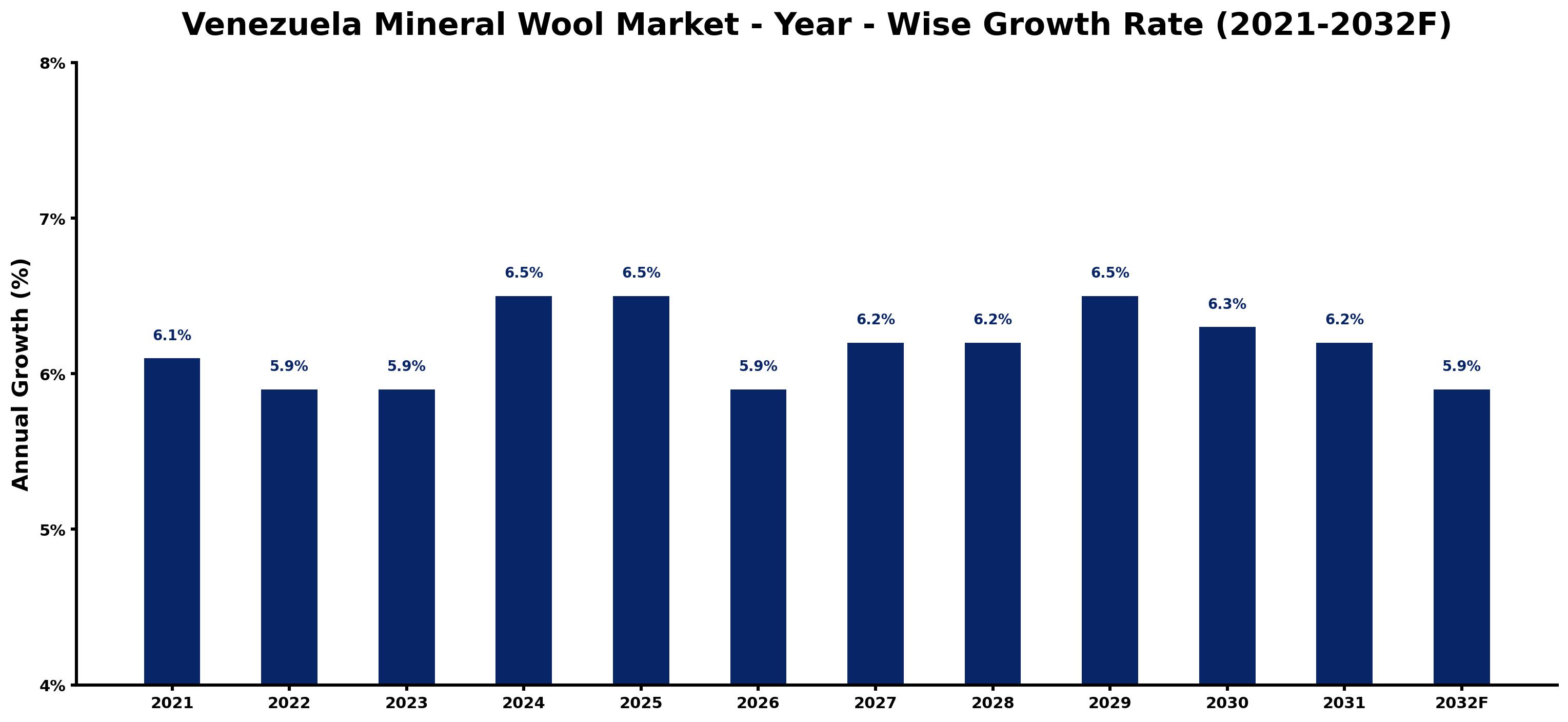
The table below presents the year wise growth rates along with the key drivers influencing the market
| Year | Growth Rate | Major Drivers |
| 2021 | 6.1% | Economic instability impacts housing and industrial sectors, increasing insulation demand. |
| 2022 | 5.9% | Local manufacturers explore sustainable options, enhancing mineral wool production capabilities. |
| 2023 | 5.9% | Emerging construction projects emphasize energy efficiency, boosting material innovation. |
| 2024 | 6.5% | Rising awareness of environmental benefits encourages homeowners to choose mineral wool. |
| 2025 | 6.5% | Heat management in residential properties becomes a priority, favoring advanced insulation solutions. |
| 2026 | 5.9% | Investment in infrastructure redevelopment nurtures demand for durable insulation materials. |
| 2027 | 6.2% | Population migration trends influence urban expansion, creating new insulation needs. |
| 2028 | 6.2% | Increased focus on acoustic properties drives interest in soundproofing applications. |
| 2029 | 6.5% | Cost-effective building materials gain traction, positioning mineral wool as an attractive choice. |
| 2030 | 6.3% | Partnerships with construction firms enhance product visibility in housing developments. |
| 2031 | 6.2% | Educational initiatives promote energy efficiency, influencing consumer purchasing decisions. |
| 2032 | 5.9% | A shift towards green construction practices solidifies mineral wool's market presence. |
Note - Market size estimations and growth projections presented in this report are based on 6Wresearch's advanced forecasting approach, validated with industry datasets as of June 2026.
Venezuela Mineral Wool Market Synopsis
The Venezuela Mineral Wool Market is projected to reach 5.9% and witness significant growth during the forecast period (2026-2032). This growth is primarily driven by the surge in construction activities, particularly in the residential sector, alongside the increasing demand for energy-efficient and sustainable insulation materials. Mineral wool products are recognized for their excellent thermal and acoustic insulation properties, making them a preferred choice for enhancing energy efficiency and minimizing noise pollution in various building applications.
Venezuela Mineral Wool Market Growth Drivers
Several factors are underpinning the growth of the Venezuela Mineral Wool Market. Firstly, the resurgence of construction projects, particularly residential buildings, is fostering a strong demand for insulation materials. This increasing focus on building energy-efficient homes is further compounded by consumer awareness regarding sustainability and environmental impacts. Secondly, the thermal and acoustic insulation properties of mineral wool make it an effective choice for construction, providing significant energy savings and comfort within buildings.
- Enhanced energy efficiency is pushing builders to opt for mineral wool, which improves insulation performance.
- The rising focus on sustainable building practices is driving demand for eco-friendly insulation solutions.
- Government regulations promoting energy-efficient building standards are anticipated to support market growth.
- As construction activities ramp up in alignment with urbanization trends, the demand for high-quality insulation materials is expected to rise.
- Mineral wool's versatility in applications, including residential and commercial buildings, is enhancing its market prospects.
Venezuela Mineral Wool Market Trends and Opportunities
A noticeable trend within the Venezuela Mineral Wool Market is the burgeoning interest in sustainable and energy-efficient construction solutions, which is auguring well for mineral wool products. As global awareness of environmental issues heightens, construction practices are evolving towards more sustainable methods that emphasize energy efficiency. Mineral wool, known for being cost-effective and eco-friendly, is emerging as a prominent choice for architects and builders.
- There is an increasing demand for high-density mineral wool boards, particularly for their enhanced fire resistance and soundproofing capabilities.
- Innovative mineral wool products are being developed to meet diverse requirements within the construction industry, thereby expanding their market reach.
- As government initiatives to promote green building practices gain momentum, the mineral wool market is poised for substantial growth.
- The demand for improved acoustic solutions in urban areas is boosting the popularity of mineral wool products.
- Strategies focusing on product innovation and enhancements are likely to create new opportunities for market players.
Venezuela Mineral Wool Market Challenges and Restraints
Despite its growth trajectory, the Venezuela Mineral Wool Market is not without challenges. Economic instability, characterized by fluctuations in currency values and inflation, poses a significant barrier to market expansion. Additionally, the limited availability of raw materials and energy resources hampers production capabilities and creates operational difficulties for manufacturers.
- The ongoing political crisis in Venezuela contributes to an unpredictable business environment, challenging companies' strategic planning.
- Access to quality raw materials is limited, leading to inconsistencies in production quality.
- Competition from alternative insulation materials could hinder market share growth for mineral wool manufacturers.
- Logistical issues and transportation constraints further complicate supply chain management in the region.
- Fluctuating demand due to economic factors adversely impacts long-term planning for manufacturers.
Venezuela Mineral Wool Market Investment Opportunities
The Venezuela Mineral Wool Market is ripe with investment opportunities, especially related to the growing demand for energy-efficient building materials. With mineral wool's reputation for thermal insulation, its usage in construction projects is likely to increase, aligning with sustainability goals. Moreover, government-driven infrastructure development initiatives offer a fertile ground for investment in manufacturing and distribution sectors.
- Investors can explore opportunities in the production of innovative mineral wool products tailored to specific construction needs.
- Partnerships with construction companies can facilitate the promotion and application of mineral wool solutions in new developments.
- As the focus on sustainable building practices intensifies, the demand for mineral wool is expected to grow, presenting attractive returns.
- Infrastructure renovation projects by the government may spur increased application of mineral wool in existing structures.
- It's crucial for investors to evaluate the prevailing economic climate and regulatory landscape before entering the market.
Venezuela Mineral Wool Market Government Investment and Initiatives
Government policies in Venezuela are primarily focused on enhancing domestic production capabilities and supporting local manufacturers in the mineral wool sector. Measures such as import tariffs and restrictions are in place to protect local industries from international competition, while also incentivizing domestic manufacturing through financial support and subsidies. These initiatives are intended to bolster production capacity and ensure competitive pricing in the market.
- The government promotes quality assurance measures to ensure mineral wool products meet safety standards.
- Investment in infrastructure projects is aligned with government policy, creating avenues for increased demand for insulation materials.
- Subsidies are provided to local manufacturers to improve technology and innovation within the sector.
- Public spending on housing and construction is being prioritized to stimulate the economy, benefiting mineral wool producers.
- Regulatory frameworks are being developed to encourage sustainable construction practices, further enhancing market attractiveness.
Venezuela Mineral Wool Market Latest Developments (May 2025 - June 2026)
Recent developments within the Venezuela Mineral Wool Market indicate a continued focus on sustainability and energy efficiency. The segment is witnessing a gradual shift towards innovative insulation solutions that enhance both thermal performance and acoustic comfort. Regulatory pressures to adhere to building energy codes are prompting construction firms to increasingly utilize mineral wool in their projects. Additionally, market players are adapting to evolving needs by launching products designed to meet specific performance standards, such as improved fire resistance.
Venezuela Mineral Wool Market - Key Attractiveness of the Report
- 10 Years of Market Numbers
- Historical Data Starting from 2022 to 2025
- Base Year: 2025
- Forecast Data until 2032
- Key Performance Indicators Impacting the Market
- Major Upcoming Developments and Projects
Key Highlights of the Report:
- Venezuela Mineral Wool Market Outlook
- Market Size of Venezuela Mineral Wool Market, 2025
- Forecast of Venezuela Mineral Wool Market, 2032F
- Historical Data and Forecast of Venezuela Mineral Wool Revenues & Volume for the Period 2022-2032F
- Venezuela Mineral Wool Market Trend Evolution
- Venezuela Mineral Wool Market Drivers and Challenges
- Venezuela Mineral Wool Price Trends
- Venezuela Mineral Wool Porter's Five Forces
- Venezuela Mineral Wool Industry Life Cycle
- Historical Data and Forecast of Venezuela Mineral Wool Market Revenues & Volume By Product Type for the Period 2022-2032F
- Historical Data and Forecast of Venezuela Mineral Wool Market Revenues & Volume By Rock Wool for the Period 2022-2032F
- Historical Data and Forecast of Venezuela Mineral Wool Market Revenues & Volume By Glass Wool for the Period 2022-2032F
- Historical Data and Forecast of Venezuela Mineral Wool Market Revenues & Volume By Form Types for the Period 2022-2032F
- Historical Data and Forecast of Venezuela Mineral Wool Market Revenues & Volume By Board for the Period 2022-2032F
- Historical Data and Forecast of Venezuela Mineral Wool Market Revenues & Volume By Blankets for the Period 2022-2032F
- Historical Data and Forecast of Venezuela Mineral Wool Market Revenues & Volume By Panel for the Period 2022-2032F
- Historical Data and Forecast of Venezuela Mineral Wool Market Revenues & Volume By Others for the Period 2022-2032F
- Historical Data and Forecast of Venezuela Mineral Wool Market Revenues & Volume By Applications for the Period 2022-2032F
- Historical Data and Forecast of Venezuela Mineral Wool Market Revenues & Volume By Building & Construction for the Period 2022-2032F
- Historical Data and Forecast of Venezuela Mineral Wool Market Revenues & Volume By Industrial for the Period 2022-2032F
- Historical Data and Forecast of Venezuela Mineral Wool Market Revenues & Volume By Transportation for the Period 2022-2032F
- Historical Data and Forecast of Venezuela Mineral Wool Market Revenues & Volume By Others for the Period 2022-2032F
- Venezuela Mineral Wool Import Export Trade Statistics
- Market Opportunity Assessment By Product Type
- Market Opportunity Assessment By Form Types
- Market Opportunity Assessment By Applications
- Venezuela Mineral Wool Top Companies Market Share
- Venezuela Mineral Wool Competitive Benchmarking By Technical and Operational Parameters
- Venezuela Mineral Wool Company Profiles
- Venezuela Mineral Wool Key Strategic Recommendations






































