Venezuela Recreational Vehicle Market Size, Share & Growth Rate
The Venezuela Recreational Vehicle Market was estimated at USD 488 Million in 2025 and is projected to reach USD 658 Million by 2032, growing at a CAGR of 4.4% from 2026 to 2032. This growth trajectory is driven by a burgeoning interest in compact RVs that align with the preferences of a younger demographic, keen on affordable travel alternatives. As consumers increasingly seek outdoor adventures, the demand for eco-friendly and fuel-efficient RV options is also gaining traction, paving the way for innovative offerings in this sector.
Venezuela Recreational Vehicle Market Year-wise Growth Rate and Key Drivers
This graph highlights how the Venezuela Recreational Vehicle Market has steadily grown over the years, supported by major growth factors.
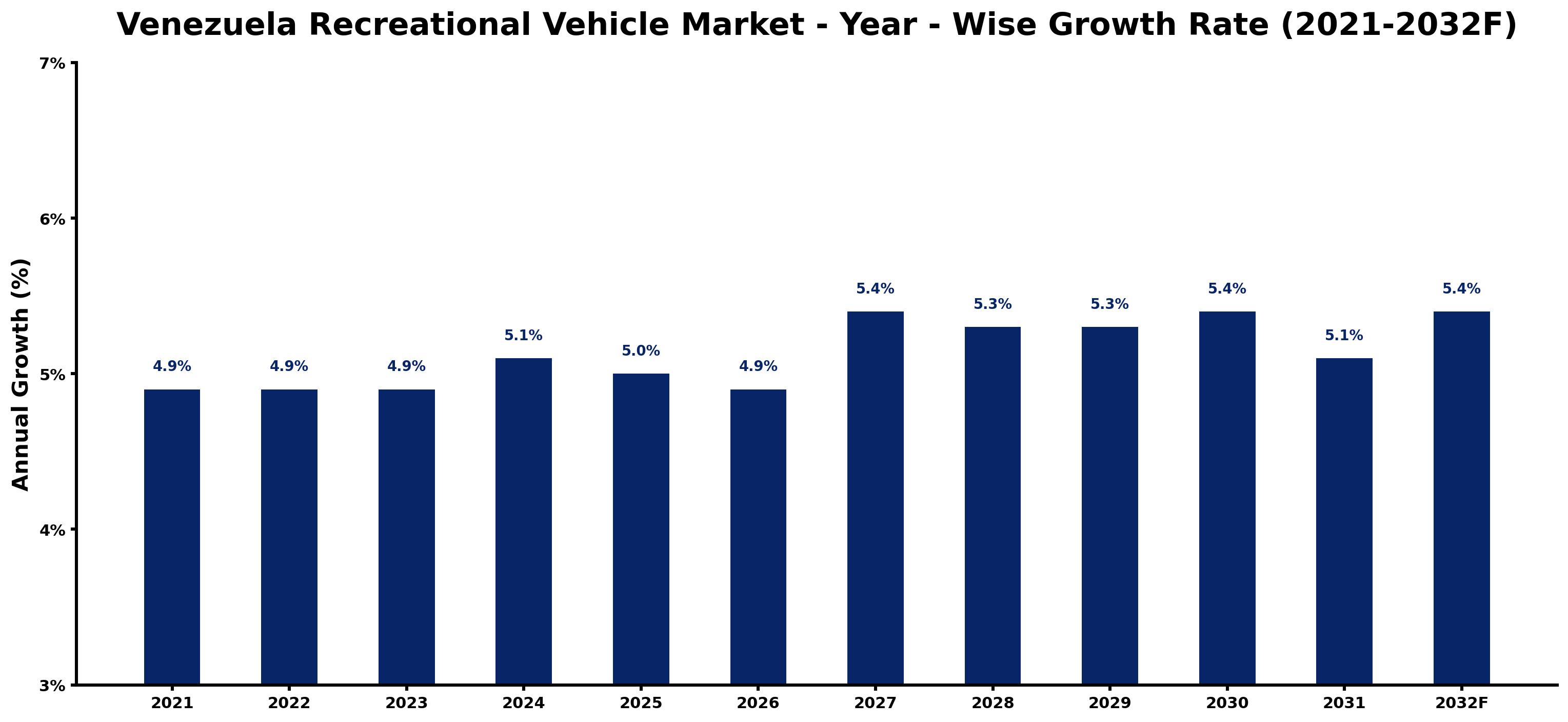
The table below presents the year‑wise growth rates along with the key drivers influencing the market
| Year | Growth Rate | Major Drivers |
| 2021 | 4.9% | Increasing industrial infrastructure investments |
| 2022 | 4.9% | Expansion of commercial construction activities |
| 2023 | 4.9% | Rapid growth in telecom and data center sectors |
| 2024 | 5.1% | Growing urbanization and commercial development |
| 2025 | 5.0% | Growing urbanization and commercial development |
| 2026 | 4.9% | Increasing industrial infrastructure investments |
| 2027 | 5.4% | Growing urbanization and commercial development |
| 2028 | 5.3% | Expansion of transportation and logistics networks |
| 2029 | 5.3% | Growing renewable energy integration projects |
| 2030 | 5.4% | Increasing adoption of advanced technologies |
| 2031 | 5.1% | Increasing industrial automation investments |
| 2032 | 5.4% | Increasing smart city development projects |
Note - Market size estimations and growth projections presented in this report are based on 6Wresearch's advanced forecasting approach, validated with industry datasets as of June 2026.
Venezuela Recreational Vehicle Market Synopsis
While recent trends have shown a steady uptick in consumer interest for recreational vehicles, the path ahead for the Venezuela RV market is fraught with challenges. Current economic conditions and infrastructural limitations may dampen momentum, yet a niche group of enthusiasts continues to explore the freedom that RV travel can offer.
The market is witnessing a growing segment of younger consumers eager to experience road trips and outdoor escapades. Despite the economic hurdles, their thirst for adventure fuels a demand for more affordable, compact RVs, signaling a possible transformation in how leisure travel is perceived in Venezuela.
Venezuela Recreational Vehicle Market Key Takeaways
- The market exhibits a notable shift towards smaller, fuel-efficient RVs, catering to a cost-conscious consumer base.
- Increasing interest in RV rentals indicates a budding market for experiential travel without long-term commitments.
- Solar-equipped and eco-friendly RV models are gaining traction, reflecting a rising environmental awareness among consumers.
- Investment opportunities exist in developing infrastructure for RV parks and camping facilities to support this niche market.
- Government regulations on imports present barriers, impacting the accessibility and affordability of RVs.
Evaluation of Restraints in Venezuela Recreational Vehicle Market
The Venezuela Recreational Vehicle Market is significantly hampered by ongoing economic turmoil, including hyperinflation and a depreciating currency that constrains consumer purchasing power. The scarcity of infrastructure necessary for RV travel—such as parks and maintenance facilities—further limits market growth. Political instability and security concerns also deter both potential investors and tourists, creating an environment rife with uncertainty and risk. These challenges ultimately lead to a conservative consumer mindset, curtailing the overall potential of the RV market in Venezuela.
Venezuela Recreational Vehicle Market Trends
A discernible trend towards compact, easily maneuverable RVs is emerging in the Venezuelan market. This is particularly pertinent, given the country's challenging road conditions and the desire for fuel efficiency. Younger consumers are driving the popularity of RVs that offer more flexible travel options. Eco-conscious features, including solar panels and sustainable materials, are becoming increasingly sought after, aligning with a global trend towards greener travel. Furthermore, the growing appeal of RV rentals is reshaping consumer engagement, enabling more people to experience RV life without upfront investment.
Venezuela Recreational Vehicle Market Opportunities
Despite the numerous challenges, there are distinct growth avenues in the Venezuelan recreational vehicle market. The demand for affordable RVs that cater to families and outdoor enthusiasts presents significant potential for investment. Developing rental services and RV tour packages could attract both domestic travelers and tourists looking for unique experiences. Additionally, as disposable incomes rise among certain consumer segments, there is a chance to introduce premium RV models targeting affluent buyers. The country's rich natural landscape further enhances the opportunity for innovative camping solutions and outdoor experiences.
Government Initiatives in the Venezuela Recreational Vehicle Market
Government policy in Venezuela significantly influences the recreational vehicle market, with ongoing economic challenges affecting vehicle imports and regulations. Efforts to enhance the tourism sector could encourage the development of RV-friendly infrastructure, although limited public spending constrains immediate progress. The government may consider initiatives aimed at easing import restrictions for RV components, which could ultimately enhance market accessibility and encourage local production. However, fluctuating political conditions must be navigated carefully by potential investors.
Future Insights of the Venezuela Recreational Vehicle Market
Looking forward to 2026-2032, the Venezuela recreational vehicle market faces a complex landscape shaped by economic and political factors. While it is likely that growth will remain slow due to these ongoing challenges, the increasing interest in RV travel could foster niche opportunities. Companies may need to pivot towards high-value offerings that appeal to affluent consumers while being mindful of logistical hurdles. Strategic partnerships could also play a pivotal role in enhancing infrastructure and facilitating market penetration in this evolving environment.
Venezuela Recreational Vehicle Market Latest Developments (May 2025 - June 2026)
Recent industry shifts indicate a gradual recognition of the potential in the Venezuelan RV market. Some local entities are exploring partnerships to enhance tourism-related services, focusing on RV rentals and eco-tourism. Moreover, there's a noticeable rise in consumer interest towards RV models with alternative energy solutions. This shift hints at a growing alignment with global trends, although comprehensive infrastructural changes remain necessary to support sustained growth.
Venezuela Recreational Vehicle Market - Key Attractiveness of the Report
- 10 Years of Market Numbers
- Historical Data Starting from 2022 to 2025
- Base Year: 2025
- Forecast Data until 2032
- Key Performance Indicators Impacting the Market
- Major Upcoming Developments and Projects
Key Highlights of the Report:
- Venezuela Recreational Vehicle Market Outlook
- Market Size of Venezuela Recreational Vehicle Market, 2025
- Forecast of Venezuela Recreational Vehicle Market, 2032
- Historical Data and Forecast of Venezuela Recreational Vehicle Revenues & Volume for the Period 2022-2032F
- Venezuela Recreational Vehicle Market Trend Evolution
- Venezuela Recreational Vehicle Market Drivers and Challenges
- Venezuela Recreational Vehicle Price Trends
- Venezuela Recreational Vehicle Porter's Five Forces
- Venezuela Recreational Vehicle Industry Life Cycle
- Historical Data and Forecast of Venezuela Recreational Vehicle Market Revenues & Volume By Product Type for the Period 2022-2032F
- Historical Data and Forecast of Venezuela Recreational Vehicle Market Revenues & Volume By Fifth Wheel Campers for the Period 2022-2032F
- Historical Data and Forecast of Venezuela Recreational Vehicle Market Revenues & Volume By Folding Camper for the Period 2022-2032F
- Historical Data and Forecast of Venezuela Recreational Vehicle Market Revenues & Volume By Truck Campers for the Period 2022-2032F
- Historical Data and Forecast of Venezuela Recreational Vehicle Market Revenues & Volume By Travel Trailers for the Period 2022-2032F
- Historical Data and Forecast of Venezuela Recreational Vehicle Market Revenues & Volume By Class A Motorhomes for the Period 2022-2032F
- Historical Data and Forecast of Venezuela Recreational Vehicle Market Revenues & Volume By Class B Motorhomes for the Period 2022-2032F
- Historical Data and Forecast of Venezuela Recreational Vehicle Market Revenues & Volume By Class C Motorhomes for the Period 2022-2032F
- Historical Data and Forecast of Venezuela Recreational Vehicle Market Revenues & Volume By Applications for the Period 2022-2032F
- Historical Data and Forecast of Venezuela Recreational Vehicle Market Revenues & Volume By Leisure for the Period 2022-2032F
- Historical Data and Forecast of Venezuela Recreational Vehicle Market Revenues & Volume By Business for the Period 2022-2032F
- Venezuela Recreational Vehicle Import Export Trade Statistics
- Market Opportunity Assessment By Product Type
- Market Opportunity Assessment By Applications
- Venezuela Recreational Vehicle Top Companies Market Share
- Venezuela Recreational Vehicle Competitive Benchmarking By Technical and Operational Parameters
- Venezuela Recreational Vehicle Company Profiles
- Venezuela Recreational Vehicle Key Strategic Recommendations






































