Venezuela Soap And Detergent Market Size, Share & Growth Rate
The Venezuela Soap And Detergent Market was estimated at USD 390 Million in 2025 and is projected to reach USD 517 Million by 2032, growing at a CAGR of 4.1% from 2026 to 2032. This growth trajectory is largely driven by an enduring demand for basic hygiene products amidst economic challenges, coupled with a rising consumer inclination toward locally produced and eco-friendly alternatives. As the market begins to stabilize, opportunities for innovation and sustainable solutions are expected to support this positive outlook.
Venezuela Soap And Detergent Market Year-wise Growth Rate and Key Drivers
This graph highlights how the Venezuela Soap And Detergent Market has steadily grown over the years, supported by major growth factors.
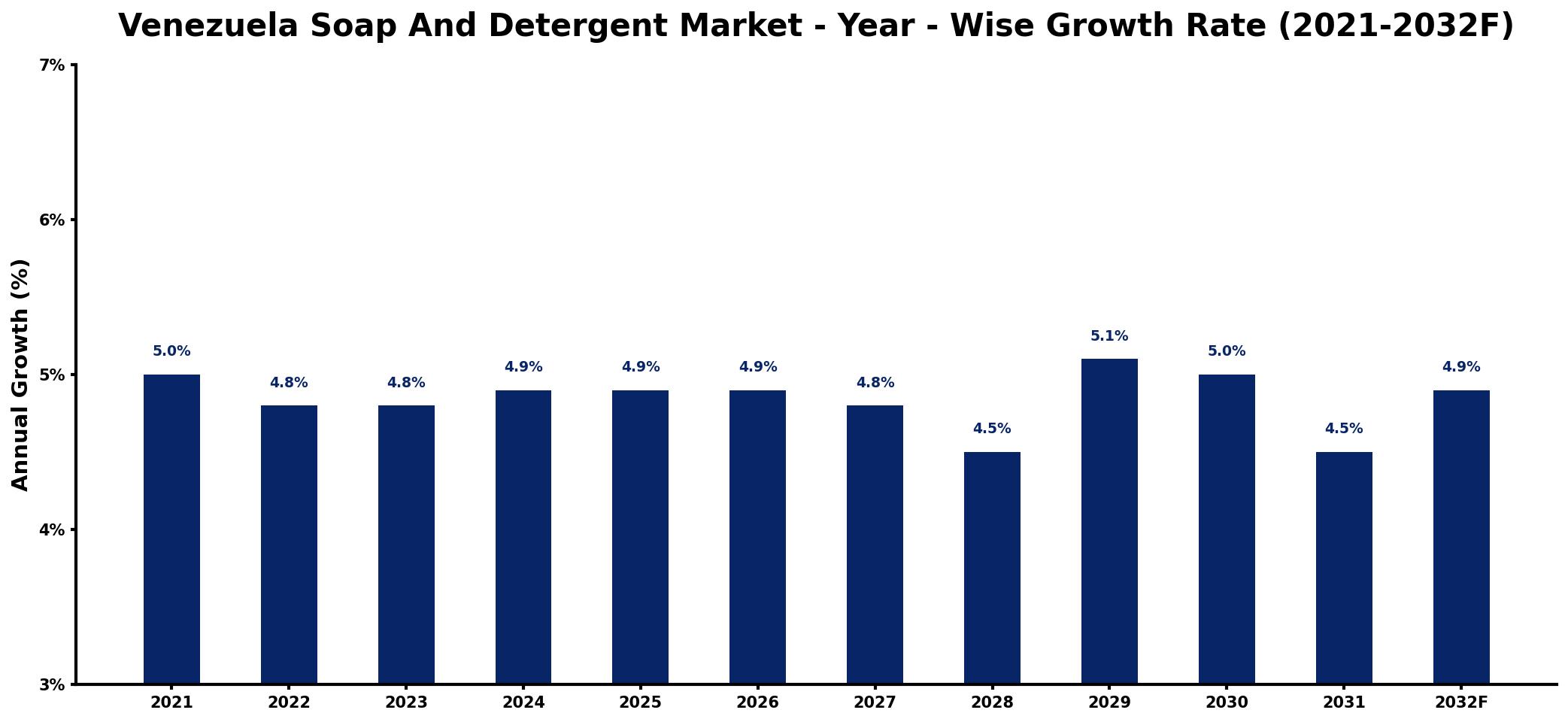
The table below presents the year‑wise growth rates along with the key drivers influencing the market
| Year | Growth Rate | Major Drivers |
| 2021 | 5.0% | Rising consumer health consciousness |
| 2022 | 4.8% | Increased urban population density |
| 2023 | 4.8% | Growing e-commerce distribution channels |
| 2024 | 4.9% | Expansion of local manufacturing facilities |
| 2025 | 4.9% | Higher disposable income levels |
| 2026 | 4.9% | Demand for eco-friendly options |
| 2027 | 4.8% | Investment in marketing strategies |
| 2028 | 4.5% | Emergence of premium product segments |
| 2029 | 5.1% | Strong export market potential |
| 2030 | 5.0% | Enhanced retail partnerships established |
| 2031 | 4.5% | Shift towards online shopping trends |
| 2032 | 4.9% | Innovations in packaging solutions |
Note: Market size estimations and growth projections presented in this report are based on 6Wresearch's proprietary forecasting methodology, utilizing the latest available industry data, government publications, and primary research inputs.
Venezuela Soap And Detergent Market Synopsis
In Venezuela, the soap and detergent market is heavily influenced by the critical demand for personal hygiene products, particularly amid ongoing public health concerns. Despite economic turbulence, consumers remain committed to maintaining cleanliness, pushing manufacturers to adapt to fluctuating purchasing power.
Local production is under significant pressure due to limited access to raw materials and the rising costs of production, prompting some consumers to seek alternative solutions such as homemade soaps. This situation has opened the door for innovative product offerings aimed at addressing both affordability and sustainability.
Venezuela Soap And Detergent Market Key Takeaways
- The market is currently grappling with supply shortages driven by economic instability and import restrictions.
- There is a notable shift towards natural and eco-friendly products, reflecting changing consumer preferences.
- Price controls imposed by the government have affected production costs and local manufacturing viability.
- Investment opportunities exist, particularly in cost-effective local production and sustainable product development.
- The demand for innovative solutions continues to grow, presenting avenues for market expansion despite challenges.
Evaluation of Restraints in Venezuela Soap And Detergent Market
The Venezuela Soap and Detergent market is hindered by a confluence of factors that stifle growth. Economic instability has led to significant fluctuations in consumer purchasing power, while high inflation and currency devaluation have driven up production costs. These economic realities are further compounded by stringent government regulations that impose price controls on essential goods, often making it economically unfeasible for local manufacturers to maintain operations at sustainable levels. Additionally, limited access to necessary raw materials due to import restrictions places further strain on production capabilities. These conditions create an environment where innovation is stifled, and market responsiveness is greatly challenged.
Venezuela Soap And Detergent Market Trends
Current trends within the Venezuela Soap and Detergent market highlight a growing consumer preference for environmentally-friendly and natural products, spurred by increased awareness of health and sustainability. As consumers seek products free from harsh chemicals, manufacturers are being prompted to invest in the development of organic formulations that align with these preferences. Additionally, convenience and efficacy have become paramount, as consumers prioritize high-quality products that deliver value for money. The market is transitioning towards a focus on versatile solutions that can serve multiple purposes, thereby enhancing consumer satisfaction in a cost-conscious environment.
Venezuela Soap And Detergent Market Opportunities
Despite the prevailing challenges, the Venezuela Soap and Detergent market presents several opportunities for growth and investment. There is a clear demand for affordable and locally produced products, which opens avenues for new manufacturing initiatives. By focusing on cost-effective production methods and efficient distribution channels, investors can capitalize on the current market need. Furthermore, the emphasis on sustainability paves the way for innovative product development aimed at meeting consumer demands for natural and organic options. Collaborations with local suppliers for raw materials and strategic marketing efforts will be critical in establishing a strong market presence.
Government Initiatives in the Venezuela Soap And Detergent Market
The Venezuelan government has implemented various policies in an attempt to stabilize essential goods' pricing, including soap and detergent. These initiatives, designed to combat rampant inflation, have introduced price controls that complicate the production process for local manufacturers. While there are subsidies offered for certain industries, the effectiveness of these measures remains debatable, given the broader economic and political landscape. The government's role in facilitating access to raw materials and improving the regulatory environment will be crucial for the growth of this market.
Future Insights of the Venezuela Soap And Detergent Market
Looking forward to 2026-2032, the future of the Venezuela Soap and Detergent market is tethered to the country's capacity to address its economic challenges. While hyperinflation and shortages continue to hinder market growth, potential reforms and a stabilization of the economy could lead to increased consumer purchasing power and demand. Opportunities for international companies to enter the market may also bring innovation and competitive dynamics that drive expansion. The evolving preferences towards sustainability are likely to further shape the market landscape, making the next few years critical for both domestic and foreign players.
Venezuela Soap And Detergent Market Latest Developments (2025 - 2026)
In recent months, there has been a noticeable increase in the production of eco-friendly soap and detergent options, aligning with consumer demand for sustainable products. Additionally, local manufacturers are exploring partnerships to enhance their supply chain resilience, particularly regarding raw material sourcing. The government's efforts to stabilize pricing and improve access to essential goods are ongoing, but challenges remain. Overall, the market is witnessing a gradual adaptation to consumer preferences amidst a backdrop of economic reform and stabilization efforts.
Venezuela Soap And Detergent Market - Key Attractiveness of the Report
- 10 Years of Market Numbers
- Historical Data Starting from 2022 to 2025
- Base Year: 2025
- Forecast Data until 2032
- Key Performance Indicators Impacting the Market
- Major Upcoming Developments and Projects
Key Highlights of the Report:
- Venezuela Soap And Detergent Market Outlook
- Market Size of Venezuela Soap And Detergent Market, 2025
- Forecast of Venezuela Soap And Detergent Market, 2032
- Historical Data and Forecast of Venezuela Soap And Detergent Revenues & Volume for the Period 2022-2032F
- Venezuela Soap And Detergent Market Trend Evolution
- Venezuela Soap And Detergent Market Drivers and Challenges
- Venezuela Soap And Detergent Price Trends
- Venezuela Soap And Detergent Porter's Five Forces
- Venezuela Soap And Detergent Industry Life Cycle
- Historical Data and Forecast of Venezuela Soap And Detergent Market Revenues & Volume By Type for the Period 2022-2032F
- Historical Data and Forecast of Venezuela Soap And Detergent Market Revenues & Volume By Laundry Detergent for the Period 2022-2032F
- Historical Data and Forecast of Venezuela Soap And Detergent Market Revenues & Volume By Soap for the Period 2022-2032F
- Historical Data and Forecast of Venezuela Soap And Detergent Market Revenues & Volume By Dishwashing Detergent for the Period 2022-2032F
- Historical Data and Forecast of Venezuela Soap And Detergent Market Revenues & Volume By Toothpaste for the Period 2022-2032F
- Historical Data and Forecast of Venezuela Soap And Detergent Market Revenues & Volume By Others for the Period 2022-2032F
- Historical Data and Forecast of Venezuela Soap And Detergent Market Revenues & Volume By Application for the Period 2022-2032F
- Historical Data and Forecast of Venezuela Soap And Detergent Market Revenues & Volume By Body for the Period 2022-2032F
- Historical Data and Forecast of Venezuela Soap And Detergent Market Revenues & Volume By Clothing for the Period 2022-2032F
- Historical Data and Forecast of Venezuela Soap And Detergent Market Revenues & Volume By Others for the Period 2022-2032F
- Venezuela Soap And Detergent Import Export Trade Statistics
- Market Opportunity Assessment By Type
- Market Opportunity Assessment By Application
- Venezuela Soap And Detergent Top Companies Market Share
- Venezuela Soap And Detergent Competitive Benchmarking By Technical and Operational Parameters
- Venezuela Soap And Detergent Company Profiles
- Venezuela Soap And Detergent Key Strategic Recommendations






































