Venezuela Soap and detergents Market Summary
The venezuela soap and detergents market was estimated at USD 443 Million in 2025 and is projected to reach USD 623 Million by 2032, growing at a CAGR of 5.9% from 2026 to 2032.
Venezuela Soap and detergents Market Year-wise Growth Rate and Key Drivers
This graph highlights how the Venezuela Soap and detergents Market has steadily grown over the past five years, supported by major growth factors.
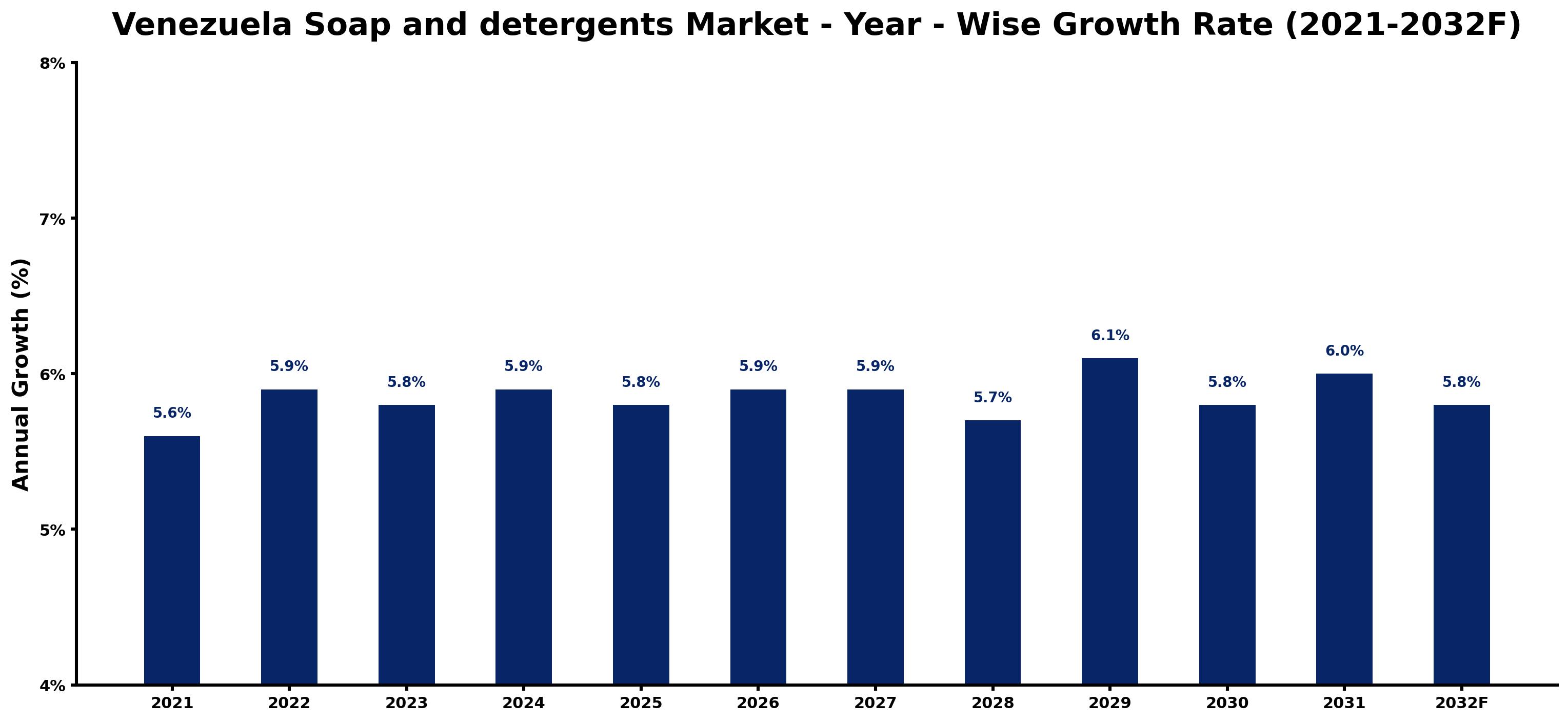
The table below presents the year wise growth rates along with the key drivers influencing the market
| Year | Growth Rate | Major Drivers |
| 2021 | 5.6% | Venezuela's economic stabilization led to gradual recovery in consumer purchasing power. |
| 2022 | 5.9% | Local manufacturing efforts significantly reduced dependence on imported soap and detergents. |
| 2023 | 5.8% | Increased focus on eco-friendly products aligned with global sustainability trends emerged. |
| 2024 | 5.9% | Urbanization trends influenced higher household consumption of cleaning products and services. |
| 2025 | 5.8% | Rising interest in personal hygiene sparked demand for premium soap options. |
| 2026 | 5.9% | Innovative packaging solutions attracted environmentally conscious consumers to local brands. |
| 2027 | 5.9% | An expanding middle class fueled preferences for diverse cleaning product offerings. |
| 2028 | 5.7% | E-commerce growth provided accessible channels for soap and detergent purchases. |
| 2029 | 6.1% | Collaborations between brands and local influencers enhanced market visibility and engagement. |
| 2030 | 5.8% | Technological advancements in manufacturing improved product quality and shelf-life. |
| 2031 | 6.0% | Emerging trends in wellness influenced the adoption of natural ingredient formulations. |
| 2032 | 5.8% | Community-driven initiatives promoted local brands, strengthening consumer loyalty and awareness. |
Note - Market size estimations and growth projections presented in this report are based on 6Wresearch's advanced forecasting approach, validated with industry datasets as of June 2026.
Venezuela Soap and detergents Market Synopsis
The Venezuela Soap and detergents Market is projected to reach 5.9% and witness significant growth during the forecast period (2026-2032). This growth can be attributed to several factors, including an increase in disposable income, a growing population, and an escalating demand for personal care products. The market is increasingly influenced by government regulations concerning product labeling standards, which are expected to further drive market expansion. Additionally, the rising public awareness of hygiene driven by health concerns has led to an uptick in the demand for soaps and detergents. The urbanization trends in major cities, particularly Caracas, have also opened avenues for organized retail, thereby influencing consumer purchasing behavior.
Venezuela Soap and detergents Market Growth Drivers
A number of pivotal factors are fueling the growth of the Venezuela Soap and detergents Market. Firstly, a notable increase in disposable income among consumers is enabling a higher spend on personal care items, including soaps and detergents. This uptick in financial capability contributes significantly to the market's upward trajectory. Secondly, the population growth in Venezuela provides a larger consumer base, which inherently drives demand for household and personal care products.
Moreover, heightened awareness about hygiene practices has been a significant factor, especially in light of recent health-related events that have underscored the importance of cleanliness. As individuals become more health-conscious, the demand for effective soaps and detergents has surged. Additionally, the introduction of stringent government regulations aimed at improving product labeling standards has encouraged manufacturers to enhance product quality, thus benefitting consumers.
Urbanization in cities like Caracas has further facilitated market growth by fostering the establishment of organized retail channels. Supermarkets and other retail outlets now offer a wider variety of products, thereby catering to diverse consumer preferences. This accessibility has likely expanded the reach of soaps and detergents to previously underserved segments of the population. Lastly, the overall trend towards personal care and grooming products continues to evolve, creating new opportunities within the market.
Venezuela Soap and detergents Market Trends and Opportunities
The Venezuela Soap and detergents Market is undergoing significant changes driven by evolving consumer preferences and socioeconomic conditions. One of the most notable trends is the increased focus on sustainable and eco-friendly products. As consumers become more environmentally conscious, there is a growing demand for biodegradable soaps and detergents that offer effective cleaning solutions without adverse environmental impacts.
Furthermore, personalized products that cater to specific consumer needs and preferences are gaining traction. The growing trend of customization is leading manufacturers to innovate and provide tailored solutions, such as hypoallergenic soaps and specialized detergents for sensitive skin. This shift not only enhances consumer satisfaction but also promotes brand loyalty.
Digitalization and e-commerce are also reshaping the landscape of the Venezuela Soap and detergents Market. The rising prevalence of online shopping is providing consumers with more convenient purchasing options, thereby augmenting sales for manufacturers who can effectively leverage digital platforms. This trend is particularly pertinent in urban areas, where technology adoption is highest.
Venezuela Soap and detergents Market Challenges and Restraints
Despite the promising growth trajectory of the Venezuela Soap and detergents Market, several challenges could impede its development. Chief among these challenges are the volatile economic conditions exacerbated by ongoing political unrest. Such instability can lead to fluctuations in production costs and impacts consumer purchasing power, potentially deterring investments in the sector.
Moreover, the weakening of the local currency poses a significant threat, as it affects import prices for key raw materials needed for soap and detergent production. This situation might compel manufacturers to either absorb costs or pass them on to consumers, leading to price volatility. The decreasing crude oil prices also add a layer of uncertainty for the market, given the economy's reliance on oil revenues.
Additionally, soaring inflation rates are another concern affecting consumer behavior. As everyday expenses rise, households may prioritize spending on essential items over non-essential personal care products, thereby impacting market sales. These factors combined create a challenging backdrop against which market players must navigate to secure advantageous positions in the Venezuela Soap and detergents Market.
Venezuela Soap and detergents Market Government Investment and Initiatives
The Venezuelan government has been taking steps to enhance the soap and detergents market through various initiatives focused on product safety and quality standards. A significant government initiative includes the implementation of regulations mandating clear and informative labeling on consumer products, aimed at promoting consumer awareness and safety. Such efforts are not only beneficial for consumers but also encourage manufacturers to maintain high production standards.
In addition, government investments aimed at improving local manufacturing capabilities are also noteworthy. By promoting local production, the government seeks to reduce dependency on imports, which can be negatively impacted by foreign exchange issues. Furthermore, policies that support research and development in the personal care sector are expected to lead to innovations that align with consumer trends.
In light of these developments, it is likely that the Venezuelan government will continue to support initiatives that encourage sustainable practices in the soap and detergents industry. As consumer preferences shift toward eco-friendly products, government backing for sustainable production methods will be essential for market growth.
Venezuela Soap and detergents Market Latest Developments (May 2025 - June 2026)
The Venezuela Soap and detergents Market has witnessed several notable developments between May 2025 and June 2026. Over this period, there has been an increasing emphasis on local production as manufacturers adapt to the challenging economic environment. This has led to collaborative initiatives aimed at enhancing supply chain efficiency and reducing dependency on imports.
Moreover, during this time, several manufacturers have pivoted towards developing eco-friendly products in response to changing consumer preferences. This strategic shift is aligned with the global trend of sustainability, thereby positioning these companies to capture a growing segment of environmentally conscious consumers.
Additionally, digital marketing efforts have intensified, with many manufacturers increasingly using online platforms to reach consumers directly. This trend not only facilitates better consumer engagement but also aids in educating consumers on product benefits and usage. The rise of social media channels has provided new avenues for brands to connect with their audience.
Venezuela Soap and detergents Market - Key Attractiveness of the Report
- 10 Years of Market Numbers
- Historical Data Starting from 2022 to 2025
- Base Year: 2025
- Forecast Data until 2032
- Key Performance Indicators Impacting the Market
- Major Upcoming Developments and Projects
Key Highlights of the Report:
- Venezuela Soap and detergents Market Outlook
- Market Size of Venezuela Soap and detergents Market, 2025
- Forecast of Venezuela Soap and detergents Market, 2032F
- Historical Data and Forecast of Venezuela Soap and detergents Revenues & Volume for the Period 2022-2032F
- Venezuela Soap and detergents Market Trend Evolution
- Venezuela Soap and detergents Market Drivers and Challenges
- Venezuela Soap and detergents Price Trends
- Venezuela Soap and detergents Porter's Five Forces
- Venezuela Soap and detergents Industry Life Cycle
- Historical Data and Forecast of Venezuela Soap and detergents Market Revenues & Volume By Product for the Period 2022-2032F
- Historical Data and Forecast of Venezuela Soap and detergents Market Revenues & Volume By Household detergents for the Period 2022-2032F
- Historical Data and Forecast of Venezuela Soap and detergents Market Revenues & Volume By Industrial soaps & detergents for the Period 2022-2032F
- Historical Data and Forecast of Venezuela Soap and detergents Market Revenues & Volume By Household soaps for the Period 2022-2032F
- Historical Data and Forecast of Venezuela Soap and detergents Market Revenues & Volume By Others for the Period 2022-2032F
- Historical Data and Forecast of Venezuela Soap and detergents Market Revenues & Volume By Applications for the Period 2022-2032F
- Historical Data and Forecast of Venezuela Soap and detergents Market Revenues & Volume By Homecare Detergents for the Period 2022-2032F
- Historical Data and Forecast of Venezuela Soap and detergents Market Revenues & Volume By Industrial Soap and Detergent for the Period 2022-2032F
- Historical Data and Forecast of Venezuela Soap and detergents Market Revenues & Volume By Homecare Soaps for the Period 2022-2032F
- Historical Data and Forecast of Venezuela Soap and detergents Market Revenues & Volume By Others for the Period 2022-2032F
- Venezuela Soap and detergents Import Export Trade Statistics
- Market Opportunity Assessment By Product
- Market Opportunity Assessment By Applications
- Venezuela Soap and detergents Top Companies Market Share
- Venezuela Soap and detergents Competitive Benchmarking By Technical and Operational Parameters
- Venezuela Soap and detergents Company Profiles
- Venezuela Soap and detergents Key Strategic Recommendations






































