Venezuela Textile Auxiliaries Market Size, Share & Growth Rate
The Venezuela Textile Auxiliaries Market was estimated at USD 940 Million in 2025 and is projected to reach USD 1365 Million by 2032, growing at a CAGR of 5.5% from 2026 to 2032. This growth trajectory is largely propelled by an increasing demand for innovative textile solutions across various sectors, including apparel and home textiles. Additionally, the ongoing push for sustainability is driving manufacturers to adopt eco-friendly textile auxiliaries, thus further enhancing market dynamics.
Venezuela Textile Auxiliaries Market Year-wise Growth Rate and Key Drivers
This graph highlights how the Venezuela Textile Auxiliaries Market has steadily grown over the years, supported by major growth factors.
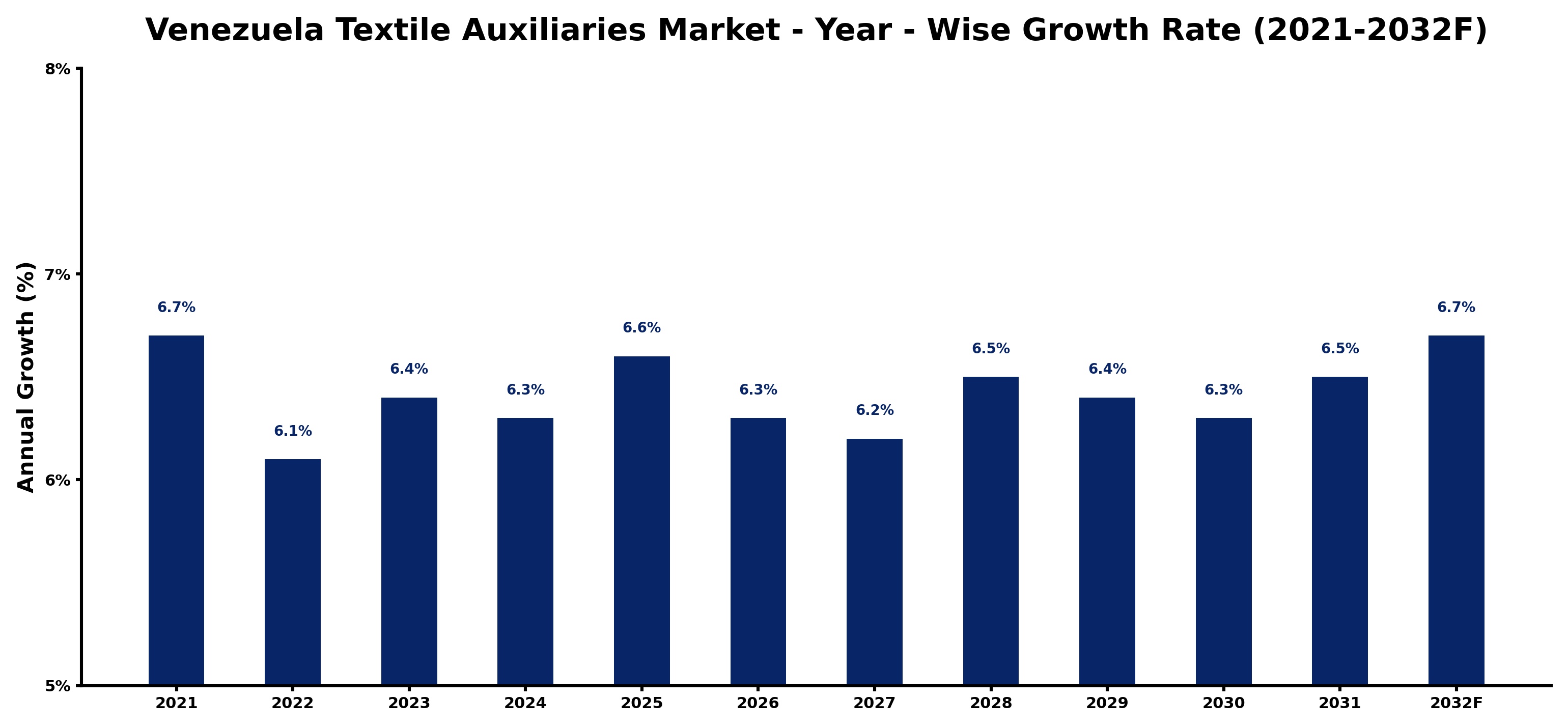
The table below presents the year‑wise growth rates along with the key drivers influencing the market
| Year | Growth Rate | Major Drivers |
| 2021 | 6.7% | Improved dyeing technology enhances local fabric production capabilities |
| 2022 | 6.1% | Accelerated demand for textiles boosted local dye and chemical production |
| 2023 | 6.4% | Textile equipment upgrades boost production efficiency and quality control |
| 2024 | 6.3% | Textile auxiliaries production expansion boosts local manufacturing capabilities significantly |
| 2025 | 6.6% | Automation in textile dyeing improved production efficiency and consistency |
| 2026 | 6.3% | Textile auxiliary imports boost local production capabilities and efficiency |
| 2027 | 6.2% | Advanced dyeing technology boosts textile color consistency and export potential |
| 2028 | 6.5% | Higher demand for textile dyes boosts production efficiency in Venezuela |
| 2029 | 6.4% | Textile machinery upgrades boosted local fabric production capabilities |
| 2030 | 6.3% | Export driven textile modernization boosts raw material demand significantly |
| 2031 | 6.5% | Textile machinery upgrades enhance local fabric production capabilities |
| 2032 | 6.7% | Export driven textile production boosts demand for auxiliary materials |
Note - Market size estimations and growth projections presented in this report are based on 6Wresearch’s advanced forecasting approach, validated with industry datasets as of June 2026.
Venezuela Textile Auxiliaries Market Synopsis
While the Venezuela Textile Auxiliaries Market has shown recent momentum due to an expanding textile industry, challenges persist that could affect future growth. The market's trajectory is influenced by factors such as fluctuating economic conditions and evolving consumer preferences for high-quality, sustainable textile products.
Despite these challenges, there is optimism surrounding the sector, particularly in the development of eco-friendly auxiliaries. Manufacturers are increasingly innovating to meet the demands of both local and international markets, positioning themselves to capitalize on emerging opportunities.
Venezuela Textile Auxiliaries Market Key Takeaways
- The market is projected to experience a CAGR of 5.5% from 2026 to 2032.
- Growing consumer demand for sustainable and eco-friendly textile solutions is reshaping the landscape.
- Innovative textile auxiliaries that enhance performance properties are gaining traction.
- Economic instability and political uncertainties pose significant challenges for market growth.
- Strategic investments in local manufacturing and R&D could unlock new opportunities.
Evaluation of Restraints in Venezuela Textile Auxiliaries Market
The Venezuela Textile Auxiliaries Market faces several significant restraints, primarily stemming from the country's ongoing economic instability and political unrest. These issues contribute to unpredictable currency fluctuations, complicating financial planning for manufacturers and suppliers. Additionally, stringent government regulations, including import restrictions and local content requirements, hinder access to necessary raw materials and technology, limiting growth opportunities. As a result, businesses must navigate a complex regulatory landscape that can significantly impact operational efficiency and competitiveness.
Venezuela Textile Auxiliaries Market Trends
A marked trend towards sustainable textile auxiliaries is currently shaping the Venezuelan market, aligning with global initiatives focused on environmental responsibility. Manufacturers are prioritizing the development of eco-friendly products that meet stringent regulatory standards while addressing consumer demands for sustainability. Concurrently, innovations in technology are facilitating the introduction of specialized auxiliaries that improve textile performance, including moisture-wicking and antimicrobial properties, further driving market growth.
Venezuela Textile Auxiliaries Market Opportunities
Investment opportunities within the Venezuela Textile Auxiliaries Market are robust, particularly in the realm of sustainable textile chemicals. The increasing consumer awareness and preference for environmentally friendly products create a fertile ground for innovation. Additionally, there is room for the development of specialized auxiliaries tailored to the unique manufacturing needs of the Venezuelan textile industry. Companies focusing on R&D to create innovative solutions that align with local market demands can significantly enhance their competitive edge.
Government Initiatives in the Venezuela Textile Auxiliaries Market
The Venezuelan government has implemented a series of policies aimed at regulating the textile auxiliaries market. These include strict import controls, price controls, and foreign exchange regulations that impact manufacturing processes. Additionally, the government emphasizes local content requirements, aimed at promoting domestic production and reducing dependency on imports. While these policies aim to strengthen local industries, they also pose challenges for businesses in terms of compliance and operational flexibility.
Future Insights of the Venezuela Textile Auxiliaries Market
The future outlook for the Venezuela Textile Auxiliaries Market remains uncertain as economic and political challenges continue to unfold. While inflation and currency devaluation may hamper demand in the short term, there is potential for localized manufacturers to innovate and cater to domestic needs. By focusing on cost-effective solutions and adapting to the evolving market landscape, players in the sector could navigate these challenges and capitalize on emerging opportunities through 2032 and beyond.
Venezuela Textile Auxiliaries Market Latest Developments (May 2025 - June 2026)
Recent trends in the Venezuela Textile Auxiliaries Market indicate a growing emphasis on digitalization and automation. Companies are exploring technology to optimize production processes and enhance efficiency. Additionally, there is an ongoing push towards collaborative efforts among local manufacturers to strengthen supply chains and improve access to raw materials. These developments are indicative of a dynamic market that is increasingly adapting to both local challenges and global trends.
Venezuela Textile Auxiliaries Market - Key Attractiveness of the Report
- 10 Years of Market Numbers
- Historical Data Starting from 2022 to 2025
- Base Year: 2025
- Forecast Data until 2032
- Key Performance Indicators Impacting the Market
- Major Upcoming Developments and Projects
Key Highlights of the Report:
- Venezuela Textile Auxiliaries Market Outlook
- Market Size of Venezuela Textile Auxiliaries Market, 2025
- Forecast of Venezuela Textile Auxiliaries Market, 2032
- Historical Data and Forecast of Venezuela Textile Auxiliaries Revenues & Volume for the Period 2022-2032F
- Venezuela Textile Auxiliaries Market Trend Evolution
- Venezuela Textile Auxiliaries Market Drivers and Challenges
- Venezuela Textile Auxiliaries Price Trends
- Venezuela Textile Auxiliaries Porter's Five Forces
- Venezuela Textile Auxiliaries Industry Life Cycle
- Historical Data and Forecast of Venezuela Textile Auxiliaries Market Revenues & Volume By Product for the Period 2022-2032F
- Historical Data and Forecast of Venezuela Textile Auxiliaries Market Revenues & Volume By Finishing Agents for the Period 2022-2032F
- Historical Data and Forecast of Venezuela Textile Auxiliaries Market Revenues & Volume By Dyeing and Printing Agents for the Period 2022-2032F
- Historical Data and Forecast of Venezuela Textile Auxiliaries Market Revenues & Volume By Spin Finish for the Period 2022-2032F
- Historical Data and Forecast of Venezuela Textile Auxiliaries Market Revenues & Volume By Knitting and Weaving for the Period 2022-2032F
- Historical Data and Forecast of Venezuela Textile Auxiliaries Market Revenues & Volume By Other Auxiliaries for the Period 2022-2032F
- Historical Data and Forecast of Venezuela Textile Auxiliaries Market Revenues & Volume By Applications for the Period 2022-2032F
- Historical Data and Forecast of Venezuela Textile Auxiliaries Market Revenues & Volume By Automotive Textiles for the Period 2022-2032F
- Historical Data and Forecast of Venezuela Textile Auxiliaries Market Revenues & Volume By Home Furnishing for the Period 2022-2032F
- Historical Data and Forecast of Venezuela Textile Auxiliaries Market Revenues & Volume By Apparel for the Period 2022-2032F
- Historical Data and Forecast of Venezuela Textile Auxiliaries Market Revenues & Volume By Digital Printing for the Period 2022-2032F
- Historical Data and Forecast of Venezuela Textile Auxiliaries Market Revenues & Volume By Others for the Period 2022-2032F
- Venezuela Textile Auxiliaries Import Export Trade Statistics
- Market Opportunity Assessment By Product
- Market Opportunity Assessment By Applications
- Venezuela Textile Auxiliaries Top Companies Market Share
- Venezuela Textile Auxiliaries Competitive Benchmarking By Technical and Operational Parameters
- Venezuela Textile Auxiliaries Company Profiles
- Venezuela Textile Auxiliaries Key Strategic Recommendations






































