Vietnam 5G Antennas Market Size, Share & Growth Rate
The Vietnam 5G Antennas Market was estimated at USD 210 Million in 2025 and is projected to reach USD 296 Million by 2032, growing at a CAGR of 5.0% from 2026 to 2032. This growth trajectory is largely attributed to the rapid expansion of digital infrastructure spearheaded by the government and the surging demand for high-speed internet connectivity. As businesses and consumers increasingly rely on data-intensive applications, the necessity for advanced 5G antenna solutions becomes more pronounced.
Vietnam 5G Antennas Market Year-wise Growth Rate and Key Drivers
This graph highlights how the Vietnam 5G Antennas Market has steadily grown over the years, supported by major growth factors.
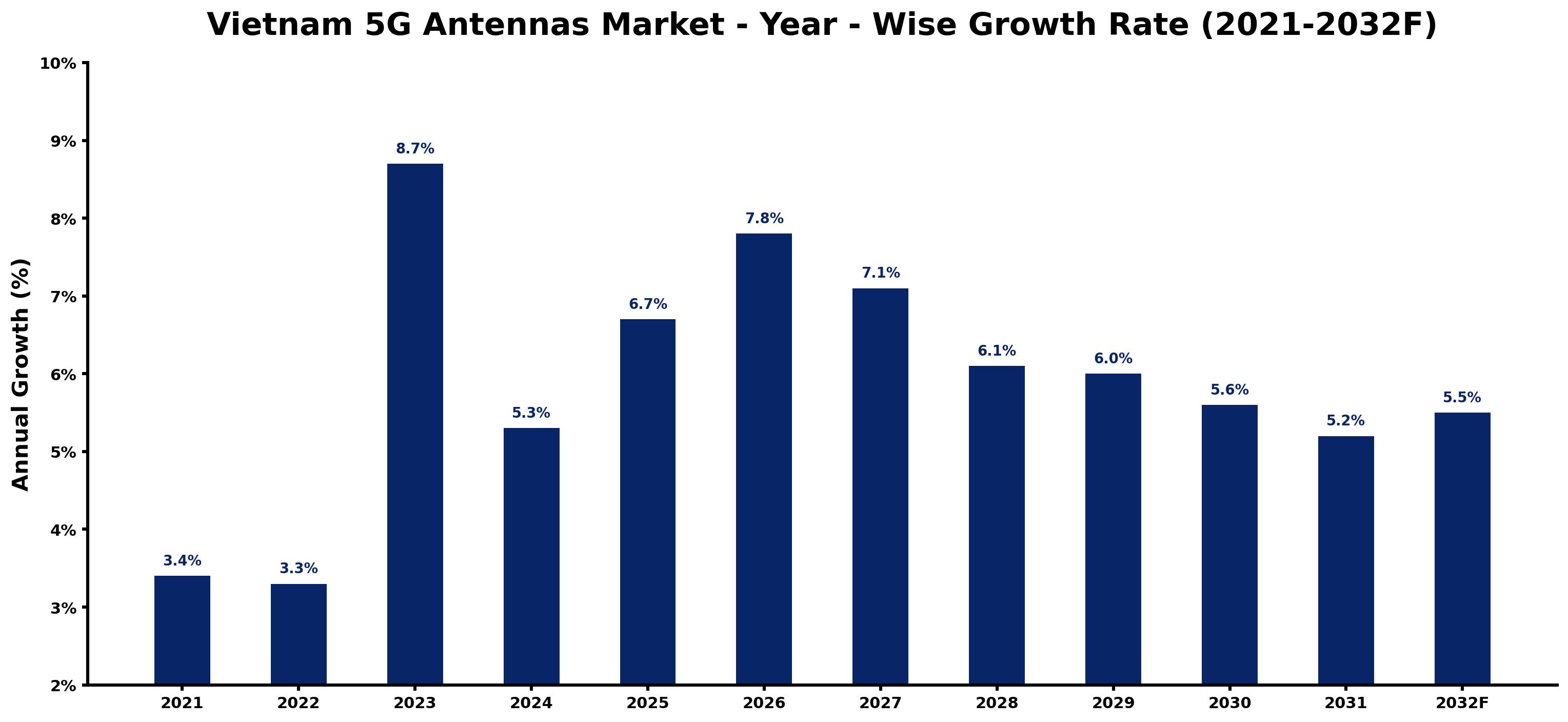
The table below presents the year‑wise growth rates along with the key drivers influencing the market
| Year | Growth Rate | Major Drivers |
| 2021 | 3.4% | Expansion of commercial construction activities |
| 2022 | 3.3% | Expansion of transportation and logistics networks |
| 2023 | 8.7% | Expansion of manufacturing activities |
| 2024 | 5.3% | Increasing adoption of advanced technologies |
| 2025 | 6.7% | Growing urbanization and commercial development |
| 2026 | 7.8% | Increasing smart city development projects |
| 2027 | 7.1% | Increasing industrial automation investments |
| 2028 | 6.1% | Growing urbanization and commercial development |
| 2029 | 6.0% | Rapid growth in telecom and data center sectors |
| 2030 | 5.6% | Increasing adoption of advanced technologies |
| 2031 | 5.2% | Expansion of commercial construction activities |
| 2032 | 5.5% | Rapid growth in telecom and data center sectors |
Note - Market size estimations and growth projections presented in this report are based on 6Wresearch's advanced forecasting approach, validated with industry datasets as of June 2026.
Vietnam 5G Antennas Market Synopsis
In recent years, the Vietnam 5G Antennas Market has gained momentum, fueled by the ongoing rollout of 5G networks. However, looking ahead, the market is poised for transformative growth as more sectors recognize the potential of 5G technology to enhance operational efficiencies and drive innovation. The successful integration of 5G infrastructure will be critical in supporting the digital landscape.
As the 5G ecosystem matures, various applications, including IoT, smart city solutions, and augmented reality, are anticipated to gain traction. This broadening spectrum of use cases reinforces the role of 5G antennas in ensuring robust connectivity and seamless communication. With both the public and private sectors prioritizing 5G deployment, the market is set to flourish.
Vietnam 5G Antennas Market Key Takeaways
- The Vietnam 5G Antennas Market is on a steady growth path, driven by rising data demand.
- Government initiatives aimed at digital transformation are providing substantial support for 5G deployment.
- Investment in advanced antenna technology is key to enhancing network performance.
- Increasing adoption of smart devices is further propelling the need for widespread 5G coverage.
- Emerging applications in IoT and smart cities highlight the transformative potential of 5G.
Evaluation of Restraints in Vietnam 5G Antennas Market
Despite the promising outlook, the Vietnam 5G Antennas Market faces several significant constraints. A primary concern is the allocation of sufficient spectrum bandwidth necessary for high-performance 5G networks. As demand for mobile data surges, efficient spectrum management becomes increasingly crucial. Financial barriers are another challenge, as the initial investment required for infrastructure development is substantial. Furthermore, regulatory hurdles regarding site acquisition and network deployment can hinder the rollout of 5G technologies. Addressing these issues is essential to unlocking the full potential of the 5G landscape.
Vietnam 5G Antennas Market Trends
Several trends are currently shaping the Vietnam 5G Antennas Market. One significant trend is the increasing integration of artificial intelligence and machine learning to optimize network performance and efficiency. Additionally, the evolution of antenna technology, such as the development of Massive MIMO (Multiple Input Multiple Output) systems, is enabling better data handling capabilities. Another noteworthy trend is the growing interest in smart cities, where the use of 5G technology is being envisioned to enhance urban infrastructure and improve public services. These trends illustrate how innovation in antenna technology is pivotal for advancing Vietnam's digital transformation.
Vietnam 5G Antennas Market Opportunities
The Vietnam 5G Antennas Market presents a plethora of opportunities for growth and investment. As telecom operators seek to expand coverage, collaborations with technology providers to develop advanced antenna solutions can prove beneficial. Moreover, sectors such as healthcare and agriculture are ripe for leveraging 5G capabilities to enhance operational efficiencies. Investment in research and development for emerging technologies, particularly in IoT applications, could yield significant returns as demand for smart connectivity continues to rise. With the government's continued support for digital infrastructure, the landscape is favorable for innovative solutions.
Government Initiatives in the Vietnam 5G Antennas Market
The Vietnamese government has implemented various initiatives aimed at facilitating the adoption of 5G technology. This includes investments in digital infrastructure and policy frameworks designed to support telecommunication advancements. Through strategic partnerships and public-private collaborations, the government is fostering an environment conducive to innovation and growth. Furthermore, policy incentives aimed at enhancing technological capabilities across various sectors highlight the commitment to driving the digital transformation agenda in Vietnam.
Future Insights of the Vietnam 5G Antennas Market
Looking ahead to the period from 2026 to 2032, the Vietnam 5G Antennas Market is anticipated to experience substantial evolution. As technology advances and consumer demand for enhanced connectivity grows, investments in 5G infrastructure will remain a priority. The market is likely to witness increased adoption of smart devices and applications, fostering a robust ecosystem that capitalizes on low-latency communication. Additionally, as new use cases emerge, including autonomous vehicles and smart industrial solutions, 5G antennas will be integral in facilitating these advancements, underscoring the need for innovative, scalable solutions.
Vietnam 5G Antennas Market Latest Developments (May 2025 - June 2026)
In recent months, the Vietnam 5G Antennas Market has seen notable developments as telecom operators ramp up their efforts to enhance network coverage. Increased investments in infrastructure upgrades and the rollout of new antenna technologies have been observed, particularly in urban areas. Additionally, partnerships between technology firms and telecom providers are emerging, aimed at accelerating the deployment of 5G services. As the industry adapts to evolving consumer needs, ongoing advancements in 5G capabilities are expected to play a critical role in shaping the market landscape.
Vietnam 5G Antennas Market - Key Attractiveness of the Report
- 10 Years of Market Numbers
- Historical Data Starting from 2022 to 2025
- Base Year: 2025
- Forecast Data until 2032
- Key Performance Indicators Impacting the Market
- Major Upcoming Developments and Projects
Key Highlights of the Report:
- Vietnam 5G Antennas Market Outlook
- Market Size of Vietnam 5G Antennas Market, 2025
- Forecast of Vietnam 5G Antennas Market, 2032
- Historical Data and Forecast of Vietnam 5G Antennas Revenues & Volume for the Period 2022-2032F
- Vietnam 5G Antennas Market Trend Evolution
- Vietnam 5G Antennas Market Drivers and Challenges
- Vietnam 5G Antennas Price Trends
- Vietnam 5G Antennas Porter's Five Forces
- Vietnam 5G Antennas Industry Life Cycle
- Historical Data and Forecast of Vietnam 5G Antennas Market Revenues & Volume By Type for the Period 2022-2032F
- Historical Data and Forecast of Vietnam 5G Antennas Market Revenues & Volume By FR1 Antennas for the Period 2022-2032F
- Historical Data and Forecast of Vietnam 5G Antennas Market Revenues & Volume By FR2 Antennas for the Period 2022-2032F
- Historical Data and Forecast of Vietnam 5G Antennas Market Revenues & Volume By Applications for the Period 2022-2032F
- Historical Data and Forecast of Vietnam 5G Antennas Market Revenues & Volume By Smartphones for the Period 2022-2032F
- Historical Data and Forecast of Vietnam 5G Antennas Market Revenues & Volume By Base Station for the Period 2022-2032F
- Historical Data and Forecast of Vietnam 5G Antennas Market Revenues & Volume By IoT and M2M Devices for the Period 2022-2032F
- Historical Data and Forecast of Vietnam 5G Antennas Market Revenues & Volume By Automotive for the Period 2022-2032F
- Historical Data and Forecast of Vietnam 5G Antennas Market Revenues & Volume By Others for the Period 2022-2032F
- Vietnam 5G Antennas Import Export Trade Statistics
- Market Opportunity Assessment By Type
- Market Opportunity Assessment By Applications
- Vietnam 5G Antennas Top Companies Market Share
- Vietnam 5G Antennas Competitive Benchmarking By Technical and Operational Parameters
- Vietnam 5G Antennas Company Profiles
- Vietnam 5G Antennas Key Strategic Recommendations






































