Vietnam 5G Core Market Size, Share & Growth Rate
The Vietnam 5G Core Market was estimated at USD 357 Million in 2025 and is projected to reach USD 506 Million by 2032, growing at a CAGR of 5.1% from 2026 to 2032. This upward trajectory is primarily fueled by the country's increasing demand for high-speed and reliable communication, essential for supporting sophisticated applications such as augmented reality and IoT services. Additionally, the Vietnamese government's commitment to establishing a robust 5G infrastructure further accelerates market growth, positioning Vietnam as a key player in the 5G landscape.
Vietnam 5G Core Market Year-wise Growth Rate and Key Drivers
This graph highlights how the Vietnam 5G Core Market has steadily grown over the years, supported by major growth factors.
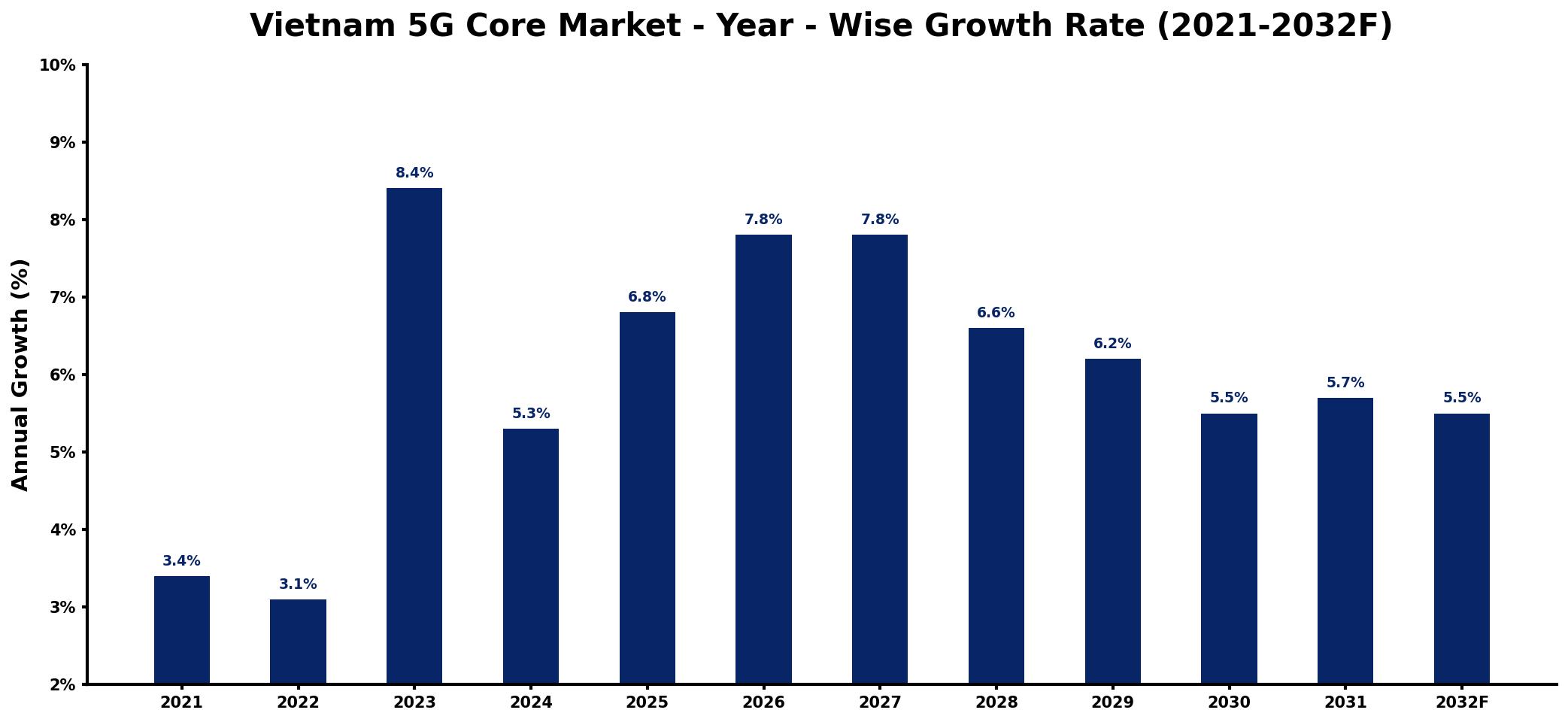
The table below presents the year‑wise growth rates along with the key drivers influencing the market
| Year | Growth Rate | Major Drivers |
| 2021 | 3.4% | Rising demand for connectivity solutions |
| 2022 | 3.1% | Increased investment in infrastructure |
| 2023 | 8.4% | Expansion of smart city initiatives |
| 2024 | 5.3% | Growth in IoT applications adoption |
| 2025 | 6.8% | Surge in mobile data consumption |
| 2026 | 7.8% | Emergence of new technology partnerships |
| 2027 | 7.8% | Development of advanced telecommunications |
| 2028 | 6.6% | Integration of AI in networks |
| 2029 | 6.2% | expanding industrial usage applications |
| 2030 | 5.5% | growing regional consumption patterns |
| 2031 | 5.7% | Increased focus on cybersecurity measures |
| 2032 | 5.5% | Rising interest in sustainable solutions |
Note: Market size estimations and growth projections presented in this report are based on 6Wresearch's proprietary forecasting methodology, utilizing the latest available industry data, government publications, and primary research inputs.
Vietnam 5G Core Market Synopsis
In Vietnam, the deployment of 5G core networks is not just a technological upgrade; it is a vital response to the surging demand for data traffic and connectivity. Enhanced mobile broadband services are becoming a crucial expectation among consumers, propelling telecommunications companies to invest in the necessary infrastructure.
Moreover, the Vietnamese telecommunications ecosystem is adapting to the complexities of 5G technology through innovative solutions like network slicing and automation. These advancements not only improve efficiency but also lay the groundwork for a future where diverse digital experiences can flourish.
Vietnam 5G Core Market Key Takeaways
- Strong growth driven by increasing demand for high-speed, low-latency communication solutions.
- Significant investments in 5G infrastructure by both the government and telecom operators.
- Key applications include augmented reality, virtual reality, and IoT integration.
- Infrastructure development is capital-intensive, necessitating strategic partnerships and investments.
- Cybersecurity and regulatory challenges present hurdles that need to be addressed to sustain growth.
Evaluation of Restraints in Vietnam 5G Core Market
While the Vietnam 5G Core Market presents substantial growth opportunities, several restraints threaten its full potential. The capital-intensive nature of building out 5G infrastructure poses a significant barrier, requiring telecom operators to secure substantial financial backing. Moreover, the effective allocation of spectrum remains a regulatory challenge that can hinder the pace of deployment. Concerns regarding cybersecurity must also be addressed, as the sensitive nature of data transmitted over 5G networks amplifies the need for robust security protocols. Additionally, the absence of standardized protocols can complicate interoperability and limit market expansion.
Vietnam 5G Core Market Trends
Current trends in the Vietnam 5G Core Market are increasingly shaped by technological advancements and consumer expectations. The integration of network slicing and function virtualization is revolutionizing how telecom operators manage resources, allowing for tailored services to meet diverse consumer needs. Furthermore, the growing adoption of IoT devices and smart city initiatives is propelling demand for enhanced connectivity, compelling operators to prioritize investments in 5G core infrastructure.
Vietnam 5G Core Market Opportunities
A plethora of opportunities lies ahead for investors and telecom operators in the Vietnam 5G Core Market. The government's strategic focus on digital transformation and smart infrastructure presents a fertile ground for growth. Additionally, the rising demand for innovative applications across sectors such as healthcare, education, and transportation opens new avenues for 5G integration. As consumer reliance on digital services continues to expand, the market's potential for return on investment becomes increasingly attractive.
Government Initiatives in the Vietnam 5G Core Market
The Vietnamese government plays a crucial role in facilitating the growth of the 5G Core Market through various initiatives and policies. Commitment to establishing a comprehensive regulatory framework for spectrum allocation ensures a smoother transition to 5G technology. Moreover, the government is investing in programs aimed at enhancing digital literacy and promoting the use of 5G services, thus encouraging public adoption. This proactive approach not only bolsters the telecommunications sector but also positions Vietnam favorably in the global digital economy.
Future Insights of the Vietnam 5G Core Market
Looking ahead to 2026-2032, the Vietnam 5G Core Market is poised for significant evolution. As digital demand continues to surge, the focus will shift towards optimizing network efficiency and ensuring robust cybersecurity measures. By embracing innovations in AI and machine learning, telecom operators can enhance service delivery and customer satisfaction. The anticipated expansion of smart city projects and IoT applications will further necessitate advancements in 5G core technology, solidifying Vietnam's place as a leader in the telecommunications landscape.
Vietnam 5G Core Market Latest Developments (2025 - 2026)
Recent developments in the Vietnam 5G Core Market have showcased an accelerated pace of infrastructure deployment, driven by heightened consumer demand for digital services. Telecom operators are actively pursuing strategic partnerships to enhance their 5G offerings and improve service reliability. Additionally, there has been a noticeable increase in government initiatives focused on ensuring effective spectrum management and addressing cybersecurity concerns as part of the broader push for 5G integration in various sectors.
Vietnam 5G Core Market - Key Attractiveness of the Report
- 10 Years of Market Numbers
- Historical Data Starting from 2022 to 2025
- Base Year: 2025
- Forecast Data until 2032
- Key Performance Indicators Impacting the Market
- Major Upcoming Developments and Projects
Key Highlights of the Report:
- Vietnam 5G Core Market Outlook
- Market Size of Vietnam 5G Core Market, 2025
- Forecast of Vietnam 5G Core Market, 2032
- Historical Data and Forecast of Vietnam 5G Core Revenues & Volume for the Period 2022-2032F
- Vietnam 5G Core Market Trend Evolution
- Vietnam 5G Core Market Drivers and Challenges
- Vietnam 5G Core Price Trends
- Vietnam 5G Core Porter's Five Forces
- Vietnam 5G Core Industry Life Cycle
- Historical Data and Forecast of Vietnam 5G Core Market Revenues & Volume By Component for the Period 2022-2032F
- Historical Data and Forecast of Vietnam 5G Core Market Revenues & Volume By Solutions for the Period 2022-2032F
- Historical Data and Forecast of Vietnam 5G Core Market Revenues & Volume By Services for the Period 2022-2032F
- Historical Data and Forecast of Vietnam 5G Core Market Revenues & Volume By Network Function for the Period 2022-2032F
- Historical Data and Forecast of Vietnam 5G Core Market Revenues & Volume By Access for the Period 2022-2032F
- Historical Data and Forecast of Vietnam 5G Core Market Revenues & Volume By Mobility Management Function for the Period 2022-2032F
- Historical Data and Forecast of Vietnam 5G Core Market Revenues & Volume By Policy Control Function for the Period 2022-2032F
- Historical Data and Forecast of Vietnam 5G Core Market Revenues & Volume By Unified Data Management for the Period 2022-2032F
- Historical Data and Forecast of Vietnam 5G Core Market Revenues & Volume By Deployment Model for the Period 2022-2032F
- Historical Data and Forecast of Vietnam 5G Core Market Revenues & Volume By Cloud for the Period 2022-2032F
- Historical Data and Forecast of Vietnam 5G Core Market Revenues & Volume By On-premises for the Period 2022-2032F
- Historical Data and Forecast of Vietnam 5G Core Market Revenues & Volume By End User for the Period 2022-2032F
- Historical Data and Forecast of Vietnam 5G Core Market Revenues & Volume By Telecom Operators for the Period 2022-2032F
- Historical Data and Forecast of Vietnam 5G Core Market Revenues & Volume By Enterprises for the Period 2022-2032F
- Vietnam 5G Core Import Export Trade Statistics
- Market Opportunity Assessment By Component
- Market Opportunity Assessment By Network Function
- Market Opportunity Assessment By Deployment Model
- Market Opportunity Assessment By End User
- Vietnam 5G Core Top Companies Market Share
- Vietnam 5G Core Competitive Benchmarking By Technical and Operational Parameters
- Vietnam 5G Core Company Profiles
- Vietnam 5G Core Key Strategic Recommendations






































